
Boston has spent decades building one of the strongest biotechnology clusters in the world. Cambridge laboratories helped turn genomics, gene editing, protein engineering, mRNA, cell therapy, and modern drug discovery into major industries.
Now several of those fields are beginning to merge.
Artificial intelligence is moving out of the computer and into the biology lab. Synthetic biology is moving in the opposite direction. Instead of relying mainly on trial and error, researchers are beginning to design proteins, genetic systems, cells, drug-delivery vehicles, and biological processes with software before testing them in the physical world.
That combination could become one of Boston’s most important technology stories of the next decade.
It is also easy to misunderstand.
The big opportunity is not simply using ChatGPT-like tools inside biotech companies. It is building systems in which AI proposes a biological design, an automated lab builds and tests it, the resulting experimental data flows back into the model, and the system uses what it learned to make a better design.
That loop changes the economics of biological engineering.
Boston is unusually well positioned to build it.
Our BostonBizScene analysis of Greater Boston companies working at the intersection of artificial intelligence, biological engineering, protein design, gene delivery, automated experimentation, and related fields found more than $2.4 billion in disclosed or publicly described equity and IPO capital across nine representative private and newly public platforms, even before including Ginkgo Bioworks, non-dilutive grants, most pharmaceutical milestone agreements, and many undisclosed rounds.
More importantly, the capital is being used to build something deeper than another generation of biotech software.
Boston is building physical learning systems for biology.
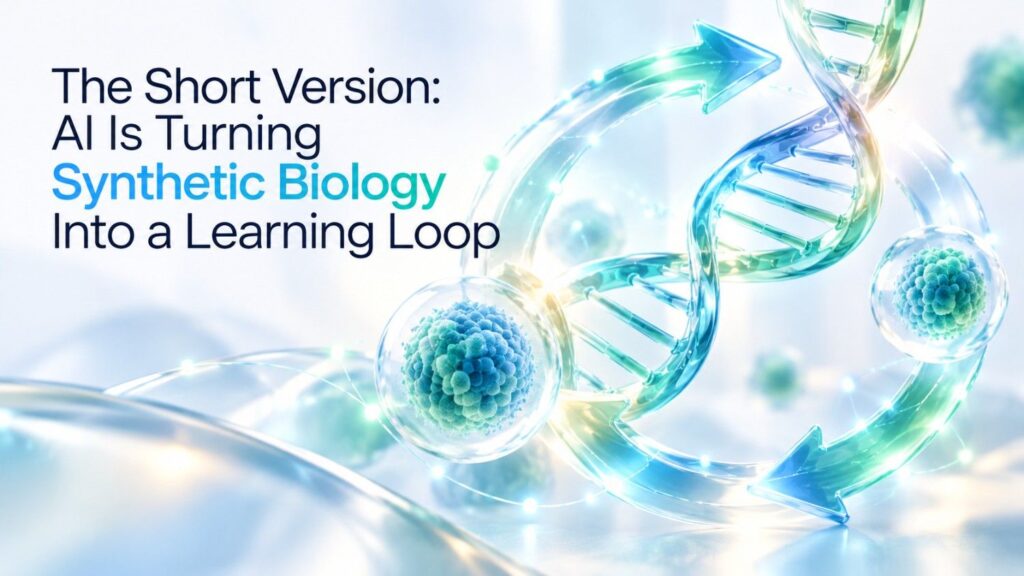
The Short Version: AI Is Turning Synthetic Biology Into a Learning Loop
Synthetic biology has traditionally been described as the engineering of living systems. Scientists change DNA, proteins, pathways, or cells so that biology performs a useful function.
AI adds a new layer to that process.
Instead of deciding every biological experiment manually, researchers can increasingly train models on biological data and ask those models to suggest promising sequences, molecules, genetic circuits, cell lines, experimental conditions, or other designs. The lab then tests those ideas.
The results become new training data.
That creates a cycle:
Design → Build → Test → Learn → Design again
The important word is not AI.
It is again.
The companies that can repeat this cycle faster may improve faster because every experiment produces information that helps determine what should be tested next.
This is why the Boston AI-synthetic-biology opportunity is bigger than a collection of software startups.
Generate is building generative models around therapeutic proteins. Asimov is combining AI, engineered cells, genetic systems, software, and laboratory validation. Dyno Therapeutics is using AI to design gene-delivery vectors. Manifold Bio is trying to measure biological behavior directly inside living systems.
Nabla Bio combines AI with experimental testing for difficult antibody targets. Ginkgo Bioworks has connected frontier AI directly to robotic laboratory infrastructure.
These companies are approaching different problems, but the architecture increasingly looks similar.
Software designs.
Biology responds.
The response becomes data.
The data improves the next design.
That is the frontier.
What AI and Synthetic Biology Actually Mean When They Come Together
The phrase “AI meets synthetic biology” can become meaningless very quickly because almost every biotechnology company now has some computational work.
A company does not suddenly become an AI-synthetic-biology company because its scientists use machine learning.
For this article, BostonBizScene used a narrower definition.
We looked for companies where computational models are materially involved in designing, selecting, optimizing, or learning from biological systems and where the company also has meaningful access to experimental biological data.
That distinction matters.
A normal software company can train a better model by obtaining more digital information. A biological design company eventually has to confront the physical world.
A protein that looks attractive computationally may be difficult to manufacture.
A viral vector may work in one model and fail in another.
A genetic construct may produce too little protein.
An antibody may bind its target but have poor drug-like properties.
A cell may behave differently inside a living organism than it did inside a plate.
The laboratory is therefore not merely a place where the algorithm is confirmed.
It is part of the computing system.
Synthetic Biology Used to Be Mostly About Building
Earlier synthetic biology companies often focused heavily on the ability to engineer DNA and cells.
The basic idea was powerful: if biological systems are programmable, scientists should be able to rewrite them for useful purposes.
That vision produced enormous advances.
Yet biological engineering remained difficult because the search space was so large.
A protein can have an extraordinary number of possible sequences. Genetic circuits contain many interacting parts. Cell behavior depends on the surrounding biological environment. Even if scientists can physically create thousands of designs, they still need to decide which thousands are worth building.
AI changes that selection problem.
Instead of exploring biological possibility almost blindly, models can help narrow the search.
AI Makes the Design Space Searchable
This is where generative biology becomes especially important.
Generate describes its platform as learning statistical relationships between protein sequences, structures, and functions using information from hundreds of millions of known proteins together with proprietary experimental data. Its models can then generate new therapeutic protein sequences rather than simply search through proteins already found in nature.
The change sounds subtle, but strategically it is enormous.
Traditional discovery asks:
Which existing molecule might work?
Generative biology increasingly asks:
What molecule should exist for this job?
Synthetic biology then provides the tools needed to build and test the answer.
BostonBizScene Original Research: Mapping Boston’s AI-Synthetic-Biology Stack
To make this article more useful than a normal company roundup, BostonBizScene created an original dataset of representative Greater Boston platforms at the intersection of AI and biological engineering.
The analysis was completed using public information available through October 6, 2026.
Our Methodology
Companies were included when they met three conditions.
First, they needed a meaningful operating presence in Greater Boston, including Boston, Cambridge, Somerville, Watertown, or the immediate local life-sciences cluster.
Second, AI, machine learning, computational design, autonomous experimentation, or data-driven optimization needed to be central to the company’s biological platform rather than simply an internal productivity tool.
Third, the business needed a meaningful connection to engineered biology, including proteins, genetic constructs, gene-delivery systems, cells, automated biological experiments, or systems-level biological design.
We then manually coded each company according to the biological layer being designed, the primary source of experimental feedback, evidence of a closed learning loop, commercial validation, and publicly disclosed financing.
Financing numbers should be read as lower-bound ecosystem indicators, not exact company valuations. Public disclosures differ in what they count, and large partnership milestone totals were excluded unless specifically discussed.
Table 1: Representative Greater Boston AI + Synthetic Biology Platforms
| Company | Greater Boston base | What AI helps design or optimize | Physical feedback layer | Evidence of market validation |
|---|---|---|---|---|
| Generate | Somerville | Therapeutic proteins | Proprietary biological experiments and biohardware | Public company; clinical pipeline |
| Asimov | Boston | Genetic systems, cell lines, RNA and manufacturing systems | Engineered cells and laboratory testing | Pharma, biotech and manufacturing customers |
| Ginkgo Bioworks | Boston | Biological experiments, strains and processes | Large automated cloud-lab infrastructure | Commercial cell engineering platform |
| Dyno Therapeutics | Watertown | AAV capsids and protein binders | High-throughput biological testing | Roche, Astellas and other pharma collaborations |
| Manifold Bio | Boston | Tissue-targeting biologics | Massively multiplexed in-vivo measurement | Roche collaboration |
| Nabla Bio | Cambridge | Antibodies | High-throughput wet-lab measurement | AstraZeneca, BMS and Takeda collaborations |
| Metaphore Biotechnologies | Cambridge | Antibody mechanisms and molecular interactions | Proprietary experimental functional-data engine | Flagship-backed therapeutic pipeline |
| Cellarity | Somerville | Cell-state-correcting medicines | Multi-omics and experimental biology | Clinical-stage asset and Novo Nordisk collaboration |
| 1910 Genetics | Cambridge | Small molecules and protein therapeutics | Biological automation | Drug-discovery partnerships and internal programs |
This is not intended to be a complete census of every Boston company touching either AI or synthetic biology.
It is designed to capture a representative set of businesses where the two fields are tightly connected.
That distinction produces an important result.
The center of gravity is not generic biotech software.
It is biological design.
Original Finding #1: Boston’s AI-Synthetic-Biology Market Is Already Backed by More Than $2.4 Billion in Disclosed Capital
BostonBizScene compiled the most clearly disclosed equity, committed platform capital, and IPO proceeds for nine representative companies.
For companies where public descriptions used phrases such as “more than,” we kept the analysis conservative.
Generate had raised more than $750 million before its 2026 IPO and then priced a 25 million-share offering at $16 per share, generating $400 million in gross proceeds.
Lila Sciences, which sits slightly outside the narrowest definition of synthetic biology because it is building autonomous science infrastructure across several disciplines, had announced $550 million in total capital by late 2025. We include it in the financing analysis because autonomous biological experimentation is directly relevant to where this market is going.
Cellarity reported $274 million raised after its Series C. Asimov announced $200 million in new financing in 2023 following earlier funding, while Dyno disclosed a $9 million seed round and $100 million Series A.
Table 2: Publicly Disclosed Capital Used in Our Sample
| Company | Conservative capital figure used |
|---|---|
| Generate | $1.15B+ |
| Lila Sciences* | $550M |
| Cellarity | $274M |
| Asimov | $200M+ |
| Dyno Therapeutics | $109M |
| Metaphore Biotechnologies | $50M committed |
| Manifold Bio | $45.4M disclosed seed + Series A |
| Nabla Bio | $37M+ |
| 1910 Genetics | $26M at launch |
| Total | More than $2.44B |
*Lila is included as an autonomous-science infrastructure company relevant to the emerging closed-loop biology stack rather than as a pure synthetic-biology company.
Manifold Bio announced a $5.4 million seed round followed by a $40 million Series A. Its later Roche agreement included $55 million upfront and potential payments above $2 billion, but BostonBizScene excluded those potential milestones from the equity-capital total because partnership economics are not directly comparable with venture financing.
Nabla Bio says it has raised $37 million and has signed collaborations with AstraZeneca, Bristol Myers Squibb, and Takeda.
Chart 1: Capital Is Highly Concentrated
| Company | Approx. capital used in analysis | Relative scale |
|---|---|---|
| Generate | $1,150M+ | ███████████████████████ |
| Lila | $550M | ███████████ |
| Cellarity | $274M | █████ |
| Asimov | $200M+ | ████ |
| Dyno | $109M | ██ |
| Metaphore | $50M | █ |
| Manifold Bio | $45M | █ |
| Nabla Bio | $37M | █ |
| 1910 Genetics | $26M | ▌ |
Our calculation shows that Generate and Lila alone account for roughly 70% of the capital represented in this sample.
The top four platforms account for roughly 89%.
That concentration tells us something important.
Investors are not spreading money evenly across dozens of experimental AI-biology ideas. They have been willing to put very large amounts behind a smaller number of platforms that could become infrastructure or product engines rather than single-asset biotechnology companies.
Original Finding #2: Boston’s Real Moat Is the Closed Experimental Loop
The most important finding from our platform comparison is not the funding number.
It is the architecture of the companies receiving the money.
The strongest Boston platforms increasingly own both a computational design layer and a way to generate proprietary experimental feedback.
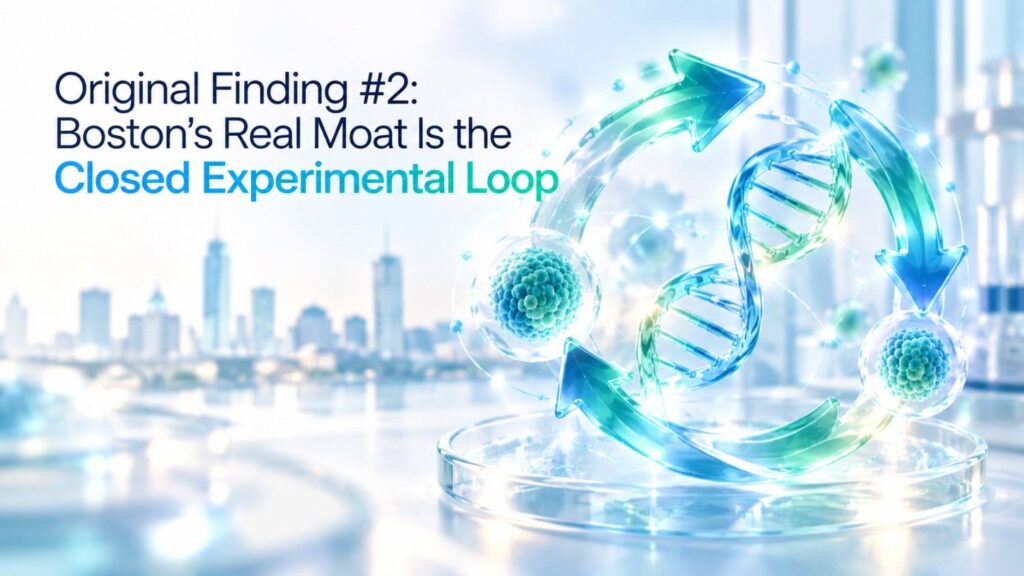
That creates a learning loop competitors cannot reproduce simply by downloading a public biological database.
Generate Makes the Loop Explicit
Generate describes its platform as a tightly integrated design-build-test-learn system combining computational innovation with scalable biological hardware. Its public filings say the loop creates proprietary therapeutically relevant data as new molecules move through the system.
This is strategically different from training a model once and using it forever.
Every experimental cycle can potentially make the platform better.
If the company learns that a certain sequence behaves poorly during manufacturing, that observation becomes useful information.
If another sequence performs surprisingly well, that becomes useful too.
Eventually the proprietary data may matter as much as the initial model architecture.
Asimov Is Extending the Loop Into Manufacturing
Asimov may be one of the clearest examples of how broad this idea can become.
The Boston company originally described its platform as combining cell biology, computer-aided design, genetic systems, proprietary cell lines, and software.
By 2026, the platform was moving further toward lab-in-the-loop AI.
Its RNA Edge system combines proprietary AI sequence optimization, genetic parts, and biological validation. The company says the system has produced a ninefold improvement in expression and a fourfold improvement in half-life in one CAR-T application and doubled expression for Cas9 in another program.
The important point is not the individual performance number.
It is what is being optimized.
AI-synthetic biology is moving beyond discovering a medicine and into the question of whether that medicine can be produced efficiently.
That could create a very large new market.
Original Finding #3: The Next Competitive Battleground Is Experimental Throughput
Better AI models attract attention.
Faster experimental loops may create the stronger business.
Ginkgo Bioworks gave Boston a unusually clear demonstration in February 2026.
Working with OpenAI, Ginkgo connected an AI model directly to its automated laboratory infrastructure and used the system to optimize cell-free protein synthesis.
Across six rounds, the system tested more than 36,000 reaction compositions on 580 automated plates. OpenAI reported that the process reduced protein-production cost by roughly 40%, while reagent costs improved by 57%.
That experiment matters because it shows what closed-loop biological research can look like at machine scale.
The AI did not merely write a report about protein synthesis.
It chose experiments.
The automated lab ran them.
Results came back.
The system proposed another batch.
Then the loop repeated.
Chart 2: What Changes When AI Gains Access to the Lab
| Traditional workflow | Closed-loop workflow |
|---|---|
| Scientist forms hypothesis | AI + scientist define search space |
| Scientist chooses experiment | Model proposes many candidates |
| Lab runs limited experiment set | Automation runs thousands |
| Scientist manually reviews results | Results return digitally |
| New hypothesis formed | Model updates next experiment batch |
| Cycle repeats slowly | Cycle repeats continuously |
The difference is throughput.
Scientists will remain essential because biological goals, safety boundaries, experimental design, interpretation, and clinical judgment cannot simply be handed over to an algorithm.
But the number of test-learn cycles completed per month can rise sharply.
That could become the new competitive unit.
Original Finding #4: Boston Companies Are Moving From Designing Molecules to Designing Biological Systems
The first generation of AI drug discovery focused heavily on molecules.
Boston’s newer platforms increasingly work across several biological layers.
Table 3: What Boston Companies Are Actually Trying to Program
| Biological layer | Boston examples | What is being optimized |
|---|---|---|
| Protein sequence | Generate, Nabla, Dyno, Manifold, Metaphore | Binding, function, selectivity, delivery |
| Gene-delivery vector | Dyno | Tissue targeting and delivery |
| RNA sequence | Asimov | Expression and stability |
| Engineered cell systems | Asimov | Production and therapeutic manufacturing |
| Cell state | Cellarity | Disease-related cellular behavior |
| Experimental process | Ginkgo | Reaction conditions and biological workflows |
| Whole-organism behavior | Manifold Bio | Biodistribution and tissue targeting |
| Scientific experiment selection | Ginkgo, Lila | What experiment to run next |
This expansion matters because biological products do not exist independently of their surrounding system.
A drug is affected by delivery.
Delivery is affected by tissue.
Tissue is affected by cell state.
Manufacturing is affected by genetic constructs and host cells.
The more layers a platform can model and measure, the more biological engineering starts to resemble systems engineering.
That may become one of Boston’s strongest advantages.
Generate Is Showing What Generative Biology Looks Like at Scale
Generate is one of the most important companies to watch because it has moved generative biology beyond an academic concept.
The company trains models on protein information and proprietary biological data to design therapeutic proteins across several formats.
Its approach can produce antibodies, peptides, enzymes, and other protein-based molecules.
By 2026, Generate had also become a public company.
Its IPO raised $400 million in gross proceeds, and its company materials describe five clinical-stage molecules alongside additional preclinical programs.
That progression matters.
Boston no longer has to ask whether generative biology can create interesting preclinical experiments.
The question is increasingly whether AI-designed biological products can survive the entire development path.
That means clinical performance, manufacturing quality, safety, regulatory review, pricing, and commercial adoption will become the real tests.
The Moat May Shift From Model Size to Experimental Memory
Large models can eventually become easier for competitors to reproduce.
Proprietary biological history is different.
Imagine a company that has designed and tested millions of protein variants over many years.
Its most valuable asset may not simply be the model weights.
The deeper asset may be the accumulated record connecting design decisions with physical results.
What sequence produced the desired structure?
Which one expressed poorly?
Which protein remained stable?
Which candidate worked inside an animal?
Which design created an unexpected immune response?
That experimental memory can become extremely difficult to copy.
Asimov Shows Why AI-Synthetic Biology Will Reach Manufacturing
Boston’s next biotech frontier will not stop at drug discovery.
Manufacturing may become just as important.
Asimov is building around that idea.
The company works across engineered genetic systems, cell lines, biological design software, RNA, gene therapy, and biologics manufacturing.
In June 2026, Asimov announced a proprietary genome-integration system called Chrysalis. The company reported that top clones in recent complex antibody-development campaigns exceeded titers of 12 grams per liter.
Three months later, Asimov reported that its CHO Edge system had produced cell lines exceeding 10 grams per liter for a four-chain bispecific-antibody program with Sidewinder Therapeutics.
These examples point toward a larger shift.
The question may no longer be only:
Can AI design the therapeutic?
It may become:
Can AI help design the biological factory that makes the therapeutic?
That is a much larger systems problem.
It also fits Boston extremely well because the region has deep expertise in therapeutics, bioprocessing, cell engineering, biologics, and manufacturing science.
Dyno Therapeutics Is Using AI to Redesign Gene Delivery
Gene therapy has an enormous engineering problem.
The genetic payload matters, but it must also reach the right tissue.
Dyno Therapeutics is trying to solve that problem by designing better adeno-associated virus, or AAV, capsids with AI.
The Watertown company raised a $100 million Series A in 2021 after an earlier $9 million seed round and has since worked with large pharmaceutical partners.
In 2026, Dyno expanded beyond capsids with Psi-Phi, a suite of generative protein-design tools and AI agents intended to connect computational design with physical experimental outcomes.
At the American Society of Gene & Cell Therapy meeting in May 2026, Dyno also introduced new capsids for central-nervous-system and muscle delivery while opening portions of its AI platform to therapeutic developers and researchers.
The strategic lesson is important.
AI-synthetic biology does not have to replace an entire drug-development process.
It can attack a bottleneck.
For gene therapy, delivery is one of the hardest bottlenecks.
If a platform materially improves delivery, it can create value across many different therapeutic programs.
Manifold Bio Is Attacking the Biggest Weakness in Biological AI: Reality
AI performs best when training data reflects the environment where the model will actually be used.
That is difficult in biotechnology.
Cell cultures are useful, but humans are not Petri dishes.
Even animal models are imperfect.
Manifold Bio is trying to improve the training loop by moving measurement deeper into living biology.
Its mDesign platform combines AI-guided protein design with massively multiplexed in-vivo testing. The company argues that many conventional assays miss properties such as pharmacokinetics and biodistribution because those properties only become visible inside a living system.
In November 2025, Roche agreed to collaborate with Manifold on brain-targeting shuttles. The deal included $55 million upfront and more than $2 billion in possible research, development, and commercial milestones.
That deal is strategically more interesting than its headline value.
It suggests that high-throughput biological measurement itself can become a platform.
Original Finding #5: In-Vivo Data May Become Boston’s Highest-Value Data Class
Most AI companies want more data.
Biology companies need the right data.
Public protein sequences are useful.
Published papers are useful.
Cell-line measurements are useful.
But if the commercial goal is to make a drug behave correctly inside a patient, data that captures biological behavior inside living systems may be disproportionately valuable.
Manifold’s strategy is therefore an important clue about the direction of the market.
Boston’s AI-biology companies may eventually compete less on who can ingest the largest public dataset and more on who can generate the most useful private experimental dataset.
Nabla Bio Shows Why Difficult Targets Could Become a Major Commercial Wedge
Some proteins are much harder to drug than others.
That makes them an attractive entry point for AI-designed therapeutics.
Cambridge-based Nabla Bio combines generative AI with large-scale biological testing to design antibodies, with particular attention to difficult targets.
Its founders came out of George Church’s Harvard ecosystem, and the company has described its technical work as combining machine learning with synthetic biology and experimental measurement.
The company announced a $26 million Series A in 2024 and partnerships with AstraZeneca, Bristol Myers Squibb, and Takeda worth more than $550 million in potential upfront and milestone payments, plus royalties.
Nabla says it has focused in part on multipass membrane proteins such as GPCRs, ion channels, and transporters.
That business model makes sense.
AI becomes much easier to value when it solves something conventional research has struggled to solve.
“Better AI” is vague.
“An antibody against a commercially important target that competitors could not drug” is much easier for a pharmaceutical buyer to understand.
Metaphore Is Trying to Design Function, Not Just Binding
Antibody engineering is also becoming more ambitious.
A conventional view of an antibody focuses heavily on whether it binds a target.
Metaphore Biotechnologies is trying to design biological function more directly.
The Cambridge company was launched by Flagship Pioneering with an initial $50 million commitment. Its platform combines computational modeling with proprietary experimental functional data to design molecules inspired by biological interactions found in nature.
By July 2026, the company described an integrated experimental and computational antibody-design engine intended to create antibodies that activate, tune, or otherwise manipulate biology rather than simply block a target.
This points toward another frontier.
The future may not be about making AI-generated copies of existing drug formats.
It may be about designing molecular behavior that conventional discovery rarely finds.
Cellarity Expands the Question From “What Target?” to “What Cell State?”
Synthetic biology usually makes people think about engineered DNA or proteins.
Cellarity demonstrates why the emerging field may become broader.
Instead of beginning with a single molecular target, the Somerville company models disease at the level of cell state using multi-omics data and AI.
The company reported $274 million in financing after its 2022 Series C and entered 2026 with a clinical-stage program plus additional work with Novo Nordisk.
The significance is conceptual.
Drug discovery traditionally asks which protein should be inhibited or activated.
Cellarity starts closer to:
What has gone wrong with the cell, and what intervention could move it toward a healthier state?
That kind of systems-level modeling could eventually connect naturally with synthetic biology.
Once scientists can model a desired cell state, engineered biological systems may increasingly be designed specifically to create it.
Ginkgo Bioworks Shows Both the Opportunity and the Business-Model Challenge
No discussion of Boston synthetic biology is complete without Ginkgo Bioworks.
Ginkgo helped popularize the idea of biology as an engineering platform and built large-scale foundry infrastructure in Boston.
Yet its financial history also demonstrates that technical scale does not automatically create an easy business.
Ginkgo reported $132.7 million in cell-engineering revenue for 2025, down from about $174 million in 2024. BostonBizScene calculates that as a decline of approximately 23.7% year over year.
That does not invalidate the platform model.
It makes the next phase more interesting.
AI could help improve the economics of biological infrastructure by making automated labs more productive, reducing the cost of experiments, increasing utilization, or creating new products from the learning loops running through the infrastructure.
The 2026 autonomous-lab experiment with OpenAI is therefore strategically important.
Ginkgo demonstrated that robotic biological capacity does not only have to execute human-designed work.
It can become a physical interface for AI.
That could change what a biological foundry is worth.
Boston University Is Building Public Infrastructure for the Same Future
The private sector is not building this ecosystem alone.
In July 2026, the National Science Foundation awarded Boston University nearly $20 million to help build a national network of programmable cloud laboratories. BU’s node is expected to focus on biotechnology and engineered biological systems.
The laboratory is expected to support remote experimentation while using AI to translate requests into executable workflows, schedule tasks, and improve based on user feedback.
Asimov is participating in that effort and plans to help build protein-production and characterization capabilities at BU’s node. The company says it intends to use the infrastructure to generate experimental data for models that predict protein manufacturability directly from DNA sequence.
That is exactly the kind of infrastructure Boston needs.
AI-biology startups require enormous amounts of physical experimentation.
If cloud labs make advanced automation easier to access, smaller companies and university researchers may be able to create useful datasets without spending years building their own laboratory infrastructure.
Original Finding #6: Boston Is Developing a Three-Layer AI-Biology Economy
Our research suggests the ecosystem is separating into three connected layers.
Layer One: Biological Intelligence
These companies build models that reason about proteins, genes, cells, molecules, or experiments.
Generate, Cellarity, Dyno, Nabla, Metaphore, and other computational-biology platforms sit heavily in this layer.
Their core question is:
What should we design?
Layer Two: Experimental Infrastructure
The second layer turns model suggestions into physical evidence.
Ginkgo’s automated labs, Asimov’s lab-in-the-loop systems, Manifold’s in-vivo measurement platform, and emerging cloud laboratories are examples.
Their question is:
How quickly can we test the design?
Layer Three: Biological Production
The final layer translates successful designs into reproducible products.
That includes engineered production cell lines, genetic constructs, RNA systems, manufacturing processes, and scalable biological production.
Asimov is especially notable here because it is deliberately connecting computational design with development and manufacturing.
The question becomes:
Can we make the biology reliably at commercial scale?
Chart 3: Boston’s Emerging AI-Synthetic-Biology Stack
| Layer | Core function | Boston advantage |
|---|---|---|
| AI design | Choose promising biological designs | AI talent + biotech expertise |
| Automated experimentation | Generate proprietary physical data | Dense wet-lab infrastructure |
| In-vivo learning | Measure real biological behavior | Hospitals + research + biotech ecosystem |
| Biological production | Turn designs into scalable products | Bioprocess and therapeutics experience |
| Clinical translation | Prove products in patients | Major hospitals and pharma network |
A city does not need to dominate every AI model to win this market.
It needs enough strength across the entire stack that the learning loop can run locally.
Boston already has most of the pieces.
Original Finding #7: Boston’s Competitive Advantage May Be Experimental Density, Not AI Talent Alone
San Francisco has extraordinary AI talent.
Boston should not try to win by pretending otherwise.
The stronger Boston strategy is to exploit what makes the region different.
Within a relatively small geographic area, Greater Boston contains universities, hospitals, pharmaceutical companies, biotech startups, contract labs, robotic-laboratory infrastructure, genomics experts, protein scientists, clinicians, computational biologists, venture firms, and large numbers of scientists who understand how real experiments fail.
That physical density matters.
Biological AI needs frequent contact with reality.
A general AI company can improve a coding model with digital evaluation.
A synthetic-biology model eventually needs DNA synthesized, proteins expressed, cells grown, tissues measured, animals studied, manufacturing processes tested, or patients treated.
The feedback loop is physical.
Boston’s advantage is therefore not simply that it has people who can build AI.
It is that those people can work within a few miles of unusually dense biological infrastructure.
Why the Next Great Synthetic-Biology Company May Look More Like a Data Company
For years, investors debated whether synthetic biology should be valued like software.
That comparison was usually incomplete.
The better comparison may be a data flywheel attached to physical infrastructure.
The value creation process looks something like this.
A model generates candidate designs.
Automation produces them.
Experiments produce outcomes.
Outcomes become proprietary data.
Proprietary data improves the model.
The improved model selects better candidates.
Better candidates increase the value of the experimental platform.
More customers and internal programs generate more experiments.
The system becomes stronger.
This model has software-like learning effects, but it also requires expensive laboratories.
That combination creates both opportunity and risk.
The Biggest Risk: A Closed Loop Can Become a Closed Money Pit
Not every AI-biology platform will work.
The industry should be careful about assuming that more automation automatically means better economics.
A laboratory can run thousands of experiments quickly and still produce little commercial value if the experiments are poorly selected.
A model can generate millions of sequences that are useless.
An enormous proprietary dataset can become an expensive collection of noise if measurements do not connect to outcomes customers care about.
The key metric is therefore not experiment count alone.
It is learning per experiment.
A Better KPI Dashboard for AI-Synthetic-Biology Companies
Investors and operators should watch several operational measures together.
| Metric | Why it matters |
|---|---|
| Design-to-test cycle time | Shows how quickly the learning loop turns |
| Cost per useful experiment | Measures economic efficiency |
| Hit-rate improvement | Shows whether AI is actually improving selection |
| Experimental throughput | Measures platform capacity |
| Percentage of proprietary training data | Indicates defensibility |
| Predictive accuracy on new biology | Tests whether learning generalizes |
| Manufacturing success rate | Shows whether designs survive production |
| Partner renewals or expansions | Measures commercial usefulness |
| Pipeline conversion | Shows whether designs become real products |
| Clinical success | Ultimately matters more than computational elegance |
A company that runs one million experiments with no improvement in downstream success may have built expensive automation.
A company that uses 20,000 highly informative experiments to double the probability of creating a manufacturable drug may have created something much more valuable.
What Boston Founders Should Build Next
Boston already has strong protein-design platforms.
That means founders should not automatically build another general generative-protein startup.
The better opportunities may exist around missing parts of the feedback loop.
Better Experimental Data Infrastructure
Biological data is often messy.
Different laboratories record experiments differently.
Metadata is incomplete.
Failed experiments disappear.
Instrument outputs may live in separate systems.
AI needs cleaner links between what was designed, what was physically done, and what happened.
Companies that build infrastructure making experimental data truly machine-readable could become important picks-and-shovels businesses.
AI-Native Bioprocess Development
Manufacturing optimization is still filled with complex experimental decisions.
Media composition, cell-line selection, growth conditions, purification, formulation, stability, yield, and product quality interact with one another.
Asimov’s direction suggests where this could go.
The next major Boston platform may not design drugs at all.
It may design the processes that manufacture them.
Autonomous Biology for Smaller Labs
Large companies can spend heavily on robotics.
Most academic laboratories and early startups cannot.
BU’s programmable-cloud-lab initiative could create space for companies that turn laboratory automation into a service.
Instead of buying millions of dollars of equipment, a researcher could describe the experiment digitally and receive structured results.
That could create an AWS-like layer for experimental biology.
The analogy should not be pushed too far, because laboratories are far more difficult to standardize than servers.
But the direction is compelling.
In-Vivo AI Infrastructure
Manifold Bio illustrates how valuable experimental data becomes when it gets closer to the biological reality a therapy will encounter.
There is room for much more innovation here.
AI models need better ways to connect molecular design with tissue behavior, toxicity, immune response, distribution, metabolism, and long-term outcomes.
Boston’s hospital and translational-research ecosystem makes it a natural place to build these systems.
What Pharmaceutical Companies Should Ask Before Partnering With an AI-Synthetic-Biology Startup
Pharma teams should not evaluate these companies mainly through model demos.
The first question should be whether the platform has produced results that matter in biology.
Then the diligence should move deeper.
How is training data produced?
How much of it is proprietary?
Are failures captured or discarded?
Does the model improve when new experiments are added?
Can the company reproduce experiments reliably?
Does the platform perform on biology that was not represented heavily in its original dataset?
Can successful designs be manufactured?
Has a partner expanded the relationship after seeing real results?
Those questions reveal whether the platform is genuinely learning or simply producing attractive computational outputs.
What Investors Should Watch Over the Next Three Years
The next stage of this market will be decided by validation.
Financing alone is not enough.
Boston already has several heavily funded platforms.
Now the ecosystem must prove that these systems can produce better products with better economics.
The strongest signal will be repeated conversion.
Can AI-designed proteins become clinical candidates?
Can gene-delivery systems improve therapeutic performance?
Can autonomous labs repeatedly reduce cost or time?
Can computational design improve manufacturing yield?
Can large pharmaceutical companies turn pilot programs into broader relationships?
Can the closed-loop platforms demonstrate that each generation of experiments materially improves the next?
That is where durable company value will emerge.
Boston’s Most Important Asset Is the Ability to Connect Digital Intelligence With Physical Biology
There is a temptation to frame every technology market as an AI race.
That framing misses what is interesting about Boston.
Boston does not need to become Silicon Valley with more laboratories.
Its opportunity is different.
The region can specialize in the place where artificial intelligence encounters physical biology.
That intersection is difficult.
Models must deal with noisy data.
Experiments are expensive.
Living systems behave unpredictably.
Manufacturing introduces new constraints.
Regulation matters.
Failures can be catastrophic.
Those problems make the market harder than normal software.
They also create barriers that normal software companies cannot cross simply by hiring a few biologists.
The Bigger Story: Synthetic Biology Is Becoming a Search Problem
Biology contains an enormous design space.
There are more possible proteins than scientists could ever test individually.
There are countless ways to modify regulatory sequences, cellular pathways, gene-delivery vehicles, experimental conditions, and production systems.
Synthetic biology gave scientists the tools to build.
AI increasingly provides tools to search.
Automation provides tools to test.
The combination changes the basic economics of engineering life.
Instead of manually exploring a tiny fraction of possible biology, researchers can increasingly build systems that decide where to look next.
That does not make biology easy.
It changes how the difficulty is attacked.
The Next Phase: Boston’s Advantage Will Depend on How Fast the Learning Loop Becomes Commercial
The next stage of AI and synthetic biology in Boston will not be decided by who has the most impressive model, the largest laboratory, or the biggest funding round. It will be decided by which companies can turn repeated biological learning into products customers are willing to pay for. That sounds obvious, but it is a very important shift.
For the last several years, many AI-biotech companies were judged mainly on the quality of their science, the pedigree of their founders, the size of their datasets, and the ambition of their platforms. Those things still matter.
But as the field matures, the market will demand harder proof. Companies will need to show that their systems can reduce development time, improve the odds of finding a useful molecule, lower experimental costs, increase manufacturing yield, or create biological products that would have been difficult to make with older methods.
This is where Boston could have an edge. The region has a dense network of organizations that can test whether a new AI-synthetic-biology platform actually works outside a research presentation. Pharmaceutical companies can become customers or partners. Hospitals can support translational research. Universities can generate new science and talent.
Automation companies can improve laboratory throughput. Biotech manufacturers can test whether a promising design is practical to produce. Venture investors can fund the next stage of development. These groups already exist close to one another, which means a company can move from computational design to experimental testing to commercial discussion without leaving the regional ecosystem. If those connections become more structured, Boston could shorten the path between a good model and a useful product.
The biggest opportunity may therefore be in building companies that control more of the feedback loop without trying to own every part of the value chain. A startup does not necessarily need to operate its own large robotic lab, manufacture every molecule, and run its own clinical programs. It does, however, need reliable access to the data that matters most to its model.
This could come from proprietary experiments, long-term pharmaceutical partnerships, cloud-lab infrastructure, manufacturing collaborations, or specialized in-vivo testing systems. The strategic goal is the same: every important experiment should create information that improves the next decision. If the company loses access to that feedback, its AI can become separated from the biological reality it is supposed to predict.
Boston founders should also pay close attention to negative data. The biotechnology industry has traditionally been much better at publishing success than failure, but failed experiments may be among the most useful inputs for AI. A model that only sees successful proteins, good cell lines, or promising therapeutic candidates receives an incomplete picture of biology.
It does not learn enough about the boundaries of the design space. Companies that systematically capture failed sequences, weak binders, unstable proteins, poor manufacturing runs, unexpected toxicity, and unsuccessful experimental conditions could build unusually valuable datasets. Those records may never appear in scientific papers, yet they could help a model avoid repeating expensive mistakes.
That creates a simple but powerful competitive question for Boston’s emerging AI-biology companies: How much does the platform learn every time something fails? The strongest companies may not be the ones that avoid failure entirely. Biology is too difficult for that.
They may be the companies that convert failure into useful information faster than competitors do. If Boston can build an ecosystem where experiments are cheaper to run, easier to automate, more carefully measured, and more consistently converted into machine-readable data, the region could develop a compounding advantage.
Each year of experimentation would not only produce new drugs, proteins, vectors, cells, and biological processes. It would also produce a deeper map of what works, what does not work, and where researchers should search next. That accumulated experimental intelligence could become one of the most valuable assets in the entire Boston biotech ecosystem.
Final Takeaway: Boston Could Win by Building the Learning Systems for Biology
The AI-synthetic-biology frontier will not be won by the company that generates the most biological sequences.
It will be won by companies that learn fastest from the physical world.
Boston already has several important pieces of that system.
Generate is showing how generative models can produce therapeutic proteins.
Asimov is connecting AI with engineered cells, RNA, genetic systems, and manufacturing.
Dyno is using AI to redesign gene delivery.
Nabla and Metaphore are pushing computational antibody design toward harder biological problems.
Manifold is creating high-throughput feedback directly from living systems.
Ginkgo has shown that frontier AI can operate through an automated biological laboratory.
Boston University is helping build public cloud-lab infrastructure that could make those capabilities more widely accessible.
The financial data suggests investors already understand the size of the opportunity. Our representative Boston dataset contains more than $2.4 billion in clearly disclosed capital, and that figure excludes much of the partnership funding, public-market history, grants, and infrastructure investment surrounding the sector.
But capital is not the most important resource.
The real asset is the loop.
Design. Build. Test. Learn. Repeat.
Boston has spent decades assembling the institutions, laboratories, scientists, hospitals, biotech companies, and engineering talent required to run that loop.
AI may finally allow the region to run it at machine speed.
If that happens, Boston’s next biotech frontier will not simply be about using artificial intelligence to understand biology.
It will be about creating systems that can continuously learn how to engineer it.