

Boston has spent decades building one of the strongest scientific research economies in the world. The region has world-class universities, major hospitals, drug companies, biotech startups, robotics companies, venture firms and thousands of scientists working within a relatively small area.
But something important is now changing inside that ecosystem.
Artificial intelligence is moving out of the computer and into the laboratory.
Instead of using AI only to analyze existing scientific data, a growing group of Boston-area companies and research teams is connecting AI directly to laboratory equipment. Software can suggest an experiment. Robots can prepare samples. Instruments can collect measurements. AI can study the results and use them to decide what should happen next.
That creates something very different from a normal automated lab.
It creates a learning system.
The most advanced version is often called a self-driving lab, autonomous laboratory, or AI science factory. The name is less important than the basic idea. The scientific process becomes a loop rather than a long chain of manual handoffs.
Boston is becoming an important testing ground for this model.
Lila Sciences is building what it calls AI Science Factories that combine scientific AI with autonomous laboratories. Atinary opened a self-driving laboratory in Boston in 2026. Ginkgo Bioworks has made autonomous laboratories a major part of its strategy and is expanding that infrastructure beyond its Boston base. MIT researchers are building robotic systems that can design, assemble, run and improve experiments. Generate is connecting computational protein design to automated experimental systems. Manifold Bio is building large experimental feedback loops between AI-designed proteins and measurements inside living organisms.
The important story is therefore not simply that Boston scientists are using more AI.
The deeper change is that AI is beginning to participate in the experimental process itself.
For Boston businesses, universities, investors and scientific leaders, this could become one of the most important changes in research infrastructure since cloud computing changed software.
The Short Version: Boston Is Turning Laboratories Into Learning Systems
Traditional scientific research often moves through a slow sequence.
A scientist forms an idea. Someone designs an experiment. Researchers prepare samples. Instruments run. Data gets cleaned. Scientists study the results. Meetings happen. A new experiment is chosen. Then the process starts again.
Each stage can take hours, days or weeks.
Autonomous science tries to compress that entire cycle.
The goal is not simply to make robots move laboratory plates faster. The real goal is to reduce the time between learning something and running the next useful experiment.
That distinction matters.
A robotic liquid handler that repeats the same procedure 5,000 times is automated, but it is not necessarily autonomous.
A true closed-loop system can change what it does because of what it just learned.
Boston now has examples at several levels of this progression. Lila and Atinary explicitly describe autonomous or self-driving laboratories. Ginkgo is building autonomous biology infrastructure. MIT’s CRESt materials platform feeds experimental results back into AI models that recommend new experiments. Generate describes its platform as a continuous cycle of generating, building, measuring and learning.

That means the Boston ecosystem is starting to connect four technologies that were previously developed separately:
AI + robotics + scientific instruments + experimental data.
Once those pieces operate together, the laboratory starts looking less like a room full of individual machines and more like one large computational system.
First, What Actually Counts as an Autonomous AI Lab?
The term “autonomous lab” is becoming popular enough that it risks losing its meaning.
For this article, BostonBizScene used a stricter definition.
An autonomous scientific system should perform most or all of four core functions.
| Core function | What it means |
|---|---|
| Design | Software chooses, creates or prioritizes experiments |
| Execute | Robotic or automated systems physically perform experimental work |
| Measure | Instruments automatically collect useful experimental results |
| Learn | Results influence the next experiment, model or decision |
The fourth step is the most important.
Without feedback, the system is mainly automation.
With feedback, it becomes a learning loop.
The Five-Level Autonomous Lab Ladder
To make the market easier to understand, we can place scientific systems on a simple maturity ladder.
| Level | Laboratory model | What happens |
|---|---|---|
| Level 0 | Manual laboratory | Scientists perform most work manually |
| Level 1 | Automated task | Machines perform individual repeated tasks |
| Level 2 | Connected automation | Several instruments share workflows and data |
| Level 3 | AI-guided laboratory | AI helps choose experiments while automation executes work |
| Level 4 | Closed-loop laboratory | Results automatically influence future experiments |
| Level 5 | Broad autonomous science | The system can operate across changing problems with limited human intervention |
Most laboratories today are somewhere between Levels 1 and 3.
Boston’s most interesting systems are pushing toward Levels 4 and 5.
That does not mean scientists disappear.
In fact, current evidence suggests the opposite. Human scientists are still essential for defining problems, interpreting unexpected results, correcting failures, creating new methods and deciding what scientific questions are worth pursuing.
MIT researchers developing CRESt specifically reported that humans still performed much of the debugging in their experiments. Chemical & Engineering News similarly reported in June 2026 that experts working on self-driving laboratories said no facility can yet operate completely without human intervention.
The near-term model is therefore better described as human-directed autonomous science.
BostonBizScene Original Research: Mapping Boston’s Autonomous Science Stack
To understand how far the Boston ecosystem has actually moved toward autonomous science, we reviewed publicly available material from companies, universities and research organizations with significant operations in Boston, Cambridge, Somerville or the surrounding research cluster.
The review was conducted using public company technical descriptions, institutional research reports, company announcements, research results and publicly described laboratory capabilities available through October 3, 2026.
We looked for direct public evidence of four functions:
experiment design, physical execution, measurement and learning from experimental results.
We deliberately did not count ordinary AI drug discovery companies simply because they use machine learning.
A company needed evidence connecting computation with physical experimentation.
Our Boston Autonomous Science Dataset
| Organization/system | Primary area | Design | Execute | Measure | Feedback/learn | Public maturity |
|---|---|---|---|---|---|---|
| Lila Sciences AI Science Factories | Cross-domain science | ✓ | ✓ | ✓ | ✓ | Full autonomous-lab model |
| Atinary Boston Self-Driving Labs | Chemistry/materials/pharma | ✓ | ✓ | ✓ | ✓ | Operational self-driving lab |
| Ginkgo Bioworks autonomous labs | Biology | ✓ | ✓ | ✓ | ✓ | Commercial autonomous infrastructure |
| MIT CRESt | Materials | ✓ | ✓ | ✓ | ✓ | Research-scale closed loop |
| Generate | Protein therapeutics | ✓ | ✓ | ✓ | ✓ | Industrial closed-loop platform |
| Manifold Bio | Protein therapeutics/in vivo biology | ✓ | ✓ | ✓ | ✓ | Closed experimental learning loop |
| Parallel Bio | Human biology | Partial | ✓ | ✓ | ✓ | Automated data-generation loop |
| MIT robotic optics laboratory | Physics/optics | Partial | ✓ | ✓ | ✓ | Autonomous experimental infrastructure |
| MIT autonomous robotic probe | Materials | ✓ | ✓ | ✓ | Partial | Autonomous characterization |
| Broad Institute CDoT automation | Drug discovery | Partial | ✓ | ✓ | Partial | Advanced lab automation |
Sources include public descriptions from Lila Sciences, Atinary, Ginkgo Bioworks, MIT, Generate, Manifold Bio, Parallel Bio and the Broad Institute. The ratings are BostonBizScene classifications rather than ratings provided by those organizations.
This is not meant to be a complete list of every automated laboratory in Greater Boston. Many pharmaceutical companies and research organizations do not publicly disclose the details of internal automation systems.
The purpose is different.
It gives us a consistent sample that shows where the publicly visible market is moving.
Original Finding #1: 60% of the Systems We Tracked Already Show a Full Scientific Feedback Loop
Six of the ten systems in our sample had clear public evidence for all four parts of the experimental loop.
That means AI or computation helps design or prioritize work, physical experiments are conducted, measurements return from the laboratory, and those measurements help improve future decisions.
Chart: Publicly Documented Closed-Loop Capability
Complete four-part loop      ████████████  60%
Partial loop                 ████████      40%
This does not mean 60% are fully autonomous laboratories.
That distinction is critical.
Only three organizations in our sample—Lila Sciences, Atinary and Ginkgo—publicly position autonomous or self-driving laboratory infrastructure as a central product or platform.
The others sit somewhere between intelligent automation and autonomous science.
That difference helps explain where the market is heading.
The transition will probably not happen in one giant leap from scientists manually holding pipettes to robots independently discovering medicines.
Instead, laboratories are gradually closing one handoff after another.
First, instruments become automated.
Then workflows become connected.
Then experiments become machine readable.
Then AI selects experiments.
Eventually the loop can keep moving with less human intervention.
Boston is already well into that transition.
Original Finding #2: Biology Dominates the Boston Autonomous-Lab Market, but Materials Science May Be Further Ahead Technically
When we assigned each system in our dataset to its primary scientific area, half were mainly focused on biology or drug discovery.
Three centered on materials, optics or physical science.
Two were designed to work across multiple scientific fields.
Chart: Primary Scientific Focus of Our Boston Sample
Biology / therapeutics       ██████████  50%

Materials / physical science ██████      30%

Cross-domain systems         ████        20%
Boston’s commercial opportunity is clearly being pulled toward biology because Boston already has an enormous biotechnology industry.
But materials science has an important advantage.
Many materials experiments are easier to standardize than complicated biological systems. A machine can mix chemicals, change temperatures, synthesize materials and measure properties under controlled conditions.
That makes materials science an ideal proving ground for self-driving laboratories.
MIT’s CRESt system is a strong example.
Researchers connected machine learning with robotic material synthesis, automated electrochemical testing, microscopy and other instruments. The system explored more than 900 chemistries and performed 3,500 electrochemical tests while developing a fuel-cell catalyst.
That is much closer to autonomous experimentation than simply asking a language model to suggest a molecule.
Biology Creates a Harder but Bigger Prize
Biology is messy.
Cells change. Animals differ. Proteins behave differently inside living systems than they do in simplified laboratory tests.
But that complexity is exactly why autonomous experimentation could become valuable.
The more unpredictable the system, the more valuable it becomes to run large numbers of structured experiments and feed the results back into models.
Boston companies are already trying to do this.
Manifold Bio, for example, reported in September 2026 that it had generated more than 50 million protein-binder designs across more than 8,700 target proteins and had tested more than 3 million binders in animals, including more than one million in non-human primates. The company says its experimental measurements are being used to build models that predict how molecules behave inside living systems.
That is not a traditional robotic self-driving laboratory.
But economically, it follows the same principle.
Generate hypotheses at machine scale. Test them physically. Capture the results. Improve the model. Repeat.
Original Finding #3: Boston’s Real Advantage May Be the Experimental Feedback Layer
There has been enormous attention around foundation models, scientific language models and generative AI.
But models eventually face a serious problem.
They need new evidence.
An AI system trained only on existing public scientific information may become very good at summarizing what humanity already knows. That does not automatically make it good at discovering things nobody has observed.
New science requires new experiments.
That changes the strategic value of laboratories.

An autonomous laboratory is not simply a faster lab.
It can become a machine for creating proprietary training data.
The New Scientific Data Flywheel
AI model
   ↓
Experiment design
   ↓
Robotic execution
   ↓
Physical measurement
   ↓
Structured proprietary data
   ↓
Model improvement
   ↓
Better experiment design
   ↺
This could become one of the most important competitive loops in scientific AI.
Companies with strong models but weak experimental systems may eventually become dependent on public data.
Companies with their own experimental infrastructure can continuously create data that competitors cannot easily obtain.
Generate describes exactly this kind of system. Its platform uses a continuous “generate, build, measure, learn” cycle, with experimental information feeding improvements in its engine. The company says more than 42,000 proteins have been generated, built and tested through its platform.
Manifold Bio is pursuing a similar idea from another direction by connecting large-scale protein design with large-scale in vivo measurement.
The moat may therefore become less about owning the biggest model.
It may become about owning the best model-to-experiment-to-data loop.
Lila Sciences Shows Where the Full Autonomous-Lab Vision Is Heading
No Boston company demonstrates the ambition behind autonomous science more clearly than Lila Sciences.
The Cambridge company emerged publicly in 2025 from Flagship Pioneering.
Lila describes its system as a scientific AI platform connected with autonomous laboratories spanning life sciences, chemistry and materials.
Flagship announced $200 million in committed seed financing when the company was unveiled. Lila later closed a $350 million Series A in October 2025, bringing total announced capital raised to $550 million.
That amount of capital matters because autonomous science is expensive.
Building another software application may require computers, engineers and cloud infrastructure.
Building an AI Science Factory requires all of that plus laboratories, robotics, instruments, scientific teams, consumables, physical facilities and operations.
Lila’s funding therefore gives us a useful signal.
Investors are beginning to treat experimental infrastructure itself as a major AI platform opportunity.
Lila Is Trying to Connect the Entire Scientific Method
The biggest ambition is not simply automating laboratory operations.
Lila says its AI works with autonomous laboratories so that systems can generate hypotheses, perform experiments and learn from physical results across scientific fields. The company has described expansion into hubs including Boston, San Francisco and London.
That creates an interesting business possibility.
If the system works across enough experimental types, Lila could eventually sell something closer to scientific capacity as infrastructure.
Instead of a company building its own robotic laboratory from scratch, it could potentially access a science factory that already has AI, instruments, robotics and workflows integrated.
That resembles an earlier shift in computing.
Companies once needed to own physical servers to access serious computing power.
Cloud infrastructure separated computing capacity from server ownership.
Autonomous science could eventually create a similar separation between scientific capability and laboratory ownership.
Atinary Is Turning the Boston Seaport Into a Self-Driving-Lab Test Site
In February 2026, Atinary opened an AI-powered laboratory in Boston.
The facility contains two autonomous platforms that the company calls Scientific Discovery Factories. They connect Atinary’s software with robotics and laboratory equipment from companies including ABB, Agilent, Bruker, Chemspeed and Mettler-Toledo.
Atinary describes the process as a continuous loop that designs, executes, analyzes and learns from experiments.
That matters because Atinary represents a different business model from a vertically integrated biotech company.
It is building infrastructure that could potentially be used across several industries.
Why the Vendor Integration Is Important
A hidden obstacle in autonomous labs is that laboratories contain equipment made by many companies.
One machine may control liquids.
Another heats samples.
Another measures molecular structure.
Another performs microscopy.
Another stores data in a completely different format.
Scientific labs were not originally designed to operate like one integrated computer.
This makes software orchestration extremely important.
The company that can reliably connect dozens of instruments may own one of the most valuable layers of the future autonomous laboratory.
Atinary’s Boston operation is therefore important for reasons beyond the specific experiments being conducted there.
It is testing the idea that laboratory hardware from many vendors can operate inside one AI-directed system.
Ginkgo Bioworks Is Turning Years of Lab Automation Into Autonomous Infrastructure
Boston-based Ginkgo Bioworks may have one of the most important structural advantages in this market: it has been building automated biological infrastructure for years.
Long before generative AI became the center of the technology industry, Ginkgo was investing heavily in automated biology.
A 2024 company presentation said Ginkgo had invested more than $1 billion over more than a decade developing its technology stack and operated roughly 300,000 square feet of automated wet-lab and office space in Boston.
In 2026, the company’s strategy shifted even more directly toward autonomous laboratories.
Ginkgo announced a cloud lab powered by autonomous-lab infrastructure in March. In August, it said it had won government contracts connected with autonomous labs at MIT, Caltech, Northwestern and the University of Maryland. In September, it announced plans to build an autonomous laboratory at Novo’s new U.S. research site in Waltham.
That sequence points toward something larger than a single laboratory.
Ginkgo May Be Building a Distributed Autonomous-Lab Network
Traditional scientific automation usually sits inside one organization.
Ginkgo increasingly appears to be treating automation as infrastructure that can be deployed elsewhere.
If that model expands, autonomous laboratories could eventually become a distributed network.
Researchers at universities, pharmaceutical companies or startups could run workflows on standardized platforms rather than building everything themselves.
That could reduce one of the largest barriers to autonomous science: the cost of creating the infrastructure.
It would also make experimental data more standardized.
That may be almost as important as the robots.
AI learns best from consistent data.
A network of laboratories operating similar workflows could generate cleaner information than hundreds of unrelated research teams working with different procedures and data formats.
MIT Is Showing Why Autonomous Science Will Not Be Limited to Biotech
Boston’s autonomous-lab story is easy to mistake for another biotech story because biotechnology dominates so much of the local innovation economy.
MIT shows why that would be too narrow.
Researchers there are applying autonomous systems to materials science, semiconductor characterization and even optical experiments.
CRESt Can Design and Run Materials Experiments
MIT’s CRESt platform combines machine learning, scientific literature, robotics, testing equipment, microscopy and human input.
Researchers can ask the system to find promising material recipes. Automated equipment can then prepare, characterize and test materials.
The results return to the models, which can use them to recommend future experiments.
During one project, CRESt explored more than 900 chemistries over approximately three months. It ultimately identified a multielement catalyst that improved an important economic performance measure for a formate fuel cell.
The important lesson is not the specific catalyst.
It is the architecture.
The system combines existing scientific knowledge with fresh physical evidence.
That is much closer to how human science works than a model operating only on historical datasets.
MIT’s Robotic Probe Shows That Measurement Itself Can Become Autonomous
Another MIT system has focused on semiconductor characterization.
Researchers developed a robotic probe using machine learning, computer vision and domain knowledge to decide where it should measure material properties.
During a 24-hour autonomous test, the robot performed more than 3,000 unique measurements, exceeding 125 measurements per hour.
This highlights another important idea.
The first autonomous labs may not automate the entire scientific process.
They may automate one major bottleneck extremely well.
Measurement is one of those bottlenecks.
If scientists can generate 100 times more reliable physical measurements, those measurements become training material for better models.
MIT’s Robotic Optics Lab Goes After a Completely Different Bottleneck
In September 2026, MIT researchers described a robotic optics laboratory that can assemble optical equipment, align components, run experiments, detect physical changes and make corrections.
In a demonstration, the system built a functional laser cavity by completing 50 robotic maneuvers in about 30 minutes. When researchers physically disturbed the setup, the system adjusted components to maintain performance.
That research demonstrates why autonomous laboratories should not be imagined as rows of robotic arms moving test tubes.
The concept can apply to nearly any scientific environment in which physical equipment can be digitally controlled.
Optics.
Materials.
Biology.
Chemistry.
Energy research.
Semiconductors.
Eventually even complex engineering systems.
Original Finding #4: The Autonomous-Lab Market Is Splitting Into Several Business Models
Our dataset reveals another important pattern.
Not every company needs to build the same kind of autonomous laboratory.
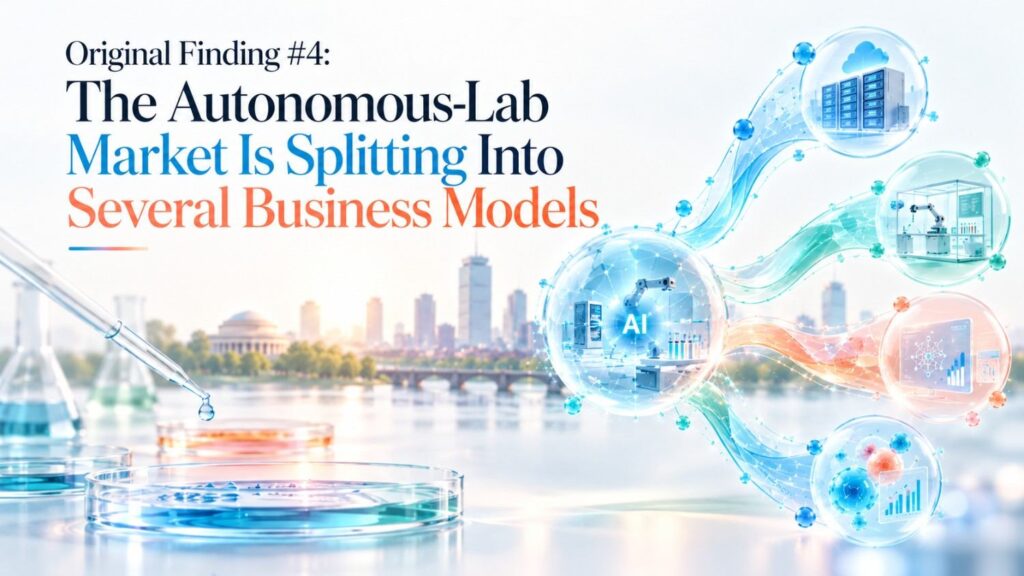
At least four distinct business models are emerging.
| Business model | Boston example | Core value |
|---|---|---|
| Science factory | Lila Sciences | General autonomous scientific discovery |
| Lab infrastructure | Atinary, Ginkgo | Autonomous experimentation platform |
| Vertical discovery engine | Generate, Manifold Bio | Better therapeutics through proprietary loops |
| Research-system innovation | MIT | New autonomous experimental technologies |
This distinction matters for investors and founders.
Trying to build “an autonomous laboratory startup” is too vague.
The better question is: Which layer of autonomous science will the company own?
Infrastructure Companies
Infrastructure companies provide tools that other researchers use.
They may sell orchestration software, robotics, laboratory services, cloud laboratories, integration platforms or entire autonomous systems.
Atinary and Ginkgo increasingly fit this group.
Their opportunity expands if autonomous experimentation becomes a standard part of corporate research.
Vertical Science Companies
Vertical companies do not need to sell laboratory infrastructure.
Their laboratory is the engine behind another product.
Generate is building medicines.
Manifold Bio is developing tissue-targeted therapeutics.
The autonomous or closed-loop system helps them make better products faster.
This resembles Amazon before AWS.
The internal infrastructure itself may be valuable, but the immediate business exists somewhere else.
Science Factory Companies
Lila represents an even broader idea.
Instead of optimizing one drug class or one scientific workflow, the goal is to create a generalized discovery system.
That is harder.
But if successful, the addressable market becomes much larger.
Original Finding #5: Experimental Throughput Is Becoming an AI Metric
AI companies usually talk about model size, computing power, tokens, parameters or inference speed.
Scientific AI introduces another important metric:
How much useful physical evidence can the system generate?
That changes how research organizations should measure infrastructure.
Consider the public examples already coming from Boston-area systems.
| System | Publicly reported scale |
|---|---|
| MIT CRESt | 900+ chemistries explored; 3,500 electrochemical tests |
| MIT autonomous probe | 3,000+ measurements in 24 hours |
| Generate | 42,000+ proteins generated, built and tested |
| Manifold Bio | 50M+ protein designs; 3M+ binders tested in animals |
| Manifold/NVIDIA study | 1M designs tested against 127 targets in one multiplexed experiment |
Sources: MIT, Generate and Manifold Bio.
These numbers measure different scientific activities, so they should not be directly compared as if one experiment equals another.
But the trend is clear.
Scientific competitiveness is starting to depend on the speed at which organizations can move between computation and reality.
A company might generate ten million possible molecules in software.
That sounds impressive.
But if it can experimentally test only 100 of them each year, the experimental system becomes the bottleneck.
The next generation of Boston AI-biotech infrastructure is increasingly being built around fixing that imbalance.
Why Experimental Data Could Become More Valuable Than Model Architecture
AI models are becoming easier to access.
Open models improve.
Cloud AI becomes cheaper.
Algorithms spread quickly through research papers and open-source software.
Physical experimental data behaves differently.
Running experiments takes money.
It requires equipment.
Samples must be prepared.
Scientists must develop reliable procedures.
Biological systems may require weeks or months.
Failures happen.
That difficulty makes experimental data scarce.
And scarcity creates value.
Proprietary Data Can Compound
Suppose two drug-discovery companies start with similar AI models.
Company A runs 1,000 carefully measured experiments per year.
Company B runs 100,000.
If Company B structures the data properly and continually retrains its models, its advantage may grow every year.
Better models select better experiments.
Better experiments create better data.
Better data creates better models.
The value is not any one part.
The value is the loop.
That is why autonomous labs could become central to the economics of scientific AI.
Generate Shows Why the Wet Lab Must Keep Up With Generative AI
Generate sits in Somerville and operates additional laboratory infrastructure in Massachusetts.
Its platform is built around a continuous generate-build-measure-learn process.
Machine learning creates protein sequences. Those proteins are physically produced. Experimental systems measure their properties. The resulting information helps improve the system.
This structure highlights a growing problem across AI-driven science.
Generating ideas has become cheap.
Testing ideas has not.
AI could potentially produce millions of candidate proteins, materials or molecules.
But physical laboratories still have finite throughput.
That means the most valuable infrastructure may move downstream.
Robotics, assay automation, measurement systems, sample handling, experiment scheduling and laboratory software become increasingly important because they determine how much of the AI-generated search space can be tested.
The Bottleneck Moves From Ideas to Verification
For decades, scientists often struggled because they did not know which possibilities to explore.
Generative AI changes that problem.
Soon organizations may have far too many plausible possibilities.
Then the scarce resource becomes experimental truth.
Which molecule actually binds?
Which catalyst actually works?
Which material survives real conditions?
Which protein actually reaches the intended tissue?
Which manufacturing process remains stable?
The laboratory becomes the judge.
Autonomous science is largely about increasing the speed of that judgment.
Manifold Bio Shows Why High-Throughput Experiments Can Be More Important Than Perfect Predictions
Manifold Bio provides another useful Boston example.
The company argues that testing therapeutic proteins only in simplified laboratory systems can miss important behavior that appears inside living organisms.
Its platform combines AI-guided protein design with high-throughput in vivo measurement.
That changes the discovery strategy.
Instead of trying to make a model perfectly predict biology before running experiments, the company can design large candidate sets and obtain physical measurements at unusual scale.
Those results can then improve future models.
This is a powerful lesson for autonomous science.
The goal does not necessarily have to be perfect prediction.
Sometimes the better strategy is to make experimentation so fast and cheap that the system can learn directly from reality.
Original Finding #6: Boston’s Competitive Advantage Is the Density Between AI and Physical Science
Why Boston?
Plenty of cities have AI engineers.
Plenty have universities.
Plenty have biotechnology companies.
Boston’s unusual advantage is the density of several capabilities within the same regional ecosystem.
The area has machine-learning researchers.
It has robotics engineers.
It has world-class biology and chemistry labs.
It has major drug companies.
It has scientific instrument users.
It has hospitals generating clinical insights.
It has MIT and the Broad Institute.
It has startups such as Lila, Generate and Manifold.
It has Ginkgo’s large-scale biological automation infrastructure.
And all of these groups operate within a compact geographic region.
That matters because autonomous science is inherently interdisciplinary.
A software engineer alone cannot build it.
A biologist alone cannot build it.
A robotics engineer alone cannot build it.
The system must integrate all three.
Boston is unusually strong precisely where those disciplines overlap.
The Broad Institute Represents the Important Middle Ground
Not every important lab will become fully autonomous immediately.
The Broad Institute illustrates the middle ground.
Its Center for the Development of Therapeutics lists capabilities including laboratory automation, high-content imaging, phenotypic screening, protein technologies, medicinal chemistry, compound management and data sciences.
That is not enough public evidence to classify the center as a fully autonomous closed-loop lab.
But it contains many of the building blocks.
This is probably how autonomy will spread through large research institutions.
They will not throw away existing labs and install one giant robot.
They will connect automated systems piece by piece.
Data standards improve.
Instrument software becomes easier to control.
AI helps prioritize experiments.
Workflows become machine readable.
Eventually closed loops appear inside specific research programs.
The Biggest Technical Problem May Not Be AI
There is an easy mistake to make when thinking about autonomous labs.
Because AI receives most of the attention, people assume AI is the hardest part.
Often it is not.
Physical systems fail in countless small ways.
Pipette tips clog.
Samples become contaminated.
Liquids behave unexpectedly.
Reagents degrade.
Plates arrive in the wrong orientation.
Robots lose calibration.
Instruments produce inconsistent data.
A camera sees something incorrectly.
An assay stops behaving like it did yesterday.
Software can crash.
That means laboratory reliability becomes a major AI infrastructure problem.
MIT’s CRESt researchers encountered exactly this issue. They found reproducibility problems significant enough that they added cameras and vision-language models to detect possible errors, although humans still performed much of the debugging.
This suggests a major startup opportunity.
Autonomous laboratories need their own version of observability software.
A New Software Category Could Emerge Around Lab Observability
Modern cloud systems have monitoring tools that track failures.
Autonomous laboratories will need something similar.
A useful system could track:
- which instrument performed every action,
- which version of a protocol ran,
- reagent batch information,
- environmental conditions,
- robot errors,
- instrument calibration,
- images of critical steps,
- unexpected deviations,
- model decisions,
- experiment costs,
- and the exact history of every sample.
The long-term objective is not merely automation.
It is scientific traceability.
When an autonomous system makes a surprising discovery, researchers must be able to understand exactly how the result was produced.
That requirement will become especially important in regulated industries such as pharmaceuticals.
What Pharmaceutical Companies Should Do Now
Companies do not need to wait for a completely autonomous laboratory.
A better approach is to close one experimental loop at a time.
Start with a workflow that is repetitive, expensive and scientifically important.
The right first target might be protein screening, assay optimization, formulation, cell-line development, analytical testing or process optimization.
Then measure the complete cycle.

Do not focus only on how quickly a robot completes one physical action.
Measure how long it takes from receiving one result to beginning the next useful experiment.
That is the metric autonomy is trying to improve.
Find the Slowest Handoff
A laboratory may already own expensive robots but still move slowly.
Why?
Because humans manually transfer data from one system into another.
Scientists wait for analysis.
Results sit in spreadsheets.
Meetings are needed to choose the next experiment.
Someone manually programs the next machine.
The real bottleneck is often not experiment execution.
It is the handoff between measurement and decision.
Organizations should map that process carefully.
A Practical Autonomous-Lab KPI Dashboard
Research leaders should track more than experimental throughput.
| Metric | Why it matters |
|---|---|
| Experiment cycle time | Measures how quickly learning becomes another experiment |
| Experiments per scientist | Shows leverage from automation |
| Machine utilization | Reveals expensive unused equipment |
| Human interventions per run | Measures true autonomy |
| Failure/recovery rate | Shows system reliability |
| Cost per useful data point | Connects automation to economics |
| Percentage of structured data | Measures AI readiness |
| Time from result to next experiment | Measures loop speed |
| Reproducibility rate | Protects scientific quality |
| Model improvement per experiment | Measures whether the loop actually learns |
One metric deserves special attention:
Time From Result to Next Experiment
Imagine two laboratories.
Lab A finishes an experiment Monday morning but waits until Friday for scientists to review the results and schedule the next experiment.
Lab B automatically analyzes Monday’s result and launches the next high-value test that afternoon.
Even if both labs own identical robots, Lab B is operating on a completely different learning curve.
That is the economic promise of autonomous science.
What Boston Startups Should Build Around the Autonomous-Lab Boom
Not every startup should try to build an entire science factory.
The ecosystem will need dozens of supporting technologies.
Instrument connectors are one opportunity.
Laboratory scheduling is another.
Data infrastructure matters.
Robot monitoring matters.
Experiment provenance matters.
Quality-control software matters.
AI systems that detect failed experiments matter.
Simulation tools matter.
Automated sample logistics matter.
Software for converting scientific intent into machine-executable protocols matters.
Security will matter as well.
The opportunity looks less like one autonomous-lab market and more like a new scientific computing stack.
The Autonomous Science Stack
| Layer | Function |
|---|---|
| Scientific AI | Creates hypotheses and experimental options |
| Experiment planner | Chooses the highest-value next experiment |
| Orchestration layer | Translates plans into machine instructions |
| Robotics | Performs physical actions |
| Instruments | Measure physical results |
| Data layer | Stores structured experimental information |
| Evaluation layer | Determines whether results are trustworthy |
| Learning layer | Improves models and future experiment selection |
| Governance layer | Controls permissions, safety and traceability |
Boston has companies and research groups working across many of these layers.
That is why the regional opportunity could become much larger than individual biotech startups.
The Talent Market Will Change
Autonomous laboratories also change what a valuable scientist looks like.
Companies will still need biologists, chemists and materials scientists.
But scientists who can work across physical and computational systems will become increasingly important.
A researcher who understands experiments, data structures and automation may become more valuable than someone who is excellent at only one repetitive laboratory technique.
Likewise, software engineers entering scientific companies will need to understand that laboratories behave differently from traditional software systems.
The physical world is noisy.
Experiments fail.
Inputs vary.
Sensors drift.
Living systems behave unpredictably.
The strongest autonomous-science teams will therefore mix scientific judgment with engineering discipline.
Humans Will Move Up the Scientific Stack
The simplistic version of the autonomous-lab story is that robots replace researchers.
The more realistic version is that researchers spend less time on repetitive execution.
Scientists should increasingly focus on:
choosing valuable questions, defining constraints, interpreting surprising evidence, designing entirely new experiments, deciding when models are wrong and connecting discoveries with real-world problems.
That could make scientific work more creative rather than less.
MIT’s robotic optics researchers described a similar goal: machines can perform repetitive, precise laboratory work continuously while researchers spend more time developing ideas.
The Business Case Must Eventually Be About Economics
Autonomous laboratories will not win simply because they look futuristic.
The systems are expensive.
Robotics costs money.
Facilities cost money.
Highly skilled engineers cost money.
Scientific instruments can cost hundreds of thousands or millions of dollars.
The business case therefore has to be measurable.
For a pharmaceutical company, the question is not:
“Do we have an autonomous lab?”
The useful question is:
“Did the system help us reach a high-confidence drug candidate faster and with less wasted experimentation?”
For a materials company:
“Did we identify a commercially useful formulation faster?”
For a manufacturing company:
“Did optimization reduce development cost or improve yield?”
Scientific autonomy becomes valuable when it changes those outcomes.
A 90-Day Plan for Companies Exploring Autonomous Science
Companies should resist the temptation to begin by buying robots.
Begin with the workflow.
Days 1–30: Map the Experiment Loop
Choose one high-value experimental process.
Document every step from hypothesis to result.
Measure waiting time.
Identify manual data transfers.
Find repetitive actions.
Record failure points.
Determine how decisions about the next experiment are currently made.
Days 31–60: Make the Workflow Machine Readable
Standardize experimental inputs.
Structure the outputs.
Connect instrument data to central storage.
Create reliable metadata.
Track every sample.
Define which decisions could be made algorithmically and which require human approval.
This step may create more value than buying another piece of equipment.
Days 61–90: Close One Small Loop
Select a narrow optimization problem.
Allow software to recommend the next experiment.
Use existing automation where possible.
Return results directly to the model.
Keep a scientist supervising the process.
Measure whether the loop increases learning speed.
If it works, expand carefully.
That approach is much safer than attempting full autonomy immediately.
The Biggest Risk Is Automating Bad Science Faster
Autonomous laboratories can increase experimental speed.
That does not guarantee better science.
If the objective is badly defined, the system may optimize the wrong thing extremely efficiently.
If measurements contain bias, the model may learn the bias.
If data quality is poor, automation can produce enormous amounts of poor data.
If researchers misunderstand a biological mechanism, the system can explore an irrelevant search space very quickly.
Automation multiplies both good systems and bad systems.
That makes experimental design, quality control and human oversight more important.
Not less.
Reproducibility Could Become One of Autonomous Science’s Biggest Benefits
There is another side to this problem.
Well-designed autonomous systems could improve reproducibility.
Machines can record each action.
They can use standardized protocols.
Sensors can monitor conditions.
Software can capture instrument settings automatically.
Unexpected deviations can be logged.
That can create a far richer scientific record than a traditional notebook.
If Boston’s autonomous science companies solve this properly, reproducibility could become one of the strongest arguments for machine-directed experimentation.
Original Finding #7: Boston Is Developing an Autonomous-Science Ecosystem, Not One Autonomous-Lab Category
Our ten-system review shows something broader than the rise of a single technology.
Boston is developing several different forms of machine-assisted science at once.
Some systems create hypotheses.
Some optimize experiments.
Some run robots.
Some produce massive biological datasets.
Some automate measurement.
Some provide general infrastructure.
Some operate vertically inside drug companies.
Some come from university research.
That diversity is strategically important.
A healthy ecosystem does not require one company to solve every layer.
It requires enough organizations working on different pieces that the pieces begin to connect.
Boston increasingly has that.
What Could Happen Over the Next Three Years
The first big shift will probably be from isolated autonomous experiments to reusable platforms.
Today, many impressive demonstrations remain heavily customized.
Researchers spend enormous effort integrating one workflow.
For autonomous science to scale commercially, new experiments must become easier to add.
That means modular hardware.
Standard APIs.
Better scientific data formats.
More reliable instrument control.
Reusable protocol libraries.
AI that understands the capabilities and limits of physical equipment.
Remote Science Could Grow Quickly
Cloud laboratories already allow researchers to submit experiments remotely.
Autonomous systems could push this much further.
A scientist might eventually describe an objective rather than a detailed protocol.
The platform could translate that objective into experiments, schedule instruments, execute the work and return structured evidence.
That could allow small startups to access laboratory capabilities that once required tens of millions of dollars of infrastructure.
Scientific AI Agents Could Become Laboratory Users
AI agents currently operate mostly inside software.
They search databases, write code and analyze information.
The next step is giving them controlled access to physical experiments.
That creates an entirely different kind of agent.
Instead of only reasoning about the world, it can request measurements from the world.
Boston’s autonomous labs are early infrastructure for that transition.
Physical Experimentation Could Become an API
The long-term endpoint may look surprisingly familiar to software developers.
A researcher requests:
“Test these 200 protein variants under these conditions.”
The scientific platform handles scheduling, robotics, instrumentation, data capture and quality checks.
The results return in structured form.
Eventually the interface could move higher:
“Find a protein that satisfies these properties.”
Now the platform determines which experiments to run.
That is when the lab starts moving from automation toward genuine autonomous discovery.
Why Boston Could Become One of the World’s Most Important Autonomous Science Clusters
Boston already has one of the world’s strongest concentrations of biological research.
But autonomous science requires more than biology.
It requires robotics.
AI.
Engineering.
Laboratory infrastructure.
Scientific instruments.
Capital.
Large industrial customers.
And researchers comfortable working across disciplines.
Boston has unusually deep capabilities in all of them.
More importantly, these capabilities are beginning to connect.
MIT is building experimental systems that demonstrate what is technically possible.
Lila is attempting to turn autonomous science into a large commercial platform.
Atinary is operating self-driving laboratory infrastructure in Boston.
Ginkgo is trying to scale autonomous biology beyond one facility.
Generate is connecting generative models with real experimental cycles.
Manifold is pushing physical validation toward the scale of computational design.
The Broad Institute and the region’s pharmaceutical industry provide another enormous base of scientific workflows that could gradually become more automated.
The result is not simply another AI startup cluster.
It could become a new type of scientific industrial base.
Final Takeaway: The Laboratory Is Becoming Part of the AI System
The most important idea behind autonomous labs is easy to miss.
AI for science started with models.
The next stage is about systems.
A model generates a hypothesis.
Software chooses an experiment.
Machines interact with the physical world.
Instruments measure what actually happened.
The result returns to the model.
Then the cycle starts again.
The faster and more reliable that loop becomes, the faster an organization can learn.
Boston is unusually well positioned for this shift because the city already has the pieces required to build that loop: world-class science, biotechnology, robotics, software, AI, laboratories, research hospitals, venture capital and a deep pool of technical talent.
Our analysis of ten publicly visible Boston-area platforms and research systems found that six already show clear evidence of the four basic stages of a scientific feedback loop, while three are explicitly being developed or operated as broad autonomous or self-driving laboratory infrastructure.
Those numbers should not be interpreted as proof that the fully autonomous scientist has arrived.
It has not.
Researchers remain deeply involved. Current systems are narrow. Physical experiments are difficult. Reliability remains a major challenge.
But the direction is becoming difficult to ignore.
Boston is moving from AI that studies scientific data toward AI that helps create scientific data.
That may ultimately prove to be the more important shift.
Because the strongest scientific AI system will not simply know what humanity has already discovered.
It will have a way to ask the physical world what is true next.