


Boston has spent years building better ways to discover drugs. The next big opportunity may be less glamorous but just as important: building better ways to test them.
A drug can look brilliant in a laboratory and still fail because the clinical study around it was poorly designed. The wrong patients may be recruited. The eligibility rules may be too narrow. Sites may struggle to find enough participants. The chosen endpoint may not clearly show whether the drug works. Researchers may discover halfway through the study that parts of the protocol need to change.
These are not small operational problems. They can determine whether hundreds of millions of dollars and years of scientific work eventually create an approved medicine.
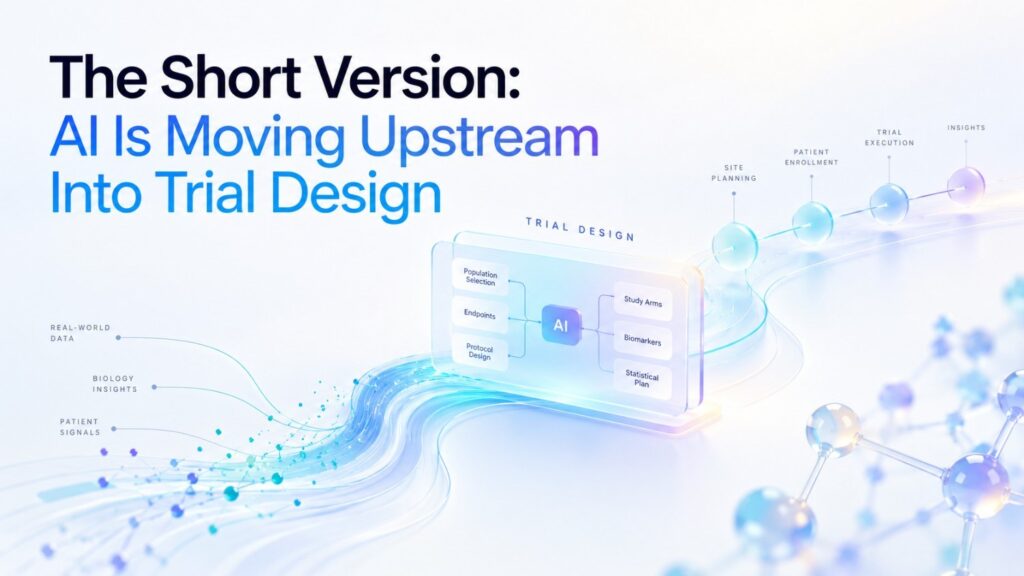
That is why artificial intelligence is beginning to move upstream in clinical development. Instead of using AI only to find trial participants after a study has already been designed, companies are starting to use data, machine learning, simulation, and automated reasoning before the protocol is locked.
The goal is simple: design the right study before spending years running the wrong one.
Boston is particularly well positioned for this shift. The region combines biotech companies, hospitals, medical researchers, clinical data companies, AI startups, statisticians, regulators, and one of the world’s most established centers for studying clinical development itself.
The result could be a new phase in Boston’s biotech story.
The city may increasingly compete not only on who can discover the best molecule, protein, gene therapy, or RNA medicine, but on who can build the smartest possible experiment around it.
The Short Version: AI Is Moving Upstream Into Trial Design
The most important change happening in AI-powered clinical development is easy to miss.
A lot of attention has focused on patient recruitment. That makes sense. Finding enough eligible patients is one of the hardest parts of running many studies.
But recruitment is partly determined by decisions made months earlier.
A clinical team writes dozens of inclusion and exclusion rules. It decides what disease stages qualify. It selects biomarkers. It chooses endpoints. It estimates enrollment rates. It selects countries. It picks sites. It decides how often patients must visit. It determines how large the trial should be.
Each decision changes the group of patients who can realistically join the study.
Design a protocol badly and AI-powered recruitment can only fix so much.
Design it intelligently from the beginning and the entire development program can become easier to run.
Cambridge-based ConcertAI provides a useful example. The company says its clinical development tools use real-world oncology data to test patient cohorts, study feasibility, patient selection, and trial design. ConcertAI says its systems work with more than 13 million de-identified patient records and claims its design technology can reduce study-design time and help lower amendment risk. Those are company-reported claims rather than independent guarantees, but they illustrate where the market is going.
Boston-based PathAI is pushing intelligence into another important part of study design: endpoints. In February 2026, the company announced new AI-powered pathology tools designed to be integrated into inflammatory bowel disease trials as standardized histopathology endpoints.
Meanwhile, regulators are creating a clearer framework for many of the techniques that could support smarter studies. FDA guidance now covers adaptive designs, decentralized trial elements, externally controlled trials, structured electronic protocols, wider participation, master protocols, Bayesian methods, and the use of AI in drug development.
These developments point toward a larger change.
Clinical trial design is gradually becoming a computational problem as well as a medical and statistical one.
Why Clinical Trial Design Has Become So Hard
Before discussing AI, it is important to understand the problem it is trying to solve.
Modern drug trials contain far more moving parts than many people outside the industry realize.
A protocol may contain dozens of patient requirements, many clinical measurements, laboratory tests, imaging procedures, safety checks, visits, secondary endpoints, exploratory endpoints, and data collection rules.
Each item sounds reasonable when viewed separately.
Together, they can create a study that is extremely difficult to run.
Boston Already Has Some of the Best Evidence on This Problem
One of the most useful sources of evidence comes from the Tufts Center for the Study of Drug Development.
Tufts CSDD has studied clinical development processes for decades. Its research databases track variables including endpoints, eligibility rules, investigative sites, patients screened, enrollment, amendments, recruitment rates, dropout rates, data volume, study duration, and cost.
Its findings repeatedly show that clinical trial protocols have become more complex.
A Tufts CSDD analysis of 187 protocols from 20 pharmaceutical companies and contract research organizations found a continuing upward trend in protocol design complexity. Phase II and Phase III studies had more endpoints, eligibility criteria, protocol pages, sites, countries, and data collection requirements. Oncology and rare-disease trials were especially difficult to execute.
Tufts’ 2025 and 2026 research agenda shows the issue has not disappeared. Its November/December 2025 report again highlighted rising protocol complexity, while a July/August 2026 report said roughly one-third of protocol data volume supported non-core endpoints or information judged non-essential.
That second finding should receive much more attention.
If a meaningful share of the information collected in trials does not directly support the most important questions, then part of the clinical-development problem is not lack of data.
It is lack of focus.
Original BostonBizScene Analysis: What Current Boston Trials Tell Us About Study Design
To understand how this issue appears inside Boston’s biotech ecosystem, BostonBizScene reviewed a directional sample of publicly available clinical trial records from companies headquartered or strongly based in the Greater Boston biotechnology cluster.
The purpose was not to rank the companies or judge whether one study design is better than another. Different diseases require very different trial structures.
Instead, we wanted to answer a simpler question:
What kinds of design problems are Boston drug developers actually dealing with?
Our Methodology
We reviewed public ClinicalTrials.gov records and, where available, public protocol or statistical-analysis documents associated with programs from Boston-area companies including Moderna, Vertex Pharmaceuticals, Intellia Therapeutics, Alnylam Pharmaceuticals, Sarepta Therapeutics, Scholar Rock, and Dyne Therapeutics.
The sample intentionally covers different therapeutic technologies rather than trying to measure every Boston clinical trial.
We looked for five design signals:
| Design signal | What we looked for |
|---|---|
| Precision population | Genetic, molecular, serological, disease-stage, or treatment-history criteria defining who enters |
| Controlled comparison | Randomization, placebo, active comparator, or other formal comparison |
| Multi-stage structure | Dose escalation, multiple parts, extensions, staged cohorts, or dose selection |
| Specialized endpoint | Biomarker, imaging, pathology, molecular, functional, or disease-specific measurement |
| Operational complexity | Large site networks, rare populations, lengthy follow-up, or highly specific eligibility |
This is a BostonBizScene editorial analysis of public records, not a clinical or regulatory assessment. It should therefore be read as a map of design complexity rather than proof that any specific company used AI to create its protocol.
What We Found
The sample contained very different medicines, yet the same theme appeared repeatedly: successful clinical development increasingly requires matching a specific therapy to a very specific population and measurement system.
| Boston-area sponsor | Example trial | Publicly visible design signal |
|---|---|---|
| Intellia Therapeutics | MAGNITUDE, NCT06128629 | Phase III study of in-vivo gene editing in ATTR cardiomyopathy |
| Intellia Therapeutics | HAELO, NCT06634420 | Approximately 60 participants, randomized 2:1 against placebo |
| Alnylam Pharmaceuticals | KARDIA-3, NCT06272487 | Phase II, randomized, double-blind study in inadequately controlled hypertension |
| Alnylam Pharmaceuticals | ALN-AGT01 RVR study, NCT07553442 | Two-part Phase II design with dose-ranging component |
| Vertex Pharmaceuticals | VX-264, NCT05791201 | Phase I/II, small population, multi-part endpoint strategy |
| Vertex Pharmaceuticals | Vanzacaftor combination program | CF population divided using CFTR mutation profiles |
| Moderna | CMV Phase III, NCT05085366 | 7,454 participants; randomized, observer-blind, placebo-controlled; serostatus important |
| Moderna | mRNA-1283 Phase III, NCT05815498 | Randomized, observer-blind, active-controlled vaccine comparison |
| Scholar Rock | SAPPHIRE, NCT05156320 | Phase III, double-blind, placebo-controlled SMA study on background therapy |
| Dyne Therapeutics | DELIVER, NCT05524883 | Randomized dose study focused on DMD patients amenable to exon 51 skipping |
| Sarepta Therapeutics | MIS51ON, NCT03992430 | Dose escalation followed by dose comparison in genetically defined DMD |
| Sarepta Therapeutics | ENVISION, NCT05881408 | Gene-transfer study spanning ambulatory and non-ambulatory DMD populations |
The underlying records illustrate the range of modern trial-design problems faced by Boston biotechs.
The important lesson is not that every study should become adaptive or AI-designed.
It is that trial design increasingly involves more interacting variables.
That creates a natural opening for computational tools.
Original Finding #1: Patient Selection Is Becoming a Design Problem, Not Just a Recruitment Problem
One of the biggest mistakes in clinical development is treating patient recruitment as something that begins after the protocol is complete.
In reality, recruitment begins while the eligibility rules are being written.
Suppose a company has 50,000 patients in the United States who technically have the disease it wants to treat.
That number can collapse surprisingly fast.
Perhaps only 60% have the required disease stage. Of those, 50% use the required background therapy. Of those, 40% fit the age limits. Of those, 50% meet laboratory requirements. Of those, 40% live close enough to a study site.
The theoretical 50,000-patient market has now become roughly 1,200 candidates before other exclusions are considered.
That is why simple disease prevalence is a poor enrollment forecast.
AI Can Model the Eligibility Funnel Before the Trial Begins
This is one of the most practical uses of real-world clinical data.
Instead of writing eligibility criteria based mainly on precedent and expert opinion, teams can test them against patient-level datasets.
What happens if an age limit moves from 65 to 70?
What happens if one laboratory threshold is relaxed?
How many additional patients become eligible if a prior-treatment restriction changes?
Does removing one exclusion rule double the candidate population without harming the scientific question?
These questions can be modeled before protocol lock.
ConcertAI publicly describes this approach in oncology. Its system converts protocol criteria into real-world cohorts so developers can test feasibility and patient selection against clinical datasets. The company says AI can also compare a proposed study with similar trials and identify relevant design characteristics much faster than manual review.
This is a much bigger opportunity than simply matching patients to an already finalized trial.
It changes the design itself.
Original Finding #2: Boston’s Precision-Medicine Strength Makes Trial Design Harder
Boston has spent years moving toward precision medicine.
That is scientifically powerful.
It can also make clinical development much harder.
A conventional drug may target a broad disease population. A gene therapy, RNA medicine, cell therapy, or targeted cancer drug can require a much narrower population.
Dyne’s DYNE-251 program, for example, focuses on patients with Duchenne muscular dystrophy who are amenable to exon 51 skipping. Vertex’s cystic fibrosis development programs divide patients using CFTR mutation profiles. Moderna’s CMV Phase III study distinguished participants partly through CMV serostatus.
Every additional biological filter can improve scientific precision while shrinking the available trial population.
That creates a basic tension.
Researchers want homogeneous populations because cleaner groups can make treatment effects easier to detect.
But operational teams need enough real patients to finish the study.
AI is useful because it can help quantify that trade-off before enrollment begins.
Why Narrower Is Not Always Smarter
Precision medicine does not automatically mean more exclusions are better.
An eligibility rule should exist because it protects participants, strengthens the scientific question, or supports interpretable results.
If a rule does none of those things, it may simply reduce enrollment.
FDA’s December 2025 guidance on clinical trial participation encourages sponsors to consider broader study populations where appropriate, including people with different ages, comorbidities, disabilities, organ function, and other characteristics that may better reflect the eventual treatment population.
This creates another useful role for AI.
A model can estimate the cost of each eligibility decision.

Instead of debating whether a rule “seems reasonable,” teams can ask how many patients it excludes and what scientific benefit it creates.
That changes the discussion.
Original Finding #3: The Best AI Opportunity May Come Before Protocol Lock
The most valuable AI system in clinical development may not be the one that finds patients fastest.
It may be the one that prevents a bad protocol from being approved internally.
A protocol amendment sounds administrative.
It is not.
Changing a study after launch can require new documents, site training, regulatory submissions, ethics approvals, database changes, patient communication, new contracts, and operational work across many countries.
The deeper problem is lost time.
Tufts CSDD has studied protocol amendments for years and continues to report rising amendment prevalence across development phases. Its research also connects greater design complexity with poorer clinical trial performance.
That makes protocol simulation extremely attractive.
Imagine a “Digital Stress Test” for a Clinical Trial
Before approving a protocol, a development team could simulate thousands of possible situations.
What if enrollment is 30% slower than expected?
What if one biomarker requirement removes half of otherwise suitable patients?
What if competing trials open at the same hospitals?
What if dropout is higher among patients who must make frequent visits?
What if one endpoint has greater measurement variation than assumed?
What if one dose performs much better than the others?
What if a major country opens six months late?
Today, many of these questions are addressed through experience, spreadsheets, statistical modeling, and discussions between specialists.
AI does not need to replace that process.
Its value is making far more scenarios cheap enough to test.
What AI-Powered Trial Design Actually Looks Like
“AI clinical trial design” sounds futuristic, but most useful applications are surprisingly practical.
They can be grouped into several areas.
Eligibility Design
AI can analyze historical patient data and estimate how proposed inclusion and exclusion criteria affect the available population.
The output is not simply “good” or “bad.”
A useful system should show the trade-off.
For example:
| Proposed change | Possible design effect |
|---|---|
| Tighten biomarker threshold | Cleaner biological population but fewer eligible patients |
| Broaden age range | Larger recruitment pool and potentially more representative population |
| Require prior treatment | More consistent population but narrower pool |
| Remove unnecessary lab cutoff | More candidates without necessarily weakening study |
| Increase visit requirements | More data but higher participant burden |
That gives clinical teams a more quantitative way to debate protocol choices.
Endpoint Selection
AI can also help analyze endpoints.
For many diseases, the hardest question is not simply whether the therapy has biological activity.
It is deciding how that activity should be measured.
Endpoints can include survival, disease progression, laboratory values, imaging, pathology, patient-reported outcomes, physical performance, biomarkers, digital measurements, or combinations of several measures.
PathAI’s recent work shows why Boston may be important here.
The company is developing AI-powered pathology measurements that can be incorporated into clinical studies. In inflammatory bowel disease, it says its tools are intended to produce standardized and reproducible histopathology endpoints.
That is important because measurement noise increases the number of participants needed to confidently detect an effect.
Better measurement can therefore improve trial economics.
Better Measurement May Matter as Much as Better Molecules
Consider two hypothetical drugs with exactly the same biological effect.
Trial A uses an endpoint with high measurement variation.
Trial B uses an endpoint with much more consistent measurement.
Trial B may have a better chance of clearly showing the treatment effect even though the underlying drug is identical.
This is why AI pathology, imaging analysis, digital biomarkers, and automated data interpretation could become strategic technologies rather than simple research tools.
They can change how evidence is generated.
Site Selection Is Becoming a Data Science Problem
A sponsor may activate 100 clinical sites and discover that a relatively small number recruit most of the patients.
That is expensive.
Each site requires contracts, training, systems, monitoring, communication, and support.
A site that enrolls almost nobody still consumes resources.
Traditional site selection often relies heavily on investigator history, surveys, relationships, previous studies, and estimates provided by the sites themselves.
AI provides another layer.
Instead of asking only whether a hospital says it has eligible patients, developers can examine signals such as historical disease populations, treatment patterns, referral networks, competing studies, enrollment history, geographic access, and patient characteristics.
ConcertAI says its site-selection tools use real-world clinical data and predictive AI to identify higher-performing sites. The company reports that its technology can reduce nonproductive sites and shorten site activation periods, although those figures are company claims and outcomes will differ between studies.
The core idea matters even without accepting any specific performance claim.
Site selection is moving from reputation-based planning toward evidence-based forecasting.
Original Finding #4: Study Design and Recruitment Are Converging
Historically, protocol design and clinical operations could feel like separate stages.
Scientists and statisticians designed the study.
Operations teams then attempted to run it.
That separation makes less sense when patient-level data can be used before the design is finalized.
The same dataset used to find eligible patients later can help estimate the size of the eligible population now.
The same data used to rank trial sites can reveal whether the proposed criteria are realistic.
The same historical clinical records used to create external comparator cohorts can show how disease progression looks before the trial begins.
The feedback loop becomes:
Design → test against real-world data → identify operational problems → revise design → simulate again → lock protocol → recruit
That is very different from:
Design → lock protocol → discover problems during recruitment
For Boston biotech leaders, the first model should become the default whenever suitable data are available.
Adaptive Trials Are Becoming More Important
Traditional clinical trials often follow a fixed design.
Researchers decide the sample size, treatment groups, doses, and analysis plan before enrollment starts. The study then follows that plan until completion.
Adaptive trials allow certain predetermined changes based on accumulating information.
The key word is predetermined.
A proper adaptive design does not mean changing the rules whenever researchers dislike the results.
The possible changes and decision rules are planned before the relevant data are examined.
FDA’s adaptive-design guidance explains that trials may use interim information while protecting the reliability and interpretability of the final results. A September 2025 ICH E20 draft guidance further moved toward internationally harmonized principles for adaptive clinical trials.
What Can Adapt?
Depending on the study, adaptation can potentially involve elements such as sample size, dose selection, treatment arms, enrollment allocation, or stopping a study early for success or futility.
The design must still control statistical errors and protect trial integrity.
This is exactly where simulation becomes essential.
Teams may need to run thousands or millions of virtual trials to understand how the decision rules behave under different assumptions.
That creates an obvious role for computational tools.
Bayesian Methods Are Moving Closer to the Mainstream
Bayesian statistics can sound intimidating, but the basic idea is straightforward.
Instead of examining each piece of evidence as though nothing was known before the trial, Bayesian methods can formally combine existing information with newly collected data.
That can be especially useful in rare diseases, small populations, adaptive designs, and other areas where every participant matters.
FDA published draft guidance on Bayesian methodology for drug and biological-product trials in January 2026. It specifically discusses applications including interim analysis, adaptive designs, dose selection, and primary inference.
The timing matters for Boston.
The region has an unusually large number of companies working on rare diseases, genetic diseases, targeted medicines, RNA therapeutics, gene editing, and cell therapies.
These are exactly the areas where conventional huge trial populations may be impossible.

Better statistical design is therefore not an academic luxury.
It can determine whether the program is feasible at all.
External Controls Could Change Some Studies
Imagine a rare genetic disease with only several hundred realistically accessible patients.
Randomizing half of them into a placebo group may be difficult, slow, or ethically complicated.
One possibility is to use information from patients outside the new trial as part of the comparison.
These may come from previous clinical studies, patient registries, electronic health records, or other real-world sources.
FDA has published guidance explaining considerations around externally controlled trials and the risks of bias that must be addressed.
External controls are not an easy shortcut.
The treated and untreated groups must be meaningfully comparable. Data quality needs to be strong. Outcomes need to be measured consistently. Confounding factors must be considered.
AI cannot make weak data magically reliable.
But it can help analyze large patient datasets, identify comparable populations, extract variables, and test different matching methods.
That makes external controls another area where AI and modern trial design increasingly overlap.
Real-World Data Is Becoming Part of the Design Toolkit
The phrase “real-world data” often gets misunderstood.
It does not mean informal evidence.
It refers to health information generated outside traditional controlled research settings, including electronic health records, insurance claims, disease registries, and routine clinical-care data.
The opportunity is not simply to use real-world data after a drug launches.
It can help developers understand the disease before designing the pivotal trial.
What treatments do patients currently receive?
How quickly does the disease progress?
Which tests are commonly performed?
Where are patients treated?
How often do they switch therapy?
What outcomes appear in routine care?
How many patients actually satisfy a proposed set of trial requirements?
Answering these questions can prevent a clinical team from designing a protocol around an imaginary patient population.
Boston Has an Unusual Real-World Data Advantage
This is where the region’s health system becomes strategically important.
Boston has major academic medical centers, biotechnology companies, health-data businesses, pathology companies, AI developers, research institutes, and a dense clinical-science workforce within a relatively small geographic area.
That density matters.
Clinical AI improves when software teams understand how clinical decisions are actually made.
Statistical models improve when statisticians work closely with physicians.
Biomarker strategies improve when drug developers, diagnostic companies, pathologists, and researchers communicate early.
Boston already contains those groups.
The harder task is connecting them.
ConcertAI Shows Where the Commercial Layer Is Going
Cambridge-based ConcertAI is one of the clearest local examples of AI moving across the clinical-development workflow.
Its offerings combine real-world oncology data with clinical-development tools for cohort design, trial feasibility, patient matching, site selection, recruitment, and monitoring.
In May 2026, ConcertAI announced AI-powered trial-matching enhancements to its CancerLinQ platform and said the system works with a real-world base of more than 13 million de-identified patient records. The company reported that its new capabilities identified trial-eligible patients 3.3 times faster in its measurements.
Again, company performance claims should not be interpreted as universal results.
The more important point is architectural.
One data layer can increasingly influence several decisions:
patient selection,
protocol feasibility,
site selection,
trial matching,
recruitment,
and operational monitoring.
That is a more powerful model than deploying a separate AI tool for every individual task.
PathAI Shows Why Trial Endpoints Are Becoming Software
Boston’s PathAI represents a different piece of the stack.
Pathology has traditionally depended heavily on human visual interpretation.
Expert pathologists remain essential, but AI can help standardize measurement across large numbers of tissue samples.
In a clinical trial, consistency matters.
If an endpoint depends on interpreting tissue samples, variation between readers can introduce noise.
PathAI’s 2026 inflammatory bowel disease announcement shows how AI-generated pathology scores can be built directly into the clinical trial workflow.
The long-term implication is significant.
Some endpoints that previously existed mainly as human assessments may increasingly become human-plus-software measurements.
That changes what is possible in trial design.
Original Finding #5: Boston’s Biggest Opportunity May Be the Feedback Loop
The most valuable clinical-trial company of the future may not sell a single AI application.
It may create a learning system.
Consider what happens across ten clinical programs.
A biotech company learns which eligibility rules created screen failures.
It learns which sites consistently met enrollment forecasts.
It learns which biomarkers predicted response.
It learns which assessments created missing data.
It learns which procedures caused patients to drop out.
It learns where amendments happened.
It learns which countries opened late.
It learns how actual control groups behaved compared with assumptions.
Most companies already collect much of this information.
The strategic question is whether the information becomes reusable knowledge.
If every new study starts with disconnected spreadsheets, documents, vendor systems, and institutional memory, the organization keeps paying to relearn the same lessons.
AI becomes far more useful when the company’s historical development experience is structured and searchable.
The Clinical Protocol Is Becoming Machine-Readable
One regulatory change in 2026 deserves far more attention from software companies.
FDA issued the final M11 Clinical Electronic Structured Harmonised Protocol guidance in May 2026. It provides a harmonized protocol template plus technical specifications and standardized fields intended to make clinical protocol information easier to exchange electronically.
This sounds like document standardization.
It could become something much larger.
When protocols are represented in standardized, structured formats, software can reason across them more easily.
AI systems can potentially compare eligibility rules.
They can identify inconsistencies.
They can map endpoints.
They can compare visit schedules.
They can search historical designs.
They can detect missing information.
They can model changes.
They can connect protocol requirements with real-world datasets.
The protocol begins to move from being primarily a document toward becoming structured executable information.
That could be a major foundation for the next generation of clinical-development software.
Why Generative AI Alone Is Not Enough
It is tempting to imagine giving a chatbot the name of a disease and asking it to design a Phase III trial.
That would be a dangerous misunderstanding of the opportunity.
Clinical trials are high-stakes scientific experiments.
The system needs more than language generation.
A serious trial-design platform needs access to reliable clinical data, previous protocols, statistical models, regulatory knowledge, disease-specific expertise, patient information, operational benchmarks, and clear audit trails.
It also needs humans.
The physician understands disease reality.
The statistician understands inference.
The regulatory expert understands what agencies require.
The operations team understands what sites can execute.
The patient understands what participation actually demands.
AI should connect those perspectives rather than pretend to replace them.
FDA Is Signaling the Same Thing
FDA’s January 2025 draft guidance on using AI to support regulatory decision-making introduced a risk-based credibility framework.
The key concept is context of use.
An AI model cannot simply be declared “accurate.”
Its credibility has to be judged in relation to the specific job it is performing.
A model helping researchers search historical protocols creates a very different level of risk from a model producing information that becomes critical evidence for whether a drug is safe or effective.
FDA and the European Medicines Agency later published ten principles of good AI practice in drug development, covering areas including human-centric design, risk-based methods, data governance, documentation, model performance, lifecycle management, and clear context of use.
For Boston startups, that creates a clear product lesson.
Trust infrastructure matters.
The Best Clinical AI Products Will Show Their Work
A black-box recommendation is not enough.
If software recommends removing an exclusion criterion, the clinical team should be able to understand why.
If it predicts a site will enroll 18 patients, teams should know which variables influenced the estimate.
If it creates a synthetic comparison group, researchers should understand how patients were selected.
If it recommends changing an endpoint, the evidence should be visible.
Useful systems should therefore provide traceability.
The user should be able to move from:
recommendation
to:
data
to:
assumption
to:
method
to:
result
That may sound less exciting than a fully autonomous AI scientist.
It is far more likely to be trusted inside real development programs.
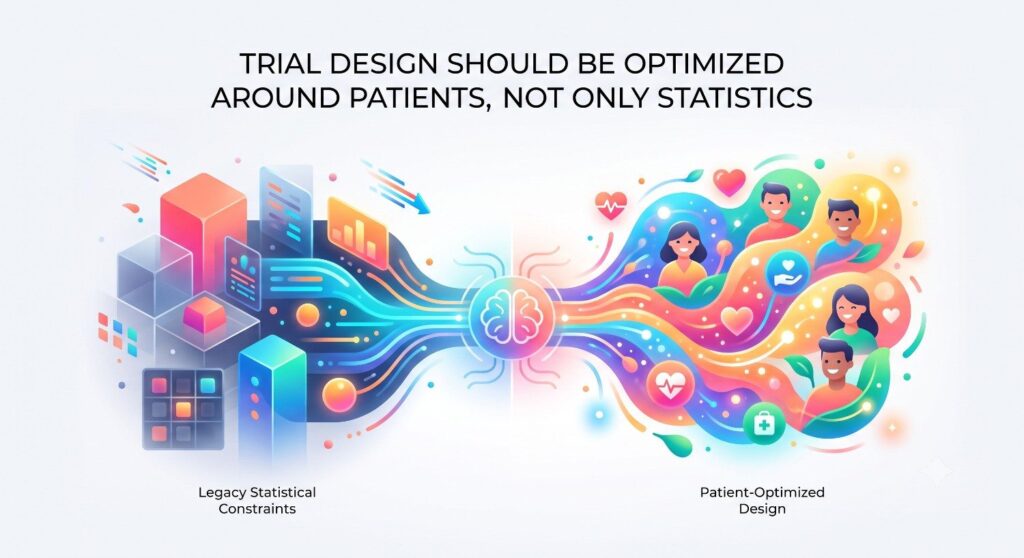
Trial Design Should Be Optimized Around Patients, Not Only Statistics
A statistically elegant study can still be a terrible experience for the person participating in it.
Patients may need to travel several hours.
They may need to miss work.
Parents may need childcare.
Some procedures may be painful.
Visits may happen too frequently.
The study may require assessments that add little scientific value.
Every extra demand creates friction.
That friction can eventually become missing visits, missed procedures, dropout, or failure to enroll.
FDA’s guidance on decentralized clinical-trial elements supports tools such as telehealth, local healthcare visits, and in-home trial activities where appropriate. The goal includes reducing participant burden and expanding access.
This is another area where design intelligence matters.
Instead of asking only, “How much data can we collect?”, sponsors should ask, “What is the minimum participant burden required to answer the scientific question well?”
Those are very different questions.
Original Finding #6: Complexity Should Become a Measured KPI
Biotech teams measure enrollment.
They measure spending.
They measure timelines.
They measure site activation.
Protocol complexity itself should receive the same attention.
A company could create an internal complexity score using factors such as:
| Variable | Why it matters |
|---|---|
| Number of eligibility criteria | More rules can reduce the candidate population |
| Number of patient visits | More visits increase participant burden |
| Number of procedures | More procedures increase cost and workload |
| Number of endpoints | More endpoints increase data collection and analysis |
| Number of countries | More geographies add operational complexity |
| Number of sites | More sites increase startup and monitoring requirements |
| Expected screen-failure rate | High failure wastes site and patient effort |
| Data fields collected | Excess information adds operational load |
| Amendment probability | Poor design can create later disruption |
The exact formula matters less than making complexity visible.
If a clinical team adds three procedures, the score changes.
If it adds five eligibility criteria, the expected patient pool changes.
Design decisions stop being free.
That is healthy.
A Better Protocol Design Workflow for Boston Biotech
Clinical teams do not need to wait for some future autonomous AI platform.
A smarter workflow can be implemented now.
Step One: Start With the Decision the Trial Must Answer
Do not begin by copying the previous protocol.
Start with the core scientific question.
What decision must this study enable?
Is the drug active?
Which dose should move forward?
Does the treatment improve a clinically meaningful outcome?
Which patient group benefits most?
Everything that does not help answer the central question deserves scrutiny.
Step Two: Build the Real Patient Population Before Writing Detailed Eligibility Rules
Use epidemiology, electronic health records, claims, registries, natural-history studies, and previous trials to understand the actual population.
Estimate how many patients remain after each major filter.
A useful eligibility funnel may look like this:
100,000 patients with disease
↓ disease stage
58,000
↓ current treatment requirements
31,000
↓ biomarker requirements
12,500
↓ laboratory criteria
7,200
↓ geographic access
3,100
↓ competing trials and participation likelihood
1,250 realistic candidates
The final figure is much more useful than the first.
Step Three: Stress-Test Every Major Eligibility Criterion
Ask three questions about each rule.
Does it protect safety?
Does it improve the scientific answer?
How many potential participants does it remove?
If a criterion excludes 20% of patients while adding very little scientific value, it deserves serious review.
Step Four: Simulate Enrollment Before Finalizing the Protocol
Do not assume every site recruits at the average rate.
Model best-case, expected, and difficult scenarios.
Include competing trials.
Include startup delays.
Include screen failures.
Include patient dropout.
Include countries opening later than planned.
A plan that works only under optimistic assumptions is not a robust plan.
Step Five: Test the Endpoint System
Ask how consistently the endpoint can be measured.
Estimate missing data.
Understand reader variability.
Determine whether digital, imaging, pathology, laboratory, or patient-reported measures can reduce noise.
Better measurement can sometimes create more value than collecting more measurements.
Step Six: Simulate Statistical Alternatives
Before protocol lock, compare fixed and adaptive approaches where scientifically and regulatorily appropriate.
Model different sample sizes.
Model alternative randomization ratios.
Model interim analyses.
Model stopping rules.
Model dose selection.
The goal is not to make every study complex.
The goal is to understand whether a simpler or more flexible design answers the question better.
Step Seven: Model the Patient Experience
Create a realistic patient journey.
How many hospital trips are required?
How much time does each visit consume?
Which procedures are difficult?
What can happen locally?
What can happen remotely?
What information can be collected passively?
A study that patients cannot reasonably complete is badly designed regardless of how elegant the statistics look.
Step Eight: Freeze the Protocol Only After Operational Testing
Before final approval, give the study design to the teams that will actually execute it.
Clinical operations should challenge it.
Sites should challenge it.
Data teams should challenge it.
Patients should challenge it where possible.
Statisticians should challenge it.
Regulatory specialists should challenge it.
Then use the feedback to stress-test the protocol again.
This is cheaper than discovering the same problem six months after launch.
What Boston AI Startups Should Build
The biggest clinical AI opportunity is probably not another chatbot for medical research.
Boston has the talent to build much deeper infrastructure.
Protocol Intelligence
A system could ingest thousands of historical protocols and convert them into structured data.
A clinical developer planning a new study could ask:
How have similar trials defined the population?
Which endpoints were common?
Which eligibility criteria repeatedly appeared?
Which studies later changed those criteria?
Which designs recruited successfully?
That becomes far more powerful when linked to outcomes.
Eligibility Simulation
This may be one of the clearest commercial opportunities.
A sponsor uploads proposed eligibility rules.
The platform applies them to suitable real-world patient data.
The company instantly sees how each requirement changes the available cohort.
The clinical team can test alternatives before the study starts.
Amendment-Risk Prediction
Historical protocol data could also be used to identify design elements associated with later changes.
The system might flag unusually high procedure burden.
It might detect eligibility rules that have commonly created enrollment problems.
It might identify endpoint schedules that differ sharply from similar successful studies.
The goal is not to predict the future perfectly.
Even a useful warning system could save meaningful time.
Endpoint Intelligence
Boston’s strength in digital pathology, imaging, genomics, and computational biology creates an opportunity to develop more precise trial measurements.
The winning tools will not simply generate impressive AI scores.
They will demonstrate that measurements are reproducible, clinically meaningful, operationally practical, and regulatorily defensible.
Clinical Development Agents
Longer term, AI agents could coordinate parts of this workflow.
One agent could analyze comparable trials.
Another could model eligibility.
Another could estimate site feasibility.
Another could examine protocol burden.
Another could review regulatory guidance.
Another could simulate enrollment.
A human clinical-development team could then examine the combined output.
The important principle is that every recommendation remains reviewable.
What Boston Biotech CEOs Should Ask Their Clinical Teams
Executives do not need to become biostatisticians.
But they should understand whether their organization is using modern design tools intelligently.
A useful executive conversation should cover several questions.
How much did the eligible population shrink between the disease-prevalence estimate and the actual protocol population?
Which eligibility criteria eliminate the most patients?
What is the estimated screen-failure rate?
Which protocol procedures do not directly support primary or key secondary objectives?
Which assumptions create the greatest timeline risk?
How was site performance estimated?
Were competing trials included?
What happens to the timeline if enrollment is 20% slower?
Could remote or local procedures reduce participant burden?
Were alternative study designs simulated?
What evidence supports the selected endpoint?
These questions can reveal whether a company has designed a study around reality or around a spreadsheet.
Do Not Use AI to Make a Bad Protocol Faster
This may be the single most important warning.
Automation makes processes faster.
It does not automatically make them better.
A company can use AI to generate 100 eligibility rules instead of 50.
It can generate enormous numbers of exploratory endpoints.
It can process huge datasets nobody needed to collect.
It can create sophisticated models built on biased data.
It can recommend sites using historical information that no longer reflects reality.
More intelligence does not always mean more complexity.
The best AI systems should often recommend removing things.
Fewer unnecessary procedures.
Fewer weak endpoints.
Fewer exclusions.
Fewer low-performing sites.
Less redundant data.
Less patient burden.
That is what optimization should mean.
Why Boston Has a Structural Advantage
Boston’s advantage is not simply that it has AI engineers.
San Francisco has plenty of them.
The deeper advantage is the combination of computation and clinical science.
Drug developers can work near major hospitals.
Biotech founders can recruit experienced clinical-development executives.
Companies can collaborate with disease experts.
The region has strong genomics, pathology, diagnostics, statistics, data science, and regulatory talent.
Tufts CSDD adds a particularly unusual asset: decades of empirical research about how drug-development processes actually perform.
That makes Boston a natural place to build systems that combine scientific intelligence with operational intelligence.
The Regulatory Environment Is Becoming More Supportive of Smarter Designs
A remarkable number of relevant regulatory developments have arrived in a relatively short period.
FDA finalized guidance covering decentralized trial elements in 2024. It issued draft AI guidance in January 2025. An international adaptive-design draft arrived in September 2025. Broader trial-participation guidance was finalized in December 2025. Bayesian methodology guidance appeared in January 2026. Structured electronic protocol guidance became final in May 2026, followed by draft master-protocol guidance in June.
These documents do not mean regulators will automatically accept an AI-designed clinical trial.
They mean the vocabulary and frameworks for more computational development are becoming clearer.
That matters.
Companies can innovate more confidently when they understand the regulatory questions they will need to answer.
What Boston Business Leaders Should Watch Through 2027
The next stage of the market will probably not be defined by one giant breakthrough.
Several smaller changes will compound.
Watch whether sponsors start validating patient populations using real-world datasets before protocol lock.
Watch whether AI-generated feasibility analysis becomes standard during protocol review.
Watch whether structured M11 protocols make clinical data easier for software systems to understand.
Watch whether adaptive and Bayesian techniques spread beyond specialized statistical teams.
Watch whether pathology and imaging AI increasingly become formal trial endpoints.
Watch whether site selection shifts away from surveys toward observed patient and performance data.
Watch whether clinical-development platforms begin linking trial design with recruitment, execution, and monitoring in one continuous data system.
Most importantly, watch whether biotech companies begin measuring protocol quality before they measure enrollment failure.
That would signal a real change.
A New KPI: Time From Scientific Hypothesis to Reliable Answer
Biotech companies often talk about getting drugs to market faster.
That goal can encourage the wrong behavior.
Speed alone is not enough.
A fast trial that answers the wrong question wastes time.
A huge trial with weak measurement wastes patients.
A complex study that constantly needs amendments wastes money.
A better metric is:
How efficiently can the company turn a scientific hypothesis into a reliable clinical answer?
That puts design quality at the center.
Sometimes the smartest study will be larger.
Sometimes it will be smaller.
Sometimes it will be adaptive.
Sometimes it will be conventional.
Sometimes it will need a placebo group.
Sometimes real-world evidence may play a role.
Sometimes AI will add substantial value.
Sometimes experienced human judgment will be enough.
The objective is not maximum technology.
It is maximum learning.
Final Takeaway: The Next Boston Biotech Advantage May Be Better Experiments
Boston became one of the world’s great biotechnology clusters because it learned how to turn basic science into companies.
Then it built stronger systems for genomics, computational biology, protein design, gene editing, RNA medicines, cell therapies, and AI-assisted drug discovery.
Now another part of the drug-development system is becoming programmable.
The clinical trial.
The opportunity is much bigger than automated recruitment.
AI can help developers test eligibility criteria against real patients before a protocol is locked. Real-world data can improve feasibility estimates. Simulation can expose fragile assumptions. Better site models can reduce wasted activation. Computational pathology can create more consistent endpoints. Adaptive and Bayesian approaches can help studies learn more efficiently. Structured electronic protocols can make study design easier for software to understand.
None of these technologies eliminates the need for doctors, statisticians, regulators, clinical operators, or patients.
They make those people better equipped to make decisions.
That distinction is important.
Clinical development is too consequential to hand over to a black box.
But it is also too expensive, slow, and complex to keep designing studies mainly through documents, spreadsheets, institutional memory, and assumptions that cannot be tested until the trial is already underway.
Boston’s advantage is that almost every piece needed to change this already exists in the region: world-class hospitals, biotech companies, clinical scientists, statisticians, real-world datasets, AI developers, computational pathology companies, regulatory expertise, and organizations such as Tufts CSDD that have spent decades measuring how trials succeed and fail.
The companies that connect those pieces could build something more valuable than another clinical AI application.
They could build learning systems for drug development.
And if that happens, the biggest effect of AI on Boston biotech may not be discovering more drugs.
It may be finding better, faster, and more reliable ways to learn which drugs actually work.