
Boston has spent decades building one of the strongest drug-development ecosystems in the world. The city already had the universities, teaching hospitals, drug companies, venture investors, biotech founders, wet labs, and scientific talent needed to turn biology into medicines.
Now another layer is being added to that system: artificial intelligence.
The interesting part is not simply that Boston biotech companies are using AI. Almost every large drug company now experiments with machine learning somewhere. The bigger change is that a new group of Boston-area companies is rebuilding the actual process of discovering medicines around computation, machine learning, automated experiments, biological data, and rapid feedback from the laboratory.
Some are designing proteins that never existed in nature. Some are using machine learning to engineer antibodies. Some are trying to predict better gene-delivery vehicles. Others are using automated laboratories where an AI system can design an experiment, run it, learn from the result, and design the next experiment.
This is a much bigger idea than using a chatbot to help a scientist read papers.
Boston is gradually moving toward a model in which software does not simply assist drug discovery. Software becomes part of the scientific engine that creates the drug.
That distinction matters.
Our analysis of nine major Boston-area companies where computation or AI plays a central role in therapeutic discovery found more than $2.2 billion in publicly disclosed or otherwise verifiable pre-public/private capital across the group before counting many partnership payments, milestone rights, grants, public follow-on offerings, or later financing. The three best-capitalized companies in our sample account for roughly three-quarters of that amount.
Even more important, Boston’s AI-biotech market is not concentrated around one type of drug. Companies in the region are applying computational systems to antibodies, proteins, small molecules, gene delivery, RNA, immune therapies, target discovery, and autonomous experimentation.
That diversity may prove more important than the headline funding numbers.
The Short Version: Boston Is Building an AI-to-Medicine Production System
The easiest way to misunderstand Boston’s AI drug-discovery market is to imagine a room full of computer scientists trying to replace medicinal chemists.
That is not what is happening.
The strongest Boston companies are combining computation with physical experiments. Their systems usually contain several layers: biological data, AI models, molecule or protein design, laboratory testing, and another round of learning from the experimental result.
Generate Biomedicines describes its platform as a continuous generate-build-measure-learn loop. Its machine-learning systems create protein sequences, those sequences are physically produced, experimental systems measure their properties, and the resulting data go back into the platform. Generate says it has generated, built, and tested more than 42,000 proteins.
Lila Sciences is pushing this idea even further. The Cambridge company is building what it calls AI Science Factories, where models are connected directly to automated laboratories. In one RNA program, Lila says its platform designed, built, and measured more than 950,000 mRNA sequences in living cells and fed those results back into its scientific reasoning system.
Manifold Bio is attacking a related problem from another direction. Instead of relying mainly on simplified laboratory tests, it combines AI-guided protein design with large-scale testing inside living systems. Its 2025 Roche agreement included $55 million upfront and more than $2 billion in potential research, development, clinical, and commercial milestones.
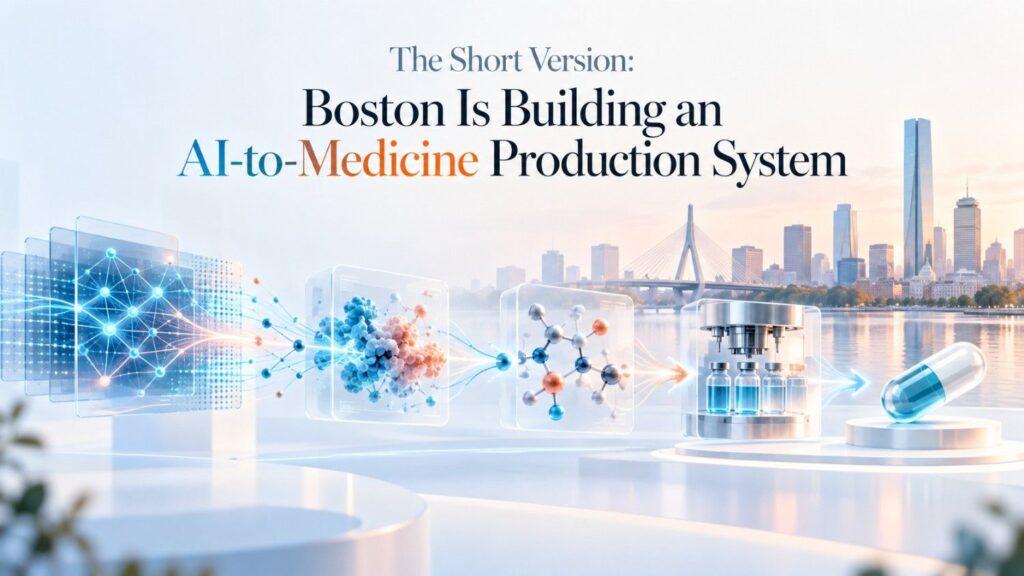
Put these companies together and a broader pattern appears.
Boston is not merely building AI models for pharmaceutical companies.
It is building increasingly automated systems for turning biological questions into experimentally tested drug candidates.
Why Boston Is Such a Natural Home for AI Drug Discovery
AI drug discovery requires two industries at once.
A company needs strong computational talent, but it also needs serious biological infrastructure. It needs machine-learning engineers who understand models and data, scientists who understand proteins and disease, expensive laboratory equipment, access to research institutions, experienced drug-development leaders, and investors willing to fund years of experimentation.
Few cities have all of those pieces sitting next to each other.
Boston does.
The Boston advantage is the distance between software and the laboratory
Boston’s advantage becomes clearer when you look at where these companies actually operate.
1910 says its office and laboratory headquarters are in Boston’s Seaport. Nabla Bio is hiring machine-learning engineers and protein scientists to work in person in Cambridge. Generate operates from Somerville and nearby Andover. Relay Therapeutics is in Cambridge. Dyno Therapeutics operates in the Boston biotechnology cluster. Seismic Therapeutic is based in Watertown.
That geography matters because AI-biotech does not work like ordinary software.
If a software model produces bad marketing copy, a company can discover the problem almost immediately. If a drug-discovery model proposes a molecule, researchers may have to synthesize it, express it, test it, measure its binding, study toxicity, run animal experiments, and eventually conduct clinical trials.
The feedback loop is slower, more expensive, and more physical.
Boston’s dense network of laboratories helps shorten that loop.
BostonBizScene Original Research: How We Built the Dataset
For this article, we built a focused Boston AI drug-discovery dataset rather than starting with a large commercial directory.
We included companies when three conditions were met.
First, the company had a meaningful operating presence in Boston, Cambridge, Somerville, Watertown, or the immediate Boston biotech cluster.
Second, AI, machine learning, advanced computation, or autonomous experimentation had to be central to how the company discovers, designs, or develops therapeutic products.
Third, the company needed enough public information for us to verify its scientific approach through company materials, regulatory filings, financing announcements, partnership announcements, or other credible sources.
This deliberately excludes many excellent Boston biotech companies that simply happen to use AI somewhere internally.
Our core analytical sample contains nine companies:
| Company | Boston-area base | Core computational approach | Main therapeutic focus |
| Generate Biomedicines | Somerville | Generative protein design + experimental feedback | Protein medicines |
| Lila Sciences | Cambridge | Autonomous science + automated labs | RNA, biological and broader scientific discovery |
| Relay Therapeutics | Cambridge | Computational modeling + experimental structural biology | Small molecules |
| Seismic Therapeutic | Watertown | Machine learning + protein engineering | Immunology biologics |
| Dyno Therapeutics | Watertown/Boston cluster | AI sequence design | AAV gene-delivery capsids |
| Nabla Bio | Cambridge | AI + massively parallel protein experiments | Antibodies |
| Manifold Bio | Boston | AI protein design + direct in-vivo measurement | Tissue-targeted biologics |
| 1910 | Boston Seaport | Multimodal AI + automated wet lab | Small and large molecules |
| Vesalius Therapeutics | Cambridge | AI, genomics and patient-derived biology | Target discovery for common diseases |
The point is not to claim that these are the only AI drug-discovery companies in Boston. They are a useful sample for understanding where the local market is moving.
Original Finding #1: Roughly Three-Quarters of the Capital in Our Sample Is Concentrated in Three Companies
Capital in AI biotechnology is extremely uneven.
Using publicly disclosed financing that could be reasonably verified, our nine-company dataset contains more than $2.2 billion of capital before counting many later partnership payments, grants, milestone rights, or public-market financings.
The three largest pools belong to Generate Biomedicines, Lila Sciences, and Relay Therapeutics.
Generate announced in 2023 that it had raised nearly $700 million in equity financing since 2020. The company later went public in February 2026, pricing a $400 million IPO, which we exclude from our private-capital comparison to avoid mixing financing categories.
Lila Sciences announced in October 2025 that its $350 million Series A brought total capital raised to $550 million.
Relay reported in an SEC filing that it had received roughly $520 million in gross proceeds from preferred stock and convertible debt before its IPO. The company then raised another $460 million gross in its 2020 IPO and later completed additional public financings.
Capital concentration in our Boston sample
| Group | Approx. verified capital | Share of sample |
| Generate | ~$700M | ~31% |
| Lila | $550M | ~24% |
| Relay, pre-IPO private capital | ~$520M | ~23% |
| Remaining six companies combined | ~$500M+ | ~22% |
| Total sample | $2.2B+ | 100% |
The exact percentage changes depending on how later financing rounds and partnership payments are treated. The underlying conclusion does not.
A relatively small number of companies have attracted enormous amounts of capital.
That makes sense because these businesses are trying to build more than software products. They need computational infrastructure, laboratories, specialized teams, biological datasets, manufacturing capability, preclinical programs, and eventually clinical trials.
Why this matters for founders
A Boston founder looking at these funding rounds should not conclude that every AI-biotech startup requires several hundred million dollars.
The more useful lesson is that the financing model depends heavily on what the company owns.
A company selling discovery software can become useful with far less capital than a company trying to take several internally owned medicines through clinical development. Once a startup chooses to own the drug pipeline, its capital requirements can rise dramatically.
That strategic choice should be made early.
Original Finding #2: Boston’s AI Drug-Discovery Market Is Becoming a Full Stack
Boston does not have just one AI-biotech business model.
Our sample covers almost every important layer between biological insight and therapeutic design.
A simple map of the Boston AI-drug stack
| Layer | Boston examples | What AI is helping do |
| Disease and target discovery | Vesalius, 1910 | Find better biological starting points |
| Molecular design | Generate, Nabla, Seismic, Relay | Design or optimize medicines |
| Gene-delivery design | Dyno | Design better delivery vectors |
| In-vivo screening | Manifold Bio | Learn from molecules tested in living systems |
| Autonomous experimentation | Lila Sciences | Design, run, measure and repeat experiments |
| Integrated discovery platform | 1910 | Connect models, biological data and laboratory automation |
This breadth is strategically important.
If AI were valuable only for virtual screening, the market could become commoditized quickly. Hundreds of teams could run similar models against similar datasets.
Boston companies are instead moving into harder parts of the problem.
They are connecting models to proprietary biological data.
They are generating physical experimental results.
They are learning from assays competitors may not possess.
They are designing delivery systems.
They are building internal therapeutic pipelines.
The competitive advantage increasingly comes from the loop around the model, not simply from the model itself.
Generate Biomedicines: Turning Protein Design Into an Engineering Discipline
Generate Biomedicines may be the clearest example of the Boston thesis.
The Somerville company sits at the intersection of machine learning, protein engineering, laboratory automation, and clinical drug development.
Its core idea is easy to understand even if the science underneath it is complex.
Traditional biologic discovery often begins by searching for a molecule in nature or generating many possible candidates and testing them.
Generate is trying to work in the opposite direction.
Start with the properties you want. Then design a protein that has them.
The company says its machine-learning systems learn general rules from protein sequences, structures, and experimental data. Those systems can then generate new proteins with desired functions.
Why Generate matters more now than it did five years ago
The company has moved well beyond the stage where investors are funding only an interesting computational hypothesis.
Its lead molecule, GB-0895, is being evaluated in Phase 3 severe-asthma studies, according to the company. Generate says the molecule was designed to block TSLP while also optimizing characteristics such as potency and half-life, with the goal of making twice-yearly dosing possible.
That is an important milestone for the entire AI-drug sector.
The hardest question facing computational drug-discovery companies has never been whether AI can produce molecules that look promising on a computer.
The harder question is whether the entire chain eventually produces useful medicines in humans.
As more computationally designed molecules move deeper into trials, the quality of the argument changes.
The field begins moving from “AI may improve discovery” toward measurable clinical evidence.
Lila Sciences: What Happens When the AI Starts Running the Laboratory?
Lila Sciences represents another Boston direction.
Instead of focusing only on generating molecules, Lila is trying to automate much more of the scientific process.
Its model can be simplified as:
question → experiment design → automated experiment → measurement → model learning → next experiment
That feedback loop is important because one of the largest constraints on scientific AI is the quality of the data.
Internet-scale AI succeeded partly because enormous quantities of text, images, video, and code already existed.
Biology is different.
The exact experiment a model needs may never have been performed.
That means a future scientific model may need to generate its own training data.
Lila’s RNA work offers an early example
Lila reported in August 2026 that its platform had tested more than 950,000 mRNA sequences in living cells. The company said the resulting system identified mRNA designs with greatly improved durability and was later used in work on an in-vivo CAR-T approach.
Whether every claim ultimately translates into successful medicines will require much more testing.
But the operating model is worth watching.
If autonomous laboratories can perform hundreds of thousands of useful experiments while continuously improving the models that select those experiments, the advantage may compound.
The data become better.
The model becomes better.
The next experiments become more useful.
Those experiments create more proprietary data.
That is a much harder loop for competitors to copy than a standalone software model.
Relay Therapeutics: A Reminder That Computational Drug Discovery Predates the Generative-AI Boom
Relay Therapeutics is important because it shows that Boston’s computational drug-development ecosystem did not begin with ChatGPT.
Relay was built around the idea that understanding how proteins move could help scientists design better drugs.
Its Dynamo platform combines computational and experimental approaches to study protein motion and discover small-molecule therapies against targets that were previously difficult to drug.
The company raised a remarkable $400 million Series C in 2018 and later completed a $460 million IPO in 2020.
The important lesson is clinical translation
Relay is now a clinical-stage company.
In February 2026, the FDA granted Breakthrough Therapy designation to zovegalisib in combination with fulvestrant for a defined form of advanced breast cancer.
Relay should not be reduced to the label “AI startup.” Its approach combines computation, structural biology, chemistry, and experimental science.
That is precisely why it belongs in this discussion.
The Boston market is moving toward hybrid companies where it becomes difficult to separate software from biology.
Seismic Therapeutic: Machine Learning Moves Into Immunology
Seismic Therapeutic applies machine learning to biologic medicines for immune disease.
The company launched with a $101 million Series A in 2022 and added a $121 million Series B in 2023, bringing disclosed capital at that point to $222 million.
Its IMPACT platform combines machine learning, structural biology, protein engineering, and translational immunology.
The goal is not merely to identify an antibody that binds a target.
Drug developers must also optimize many additional properties. A molecule may need appropriate potency, selectivity, stability, manufacturability, dosing characteristics, and safety.
Optimizing one property can damage another.
Machine learning becomes particularly useful when the discovery problem is multidimensional.
Seismic has already crossed into human testing
In April 2025, Seismic announced that the first healthy-subject cohort had been dosed in a Phase 1 study of S-4321, its bifunctional antibody designed for autoimmune disease.
By 2026 the company described itself as a clinical-stage biotechnology company with a growing pipeline derived from its machine-learning-enabled platform.
That makes Seismic another example of a major shift occurring across Boston.
The AI story is slowly moving from discovery metrics to clinical metrics.
Nabla Bio: Going After Difficult Antibody Targets
Nabla Bio is one of the more focused companies in the group.
The Cambridge company combines AI with large-scale experimental systems to design protein drugs, with particular emphasis on antibodies.
Nabla’s own hiring materials say it uses AI and massively parallel experimentation to design antibodies that bind the right part of a disease target while also reducing risks involving manufacturability and toxicity.
That second part matters.
Finding something that binds is not enough.
A useful therapeutic antibody must behave like a medicine.
Why Nabla’s partnerships are strategically important
In 2024 Nabla announced a $26 million Series A and collaborations with AstraZeneca, Bristol Myers Squibb, and Takeda. The company said those collaborations could be worth more than $550 million across upfront and milestone payments, plus royalties.
Its target class is also revealing.
Nabla has highlighted difficult membrane proteins such as G protein-coupled receptors, ion channels, and transporters.
These are precisely the types of problems where a technology platform becomes valuable.
If conventional antibody discovery already works cheaply and reliably, AI has less room to create economic value.
The largest opportunity often sits where current discovery methods struggle.
Dyno Therapeutics: Using AI to Solve the Delivery Problem
Many discussions about AI medicines focus on designing the therapeutic payload.
Dyno Therapeutics focuses on another huge bottleneck: getting genetic medicines into the right cells.
The company uses artificial intelligence to design adeno-associated virus, or AAV, capsids.
You can think of a capsid as part of the delivery vehicle carrying a genetic therapy.
A better vehicle could potentially improve where a medicine travels, how effectively it enters cells, its safety characteristics, and how easily it can be manufactured.
Dyno raised a $100 million Series A in 2021 to expand its CapsidMap platform.
2026 delivered an important commercial validation
In April 2026, Dyno announced that Astellas had exercised an option to license an AI-designed AAV capsid for skeletal-muscle delivery.
Dyno said it would receive a $15 million fee plus potential milestone payments and royalties. It also described the event as its second licensed capsid from the platform.
This highlights something that gets missed when people judge AI-biotech only by FDA approvals.
Platform validation can happen earlier.
A pharmaceutical company paying to license a molecule, antibody, capsid, dataset, or discovery program is not the same as proving that the resulting drug will work in patients.
But it is meaningful commercial evidence that an outside scientific organization sees value in what the platform produced.
Manifold Bio: AI Meets the Real Biology Bottleneck
Drug discovery has a frustrating problem.
A molecule can look excellent in a simplified laboratory assay and fail when exposed to the complexity of a living body.
Manifold Bio is attempting to move more learning into living systems earlier.
Its platform combines AI-guided protein design with direct in-vivo measurements.
The company describes a system where many molecules can be tested in parallel in living systems, generating data that can improve the next round of AI-guided design.
That is strategically interesting because it changes the type of dataset used to train the model.
Roche’s $55 million upfront payment is worth paying attention to
In November 2025, Roche agreed to collaborate with Manifold Bio on next-generation brain shuttles for neurological disease.
The agreement included $55 million upfront and more than $2 billion in potential milestones, according to Manifold.
Brain delivery is an excellent example of a problem where AI needs real biological feedback.
The blood-brain barrier exists to keep many substances out of the brain.
That makes neurological drug delivery extremely difficult.
A system that can design candidate molecules and quickly learn how they behave inside living systems could create a valuable data advantage.
1910: Building an AI-Native Drug-Discovery Infrastructure
1910 operates from Boston’s Seaport and describes itself as an AI-native biotechnology company working across both small and large molecules.
The company says it has raised $40 million through seed, Series A, and Series A-2 financing. Its investors include Microsoft’s M12, Accenture, Playground Global, Y Combinator-linked investors, and others.
1910’s approach is particularly useful for understanding where the industry may be heading because the company frames drug discovery as an infrastructure problem.
Its ITO platform connects multiple AI models, computational information, biological data, and wet-lab experimentation. 1910 has described the platform as a multi-agent system containing hundreds of models.
The business model may matter as much as the science
Not every AI-drug company needs to become a pharmaceutical company.
Some may build internal drugs.
Some may license molecules.
Some may provide a discovery engine to pharmaceutical partners.
Others may effectively become an AI infrastructure layer for R&D.
1910 appears interested in several of these routes, including co-engineering customized discovery modules with partners.
That flexibility could become increasingly common as pharmaceutical companies build more internal AI capabilities but still need specialized data, models, automation, and scientific infrastructure.
Vesalius Therapeutics: Using AI Before the Molecule Is Designed
Vesalius sits earlier in the chain.
The Cambridge company is trying to rethink how common diseases are divided into biological subgroups and then identify drug targets for those groups.
Its platform combines large clinical datasets, genetics, genomics, AI, machine learning, and experimental systems. Flagship Pioneering launched the company publicly in 2022 with $75 million in committed capital.
The basic idea is important.
AI drug discovery is not only about designing a molecule faster.
A beautifully designed drug aimed at the wrong biological target can still fail.
Target selection may be one of the most valuable places for better computation.
This points toward a broader definition of AI drug discovery
Consider the full sequence:
disease definition → patient subgroup → biological mechanism → target → molecule → delivery → preclinical validation → clinical development.
AI can influence every step.
Boston has companies operating at almost every position in that chain.
That is why looking only for startups advertising “generative chemistry” misses much of the local opportunity.
Original Finding #3: Boston’s Strongest Companies Close the Loop Between Computation and Experiments
We classified the nine companies in our sample according to whether their public descriptions explicitly connect computational design with proprietary physical experiments.
The majority do.
Generate has its generate-build-measure-learn cycle.
Lila connects scientific AI to automated experimental systems.
Nabla combines AI with high-throughput wet-lab testing.
Seismic combines machine learning with structural biology and protein engineering.
Manifold connects AI protein design to in-vivo measurement.
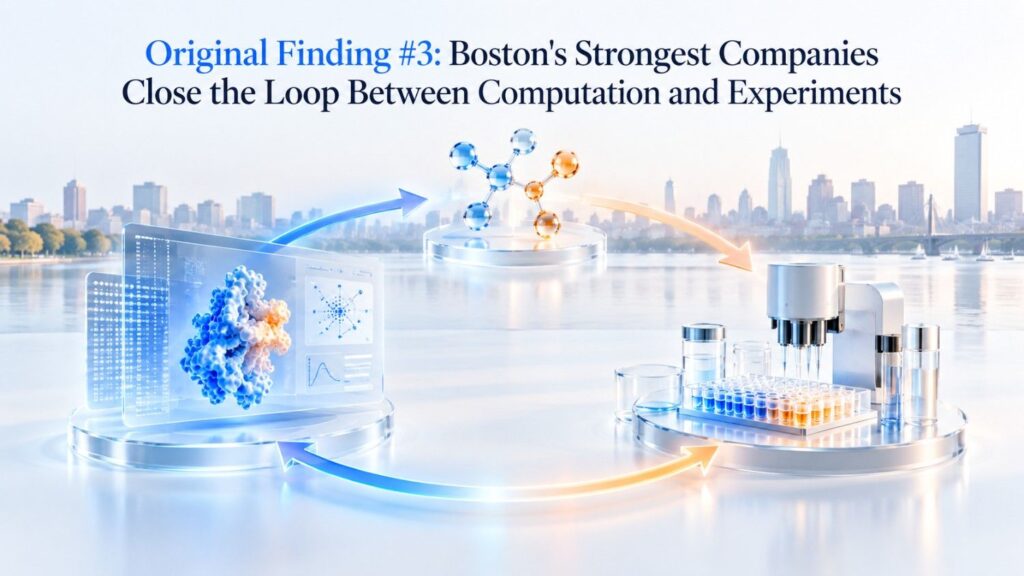
1910 combines computational models with automated biological experimentation.
This is not an accident.
Why closed-loop systems are becoming the real moat
A standalone model is easier to copy than an experimental system.
Modern AI research spreads quickly. Scientific papers are published. Open-source models appear. Talented engineers move between companies.
But a company that runs thousands or millions of proprietary experiments creates something much harder to reproduce.
It accumulates data competitors never see.
That data improves the model.
The better model chooses better experiments.
Those experiments produce better data.
The flywheel strengthens.
This suggests that the long-term winners in AI drug discovery may not be the companies with the most impressive model demonstration.
They may be the companies with the best learning loop.
Original Finding #4: The Boston Market Is Moving From Model Validation to Platform Validation
The first era of AI drug discovery focused heavily on technical benchmarks.
Could the model predict a structure?
Could it generate a molecule?
Could it predict binding?
Could it outperform an existing computational technique?
Those questions still matter, but commercial evidence is changing.
Boston companies are now producing more advanced forms of validation.
Dyno has licensed AI-designed capsids.
Nabla has signed major pharma collaborations.
Manifold has a large Roche partnership.
Relay has compounds in clinical development.
Seismic has moved machine-learning-derived programs into human trials.
Generate has progressed an internally developed protein medicine into Phase 3 studies.
This creates a simple hierarchy.
A practical validation ladder for AI biotech
| Level | Evidence | What it tells you |
| 1 | Computational benchmark | Model may predict something useful |
| 2 | Wet-lab validation | Designed molecules work in experiments |
| 3 | Repeated platform output | System can produce results more than once |
| 4 | Pharma partnership/licensing | External expert sees economic value |
| 5 | IND/clinical entry | Candidate passes major development gates |
| 6 | Human efficacy | Biology is working in patients |
| 7 | Approval | Complete development system produced a medicine |
For investors, founders, and corporate partners, this ladder is more useful than asking whether a company uses the newest AI architecture.
Models will change constantly.
Biological validation is harder to fake.
Original Finding #5: Protein Engineering Is Boston’s Most Visible AI-Drug Beachhead
Another pattern in our sample is the importance of proteins.
Generate designs protein therapeutics.
Nabla designs antibodies.
Seismic uses machine learning to create biologic medicines.
Manifold uses AI-guided protein design.
Dyno uses sequence-design methods on viral capsids.
Lila’s work includes biological sequence design and RNA systems.
Why are proteins such a natural area for AI?
Because proteins are built from sequences.
Sequence data can be represented computationally.
Protein structures and functions can increasingly be modeled.
Researchers can generate many candidate sequences.
Modern laboratory systems can test large numbers of them.
That creates an unusually strong environment for iterative machine learning.
Boston may benefit from the convergence of AI and experimental protein science
The region already had deep expertise in antibodies, biologics, genetics, structural biology, immunology, and therapeutic development.
AI does not replace that base.
It makes the base more programmable.
That difference is important.
San Francisco can build extraordinary foundation models.
Boston’s distinctive opportunity may be turning advanced models into experimentally tested biological products.
The Biggest Misconception: AI Does Not Remove Drug-Development Risk
AI can make drug discovery more productive without making medicine easy.
A drug can fail because the target was wrong.
It can fail because of toxicity.
It can fail because the molecule does not reach the required tissue.
It can fail because animal biology does not translate into humans.
It can fail because the clinical trial was poorly designed.
It can fail because the drug works but not enough to beat an existing treatment.
It can fail because manufacturing becomes too difficult or too expensive.
AI may improve several of those decisions.
It does not erase the remaining risk.
That is why investors should be cautious with claims that a model can “solve” drug development.
The most credible Boston companies generally combine AI with deep experimental and development capabilities rather than pretending biology has become a pure software problem.
What Boston Biotech Leaders Should Measure Instead of AI Hype
Corporate leaders evaluating an AI-drug platform should avoid becoming overly impressed by model vocabulary.
Ask what the system actually changes.
Measure the experiment cycle
How long does it take to move from an initial design to physical experimental evidence?
Reducing this loop from months to weeks can be extremely valuable even if AI never replaces the scientist.
Measure design-to-success rate
Of the candidates proposed by the system, how many satisfy the experimental requirement?
A platform generating ten thousand molecules is not automatically better than one generating one hundred if the smaller set is more useful.
Measure how many properties are optimized together
Real medicines are multi-variable products.
Binding alone is rarely enough.
Stability, selectivity, potency, manufacturing behavior, distribution, immune response, and other properties may all matter.
A valuable system should improve several constraints simultaneously.
Measure how fast the platform learns
A powerful discovery platform should improve after every major experimental cycle.
If a company has been generating data for years but its success rate is not improving, its supposed data flywheel may not be working.
Measure external validation
Look at what sophisticated third parties actually do.
Did a pharmaceutical company sign a partnership?
Did it expand the agreement?
Did it license a candidate?
Did regulators allow clinical testing?
Did the program advance?
These signals are imperfect, but they are usually more useful than a polished AI demo.
What This Means for Boston Startups
Founders entering the market should be careful about building another generic AI-for-drug-discovery platform.
The bar is becoming much higher.
Large pharmaceutical companies already employ machine-learning teams.
Universities release powerful biological models.
Cloud companies provide increasingly strong infrastructure.
Open models continue improving.
A new company needs a more durable advantage.
Proprietary experimental data is one possible moat
A startup that can generate a unique type of high-quality biological data may have something strategically important.
The model can change.
The dataset remains valuable.
A hard biological problem is another moat
Nabla’s focus on difficult membrane proteins is a useful example.
Dyno focuses on gene delivery.
Manifold focuses on tissue targeting and in-vivo behavior.
These are not generic “AI for biology” ideas.
They are difficult bottlenecks where solving the underlying problem creates obvious economic value.
Workflow ownership matters too
The startup that owns more of the discovery loop can learn faster.
That does not necessarily mean building every capability internally.
But the company should understand where proprietary learning occurs and protect that layer.
What This Means for Pharmaceutical Companies
Boston pharmaceutical and biotech leaders should not begin with the question, “Where can we use AI?”
That question is too broad.
Start with an expensive scientific bottleneck.
Where are teams waiting months for answers?
Where are too many compounds being synthesized?
Where is biological data plentiful but difficult to interpret?
Where does the company repeatedly fail to optimize several properties together?
Where does candidate selection depend too heavily on slow manual workflows?
Those are better entry points.
Then determine whether AI can reduce the number of experiments, make experiments more informative, or identify candidates humans would probably miss.
Build around measurable economics
Every AI discovery program should eventually connect to a business metric.
That metric might be cost per validated hit.
It might be design-to-lead time.
It might be number of experimental cycles.
It might be probability of reaching a development candidate.
It might be laboratory throughput.
It might be the number of programs one research team can support.
AI becomes strategically useful when those numbers improve.
Boston’s New AI-Biotech Startups Are Starting Younger
The ecosystem is also replenishing itself.
MassBio’s Fall 2026 Drive cohort includes companies using methods such as generative protein design, causal inference, and virtual-cell modeling. Cambridge-based ScriptBio AI, for example, describes itself as a causal-AI target-discovery company focused on diseases of aging.
That matters because the companies covered in this article are unlikely to represent the final structure of Boston’s market.
The next generation may be narrower.
A small startup may specialize in a particular disease.
Another may specialize in virtual-cell models.
Another may build a discovery agent for a particular scientific workflow.
Another may produce a unique experimental dataset rather than developing medicines directly.
The category will fragment as the underlying tools become cheaper.
The Economic Model of AI Drug Discovery Is Also Changing
Traditional biotech typically raises capital, develops drugs, advances them through clinical trials, and hopes to create value through licensing, acquisition, or commercialization.
AI introduces several additional ways to make money.
A company can license its platform.
It can sell access to specialized models.
It can run discovery programs for pharmaceutical partners.
It can receive upfront payments and milestones.
It can license molecules.
It can build its own pipeline.
It can combine several of those strategies.
Partnerships can partially finance the platform
Manifold’s Roche deal shows how significant this can become.
The $55 million upfront payment is substantial for a private platform company, while the potential milestone value exceeds $2 billion.
Nabla’s partnerships with three major pharmaceutical companies similarly show how a focused technology can attract non-dilutive or partnership-linked capital alongside venture financing.
This can create a powerful model.
Partner programs finance part of the platform.
The platform generates more data.
The improved platform supports internal programs.
Internal programs preserve more long-term economics.
The challenge is maintaining focus.
A startup can easily become a contract research organization if every partner requests something different.
The best platform companies will need to choose collaborations that strengthen the same underlying discovery engine.
Why the Laboratory May Become More Important as AI Improves
There is a strange possibility at the center of the AI-drug revolution.
As computational models become cheaper and more powerful, physical laboratories may become more strategically important, not less.
Why?
Because good models need ground truth.
If thousands of companies can access similar foundation models, the scarce asset becomes the ability to produce differentiated biological evidence.
This makes automated laboratories extremely valuable.
It also makes Boston unusually well positioned.
The city already has dense laboratory infrastructure, research hospitals, biotech talent, instrument companies, universities, and experienced development teams.
The future bottleneck may be experimental throughput
Imagine that an AI system can produce one million plausible protein designs overnight.
That sounds impressive.
But someone still has to determine which designs actually work.
The computational bottleneck disappears.
The experimental bottleneck gets larger.
Companies such as Generate, Nabla, Lila, and Manifold can be viewed partly as attempts to solve this second problem.
They are not merely generating more ideas.
They are building systems that can test and learn from those ideas at much greater scale.
The Boston AI Drug-Discovery Flywheel
The most useful way to understand the ecosystem is as a flywheel.
Boston universities produce scientific research and talent.
That talent creates biotech companies.
Venture firms fund them.
Companies build proprietary laboratories and datasets.
Pharmaceutical partnerships provide validation and more capital.
Successful programs attract experienced drug developers.
Those developers train another generation of founders.
The resulting companies produce even more local scientific infrastructure.
AI accelerates each turn of that system.
The new flywheel looks like this
Research talent
→ new AI-biotech startups
→ proprietary experiments
→ better biological datasets
→ stronger models
→ better drug candidates
→ partnerships and funding
→ larger experimental infrastructure
→ more talent and startups
The important asset is not any single AI company.
It is the density of the loop.
That is difficult for another city to reproduce quickly.
Which Boston AI Drug-Discovery Companies Should Businesses Watch Most Closely?
The answer depends on what signal you care about.
Generate is important to watch because its computational approach has reached late-stage clinical development.
Relay is important because it shows how a computational drug company matures into a clinical biotechnology company.
Seismic is worth tracking because machine-learning-designed immunology programs have entered human studies.
Dyno and Manifold provide useful signals about whether pharmaceutical companies will continue licensing products created by computational platforms.
Nabla offers a strong test of whether focused AI protein-design companies can repeatedly solve difficult antibody programs.
Lila may answer an even larger question: can AI move from recommending experiments to running significant parts of scientific discovery itself?
1910 helps test the platform and infrastructure model.
Vesalius tests whether AI can create value earlier by improving disease definition and target selection.
Together, these companies cover much more of the drug-development system than the phrase “AI drug discovery” initially suggests.
What Could Go Wrong?
The bullish story is easy to tell.
AI becomes better.
Experiments become automated.
Drug discovery becomes faster.
More successful medicines reach patients.
Reality will probably be messier.
Better discovery may simply move the bottleneck
If companies generate development candidates faster, clinical testing could become the new constraint.
Trials still require patients, sites, regulators, manufacturing, monitoring, and time.
Biological datasets can contain hidden problems
More data does not automatically mean better data.
Experimental bias, assay noise, batch effects, incomplete disease models, and weak translation between animals and humans can all mislead a model.
Models may become commoditized
A startup whose only advantage is an algorithm could see that advantage disappear.
Large technology companies, pharmaceutical companies, academic labs, and open-source researchers are all advancing quickly.
Drug economics remain brutal
Even a technologically impressive company can fail if its medicines fail clinically.
This is why scientific validation and financial discipline remain essential.
The Metric That Matters Most May Be Learning Speed
There is a temptation to judge AI-biotech companies by the number of molecules they generate.
That may eventually become a vanity metric.
Generating candidates is getting easier.
Generating useful knowledge is harder.
A stronger metric is how quickly a company learns which ideas are wrong.
Every failed experiment can create value if the system captures the reason and uses it to make the next experiment better.
That changes the economics of failure.
Traditional discovery programs often treat failed candidates as sunk cost.
A closed-loop AI platform can potentially treat failure as training data.
That may become one of the most powerful ideas in computational medicine.
Final Takeaway: Boston Is Turning Drug Discovery Into a Learning System
The Boston AI drug-discovery story is not really about replacing scientists with algorithms.
It is about changing the unit of scientific progress.
Traditional drug discovery has often looked like a long chain of separate activities. A research team identifies a target. Another group designs molecules. Another group tests them. Data move between departments. Decisions take time. Many experiments fail without strengthening the entire system.
The new Boston model looks more circular.
Design.
Build.
Test.
Measure.
Learn.
Repeat.
Generate Biomedicines uses that cycle for engineered proteins. Lila is extending it toward autonomous experimentation. Manifold is connecting AI design to in-vivo evidence. Nabla is combining protein models with large-scale antibody testing. Seismic is using machine learning to optimize immunology drugs. Dyno is applying AI to gene-delivery systems. 1910 is integrating computational models with automated biology. Relay shows how a computation-first drug platform can become a mature clinical company. Vesalius is trying to improve the biological decisions made before molecule design even starts.
Our BostonBizScene analysis suggests three conclusions.
First, the ecosystem is already financially substantial. A focused nine-company sample represents more than $2.2 billion of verifiable capital before many partnership payments and public financings are included.
Second, that capital is concentrated. Roughly three-quarters of the amount in our sample sits in Generate, Lila, and Relay, showing how expensive it can be to build large integrated AI-biotech platforms.
Third, and most important, Boston’s strongest competitive advantage may not be any single AI model.
It is the connection between computation and physical biology.
Boston has world-class computer scientists. It also has scientists who can engineer proteins, study immune systems, run high-throughput experiments, manufacture complex therapeutics, design clinical trials, and move experimental drugs into hospitals.
When those capabilities sit within a few miles of each other, AI becomes more than software.
It becomes part of an industrial system for making medicines.
That is the larger Boston story to watch.
The coming competition will not simply be about which company has the smartest model.
It will be about which company can turn every experiment into better data, every dataset into a better model, every model into better experiments, and that entire learning loop into medicines that actually help patients.
Boston is assembling exactly that kind of system.