
For years, the biggest promise of artificial intelligence in science was simple: AI would help scientists think faster.
It could read papers. It could predict protein structures. It could rank molecules. It could find patterns hidden inside huge datasets. But after the model made a prediction, something very old-fashioned still had to happen. A scientist had to walk into a laboratory and test whether the prediction was actually true.
That physical step has quietly become one of the biggest limits on AI-powered science.
A computer can generate 10,000 possible molecules before lunch. A laboratory cannot necessarily make, test, measure, and learn from 10,000 molecules before lunch. It may not even be able to test 100 of them quickly.
That gap is why laboratory automation is suddenly becoming much more important.
And Boston is emerging as one of the most interesting places to watch it happen.
Companies including Lila Sciences, Ginkgo Bioworks, Atinary, HighRes Biosolutions, Kebotix, Asimov, Robot on Rails, and Whelix are attacking different parts of the same problem. Boston University is developing cloud-based automated biology infrastructure. MIT researchers are building robotic systems that can make materials, measure them, learn from the results, and decide what experiment to run next.
The result is something bigger than ordinary lab automation.
The laboratory itself is starting to become part of the AI system.
Instead of a human designing every experiment, manually running it, recording the result, and deciding what comes next, the emerging model looks more like this:
AI proposes an experiment → software turns it into instructions → robots perform the experiment → instruments measure the result → software captures the data → AI decides what to test next.
Then the cycle starts again.
When those pieces are connected properly, the laboratory stops acting like a collection of machines and begins acting like a learning system.
That is the idea behind the self-driving laboratory.
And Boston may be particularly well positioned to build it.
The Short Version: AI Is Starting to Control the Physical Experiment
The easiest way to understand the self-driving lab is to compare it with today’s normal AI workflow.
A typical AI drug-discovery company may use a model to predict which molecule is likely to work. Scientists then select candidates, hand them to laboratory teams, wait for experiments to be completed, analyze the results, and finally train or improve the model.
The entire cycle might take days or weeks.
A self-driving laboratory tries to compress that loop.
The AI does not simply produce predictions. It becomes connected to the machines performing the experiments.
Lila Sciences describes its AI Science Factory approach as a system where AI can generate hypotheses, design experiments, conduct them, observe the results, and redesign the next experiments.
Atinary’s Boston laboratory follows a similar idea. Its systems combine AI software, robotic equipment, laboratory instruments, and automated analysis so that experiments can be designed, executed, measured, and learned from inside a continuous loop.
MIT researchers have demonstrated the same concept in materials science. The DiSCO system described in a 2025 MIT thesis can synthesize new semiconductor compositions, characterize them, use machine learning to select promising new experiments, and repeat the process automatically. The system was designed to handle more than 1,000 unique material compositions per day.
This is an important change.
Traditional laboratory automation answers the question:
How can we perform this experiment automatically?
A self-driving laboratory asks a much larger question:
What experiment should we perform next, and can the system execute that decision without waiting for a person?
That second question is where AI changes the economics of the laboratory.
What Actually Makes a Lab “Self-Driving”?
The phrase is starting to appear everywhere, which makes it easy to misunderstand.
Buying a robotic liquid handler does not create a self-driving lab.
Installing laboratory software does not create one either.
Even automating an entire assay is not necessarily enough.
Ginkgo Bioworks offered a useful definition in a 2026 shareholder document. The company said an autonomous lab should be end-to-end automated, general purpose, and easy for scientists to use. In its definition, experimental work moves from design through execution and data generation without requiring a scientist to step into the middle of the process and manually perform benchwork.
That definition is helpful because autonomy is really about the connections between different layers of the laboratory.
Layer One: Experimental Intelligence
The system needs some way to choose or improve experiments.
That intelligence might come from Bayesian optimization, machine learning, scientific foundation models, reinforcement learning, AI agents, or another optimization method.
The specific AI technique matters less than the role it plays.
If AI only analyzes results after the experiment is finished, the lab is AI-assisted.
If AI uses those results to decide what should physically happen next, the lab begins moving toward autonomy.
Layer Two: Machine-Readable Protocols
The experimental plan has to be converted into instructions machines can understand.
That sounds simple, but laboratories are messy environments.
Scientists use different instruments from different manufacturers. File formats differ. Protocol steps contain exceptions. Samples move from one machine to another. Instruments sometimes fail.
Before a robot can operate the laboratory, scientific intent has to become machine-readable.
This orchestration layer is one reason companies such as HighRes Biosolutions matter so much.
HighRes says its Cellario OS connects instruments, workflows, and data through a common orchestration layer. Its newer AutoPod system combines modular laboratory hardware with control software aimed at increasingly autonomous operation.
Layer Three: Physical Execution
Then something must actually move.
Robotic arms need to carry plates.
Liquid handlers need to transfer samples.
Incubators need to open.
Materials need to be synthesized.
Samples need to move between instruments.
Microscopes, mass spectrometers, sequencers, plate readers, and other systems need to start at the right moment.
This physical layer is what separates autonomous science from purely digital AI.
Layer Four: Measurement
The experiment must produce usable data automatically.
If a robot performs an experiment but a scientist later has to manually move the sample, export a file, clean the data, and upload it somewhere, the closed loop is broken.
A self-driving system therefore needs measurement and data capture to be part of the automated workflow.
Layer Five: Learning
Finally, the result needs to influence what the system does next.
This is the crucial step.
Without feedback, automation simply repeats instructions.
With feedback, automation becomes experimentation.
That difference is why closed-loop systems matter so much.
BostonBizScene Original Research: Measuring Boston’s Autonomous-Lab Stack
To understand where Boston actually stands, BostonBizScene reviewed public technical descriptions, company materials, research publications, current product information, and laboratory announcements for eight commercial organizations strongly connected to the Greater Boston laboratory-automation ecosystem.
The commercial sample includes:
Lila Sciences, Atinary, Ginkgo Bioworks, Kebotix, HighRes Biosolutions, Asimov, Robot on Rails, and Whelix.
We then reviewed two academic systems separately: Boston University’s DAMP Lab and MIT’s DiSCO project.
The goal was not to create a ranking of which organization is “best.”
That would be misleading because these companies solve very different problems.
Instead, we wanted to answer a more useful question:
How much of the autonomous scientific loop is already being built in Boston?
Our Method
We evaluated five capabilities.
Each capability received a score from zero to two.
| Capability | 0 | 1 | 2 |
|---|---|---|---|
| AI experimental decision-making | No clear evidence | AI assists planning or interpretation | AI explicitly selects, redesigns, or optimizes experiments |
| Automated physical execution | Mainly manual | Partial workflow automation | Multi-step robotic execution |
| Automated measurement | Mainly manual | Some automated data capture | Measurement directly integrated into workflow |
| Closed-loop learning | No clear feedback loop | Partial or developing feedback | Results explicitly drive future experiments |
| Remote or external accessibility | Internal only | Customer deployment/service access | Physical experiments can be ordered remotely/cloud-style |
This is an evidence score, not a technology-quality score.
We only counted capabilities that could be supported through public information available as of October 6, 2026.
Boston Autonomous Laboratory Capability Index
| Organization | AI Decision | Physical Execution | Measurement | Closed Loop | Remote / External | Total /10 |
|---|---|---|---|---|---|---|
| Lila Sciences | 2 | 2 | 2 | 2 | 1 | 9 |
| Atinary | 2 | 2 | 2 | 2 | 1 | 9 |
| Ginkgo Bioworks | 1 | 2 | 2 | 1 | 2 | 8 |
| Kebotix | 2 | 2 | 1 | 2 | 1 | 8 |
| Asimov | 2 | 1 | 1 | 2 | 1 | 7 |
| Whelix | 1 | 2 | 2 | 1 | 1 | 7 |
| HighRes Biosolutions | 1 | 2 | 1 | 1 | 1 | 6 |
| Robot on Rails | 1 | 2 | 1 | 0 | 1 | 5 |
The most important result is not the ranking.
It is the shape of the market.
Every company in the sample contributes to physical automation. But only part of the group publicly describes a true experimental learning loop where results can influence what happens next.
That tells us the market is moving through two stages at the same time.
One group is solving the execution problem: making robots capable of reliably operating ordinary laboratory workflows.
Another group is attacking the harder learning problem: allowing software to decide which experiment should follow the previous one.
Boston needs both.
Original Finding #1: Half of the Commercial Sample Already Shows a Clear Closed-Loop Model
Using our strict definition, four of the eight commercial organizations in the sample publicly describe strong closed-loop experimentation: Lila Sciences, Atinary, Kebotix, and Asimov.
That produces a closed-loop share of:
4 of 8 companies = 50%.
Chart: Closed-Loop Experimental Learning in the Boston Sample
| Model | Companies | Share |
|---|---|---|
| Explicit closed-loop learning | 4 | 50% |
| Partial/developing closed loop | 3 | 37.5% |
| Primarily execution automation | 1 | 12.5% |
This matters because AI without an experimental feedback loop eventually runs into a data problem.
Models trained on old data can only learn so much from information that already exists.
The laboratory generates new information.
When the model can choose what information to generate next, the lab becomes a data engine rather than simply a testing service.
That is the deeper business opportunity.
Lila Sciences: Building an AI Science Factory
No Boston company represents the most ambitious version of this idea more clearly than Lila Sciences.
The Cambridge company says it is building a scientific superintelligence platform connected to autonomous laboratories across life science, chemistry, and materials science. Its stated goal is not simply to automate known experiments. It wants AI to participate in the entire scientific method.
Lila describes its physical infrastructure as AI Science Factories.
The concept combines AI models, software, robotics, scientific instruments, and automated experimentation.
The important idea is that the AI does not stop at predicting an answer.
It gets to test the answer.
The Model Gets a Body
Modern AI systems are mostly separated from the physical world.
A language model can produce a chemistry hypothesis, but it cannot determine whether a reaction actually works unless someone performs the reaction.
Lila’s architecture tries to eliminate that separation.
Its AI Science Factories are intended to give AI systems access to physical experiments so that models can generate hypotheses, run tests, learn from the outcome, and repeat the cycle.
That makes the laboratory part of model training.
And that may eventually become much more important than simply having a larger model.
Lila’s Green-Hydrogen Experiment Shows the Scale of the Idea
In September 2026, Lila described a three-month catalyst-discovery campaign where its AI-directed laboratory proposed, synthesized, and screened 2,942 catalysts for green-hydrogen applications and identified six high-performing material families.
The number itself is interesting.
But the more important point is the workflow.
The system was not merely screening a fixed library.
AI was tied to physical experimentation.
That is the pattern investors, pharmaceutical companies, chemical companies, and materials companies should watch.
When AI can generate experiments faster than researchers can manually execute them, the physical lab becomes the limiting resource.
Lila is effectively betting that the solution is to build laboratories designed around AI from the beginning.
Atinary: Boston Gets a Working Self-Driving Chemistry Lab
Atinary provides another unusually clear example.
In February 2026, the company opened a self-driving laboratory in Boston containing two autonomous experimental platforms.
The facility combines Atinary’s SDLabs AI platform with equipment from companies including ABB, Agilent, Bruker, Chemspeed, and Mettler-Toledo.
The two systems are designed to run continuous experimental cycles.
One platform integrates Chemspeed robotic synthesis equipment with inline Bruker NMR analysis. Another combines ABB robotic arms with Mettler-Toledo instruments and Agilent analytical equipment.
That integration is what makes the facility important.
AI is useful only if the laboratory can reliably carry out its decisions.
Why Chemistry Is a Powerful Test Case
Chemistry optimization can involve enormous search spaces.
A researcher might change temperature, solvent, concentration, catalyst loading, reaction time, reagent ratio, or other variables.
Testing every possible combination is impossible.
Traditional research therefore depends heavily on human judgment.
Experienced chemists select combinations they believe are likely to work.
A self-driving laboratory changes that process.
The AI can propose a small group of informative experiments, run them, observe the results, and select the next experiments based on what was learned.
Instead of searching the entire space, the system tries to learn where the useful regions are.
That is where AI can produce a major improvement.
The advantage does not necessarily come from performing one experiment faster.
It comes from requiring fewer bad experiments to reach the answer.
Ginkgo Bioworks: Turning the Biology Lab Into Infrastructure
Ginkgo Bioworks has been building automated biological foundries in Boston for years.
Its earlier foundries already used robotics to industrialize processes such as DNA construction, biological testing, and strain engineering. MIT described Ginkgo’s first major automated foundry as an 18,000-square-foot facility built around robotics and rapid biological prototyping.
But Ginkgo’s 2026 strategy pushes the model further.
The company now talks explicitly about autonomous laboratories.
Its current platform uses Reconfigurable Automation Carts, or RACs, together with Catalyst software. RACs are modular automation units that can connect laboratory instruments into larger workflows.
That matters because traditional laboratory automation tends to be rigid.
A huge robotic line might perform one workflow extremely well.
Then the research changes.
Suddenly the lab needs a different instrument or different sequence of operations.
Reconfigurable automation tries to make the laboratory more like software.
Pieces can be reorganized.
Workflows can change.
New instruments can be added.
Ginkgo Cloud Lab Could Be the Bigger Story
In March 2026, Ginkgo launched Ginkgo Cloud Lab.
Researchers can access the company’s autonomous laboratory infrastructure through a web interface rather than owning all of the equipment themselves. The launch included access to more than 70 instruments covering sample preparation, liquid handling, storage, incubation, and analytical measurements.
The company also introduced an AI agent called EstiMate that can evaluate a protocol written in ordinary language, determine whether the autonomous laboratory can currently execute it, and provide pricing.
That might sound like a convenience feature.
Strategically, it is much bigger.
The laboratory could be moving toward an API.
Original Finding #2: Remote Laboratory Access Is Still the Rarest Layer
Among the eight commercial Boston-area organizations we studied, only Ginkgo clearly markets broad browser-based remote access to a physical autonomous laboratory today.
That makes remote physical experimentation one of the least developed layers in our sample.
Chart: Maturity of the Boston Autonomous-Lab Stack
| Layer | Relative maturity in our sample |
|---|---|
| Robotic physical execution | ██████████ Very high |
| Automated measurement | ████████░░ High |
| AI-assisted planning | ████████░░ High |
| Closed-loop experimental learning | ██████░░░░ Emerging |
| Cloud-style remote physical access | ██░░░░░░░░ Early |
Why does this matter?
Because cloud access could fundamentally change who can use advanced automation.
A small biotechnology startup may not be able to spend millions of dollars building its own automated laboratory.
But it might be able to rent experiments.
That is exactly what happened in computing.
Companies once had to own servers.
Cloud infrastructure made computing capacity available on demand.
A similar shift in laboratories would mean companies could access scientific infrastructure without building the entire physical stack themselves.
Boston University is exploring a related academic model.
Its DAMP Lab describes itself as a cloud bio-foundry that provides remote users with automated biological services combining software, robotics, standard protocols, and expert staff.
The model does not eliminate physical science.
It changes who needs to own the machines.
Boston University’s DAMP Lab: A Preview of Science as Cloud Infrastructure
The Design, Automation, Manufacturing, and Processes Laboratory at Boston University is especially interesting because it shows how automation could become shared infrastructure.
The DAMP Lab allows researchers to access standardized automated biological workflows rather than building everything themselves.
Its history also demonstrates what high-throughput laboratory automation can accomplish.
During the pandemic, Boston University built a robotic testing operation intended to process as many as 6,000 COVID tests per day. After testing demand fell, BU began converting that infrastructure into a broader cloud-based research facility connected to DAMP.
The lesson is important.
A large automated laboratory is expensive.
But once built, its capacity can be reused across many scientific problems.
That begins to make the economics look more like infrastructure.
The Next Step Is AI-Programmable Science
In July 2026, Boston-based Asimov announced that it would work with Boston University’s NSF-backed programmable cloud laboratory effort to build high-throughput therapeutic-protein production and characterization capabilities.
The planned workflow is especially relevant to self-driving science.
Asimov intends to design protein candidates computationally, manufacture and test them through the cloud lab, and then feed experimental results back into models designed to predict manufacturing behavior.
That is a laboratory-in-the-loop system.
And it may be one of the strongest examples of how Boston’s existing biology infrastructure can connect to AI.
Asimov: When Biological Models Get Their Own Experimental Feedback Loop
Asimov has spent years building a synthetic-biology platform combining genetic design, cells, computational tools, and experimental work.
Its Boston laboratory includes the former MIT-Broad Foundry team.
That foundry infrastructure was designed for high-throughput biological engineering, and Asimov has described using large experimental datasets to improve computational models for genetic design.
The new BU collaboration pushes that idea further.
Instead of computational design and laboratory testing operating as separate activities, they can form one loop.
Design.
Build.
Test.
Learn.
Design again.
This architecture is likely to become increasingly common in AI biotech.
Why?
Because biology models need data that actually reflects biological behavior.
A model can predict whether a protein looks promising.
But manufacturing might fail.
Cells might produce too little of it.
The protein might fold incorrectly.
It may become unstable.
Those problems are discovered through experiments.
A company that can repeatedly connect predictions with physical results creates something extremely valuable: proprietary experimental feedback.
Original Finding #3: Boston’s Advantage Is Not One Self-Driving Lab Company — It Is the Full Stack
Looking across the sample revealed something more important than any individual company.
Boston has organizations working at almost every layer required to build autonomous science.
Boston’s Emerging Autonomous-Lab Stack
| Layer | Boston examples |
|---|---|
| Scientific AI and hypothesis generation | Lila Sciences, Asimov, Atinary, Kebotix |
| Workflow orchestration | HighRes Biosolutions, Ginkgo |
| Robotic laboratory execution | HighRes, Ginkgo, Atinary, Robot on Rails, Whelix |
| Biological foundries | Ginkgo, Asimov, BU DAMP |
| Chemistry automation | Atinary |
| Materials self-driving labs | Lila, Kebotix, MIT |
| Cell-culture robotics | Whelix |
| Cloud laboratory access | Ginkgo, BU DAMP |
| Academic autonomous-lab research | MIT, Boston University |
This is why Boston’s position is interesting.
The region does not need every company to build the whole system.
One company may build AI.
Another may make robotic infrastructure.
Another may specialize in biological experiments.
Another may provide orchestration.
Another may operate laboratories for outside customers.
The ecosystem becomes stronger when those layers can work together.
HighRes Biosolutions: The Orchestration Layer May Be More Important Than It Looks
HighRes Biosolutions, headquartered in Beverly, may not receive as much mainstream AI attention as companies building large models.
But laboratory autonomy cannot work without reliable orchestration.
HighRes has spent more than two decades building automation systems for drug discovery, genomics, synthetic biology, and other scientific workflows. The company says it has more than 300 employees globally and operates its North American headquarters in Beverly.
Its Cellario software is designed to connect different instruments and workflows into a common operating layer.
That solves a major problem.
Laboratories do not normally consist of identical machines from one company.
They contain equipment from many vendors.
A sample may need to move through six different machines before the experiment is complete.
Some equipment may be ten years old.
Other equipment may have been installed last month.
Autonomous science requires these systems to work together.
AI Needs Reliable Robotics More Than Impressive Demos
In January 2026, HighRes announced an expanded collaboration with NVIDIA focused on AI-driven autonomous laboratories.
One important area is robotic perception.
Instead of operating only in perfectly controlled environments, robots need to recognize what is happening around them and respond when conditions change.
This sounds like a small technical detail.
It is not.
Real laboratories contain uncertainty.
A plate may not be perfectly aligned.
A door may fail to close.
A tube may be missing.
An instrument may generate an error.
Traditional automation often stops when something unexpected happens.
Autonomous automation has to detect the problem, understand it, and decide what to do.
That ability could determine whether future self-driving labs operate for twenty minutes or twenty hours without human intervention.
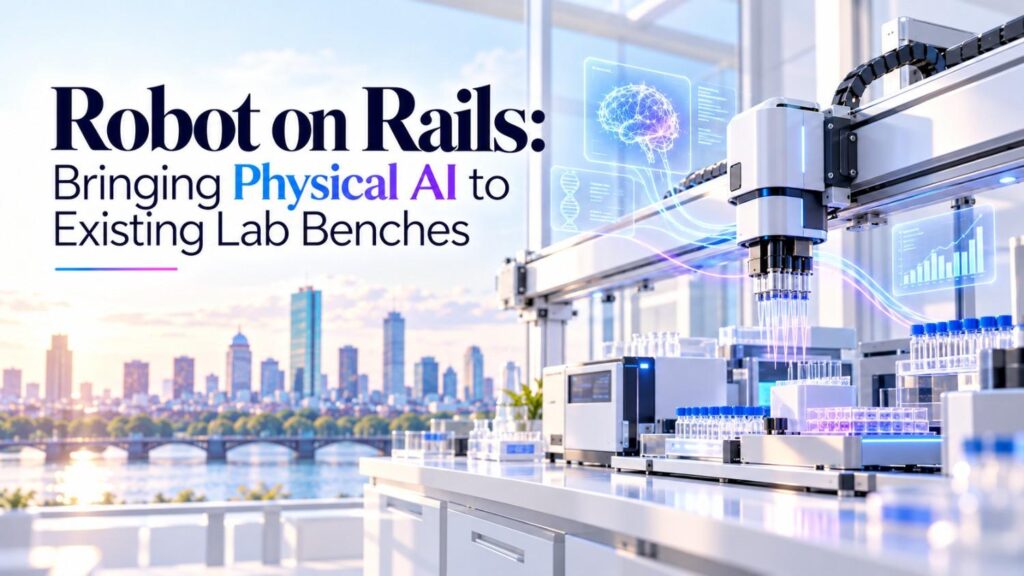
Robot on Rails: Bringing Physical AI to Existing Lab Benches
Another Boston company is approaching the problem from the opposite direction.
Robot on Rails is building robots intended to operate existing laboratory benches and instruments.
The company’s “Undergrad” system is designed to take protocols described in normal language and physically execute them while using computer vision to verify laboratory steps.
This approach matters because replacing an entire lab is expensive.
Biotech companies have already spent millions of dollars on equipment.
They may not want to throw it away and rebuild the lab around a new automation platform.
A mobile or flexible robotic operator could automate infrastructure that already exists.
That could make adoption much easier.
Brownfield Automation Could Be a Huge Market
There are two ways to build the laboratory of the future.
The first is to build a completely new autonomous facility.
That is powerful, but expensive.
The second is to teach robots how to operate the laboratory companies already have.
If that works reliably, the addressable market expands dramatically.
Robot on Rails says it is developing its technology in Boston’s robotics ecosystem through MassRobotics.
That connection also illustrates another Boston advantage.
The autonomous-lab market does not only require biologists.
It needs robotics engineers, machine-vision specialists, software engineers, instrument experts, mechanical engineers, and scientists.
Boston has all of those talent pools within a relatively small geographic region.
Whelix: Automating One of Biology’s Most Human-Dependent Workflows
Cell culture remains surprisingly manual.
Scientists regularly move cells between incubators and biosafety cabinets, feed them, image them, split them, monitor their condition, and decide when intervention is required.
Whelix is trying to turn that process into automated infrastructure.
The Boston startup describes its systems as intelligent robots for end-to-end mammalian cell culture. Its platform combines robotic equipment, computer vision, digital twins, and agent-based software for incubation, liquid handling, imaging, protocol execution, and cell monitoring.
The company has operated through Boston-area innovation hubs including MassRobotics and The Engine and has been piloting its systems with research institutions.
This is an important part of the self-driving-lab story because some biological processes cannot simply be placed inside a standard liquid handler.
Cells live.
They change.
They behave differently from batch to batch.
Automation therefore needs perception.
The system has to see what is happening rather than blindly executing the same instruction every time.
That makes cell culture an interesting proving ground for physical AI.
Kebotix: One of Boston’s Earlier Closed-Loop Materials Plays
Cambridge-based Kebotix has been developing a self-driving laboratory model for materials discovery for years.
Its system combines cloud infrastructure, artificial intelligence, chemical informatics, physical modeling, and laboratory automation. The company explicitly describes its process as a closed loop where predictions, physical production, measurement, and learning connect together.
This is particularly useful in materials science because the number of possible molecules and formulations can become enormous.
Kebotix has described screening millions of commercially available molecules computationally before using its AI and robotic platform to pursue promising candidates for applications including electrochromic materials.
Again, the key advantage is not just robotic speed.
It is search efficiency.
If the AI can use every physical result to improve the next decision, each experiment becomes more informative.
The laboratory learns where to look.
MIT’s DiSCO System Shows What Full Autonomy Actually Looks Like
Academic work at MIT helps show the technical end state more clearly.
Alexander Siemenn’s 2025 MIT doctoral work described DiSCO: Discovery, Synthesis, Characterization, and Optimization.
It is an unusually complete self-driving materials laboratory.
The system can create semiconductor compositions, measure their optical and electrical properties, use machine learning to select promising new compositions, and send those decisions back to robotic hardware.
The system demonstrated a 24-hour autonomous optimization campaign.
Its designed throughput exceeded 1,000 unique compositions per day.
That is important because self-driving laboratories become much more powerful when three things happen simultaneously:
experiments become smaller,
experiments become parallel,
and experiment selection becomes intelligent.
When those changes combine, the laboratory does not merely automate human research.
It begins operating at a scale humans would find difficult to manage manually.
MIT Is Also Teaching Robots to Rebuild the Experiment Itself
Another MIT project announced in September 2026 pushes the idea in a different direction.
Researchers developed a robotic optics laboratory capable of autonomously assembling optical components into requested experimental setups.
This is a deeper form of flexibility.
Traditional automation assumes the equipment setup stays mostly fixed.
The robot runs samples through it.
But what if the robot can reconfigure the actual experimental apparatus?
That would make automated laboratories useful across a much larger range of scientific questions.
In the long term, the most capable autonomous labs may not simply execute protocols.
They may physically reorganize themselves around the problem.
Original Finding #4: The Market Is Moving From Automated Instruments to Automated Scientific Systems
The companies in our sample can roughly be placed across four stages.
Stage One: Automated Task
A machine performs one repetitive laboratory action.
Examples include pipetting, imaging, plate movement, or sample preparation.
Stage Two: Automated Workflow
Several instruments work together to execute an entire protocol.
This dramatically improves throughput and reproducibility.
Stage Three: Autonomous Workflow
Software manages the workflow dynamically, responds to errors, and reduces the need for human intervention.
Stage Four: Autonomous Science
AI interprets experimental outcomes and decides what experiment should happen next.
That final stage is the real destination.
Chart: The Evolution of Laboratory Automation
| Stage | Human decides next experiment? | Robots execute? | AI learns from results? |
|---|---|---|---|
| Manual lab | Yes | No | Sometimes |
| Automated task | Yes | Partly | Usually no |
| Automated workflow | Yes | Yes | Sometimes |
| Autonomous workflow | Usually | Yes | Partly |
| Self-driving science | Not always | Yes | Yes |
The distinction matters for investors and executives.
A company selling robotic equipment and a company operating an autonomous discovery engine may both use the words “AI lab.”
Their economics could be completely different.
One sells productivity infrastructure.
The other may be creating proprietary scientific knowledge.
Why the Feedback Loop Changes the Economics
Consider a simple example.
A pharmaceutical research group wants to improve a chemical reaction.
Five variables can be changed.
Each variable has ten possible values.
A naive search would contain:
10 × 10 × 10 × 10 × 10 = 100,000 possible combinations.
No team wants to manually test 100,000 combinations.
So scientists use experience to narrow the search.
AI provides another option.
Run 20 experiments.
Measure them.
Let the model learn where promising regions appear.
Choose another 20.
Measure again.
Continue until the model converges on useful conditions.
If intelligent search finds a strong answer after 200 experiments instead of 10,000, the primary advantage is not that the robot pipetted faster.
The advantage is that the system avoided 9,800 experiments.
That is why the combination of AI and automation is so powerful.
Automation increases experimental capacity.
AI decides how to spend that capacity.
Original Finding #5: Experimental Throughput May Become an AI Advantage
AI companies often talk about compute.
Scientific AI companies may increasingly talk about experiments.
Why?
Because experiments create new training data.
That means physical laboratory capacity could become a strategic asset similar to computing infrastructure.
Imagine two scientific AI companies.
Both begin with similar models.
Company A runs 200 experiments every month.
Company B operates autonomous laboratories capable of running 20,000 carefully selected experiments every month.
After a year, the models may no longer be comparable.
Company B has generated vastly more proprietary physical evidence.
Its model has seen more successes.
More failures.
More edge cases.
More strange outcomes.
More combinations that nobody had previously documented.
That knowledge can improve future experiment selection.
Better experiment selection produces better data.
Better data improves the model.
The model chooses better experiments.
The loop compounds.
This is why the most valuable autonomous-lab companies may eventually resemble data companies as much as robotics companies.
Failed Experiments May Become Valuable Data
Traditional scientific organizations often dislike failed experiments.
They consume materials, machine time, and employee hours.
But for machine learning, failure can be informative.
If a model proposes a molecule and the experiment fails, the system has learned something about the boundary between working and not working.
If that result is captured properly, future models can avoid similar mistakes.
That creates a subtle advantage for automated laboratories.
They can record failure systematically.
Every temperature.
Every reagent.
Every instrument reading.
Every image.
Every intermediate measurement.
Every unsuccessful outcome.
A human scientist may summarize an experiment as “didn’t work.”
An autonomous system can store thousands of details about why it may not have worked.
Over time, that experimental memory may become one of the strongest competitive moats in scientific AI.
Why Boston Is Unusually Well Positioned for This Market
Self-driving laboratories sit at the intersection of several industries.
Boston is already strong in nearly all of them.
Boston Has Dense Life-Science Demand
The region contains pharmaceutical companies, biotechnology startups, hospitals, research institutions, contract research organizations, and university laboratories.
That creates immediate customers for automation.
Laboratory-automation companies do not have to convince Boston that scientific experiments matter.
They only have to demonstrate that those experiments can be performed faster, cheaper, or more reliably.
Boston Has Robotics Talent
Autonomous labs require more than software.
Robots have to interact with the physical world.
Boston’s long history in robotics gives the region an important advantage here.
Companies can recruit engineers with experience in computer vision, motion planning, sensors, autonomous systems, robotics software, and mechanical design.
Those skills transfer naturally into laboratory automation.
Boston Has AI Researchers
The system also requires machine learning.
Optimization.
Scientific foundation models.
Computer vision.
Agent software.
Simulation.
Boston and Cambridge already contain major academic and commercial AI communities.
Boston Has Scientific Instrument Knowledge
Laboratory autonomy cannot be separated from instruments.
Robots have to work with microscopes, sequencers, liquid handlers, chromatography systems, mass spectrometers, incubators, plate readers, and dozens of other machines.
That means teams need people who understand both software and experimental science.
Boston’s scientific density makes those hybrid teams easier to build.
The Biggest Bottleneck May Become Instrument Interoperability
The exciting part of autonomous labs is AI.
The frustrating part may be instrument integration.
Laboratories contain machines built by different manufacturers.
Many were never designed to be operated by intelligent software.
One device might expose a modern API.
Another might require proprietary desktop software.
A third may output files in an unusual format.
A fourth may require a human to physically press something.
That makes interoperability a major opportunity.
The company that creates a reliable translation layer between scientific intent and thousands of laboratory instruments could occupy an extremely valuable position.
This is partly why orchestration platforms such as HighRes Cellario and Ginkgo Catalyst deserve attention.
The intelligence layer gets most of the headlines.
The control layer may determine whether the intelligence can do anything useful.
The Second Bottleneck Is Reliability
A robot running one demonstration is not the same as an autonomous laboratory running continuously.
Long-running automation creates new problems.
Consumables run out.
Tips jam.
Liquids behave strangely.
Sample plates warp.
Sensors drift.
Machines need calibration.
Robotic arms miss objects.
Files arrive late.
Network connections fail.
A human scientist handles many of these exceptions without thinking about them.
An autonomous lab cannot.
The system needs to understand what went wrong and recover safely.
That means laboratory autonomy is partly an AI problem, partly a robotics problem, and partly an operations problem.
Companies that underestimate the operations layer may produce impressive demos without reliable production systems.
The Third Bottleneck Is Scientific Trust
Scientists need to trust experimental results.
That standard is much higher than making a chatbot sound convincing.
Every action needs to be traceable.
Researchers need to know which reagent was used.
Which machine performed the measurement.
When calibration happened.
Which software version executed the workflow.
Which model recommended the next experiment.
Which data caused the model to change direction.
This makes auditability extremely important.
In regulated pharmaceutical development, it becomes even more important.
Autonomous laboratories therefore need strong data lineage.
The system cannot merely produce an answer.
It needs to produce a scientific record.
What Boston Biotech Companies Should Automate First
The wrong strategy is often to walk through the laboratory asking:
Where can we put a robot?
A better question is:
Which scientific loop is currently limiting how quickly we learn?
That changes the automation roadmap.
A process is a strong automation candidate when it has several characteristics.
It happens frequently.
The steps are reasonably structured.
Human execution creates meaningful variation.
The data can be captured digitally.
Faster experiments would change an important business decision.
And ideally, results can influence what experiment should happen next.
Start With Learning Loops, Not Individual Tasks
Suppose a biotech company performs protein-expression experiments every week.
Automating one pipetting step saves labor.
Useful.
But automating the full design-build-test-learn loop could change how quickly the company discovers manufacturable proteins.
That is much more valuable.
Executives should measure automation ROI in terms of scientific learning.
How many useful decisions can the research team make each month?
How long does it take to move from hypothesis to evidence?
How many experiments can run without human intervention?
How quickly can failed experiments become training data?
Those metrics tell a much better story than “hours of pipetting saved.”
What Investors Should Ask Autonomous-Lab Companies
Investors should be careful with the term “autonomous.”
The market will contain many different levels of automation.
The most useful questions are operational.
Can the system decide what experiment happens next?
How long can it operate without human rescue?
How many different workflows can the system support?
How many instruments can it integrate?
Does it automatically capture structured experimental data?
Can failed runs be recovered?
Can the platform improve experiment selection from previous results?
Can outside customers use the infrastructure?
Does increased laboratory usage generate a proprietary dataset?
These questions expose the difference between robotic equipment and a genuine autonomous-science platform.
Both may be valuable businesses.
But they are not the same business.
What Pharma Should Ask Before Building a Self-Driving Lab
Large pharmaceutical companies face a different choice.
Should they build autonomous infrastructure internally?
Buy commercial automation?
Use an external cloud lab?
Or combine all three?
The answer probably depends on the scientific workflow.
Core proprietary experiments may justify dedicated internal infrastructure.
Standardized, high-volume tasks may be ideal for external automated labs.
Early experimentation may begin in a cloud laboratory before a workflow becomes important enough to reproduce internally.
That suggests a hybrid future.
Companies will own some automation.
Rent some.
Connect to external facilities.
And use orchestration software to manage experiments across all of them.
In other words, the future laboratory may not be a single building.
It may be a network.
Original Finding #6: The Cloud Lab Could Do to Experimental Science What Cloud Computing Did to Software
This comparison is easy to overuse, but the structural similarity is real.
Before cloud computing, launching a software company often required buying and operating physical servers.
Cloud infrastructure separated software creation from server ownership.
Something similar may happen in science.
Today, building a biotech company often means leasing laboratory space, purchasing instruments, hiring technicians, creating workflows, maintaining equipment, and dealing with a long list of physical operations.
Cloud laboratories could separate scientific design from laboratory ownership.
A scientist could describe the experiment digitally.
A remote automated facility could perform it.
Structured data would return.
The scientist could then design the next experiment.
Ginkgo’s browser-accessible Cloud Lab already points toward this model.
Boston University’s DAMP Lab provides another version through academic infrastructure.
If these systems become standardized, the effect on startups could be significant.
A computational biology company might begin generating physical data before leasing a full laboratory.
A small materials startup might test formulations without buying every instrument.
University researchers might access equipment located across the country.
Experiments could increasingly become programmable services.
AI Agents Could Become Customers of the Laboratory
There is an even stranger possibility.
Today, scientists order experiments.
Tomorrow, AI agents may order them.
Imagine an AI system researching a new battery material.
It reviews existing literature.
Generates several hypotheses.
Checks the available experimental capabilities.
Submits a synthesis workflow to an automated laboratory.
Waits for the results.
Analyzes the measurements.
Designs another experiment.
Then repeats the cycle overnight.
Humans would still define the research goal and supervise the system.
But individual experimental decisions could increasingly happen machine-to-machine.
The user of a cloud laboratory would no longer always be a person.
It could be software.
That changes how laboratory infrastructure should be designed.
APIs become important.
Structured data becomes essential.
Machine-readable pricing matters.
Instrument scheduling becomes a software problem.
The entire laboratory starts behaving more like computing infrastructure.
The Real Prize Is Not a Robot Scientist
Popular descriptions of autonomous laboratories often focus on replacing scientists.
That framing misses the more interesting opportunity.
Scientists are not primarily valuable because they move plastic plates around rooms.
Their real value comes from judgment.
Choosing important questions.
Recognizing surprising results.
Connecting ideas from different fields.
Understanding when a result changes the direction of a research program.
Automation can remove much of the mechanical work around those decisions.
That means a scientist may eventually supervise hundreds or thousands of experiments instead of personally handling dozens.
The job becomes more leveraged.
A researcher becomes the architect of a scientific search process.
AI handles more of the exploration.
Robots perform more of the execution.
Humans decide what questions are worth asking.
The Bigger Story: AI Is Moving From Prediction to Experimentation
The first major wave of scientific AI was about learning from existing data.
Protein sequences.
Chemical databases.
Scientific papers.
Medical images.
Genomic datasets.
The next wave may be about generating new data.
That is a profound change.
Once AI connects to the physical laboratory, it can test whether its ideas are correct.
It can discover where predictions fail.
It can explore places where public datasets contain almost no information.
It can create the next training set instead of waiting for someone else to publish one.
That turns scientific AI from a passive student of previous experiments into an active participant in producing evidence.
Boston’s autonomous-lab ecosystem is one of the clearest places to see that shift happening.
What Could Happen Over the Next Five Years
The most likely future is not one enormous general-purpose robotic scientist appearing overnight.
Progress will probably happen workflow by workflow.
Cell culture becomes increasingly autonomous.
Protein production becomes automated.
Chemistry optimization becomes closed-loop.
Materials synthesis becomes AI-directed.
Biological assays become remotely programmable.
Individual systems gradually connect.
The labs become more flexible.
AI agents gain access to more experimental tools.
Eventually, the boundaries between AI software, laboratory automation, contract research, and scientific infrastructure may become difficult to see.
A company might begin as a robotics vendor and become a cloud-lab provider.
A biotech platform might begin as a scientific service and become an autonomous data engine.
An AI company might build laboratories because proprietary experiments improve its models.
That convergence is already visible in Boston.
What Boston Needs to Get Right
Boston’s scientific density provides a major starting advantage, but the region should not assume it automatically wins this market.
Autonomous laboratories require capital.
Robotics companies need hardware.
Labs need space.
Equipment is expensive.
Integration is slow.
Companies also need people who understand combinations of skills that traditionally lived in separate departments.
Biology plus robotics.
Chemistry plus software engineering.
AI plus laboratory operations.
Instrument engineering plus cloud infrastructure.
Boston universities and companies should actively train those hybrid workers.
The region should also make it easier for startups to access shared automation facilities.
A founder should not need $20 million of laboratory infrastructure simply to test whether an autonomous research idea works.
Shared facilities, cloud labs, equipment networks, and programmable research infrastructure could lower that barrier.
That may be one of the most important ecosystem investments Boston can make.
The Most Valuable Dataset May Come Directly From the Robot
AI biotech conversations often focus on public datasets.
But autonomous laboratories can create something more valuable.
Purpose-built experimental data.
The system can choose experiments specifically because the results would reduce uncertainty.
That means data generation becomes intentional.
A model identifies what it does not know.
The laboratory runs an experiment designed to answer that question.
The result improves the model.
This is very different from training AI on whatever data happens to already exist.
It creates what could be called an active scientific dataset.
And companies that generate those datasets at high speed may develop an advantage that becomes increasingly difficult to copy.
Final Takeaway: The Laboratory Is Becoming Part of the AI Model
The biggest change in scientific AI may not be another larger foundation model.
It may be giving the model access to the physical world.
Boston is increasingly building the infrastructure required to make that happen.
Lila Sciences is connecting scientific AI with autonomous experimental factories.
Atinary is operating closed-loop chemistry systems in Boston.
Ginkgo is turning biological automation into autonomous and cloud-accessible infrastructure.
HighRes is building the orchestration technology required to connect machines.
Kebotix is applying closed-loop AI to materials discovery.
Asimov is connecting computational biological design to high-throughput experimental feedback.
Robot on Rails is trying to let intelligent robots operate existing laboratory benches.
Whelix is bringing automation and machine perception into cell culture.
Boston University is building cloud-lab infrastructure.
MIT is demonstrating laboratories that can make, measure, learn, optimize, and even reconfigure experiments.
Individually, these projects look like different businesses.
Together, they reveal the same direction.
Scientific software is moving closer to physical experimentation.
Robots are becoming easier to program.
Laboratory data is becoming more structured.
AI is starting to decide what should be tested next.
The result is a new kind of scientific machine.
Not simply a robot.
Not simply an AI model.
Not simply a laboratory.
It is a continuous learning loop connecting all three.
And if Boston can connect its strengths in AI, biotechnology, robotics, scientific instruments, and research infrastructure, the city may become one of the places where the self-driving laboratory moves from an impressive demonstration into the normal way serious science gets done.