


Artificial intelligence has already changed how people write, search, code, analyze documents, and answer questions. Agentic AI is pushing that change one step further.
Instead of waiting for a person to ask a question every time something needs to happen, an AI agent can be given a goal, decide what steps are needed, use tools, check what happened, make adjustments, and continue working until the job is finished or a human needs to step in.
That difference may sound small. It is not.
A chatbot can tell an employee how to process an insurance claim. An agent can open the right systems, collect the required information, check the claim against rules, request missing documents, update records, and send a difficult case to a human.
A coding assistant can suggest a block of code. An agent can inspect a project, decide what files need to change, write code, run tests, find an error, fix it, and report what happened.
A healthcare AI model can summarize medical information. An agent can move through a multi-step administrative process involving an electronic health record, payer portal, phone system, and internal database.
This shift from answering to acting is what makes agentic AI important.
It is also one reason Boston may be an especially interesting place to watch the technology develop.
Boston does not only have software companies. It has healthcare systems, biotechnology companies, robotics labs, universities, industrial technology, cybersecurity firms, financial companies, and scientific research organizations.
Those industries contain something agentic AI needs badly: expensive, complicated work that happens across many steps.
Our original BostonBizScene analysis also suggests that agentic products are already becoming a meaningful part of Boston’s newest AI startup population. In a cleaned sample of 20 active Boston companies from Y Combinator’s September 2026 AI directory, seven met our strict definition of a core agentic company. That is 35% of the sample. Among companies from 2023 or later, the percentage was much higher.
The bigger story is therefore not that Boston has discovered another AI buzzword.
Boston startups are beginning to build software that can actually take responsibility for pieces of work.
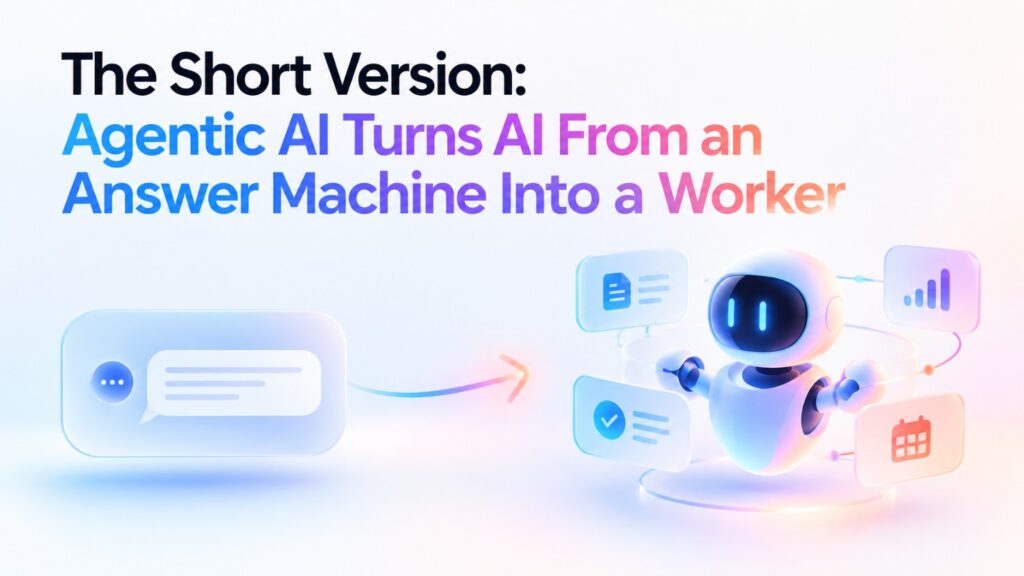
The Short Version: Agentic AI Turns AI From an Answer Machine Into a Worker
The easiest way to understand agentic AI is to compare it with the software that came before it.
Traditional software waits for someone to click buttons.
A chatbot waits for someone to ask a question.
A copilot helps a person complete a task.
An agent can be given an outcome and allowed to perform part of the work needed to reach that outcome.
MIT Sloan describes AI agents as autonomous software systems that can perceive, reason, and act in digital environments to achieve goals for people. NIST similarly describes agentic AI as systems that can make decisions, learn from interactions, adapt, and pursue goals with more independence than traditional AI.
That does not mean agents should operate without limits. In most useful business settings, the better model is controlled autonomy: give the agent authority over a clearly defined area while keeping important decisions, unusual cases, and high-risk actions under human control.
AI Assistant vs. Workflow Automation vs. AI Agent
| System | What the person gives it | What the system does | Typical result |
| Traditional software | Exact commands | Executes programmed steps | One action |
| AI assistant | Question or request | Generates an answer or suggestion | Information |
| Automated workflow | Trigger | Follows fixed steps written in advance | Predictable process |
| AI agent | Goal plus boundaries | Decides how to use tools and complete multiple steps | Completed work |
| Multi-agent system | Larger goal | Coordinates several specialized agents | Complex workflow |
Anthropic makes an important distinction here. A workflow follows paths that developers define in advance. An agent has more freedom to decide which steps and tools are needed while it works toward a goal.
That distinction matters because many products marketed as “agents” are still closer to ordinary workflow automation.
Agentic AI is not simply automation with a new name.
The real change is who decides what happens next.
What Actually Makes an AI System Agentic?
There is no single definition accepted by every researcher, company, and standards body. That is partly because agentic AI exists on a spectrum rather than as a simple yes-or-no category.
Still, useful agentic systems normally share several basic characteristics.
The Agent Has a Goal
Traditional automation needs detailed instructions.
An agent can start from a higher-level goal.
Imagine telling software:
“Find all unpaid invoices older than 60 days, identify the accounts worth contacting, draft the right message for each customer, update the CRM, and send anything unusual to our finance manager.”
A normal program would need rules for almost every branch in that process.
An agent can reason through some of those branches while it works.
The Agent Can Use Tools
A language model by itself mainly generates information.
An agent becomes useful when the model can interact with other systems.
Those tools may let it search databases, retrieve documents, call software interfaces, send messages, update a CRM, run code, access a browser, schedule appointments, or hand a task to another agent. OpenAI’s agent guidance describes the basic structure as a model combined with instructions and tools, with guardrails and handoffs added when needed.
This is why the tool layer matters almost as much as the AI model.
A brilliant agent with no access to the systems where work happens is still mostly an adviser.
The Agent Observes What Happened
A useful agent cannot simply take an action and assume it worked.
It needs feedback.
The system may submit a form, inspect the response, realize a field was rejected, change the input, and try again.
That creates a loop:
Plan → Act → Observe → Adjust → Continue
Anthropic describes agents in similar terms: the model directs its own process and tool use, observes results, and keeps adjusting until the task is complete or human help is needed.
The Agent Has Some Freedom to Decide
This is the part that separates an agent from a fixed workflow.
Suppose three suppliers fail to respond to a purchasing request.
A traditional workflow might send exactly three reminders and stop.
An agent might notice that one supplier usually responds by phone, another has an updated contact record in the CRM, and the third is no longer active. It can choose different next steps based on what it finds.
The point is not unlimited independence.
The point is bounded decision-making.
The Agentic AI Stack in Simple Terms
An AI agent can sound mysterious when described with technical language. In practice, most systems can be understood as a small set of layers.
| Layer | Simple explanation | Example |
| Goal | What the agent is trying to accomplish | Resolve a support ticket |
| Model | The reasoning engine | Decides what should happen next |
| Context | Information the agent needs | Customer history and policies |
| Tools | Systems it can use | CRM, email, billing platform |
| Memory | Useful information retained across steps | Previous actions or preferences |
| Control loop | Plan, act, inspect, repeat | Tries another path after failure |
| Guardrails | Rules limiting behavior | Refund limit of $200 |
| Human approval | Places where a person must decide | Large refund or legal exception |
| Evaluation | Measurement of quality | Was the issue actually resolved? |
The best agentic products usually make these boundaries very clear.
The worst ones hide them.
Why Agentic AI Is Becoming Possible Now
Researchers have worked on autonomous software for decades. The current wave is different because several technologies have reached useful levels at roughly the same time.
Models are better at reasoning across longer tasks. Tool calling has improved. Computer-use systems can interact with interfaces that lack modern software connections. Context systems can retrieve information when it becomes relevant. Companies are also learning how to combine agents with approval rules, testing, monitoring, and human review.
Agent systems therefore do not need to know everything themselves.
They need to know what to do next, what information to retrieve, what tool to call, and when to stop.
That is a much more practical problem.
Why Boston Is an Interesting Market for Agentic AI
Boston has several characteristics that fit this new model unusually well.
The city is full of industries where work is difficult, expensive, technical, regulated, or physical.
That is important because agentic AI becomes more valuable when the workflow contains enough complexity to justify the extra cost and engineering.
Boston Has Lots of High-Value Workflows
Consider the types of problems common across Greater Boston:
Drug researchers have to gather and interpret huge amounts of evidence.
Hospital teams move information between clinical, billing, insurance, scheduling, and administrative systems.
Robotics companies need machines to sense environments and take actions.
Cybersecurity teams investigate alerts across massive amounts of data.
Industrial companies inspect physical equipment.
Financial firms analyze documents and manage controls.
Software teams coordinate increasingly large numbers of coding tools.
These are not simple “write me an email” problems.
They are multi-step jobs.
That is exactly where agents become interesting.
Massachusetts Is Also Building AI Infrastructure Around the Ecosystem
Massachusetts launched the Massachusetts AI Hub to connect government, companies, academic institutions, startups, infrastructure, and workforce programs. The state has funded AI computing capacity and programs aimed at areas including healthcare, life sciences, robotics, financial services, advanced manufacturing, and education.
In May 2026, Massachusetts also announced a Boston-based AI startup accelerator with IBM and Red Hat through the Massachusetts AI Hub.
These programs do not guarantee that Boston will become an agentic AI leader.
But they improve the conditions around companies trying to build difficult AI products.
BostonBizScene Original Research: How Much of Boston’s AI Startup Scene Is Already Agentic?
To move beyond anecdotes, we built a small original dataset.
The goal was not to estimate every agentic AI company in Greater Boston. No complete public database for that category exists, and the meaning of “agentic” is still changing.
Instead, we wanted a transparent sample where every company came from the same starting population.
Our Starting Dataset
We used Y Combinator’s public Boston AI directory as it appeared on September 24, 2026.
The directory displayed 22 AI companies.
We then cleaned the data.
One listing, Insurf, showed its location as Providence, Rhode Island despite appearing in the Boston filter, so we removed it from the location-specific analysis.
Bytebot showed a Boston location but was marked acquired, so we removed it from our main active startup calculation. We retained it only when discussing historical agent infrastructure.
That left:
20 active Boston-located AI companies.
Our Strict Definition of Agentic
We did not count a startup as agentic merely because its page mentioned AI or automation.
To enter the core agentic group, its public description needed to show clear evidence of goal-directed or autonomous action. That meant the product had to do more than generate content, predictions, or recommendations.
We looked for evidence such as:
- explicit AI agents;
- autonomous operation;
- a system deciding how to pursue a stated goal;
- adaptive action across multiple steps; or
- autonomous physical execution.
Two other companies were placed in an agent-adjacent category because they automate important physical or laboratory work but their public descriptions did not provide enough detail to prove dynamic agent-style decision-making.
This conservative method is important.
We would rather undercount agents than call every automated AI product “agentic.”
Original Finding #1: 35% of the Active Boston YC AI Sample Is Already Core Agentic
Seven of the 20 active Boston AI companies passed our strict test.
That produces a core agentic share of:
7 ÷ 20 = 35%
Two additional companies fell into our agent-adjacent group.
Including those would produce a broader estimate of:
9 ÷ 20 = 45%
Chart: Agentic Share of the Active Boston YC AI Sample
Core agentic 35% ██████████████████
Agent-adjacent 10% █████
Other AI 55% ████████████████████████████
Broad agentic + adjacent estimate: 45%
Strict core-agent estimate: 35%
Sample size: 20 active Boston companies
The finding should not be interpreted as “35% of every Boston AI startup is agentic.”
The dataset is limited to companies appearing in YC’s Boston AI directory, so it will reflect YC’s investment mix and company definitions.
But it does show something useful.
Within one consistent sample of young Boston AI companies, true autonomy is already common enough to be a major product category rather than a small experiment.
The Companies That Passed Our Strict Agentic Test
| Company | YC cohort | Main problem | Why we classified it as core agentic |
| Rindler | 2026 | Coding and web-agent infrastructure | Coordinates coding agents and agent actions |
| Degla | 2026 | Drone missions | User states goal; system determines mission execution |
| Boost Robotics | 2025 | Data-center operations | Autonomous robots inspect and perform physical tasks |
| Delineate | 2025 | Clinical-trial research | Publicly describes product as AI agents |
| HYBRD | 2024 | Fitness coaching | Agent adjusts plans around changing user conditions |
| Yuma AI | 2023 | E-commerce support | Autonomous agents resolve customer-service work |
| Nextera Robotics / DIDGE.ai | 2020 | Industrial robotics | AI-native robotics with autonomous operation |
The underlying descriptions come directly from YC’s Boston directory and individual company pages. Yuma, for example, describes autonomous support agents that can retrieve information and take actions in other systems, while Delineate describes agents designed to accelerate clinical-trial work. Boost Robotics describes autonomous mobile manipulation robots for data-center inspection and maintenance.
Original Finding #2: Agentic AI Is Much More Common in Boston’s Newer YC Cohorts
This was the strongest pattern in the dataset.
We divided the 20 active companies into two groups.
The first group included YC companies from 2023 through 2026.
The second covered companies from 2017 through 2022.
There were 11 companies in the newer group and nine in the older group.
Six of the 11 newer companies met our strict definition of agentic.
Only one of the nine older companies did.
Chart: Strict Agentic Share by Startup Era
YC 2023–2026 54.5% ███████████████████████████
YC 2017–2022 11.1% ██████
That means the strict agentic share was approximately 4.9 times higher in the newer group.
The result still held when we ran a broader sensitivity check.
When agent-adjacent businesses were included, the newer group reached 63.6%, compared with 22.2% among the older companies.
Sensitivity Check
| Classification rule | 2023–2026 companies | 2017–2022 companies |
| Strict core-agent definition | 54.5% | 11.1% |
| Core + agent-adjacent | 63.6% | 22.2% |
This is important because classification systems can affect results.
A good analysis should test whether its conclusion disappears when reasonable assumptions change.
Ours did not.
Whether we used the strict or broad test, agentic products were much more concentrated in the newer Boston cohort.
Original Finding #3: Boston’s Agentic Story Is Not Just Software
The seven active core-agent companies also reveal something unusual about Boston.
Only one sits primarily in horizontal agent infrastructure.
Three are vertical digital agents.

Three involve physical autonomy and robotics.
Chart: Type of Core Agentic Company
Vertical digital agents 3 █████████████████████ 42.9%
Physical / robotic agents 3 █████████████████████ 42.9%
Agent infrastructure 1 ███████ 14.3%
This matters because most public discussion around agentic AI focuses on office software.
Boston’s opportunity looks wider.
The city’s robotics, biotech, healthcare, industrial, and scientific ecosystems create places where autonomous systems can move beyond browsers and spreadsheets.
That may become one of the most important differences between Boston and AI markets centered more heavily on pure software.
Degla Shows What Physical Agentic AI Looks Like
Degla is a particularly clear example.
Its YC description says users can express a goal for a multi-drone mission instead of manually controlling each action. The system then determines how to execute that mission and deal with failures.
That is agentic behavior in a physical environment.
The AI is not simply telling a human what a drone should do.
It is translating intent into action.
The distinction matters because Boston has deep robotics expertise. If model intelligence continues moving into machines, warehouses, laboratories, hospitals, industrial sites, and infrastructure, Greater Boston already has many of the skills required to participate.
Boost Robotics Moves the Same Idea Into Data Centers
Boost Robotics is building autonomous mobile manipulation robots designed to inspect and maintain data centers.
The company’s YC profile describes robots performing manual tasks remotely and autonomously in environments where inspection, maintenance, downtime, and service-level failures can become expensive.
This points toward a larger idea.
Agentic AI does not have to look like a digital employee sitting inside Salesforce.
It can be software intelligence connected to a machine.
Original Finding #4: Boston Is Developing Three Different Agent Economies at Once
The evidence suggests that “Boston agentic AI” should not be treated as one market.
It is becoming at least three.
Digital Work Agents
These agents live mainly inside software.
Yuma works in e-commerce support. Delineate works around clinical research. GenHealth.ai is applying agents to healthcare administration.
Their shared idea is simple: give software more responsibility over a business workflow.
Physical Agents
These systems connect reasoning to machines.
Degla works with drones. Boost Robotics works with data-center robots. The broader Boston robotics ecosystem gives this category room to expand.
Scientific Agents
The third category may be the most distinctively Boston-Cambridge opportunity.
Scientific agents do not only complete office tasks.
They form hypotheses, design experiments, control equipment, examine results, and decide what to test next.
Lila Sciences says its operating system for science is designed to execute the scientific method autonomously by generating hypotheses, designing and running experiments, and learning from the results. The Cambridge company announced a $350 million Series A in 2025, bringing the capital disclosed at that point to $550 million.
That is agentic AI connected to a laboratory.
For Boston, that is a very different opportunity from another sales chatbot.
Yuma AI Shows the Shift From Customer Support Answers to Customer Support Resolution
Customer service is one of the easiest places to see the difference between generative AI and agentic AI.
A chatbot answers:
“Where is my order?”
An agent can inspect the customer’s account, locate the order, understand a shipping problem, apply policy rules, update the ticket, communicate with another service, and resolve the case.
Yuma AI describes its platform as autonomous AI agents for customer service and e-commerce. Its YC profile says agents can retrieve information from external systems and take actions in other applications to resolve support tickets.
That changes the KPI.
For chatbots, companies often measure containment, messages answered, or response time.
For agents, the more important question becomes:
Was the work resolved?
That is a much more meaningful business metric.
Delineate Shows Why Boston’s Life-Science Density Matters
Delineate is building AI agents around clinical-trial design and research.
The company says it processes existing clinical-trial research into specialized datasets that can save scientists significant manual work. Its founder, Emily Nieves, previously worked in biological engineering at MIT and in pharmaceutical research at Pfizer and AstraZeneca.
This is a useful example of what could make Boston’s agent ecosystem different.
The opportunity is not simply creating a general agent and looking for customers.
The stronger model may be starting with a difficult industry problem, understanding it deeply, and then applying agentic technology.
In life sciences, domain understanding becomes part of the moat.
GenHealth.ai Shows Why Healthcare Administration May Be an Agent Market
Healthcare has another giant category of repetitive work: administration.
GenHealth.ai announced a $16.5 million Series A in September 2026, bringing its reported total funding to $30 million. The Boston-based company says its agents can work across patient intake, insurance eligibility, prior authorization, billing, denials, electronic health records, payer portals, phones, and other systems.
That is exactly the kind of workflow where agents could create value.
Healthcare administration often involves many systems, many decisions, repeated follow-up, and messy information.
It is not one task.
It is a chain of tasks.
Rindler Shows the Next Problem: Humans Are Becoming the Bottleneck Between Agents
Agentic AI creates its own second-order problems.
What happens when one developer is no longer using one coding assistant, but ten coding agents?
Rindler’s Maxxwell product is aimed at that problem. The company describes software that helps users manage multiple coding-agent sessions and includes an orchestrator designed to understand what those sessions are doing and identify where human decisions are actually needed.
This is a sign of where the market could go.
The first generation of tools helps humans perform work.
The next generation performs pieces of the work.
Then another layer becomes necessary to coordinate, inspect, and control the workers.
Agent management may therefore become its own software category.
The Control Layer Could Become One of the Biggest Agentic AI Markets
The more authority an agent gets, the more businesses need to answer difficult questions.
What systems can the agent access?
What data can it see?
What actions did it take?
Why did it take them?
Can the action be reversed?
What happens if the agent gets manipulated?
Who approves high-risk actions?
How do we stop it?
These are not optional questions once agents begin acting inside companies.
NIST’s current work around agentic AI specifically highlights areas such as testing, interoperability, standards, governance, risk management, and trustworthiness.
Boston is already seeing companies build into this control problem.
Neo Is Building Security for Agentic Software
Boston-based Neo emerged from stealth in July 2026 with $100 million in funding.
The company describes itself as building a control layer that helps security teams identify, monitor, and enforce policies around AI agents, AI-enabled applications, identities, browsers, and other software gaining agent-like capabilities.
Why could this matter?
Traditional security usually assumes software behaves within fairly predictable boundaries.
Agents introduce systems that can choose actions dynamically.
That creates a new problem:
Companies need to control not only what software can technically access, but also what an AI is allowed to decide.
Coralogix Shows Why Observability Becomes More Important as Agents Multiply
Coralogix announced a $200 million Series F in June 2026, bringing its total funding to $550 million.
The Boston-headquartered company explicitly connected the financing to an environment where AI agents and engineers increasingly operate together.
Observability sounds technical, but the business idea is simple.
If an agent makes hundreds of decisions while completing a task, companies need a way to understand what happened.
Otherwise, autonomy becomes opacity.
That is dangerous.
Subconscious Is Attacking the Long-Running Agent Problem
Some agent tasks can finish in seconds.
Others may operate across enormous amounts of context and many steps.
Cambridge-based Subconscious announced $5.1 million across pre-seed and seed funding in September 2026 for infrastructure aimed at long-running agents. The company says its system uses techniques such as context compression and caching to reduce the computing required as agents process more information.
This illustrates another important part of the agent economy.
The winners may not all be companies selling agents to end users.
Some will sell infrastructure that makes everyone else’s agents cheaper, faster, safer, and easier to manage.
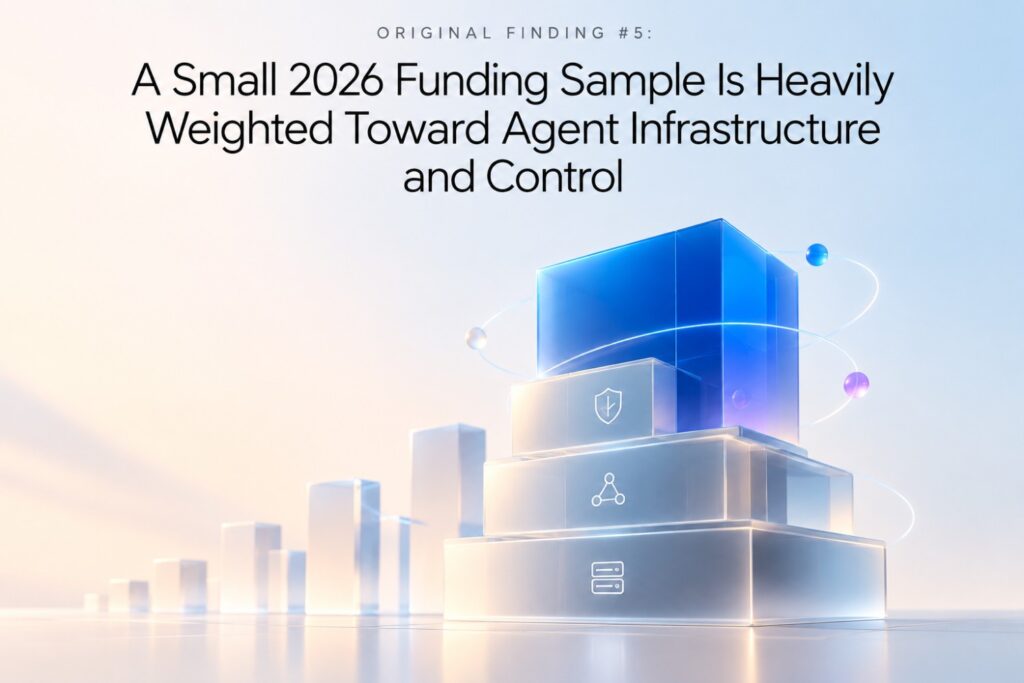
Original Finding #5: A Small 2026 Funding Sample Is Heavily Weighted Toward Agent Infrastructure and Control
We also built a second, narrower dataset.
This one is intentionally illustrative rather than comprehensive.
We collected four Boston or Cambridge agent-related companies with 2026 financing announcements where the financing amount was publicly disclosed and could be verified through public reporting.
| Company | 2026 announced financing | Main agentic layer |
| Coralogix | $200M | Observability / control |
| Neo | $100M | Security / control |
| GenHealth.ai | $16.5M | Vertical healthcare agents |
| Subconscious | $5.1M | Agent infrastructure |
| Total | $321.6M |
Sources: company announcements and contemporary reporting.
Of the $321.6 million in this small disclosed-round sample, $305.1 million went to companies primarily serving the infrastructure, security, or observability layer.
That equals about 94.9%.
Chart: Financing in Our Illustrative 2026 Sample
Agent infrastructure / control $305.1M ███████████████████████████████████████████████
Vertical agent application $16.5M ███
Share of disclosed dollars:
Infrastructure / control: 94.9%
Vertical application: 5.1%
This does not mean 94.9% of all Boston agent investment is infrastructure.
The sample is far too small and was not built from a complete private-market database.
What it does show is that investors are willing to fund the less glamorous parts of the agent stack at very large levels.
That makes sense.
As more agents enter production, security, monitoring, context management, cost control, evaluation, and orchestration become unavoidable.
MIT’s 2026 Startup Pipeline Suggests More Agentic Companies Are Coming
The next wave is visible before companies even become large.
At MIT’s September 2026 Demo Day, participating teams included Banzai, which was building an AI-powered agent for property repair; Exo AI, which was applying AI-native software to financial back-office workflows; Pixology, which was using agentic AI for sales materials; and Robox, which was working on AI for physical automation.
That combination again matters.
Software workflows.
Finance.
Property operations.
Physical automation.
The Boston pipeline is not moving toward a single generic agent.
It is moving toward agents built around domains.
Why Boston Could Be Better Suited to Vertical Agents Than Generic Agents
A general-purpose agent is attractive because the potential market is enormous.
It also creates a difficult competitive problem.
If a product does nothing except place a thin interface around a frontier AI model, the underlying model company may eventually build the same feature.
Vertical agents can create deeper advantages.
A healthcare agent can understand payer processes.
A biotechnology agent can understand scientific evidence.
A security agent can understand access policies.
An industrial agent can understand equipment.
A financial agent can understand documents, controls, and workflows.
A robotics agent can understand the physical system it operates.
The harder the domain, the more room there is to build technology around the model.
Boston has many of those hard domains.
That could be one of its greatest advantages.
Agentic AI vs. AI Copilots: The Difference Businesses Should Care About
The easiest mistake is assuming every task should become autonomous.
It should not.
Copilots and agents are suited to different work.
When a Copilot Makes More Sense
Use a copilot when the person should remain the primary decision-maker.
Good examples include strategy, creative direction, legal judgment, unusual financial decisions, medical judgment, negotiation, and work where the cost of a bad decision is very high.
The AI can gather information and suggest options.
The person decides.
When an Agent Makes More Sense
Agents become attractive when the job contains repeated multi-step execution.
A support case may require six actions.
A healthcare authorization may require checking three systems.
A sales process may require research, CRM updates, follow-up, scheduling, and reminders.
A security investigation may involve collecting logs, checking identities, comparing activity, and escalating suspicious cases.
The more predictable the boundaries but variable the path, the more interesting agents become.
Decision Table: Copilot or Agent?
| Question | Copilot is usually better | Agent is usually better |
| Is judgment highly subjective? | Yes | No |
| Are actions reversible? | Not always | Usually |
| Is there a clear definition of success? | Weak | Strong |
| Does the work involve repeated steps? | Sometimes | Often |
| Can tools expose required data/actions? | Limited | Yes |
| Can exceptions be escalated? | Less important | Essential |
| Is the task performed frequently? | Not required | Usually |
| Can results be tested objectively? | Difficult | Easier |
The correct goal is not maximum autonomy.
It is useful autonomy.
A Simple Authority Ladder for Agentic AI
Businesses should think about agent authority in levels.
Level 1: Read
The agent can inspect information but cannot change anything.
This is the safest starting point.
Level 2: Recommend
The agent can tell a person what action it thinks should happen.
The human still performs the action.
Level 3: Draft
The agent prepares the action but waits for approval.
It might draft an email, prepare a refund, or fill out a form.
Level 4: Execute Within Limits
The agent can act independently when the request stays inside clear boundaries.
A support agent might issue refunds below $100 but request approval above that amount.
Level 5: Operate a Workflow
The agent owns most of a larger process and calls a person mainly for exceptions.
Few businesses should jump directly from Level 1 to Level 5.
Moving one level at a time makes failures easier to understand.
The Best Agentic AI Startups May Sell Outcomes Instead of Seats
Traditional software economics revolve around users.
A company buys 100 licenses for 100 employees.
Agentic software challenges that model.
If one agent performs work previously spread across several tools and multiple people, charging “per seat” becomes less logical.
Companies may increasingly charge for:
cases resolved;
orders processed;
claims completed;
security investigations handled;
documents reviewed;
experiments run;
code tasks completed;
or another measurable unit of work.
That creates a major shift in software positioning.
The question stops being:
“How many employees are using our product?”
It becomes:
“How much work did our product finish?”
The Most Important Agent KPI Is Resolved Work
This deserves extra attention because weak metrics can make an agent look better than it really is.
Imagine an agent answers 10,000 support tickets.
That sounds impressive.
But suppose 4,000 customers come back because their issues were not actually solved.
The message count tells you almost nothing.
For agentic systems, businesses need operational metrics.
| KPI | What it tells you |
| Task completion rate | How often the agent reaches the desired outcome |
| Human intervention rate | How often a person has to rescue the agent |
| Escalation rate | How often a case correctly goes to a human |
| Rework rate | How often completed work has to be fixed |
| Cost per completed task | Whether automation is economically useful |
| Time to resolution | Whether the process is actually faster |
| Tool failure rate | Whether integrations are dependable |
| Recovery rate | Whether the agent can fix problems by itself |
| High-severity error rate | Whether failures create serious business risk |
| Customer outcome | Whether the user got what they needed |
If a vendor talks endlessly about model benchmarks but cannot explain its resolved-work rate, ask harder questions.
Why Agentic AI Can Fail Even When the Model Is Good
Good models do not automatically create good agents.
Agents operate over time.
That multiplies opportunities for failure.
Small Errors Can Compound
Suppose an agent is 98% reliable at each important decision.
That sounds excellent.
But if a workflow contains 20 dependent decisions, reliability can deteriorate quickly if errors compound.
This is why teams need end-to-end evaluation rather than testing individual prompts in isolation.
Tools Break
The model may reason correctly but encounter a changed website, expired login, missing API field, slow database, incorrect permission, or unexpected form.
Real businesses are messy.
Agents have to survive that mess.
Rindler’s product direction itself reflects this challenge: browser and coding agents encounter changing interfaces, pop-ups, authentication gates, and other conditions that make automated action harder.
Agents Can Take the Wrong Action Correctly
This is more dangerous than a chatbot hallucinating a sentence.
An agent might correctly call a refund tool.
The problem is that the refund should never have happened.
Agent design therefore has to separate technical capability from business authority.
The system may be capable of issuing a $20,000 refund.
Its policy should not necessarily allow that.
Human-in-the-Loop Should Mean More Than “A Person Can Check It”
Many companies say their AI has a human in the loop.
That phrase is almost meaningless unless the loop is designed.
Who reviews the action?
Before or after it happens?
What causes a review?
What information does the reviewer see?
Can the action be reversed?
What happens if nobody responds?
How quickly must they respond?

A well-designed agent decides in advance where human judgment belongs.
That is much stronger than placing an “approve” button at the end of a workflow.
Security Becomes More Serious When AI Can Act
Prompt injection was already a problem when AI mainly generated text.
It becomes more dangerous when the same AI can send emails, download documents, change records, run code, or access business systems.
This is why agent permissions should be narrow.
An accounting agent does not need access to every system in the company.
A support agent should not automatically receive administrator privileges.
Anthropic’s work on trustworthy agents emphasizes keeping humans in control, securing agent interactions, maintaining transparency, and protecting privacy as autonomy grows.
The principle is simple.
Give agents the least authority required to perform the job.
Boston Founders Should Start With the Workflow, Not the Agent
The biggest mistake founders can make is starting with:
“We need to build an AI agent.”
Start instead with:
“What expensive work is still being done badly?”
Then examine that work.
Find a Workflow With Real Pain
Good agent opportunities usually have several characteristics.
The process happens frequently.
It consumes meaningful labor.
The result can be measured.
Employees move between multiple systems.
Rules exist, but exceptions also exist.
The company already spends money solving the problem.
That last point matters.
Automation is easier to sell when the budget already exists.
Map the Workflow Before Building the Agent
Write down what a skilled employee currently does.
Where does the task begin?
What information do they collect?
What decisions do they make?
Which systems do they open?
Which actions can be reversed?
Which situations require judgment?
Where do mistakes become expensive?
Which steps create most of the delay?
Only then should the team decide what the agent should own.
Build the Smallest Useful Agent First
Agent demos become complicated very quickly.
That does not mean production systems should.
Anthropic recommends starting with the simplest approach that can solve the problem and adding agentic complexity only when it creates enough value to justify additional cost and latency.
A startup does not need five agents debating one another simply because multi-agent architecture sounds impressive.
Start with one agent.
Give it one job.
Connect only the tools required for that job.
Create clear boundaries.
Measure whether it finishes the work.
Then expand.
Create an Evaluation Set Before Giving the Agent More Authority
A serious agent startup should maintain a large collection of realistic test cases.
Suppose you are automating insurance verification.
Gather examples of:
normal cases;
missing information;
expired policies;
conflicting records;
system failures;
unusual plans;
duplicate patients;
and cases that must go to a human.
Run every meaningful new version of the agent against those cases.
Otherwise, improving one behavior may quietly break another.
A Practical 90-Day Agent Deployment Plan
Boston companies experimenting with agentic AI do not need to begin with company-wide autonomy.
A controlled 90-day deployment is much safer.
Days 1–30: Understand the Work
Choose one narrow workflow.
Measure its current cost, time, error rate, and volume.
Document every system touched by the process.
Identify high-risk decisions.
Define what success means.
Create an initial evaluation dataset from real historical cases.
Do not automate anything important yet.
The goal of the first month is understanding.
Days 31–60: Run in Shadow Mode
Let the agent perform the workflow without taking real actions.
Compare its recommended actions with what employees actually do.
Track disagreements.
Find failure patterns.
Improve tools and instructions.
Decide which actions are safe enough for automation.
Shadow mode is valuable because businesses can learn how the agent behaves without exposing customers or operations to unnecessary risk.
Days 61–90: Grant Limited Authority
Allow the agent to perform reversible, low-risk actions.
Keep high-value or unusual actions behind human approval.
Track intervention rate, cost per completed task, resolution rate, errors, and recovery.
Gradually expand authority only when the data supports it.
That is a better path than announcing “full autonomy” and hoping the system behaves.
Businesses Buying Agentic AI Should Ask Different Questions
Buying an agent is not the same as buying ordinary SaaS.
A normal software product mostly waits for employees to decide what to do.
An agent makes some decisions itself.
The evaluation process therefore has to go deeper.
Ask What the Agent Can Actually Do
Do not accept a polished demo as evidence.
Ask for the exact actions the agent can take.
Can it only read information?
Can it write to the CRM?
Can it issue refunds?
Can it send emails?
Can it operate a browser?
Can it trigger payments?
Can it edit production data?
The answer determines the risk.
Ask How It Knows When to Stop
A good agent needs stopping conditions.
It should know when the task is complete.
It should also know when confidence is too low, permissions are insufficient, information conflicts, a tool fails, or a human decision is required.
Escalation is not a weakness.
Good escalation is a feature.
Ask How Actions Are Logged
Businesses should be able to reconstruct important decisions.
What did the agent see?
What tools did it use?
What action did it take?
What result came back?
Was a human involved?
Without this record, debugging becomes difficult and accountability becomes weak.
Ask for Outcome Data
The strongest vendor question may be:
“Show me what percentage of the work your system completes correctly from beginning to end.”
That is harder to answer than:
“How accurate is your model?”
It is also far more useful.
Agentic AI Could Change Boston’s Startup Economics
Agents may change more than product features.
They may also change how startups themselves operate.
A small company can already use AI for coding, sales research, support, design, analysis, documentation, and internal operations.
As these tools become more autonomous, the amount of work a small team can manage may increase.
That does not mean companies will stop hiring.
It means the shape of hiring may change.
People may increasingly supervise systems, handle unusual cases, build relationships, make high-stakes decisions, design processes, and own outcomes rather than manually perform every repetitive step.
The Next Boston Opportunity May Be the Agent Control Plane
As businesses move from five agents to 50 and eventually hundreds, another market appears.
Companies will need to know:
Which agents exist?
Who created them?
What systems can they access?
What are they costing?
Which model are they using?
What decisions are they making?
Which ones are failing?
Which agents can communicate with each other?
Which actions require approval?
Which agent should be shut down?
Software companies spent decades building identity systems, device management, cloud monitoring, cybersecurity, and access control for humans and traditional software.
The agent economy may need similar infrastructure.
Neo, Coralogix, Subconscious, Rindler, and other companies are approaching pieces of that problem from different directions.
This could become a major enterprise software category.
Multi-Agent Systems Will Matter, but Companies Should Not Rush Into Them
If one agent is useful, it is tempting to assume five agents must be better.
Sometimes they are.
A research agent could gather information.
A financial agent could analyze numbers.
A compliance agent could check rules.
A manager agent could coordinate them.
But every added agent creates new communication paths, costs, delays, and failure modes.
Multi-agent architecture should solve a real coordination problem.
It should not exist because it makes a diagram look advanced.
The right question is:
“Does splitting this job into separate agents make the work more reliable?”
If the answer is no, keep the system simpler.
Scientific Agents Could Become Boston’s Most Distinctive Long-Term Opportunity
Many cities can produce enterprise software startups.
Far fewer combine leading AI research, biotechnology, laboratories, hospitals, chemistry, materials science, robotics, venture capital, and academic talent within a compact region.
That combination is important for autonomous science.
Lila’s stated goal is particularly ambitious: connect AI reasoning with automated laboratories so software can participate directly in the scientific method.
If systems like this work at scale, scientific research begins to look more agentic.
An AI can form a hypothesis.
Software can determine what experiment should test it.
Robotic equipment can perform that experiment.
The results can return to the AI.
The system can decide what to try next.
Humans still set goals, design controls, interpret meaning, and make major scientific decisions.
But the loop between idea and experiment becomes faster.
For a region built around research-intensive industries, that is an important possibility.
Original Research Summary
Our analysis does not prove that Boston will dominate agentic AI.
It does show several meaningful signals.
| Finding | Result |
| Active Boston companies in cleaned YC AI sample | 20 |
| Strict core-agent companies | 7 |
| Strict agentic share | 35% |
| Broader core + adjacent share | 45% |
| Strict agentic share among 2023–2026 companies | 54.5% |
| Strict agentic share among 2017–2022 companies | 11.1% |
| Difference between newer and older strict shares | 4.9× |
| Physical/robotic share of strict agent group | 42.9% |
| Vertical digital share of strict agent group | 42.9% |
| Agent infrastructure share | 14.3% |
| Disclosed financing in our four-company 2026 funding sample | $321.6M |
| Infrastructure/control share of that funding sample | 94.9% |
The most important result may be the difference by age.
Agentic businesses are dramatically more common in the newer YC Boston cohort than the older one.
That is consistent with a startup market moving from AI that generates output toward AI that owns pieces of work.
Limitations of Our Analysis
Original research becomes more useful when its limits are clear.
Our YC dataset is not a complete list of Boston AI companies. YC companies are a particular slice of the startup market.
Company descriptions are also marketing material, not independent technical audits.
Some companies may have agentic capabilities that are not mentioned publicly.
Others may describe autonomy more aggressively than their deployed products currently support.
Our classification therefore measures what could be verified from public product descriptions, not confidential technical capabilities.
We also intentionally used a strict definition.
That is why systems such as Bramante and Perceptive Technologies were placed in the adjacent category rather than automatically counted as agents.
The financing dataset is even narrower. It is an illustrative collection of four publicly announced 2026 financings with verified amounts, not an estimate of all capital invested in Boston agentic AI.
These limits mean the exact percentages should not be treated as ecosystem-wide market-share figures.
The pattern is more useful than the absolute number.
What Boston Founders Should Take From This
Agentic AI is becoming crowded quickly.
Simply adding “agent” to a product will not create a lasting company.
The best opportunities are likely to come from difficult workflows where founders understand the customer better than general-purpose AI companies do.
Boston founders should look closely at healthcare administration, clinical research, scientific discovery, industrial maintenance, robotics, security operations, financial workflows, insurance, compliance, infrastructure, and other areas where local domain expertise is already deep.
Then build from the workflow backward.
Do not start with the model.
Do not start with a multi-agent diagram.
Do not start with the buzzword.
Find painful work.
Understand every decision inside it.
Give the AI only the authority it needs.
Connect the right tools.
Measure completed outcomes.
Build controls before autonomy becomes dangerous.
That approach is less exciting than saying a digital employee will run an entire department.
It is also much more likely to produce a useful company.
The Bigger Story: Boston AI Is Moving From Intelligence to Execution
The first wave of generative AI proved that machines could create useful text, images, software, and analysis from natural language.
Agentic AI asks a harder question:
Can AI reliably complete the work around those outputs?
Boston’s startup scene is beginning to answer that question in several different ways.
Yuma is moving customer support toward autonomous resolution. Delineate is bringing agents into clinical-trial work. GenHealth.ai is targeting healthcare administration. Degla and Boost Robotics connect autonomy with physical machines. Rindler is working on the problem of coordinating agent work. Neo and Coralogix represent the security and monitoring layer. Subconscious is attacking long-running agent infrastructure. Lila is pushing the idea into autonomous science.
Our original YC analysis adds another signal.
Under a conservative classification, 35% of the cleaned active Boston AI sample was already core agentic. Among companies from 2023 onward, that number reached 54.5%.
The technology is still early.
Agents still fail.
Tools break.
Security problems remain serious.
Many workflows should stay under human control.
But the direction is becoming easier to see.
AI software is moving from telling people what they could do toward taking responsibility for carefully defined pieces of work.
For Boston, that shift may be especially important because the region’s strongest industries are full of exactly the kinds of difficult workflows that agents are being built to handle.
The most valuable Boston AI company of the next decade may therefore not be the one with the smartest chatbot.
It may be the one that finds an expensive job, understands it better than anyone else, and builds an agent that can reliably get that job done.