
The next version of the internet may not be built mainly around people opening browsers, searching for information, and clicking links. It may also be built around software systems that can search, communicate, make decisions, and take actions on behalf of people and businesses.
An AI agent, for example, could receive a task from a user, search several services, compare possible options, contact another agent for specialized information, verify whether that agent can be trusted, request approval from a human, complete a transaction, and record what happened. Instead of simply providing an answer, the software could carry a workflow from beginning to end.
Now imagine that process happening not thousands of times, but billions of times every day.
A person might eventually use many specialized agents rather than one general-purpose assistant. A company could operate hundreds or thousands of agents across finance, customer service, security, procurement, software development, research, compliance, and operations. Software platforms could even create short-lived agents for individual tasks and shut them down when the job is complete.
This is the kind of future MIT researchers are beginning to prepare for.
MIT’s Project NANDA, which stands for Networked AI Agents in Decentralized Architecture, is exploring infrastructure for what its researchers call an Internet of AI Agents. The project is focused on a basic but increasingly important question: if autonomous software becomes as common as websites, apps, APIs, and cloud services, how will these systems find one another, prove who they are, communicate securely, establish trust, exchange value, and work across company boundaries?
These are not small questions because the possible scale is enormous.
A NANDA research paper published in 2025 describes a future internet that could support billions or even trillions of autonomous agents that negotiate, delegate work, and interact across networks. The researchers argue that today’s internet infrastructure, including systems built around the Domain Name System, was never designed for a world containing such a large and constantly changing population of software actors.
That is where the idea of the Agentic Web becomes important.
The Agentic Web does not simply mean adding AI chatbots to websites. It describes a broader shift toward an internet where software can increasingly discover, communicate, decide, and act.
For Boston, this subject is particularly important because some of the research is happening in Cambridge, while Massachusetts is also investing heavily in applied AI, high-performance computing, public-sector AI, and advanced technology infrastructure. Project NANDA is even exploring a Massachusetts initiative described as “An Agent for Every Bostonian,” which considers how personal AI agents might interact with public services.
The bigger Boston opportunity, therefore, may not be limited to building better AI assistants. It could come from building the infrastructure required when millions or billions of AI systems need to work with one another safely.
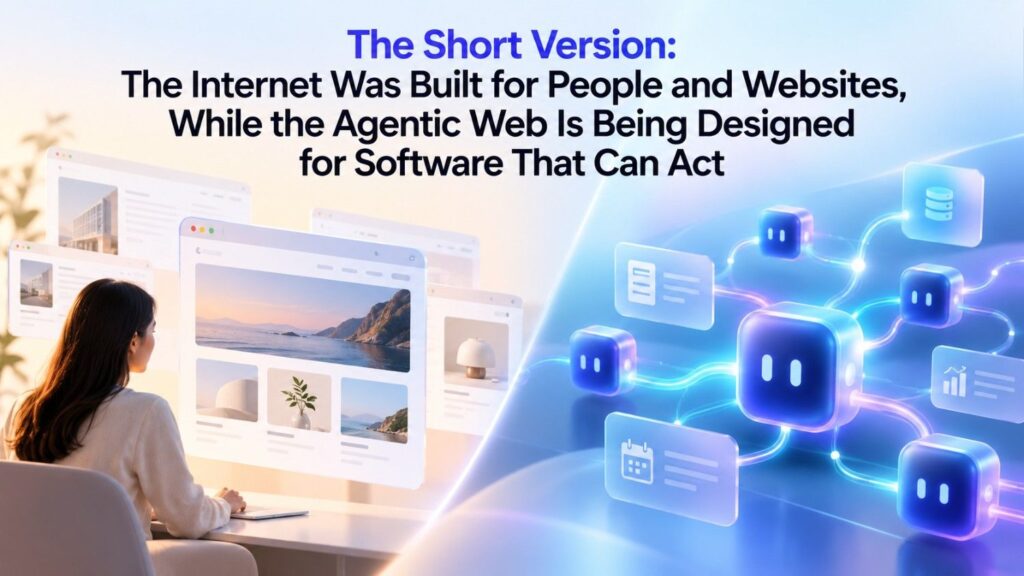
The Short Version: The Internet Was Built for People and Websites, While the Agentic Web Is Being Designed for Software That Can Act
The web most people use today is largely reactive. A person opens a browser, enters a search query, visits a website, fills out a form, clicks a button, or uses an application that communicates with an API.
In most cases, a human begins the process and continues guiding it.
Agentic systems change that model because an AI agent can receive a goal and continue working toward it. The agent may search multiple systems, choose tools, contact other software, review new information, adjust its plan, and complete parts of a workflow without requiring a person to manually control every step.
MIT computer scientist Phillip Isola described agentic AI in simple terms in 2026: it is AI that takes actions in the world. MIT also cited research showing that 35% of surveyed businesses had already deployed AI agents, while another 44% were planning to implement them.
Once software begins taking actions, however, the technical challenge becomes much larger than generating useful text.
An agent needs to know how to find the correct service. It needs to know whether another agent is genuine, what that agent is capable of doing, what information it can safely access, and what authority it has been given. Businesses also need a way to revoke access, monitor activity, prevent abuse, manage payments, and investigate what happened when something goes wrong.
These are infrastructure questions rather than chatbot questions.
That distinction is central to MIT’s work on Project NANDA.
What Exactly Is the Agentic Web?
A useful way to understand the Agentic Web is to compare it with the internet businesses already know.
When someone enters a website address today, a collection of invisible infrastructure systems helps the browser locate the correct server, establish a connection, request information, and deliver the page. The user rarely thinks about any of these technical layers because mature infrastructure is designed to make complexity disappear.
The Agentic Web will need a similar foundation, although the systems being connected are much more complex than ordinary webpages.
An AI agent can have an identity, memory, changing permissions, access to tools, private data, payment authority, and relationships with other agents. Its capabilities may also change over time.
MIT’s NANDA architecture is exploring ways to make these systems easier to discover and verify. One proposed component, the NANDA Index, works with what researchers call AgentFacts, which can publish structured and verifiable information about an agent and its capabilities.
Instead of simply trusting an agent’s claim that it can perform a task, another system could potentially inspect structured information about what the agent does, where it operates, how it can be reached, and what parts of its identity or capability record can be verified.
That creates a very different internet.
The Traditional Web Versus the Agentic Web
| Traditional web | Agentic web |
| A person searches | An agent discovers |
| A person clicks | An agent initiates |
| A website publishes information | An agent exposes capabilities |
| DNS helps locate websites | Agent indexes may help locate agents |
| APIs connect software | Agent protocols connect autonomous systems |
| Humans evaluate trust | Machines also need machine-readable trust |
| Users approve most important actions | Authority can be delegated |
| Sessions are often temporary | Agents may maintain continuing state |
| Humans read information | Software may act on information |
| Companies optimize webpages for people | Companies may also optimize services for agents |
The difference becomes easier to understand when we look at a real business process.
Consider a Boston manufacturer that needs a specialized component.
Today, an employee might search supplier websites, send several emails, request specifications, compare quotes, check vendors against internal policies, create a purchase request, wait for approval, and then arrange shipping.
In an agentic system, much of that work could happen automatically.
A procurement agent could describe the requirement to a supplier network. Supplier agents could respond with availability and pricing. A verification agent could check certifications. A logistics agent could estimate delivery time. A financial agent could compare payment terms, while a compliance agent checks company policy.
The procurement agent could then prepare a recommended transaction and send only the final high-impact decision to a human for approval.
The internet starts to look less like a collection of pages and more like a collection of capabilities that can be discovered and used.
Why MIT Researchers Are Thinking in Trillions
The phrase “trillions of AI agents” can sound exaggerated until we consider what an agent may eventually be.
An agent does not have to be a permanent digital employee with a name, profile, and long-term role. Some agents may exist for years, but others may exist for a few minutes or even seconds.
A software platform could create one agent to inspect inventory, another to compare shipping routes, another to evaluate a contract clause, and another to verify a payment. After completing those tasks, those temporary agents could disappear.
Once agents become lightweight software units rather than single permanent assistants, the possible population grows very quickly.
MIT’s NANDA research explicitly discusses an internet containing billions to trillions of autonomous agents that could negotiate, delegate, and move between systems at machine speed.
That scale changes the nature of the problem.
BostonBizScene Original Analysis #1: What Does One Trillion Agents Actually Mean?
To understand what one trillion agents represents, BostonBizScene compared that figure with the global population.
The U.S. Census Bureau’s population clock estimated the world’s population at roughly 8.21 billion people on September 25, 2026.
Dividing one trillion agents by that population gives the following result:
1,000,000,000,000 agents ÷ 8.2086 billion people = approximately 121.8 agents per person
This does not mean MIT is predicting that every person will personally own 122 AI agents. The calculation is simply a way to understand the size of the system being discussed.
Once agents can belong to companies, machines, software platforms, government systems, temporary workflows, and other agents, their number does not need to remain close to the number of humans.
| Scenario | Agents per person | Approximate global agent population |
| One personal agent | 1 | 8.2 billion |
| Small agent team | 10 | 82.1 billion |
| Large personal and business ecosystem | 100 | 820.9 billion |
| Trillion-agent threshold | ~122 | ~1 trillion |
| Highly fragmented agent economy | 1,000 | 8.21 trillion |
How Quickly Agent Counts Could Grow
1 agent/person 8.2B █
10 agents/person 82B ███
100 agents/person 821B ████████████████
122 agents/person ~1T ███████████████████
1,000 agents/person 8.2T ███████████████████████████████████████
The important point is not that every person will manage hundreds of assistants.
Businesses already operate many automated processes for every employee, and cloud platforms routinely create and destroy computing resources without human intervention. If agents develop in a similar direction, their population could grow much faster than the number of people using them.
That is why MIT’s infrastructure work matters.
Original Finding #2: The Agentic Web Is Already Developing a Protocol Stack
It is easy to imagine the Agentic Web as something that exists only in research papers.
That is no longer the case.
Several important parts of an agent infrastructure stack are already emerging.
Anthropic created the Model Context Protocol, better known as MCP, as an open standard that helps AI applications connect with tools and external data. Instead of every AI company creating separate custom integrations for every database, application, and service, MCP provides a shared approach.
Google created Agent2Agent, or A2A, to support communication between AI agents. Google later contributed A2A to the Linux Foundation. By April 2026, the Linux Foundation said more than 150 organizations were supporting A2A, and the protocol was already being used in production environments across several industries.
MIT’s Project NANDA is working on a different part of the problem, including discovery, identity, verification, and decentralized infrastructure.
These technologies should not be treated as simple substitutes for one another because they address different layers of the ecosystem.
A Simple View of the Emerging Agentic Stack
| Layer | Core question | Example |
| Models | Can the system reason? | Large language models |
| Tools and data | How does an agent use outside systems? | MCP |
| Agent communication | How do agents talk to one another? | A2A |
| Discovery | How does an agent find another agent? | NANDA Index |
| Identity | Who is this agent? | Agent identity systems |
| Capability verification | What can the agent actually do? | AgentFacts and attestations |
| Security | What can the agent access? | Zero-trust controls |
| Observability | What did the agent do? | Agent monitoring systems |
| Payments | How do agents exchange value? | Agentic commerce systems |
| Reputation | Should another agent trust it? | Reputation infrastructure |
| Governance | Who is accountable? | Policy and approval systems |
The commercial importance of these layers becomes easier to see when we compare the situation with the early internet.
The web became enormously useful because every developer did not have to invent networking, naming, and basic communication from the beginning. Shared standards allowed businesses to focus on the service they were building.
The same principle could apply to agents.
If discovery, identity, authorization, communication, and payment become shared infrastructure, startups can focus more of their energy on solving useful business problems rather than rebuilding the underlying network.
Why MCP and A2A Matter
Custom integrations become difficult to manage as the number of systems grows.
Consider a company with 20 internal applications and 10 AI agents. If each agent needs its own separate connection to each system, the number of integrations can increase quickly.
The problem becomes even more complicated when agents from outside vendors need to interact with the company’s internal agents.
MCP addresses part of this challenge by standardizing how AI systems connect with tools and data.
Anthropic said in December 2025 that the MCP ecosystem had grown beyond 10,000 active public MCP servers and had been adopted across major products, including ChatGPT, Cursor, Gemini, Microsoft Copilot, and Visual Studio Code. Anthropic later donated MCP to the Agentic AI Foundation under the Linux Foundation.
A2A addresses another part of the problem by giving agents a common way to communicate.
The Linux Foundation reported in April 2026 that A2A had support from more than 150 organizations. That was roughly three times the level of participation reported around its early launch period.
Another useful signal came from the Linux Foundation in September 2026. It reported that MCP tool calls made by ChatGPT users had grown to 98 times their January level by August 2026.
These figures do not prove that MCP or A2A will become permanent winners.
They do show that agent interoperability has already moved beyond research discussions and into active software development.
Why Discovery May Become the Next Major Infrastructure Problem
A service is not useful if nobody can find it.
The same problem existed on the early web.
A website could technically exist, but without search engines, links, directories, and DNS, discovering that website would be difficult.
Agents will face a similar challenge.
A company might build an excellent shipping agent, medical scheduling agent, tax agent, research agent, or machine-maintenance agent. That does not automatically mean another agent knows that service exists.
Discovery therefore becomes infrastructure.
MIT’s NANDA Index is designed around that problem.
Instead of one agent simply claiming that it can perform a particular task, the system could expose structured information about the agent’s capabilities, network location, identity, and supporting verification data.
NANDA researchers describe AgentFacts as dynamic and cryptographically verifiable. The architecture is designed to support fast resolution, privacy-aware discovery, changing capabilities, key rotation, and rapid revocation.
Those details may sound technical, but they have major commercial consequences.
A global agent economy becomes much harder to build if discovery depends entirely on a few closed corporate directories.
That is one reason MIT researchers have placed so much emphasis on an open Agentic Web.
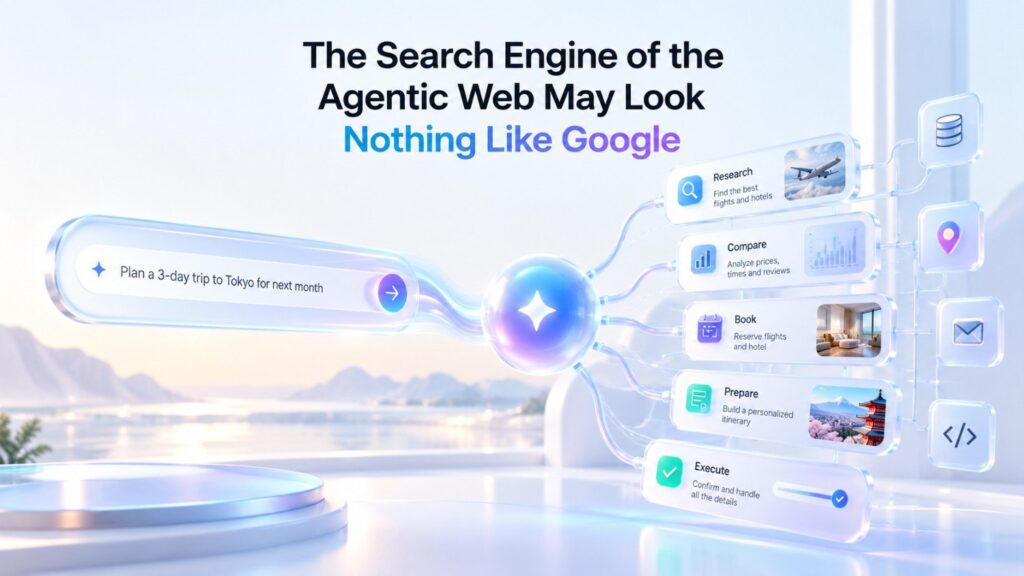
The Search Engine of the Agentic Web May Look Nothing Like Google
Human search engines rank information for people.
Agent discovery systems may need to rank capabilities for machines.
Imagine a hospital agent searching for software that can process a certain type of medical imaging file while meeting strict security requirements.
The agent may need answers to several questions before choosing a service.
Can this agent perform the exact task?
Does it support the correct communication protocol?
Can its identity be verified?
Does it operate in the required region?
What does it charge?
How quickly can it respond?
What data will it access?
How reliable has it been?
Does it meet the hospital’s security rules?
Can access be revoked immediately if necessary?
The result begins to look like a combination of search, DNS, procurement, identity management, cloud orchestration, and cybersecurity.
That creates a wide range of possible markets for Boston startups.
Agent directories, identity platforms, trust systems, reputation layers, secure gateways, testing platforms, observability tools, payment infrastructure, and specialized enterprise agent networks could all become valuable if autonomous software becomes common.
The business opportunity may therefore move away from simply creating another assistant and toward building the systems that allow thousands of assistants to cooperate safely.
Original Finding #3: MIT’s Agent Ecosystem Is Already Broader Than Chatbots
BostonBizScene reviewed public statistics displayed by Project NANDA’s NEST network.
At the time of analysis, the network reported more than 6,000 participants, 75 projects, 61 organization partners, 18 global regions, 2,300 registered agents, 15 research papers, 12 hackathons, and more than 100 industry speakers.
NANDA/NEST Network Snapshot
| Public metric | Reported figure |
| Network participants | 6,000+ |
| Projects | 75+ |
| Organization partners | 61 |
| Global regions | 18 |
| Registered agents | 2,300+ |
| Research papers | 15+ |
| Hackathons | 12 |
| Industry speakers | 100+ |
Those numbers also allow several useful calculations.
Using the minimum reported values, the ecosystem contains at least:
30.7 registered agents per project
80 participants per project
127.8 registered agents per global region
These ratios should not be treated as performance metrics because the projects are not equal in size and many agents may still be experimental.
They do, however, reveal something important about MIT’s approach.
The project is being developed as a network problem, not as a single chatbot product.
MIT’s 2026 Demo Day Shows Where the Infrastructure Is Emerging
MIT Media Lab’s May 2026 Agentic Web demo day provides another useful signal about where researchers and builders see opportunity.
The projects covered areas such as enterprise infrastructure, banking systems, Internet of Things deployment, agent relationships, portable agent packaging, cryptographic isolation, reputation, identity, education, federated learning, and wearable-linked systems.
That mix matters.
If agentic AI were mainly a conversational-interface trend, we would expect most projects to focus on making chatbots smarter.
Instead, many projects are focused on the systems underneath the interface.
Where should agent identity live?
How should state be maintained?
How should an agent move between environments?
How should agents exchange money?
How can a company isolate sensitive information?
How can businesses test agents before allowing them into production?
How should reputation move between networks?
These problems are less visually impressive than a polished assistant demo, but they may create much larger and more durable infrastructure markets.
Original Finding #4: MIT’s Agentic Web Roundtable Was Split Between Infrastructure and Real Industries
MIT’s August 2026 Agentic Web event offers another way to understand the direction of the ecosystem.
The published agenda identified about 30 invited or confirmed companies and organizations across four discussion groups: enterprise applications, agent infrastructure, financial services, and commerce.
BostonBizScene counted the organizations listed in each category.
| MIT roundtable group | Named organizations | Share of 30 named slots |
| Enterprise applications | 9 | 30.0% |
| Agentic ecosystem collaborators | 10 | 33.3% |
| Financial services | 6 | 20.0% |
| Commerce and retail | 5 | 16.7% |
| Total | 30 | 100% |
Composition of MIT’s Published Agentic-Web Roundtable
Agent infrastructure 33.3% █████████████████
Enterprise applications 30.0% ███████████████
Financial services 20.0% ██████████
Commerce and retail 16.7% ████████
The distribution is revealing because roughly one-third of the named organizations were concentrated specifically on infrastructure, while the remaining groups represented industries where agents could perform real work.
That balance is what an emerging platform market needs.
Infrastructure without useful applications has little value, while applications built without reliable infrastructure struggle to scale.
MIT is bringing both sides together.
Why Boston Is an Unusually Strong Place for the Agentic Web
Boston does not need to become the world’s largest consumer AI market to become important in agent infrastructure.
The region’s strengths line up unusually well with the hardest technical and business problems created by autonomous software.
Greater Boston has a long history in enterprise software, cybersecurity, robotics, financial services, health care, biotech, scientific computing, and university research.
That combination matters because agents operating in serious business environments need far more than good language generation.
An AI agent working inside a casual entertainment application can make a mistake without causing serious harm.
An agent working with hospital data, financial transactions, scientific systems, industrial equipment, or government services operates under a very different standard.
In those environments, businesses care deeply about identity, authorization, reliability, audit trails, security, and human oversight.
Those are exactly the kinds of problems that Boston’s technology ecosystem has experience solving.
Massachusetts Is Putting Public Capital Behind Applied AI
Massachusetts has also moved beyond treating AI as a general innovation theme.
The state authorized $100 million for the Massachusetts AI Hub as part of its economic development strategy. Its FY2026-FY2030 capital plan includes approximately $68.6 million for the initiative, including $10 million in FY2026 and roughly $33.3 million in FY2027.
Massachusetts also announced a $31 million grant in 2025 to expand access to sustainable high-performance computing.
Those investments do not guarantee that Massachusetts will become a major Agentic Web center.
They do, however, strengthen several important ingredients.
Agent infrastructure requires computing capacity, research talent, companies willing to run experiments, strong universities, public-private collaboration, and organizations that can test systems in demanding real-world environments.
Boston has all of those ingredients.
The “Agent for Every Bostonian” Experiment Could Be Especially Important
Project NANDA’s public materials describe a Massachusetts initiative called “An Agent for Every Bostonian.”
The idea is to explore personal AI agents that could help residents navigate public services while allowing users to maintain greater control over their own information.
NANDA’s Civic Agents work goes further by exploring an open infrastructure layer through which private resident agents could connect to public services.
This is an important experiment because government services expose many of the hardest problems in agent design at the same time.
Identity matters because the system must know which resident it is serving.
Privacy matters because public services can involve sensitive information.
Accessibility matters because residents have different abilities, languages, and levels of technical knowledge.
Permissions matter because an agent that reads information should not automatically gain authority to submit forms or make binding changes.
Accuracy matters because government information changes and mistakes can affect benefits, deadlines, taxes, or legal obligations.
A useful public agent cannot simply be a chatbot with city information.
It needs a reliable technical foundation.
BostonBizScene Original Analysis #5: A City-Scale Agent Population Could Become Huge Very Quickly
The U.S. Census Bureau estimated Boston’s July 1, 2025 population at 672,973.
If the city eventually had one software agent associated with every resident, Boston would already contain close to 673,000 personal agents.
However, the numbers become much larger when agents are specialized.
| Scenario | Agents per Boston resident | Potential agent instances |
| One general personal agent | 1 | 672,973 |
| Small team of specialized agents | 10 | 6.73 million |
| Broad ecosystem | 100 | 67.30 million |
| Global trillion-scale equivalent | 122 | 82.10 million |
| Highly granular architecture | 1,000 | 672.97 million |
These figures are not deployment forecasts.
They are scenario calculations designed to show how quickly agent populations can grow once software becomes specialized and temporary.
Even a single city could eventually generate tens of millions of agent identities or instances if agents are created for different tasks.
At that point, registration, authentication, discovery, reputation, and revocation stop being abstract research topics.
They become operating requirements.
Identity Could Become One of the Largest Markets in Agentic AI
The internet has already shown how important digital identity becomes once valuable activity moves online.
The Agentic Web raises the stakes because agents may be able to act rather than simply log in.
Imagine that an AI agent contacts a business and claims to represent one of its customers.
Should the business trust that agent?
Can the agent see the customer’s invoice history?
Can it change an address?
Can it request a refund?
Can it negotiate a contract?
Can it spend $50?
Can it spend $50,000?
Can it delegate its authority to another agent?
Can the customer revoke that authority immediately?
These questions turn identity into something much larger than login security.
The real issue becomes authority.
MIT’s NANDA research has explored zero-trust approaches to agent access, extending familiar cybersecurity ideas into environments containing autonomous software.
That could create a large opportunity for Boston’s cybersecurity industry.
Identity and Authority Need to Be Separated
One of the most important design principles for agent systems is that a trusted identity should not automatically receive unlimited permission.
A finance agent can be genuine while still lacking permission to hire an employee.
An HR agent can be authentic while having no authority to transfer company money.
A purchasing agent may be allowed to approve a $300 order automatically while requiring human approval for a $30,000 purchase.
Businesses should therefore think about agents across several separate dimensions.
Who is the agent?
What job is it supposed to perform?
What information can it access?
What actions can it take?
How much authority has been delegated?
Who is responsible for its behavior?
Organizations that answer these questions early will have a much easier time scaling agent systems safely.
Reputation Will Matter Because Identity Does Not Prove Quality
Knowing that an agent is genuine does not tell another system whether the agent performs well.
The same principle applies to ordinary businesses.
A registered company may be legitimate, but that does not mean it provides reliable service.
Agent markets may eventually need machine-readable reputation.
A system could potentially evaluate how often another agent completed similar tasks successfully, how quickly it responded, whether its claims had been verified, whether it had generated security incidents, or how often users reversed its actions.
Reputation becomes especially important when agents begin selecting services automatically.
Humans use reviews and recommendations.
Agents may use structured trust signals.
That could produce an entirely new market around machine-readable reputation and capability verification.
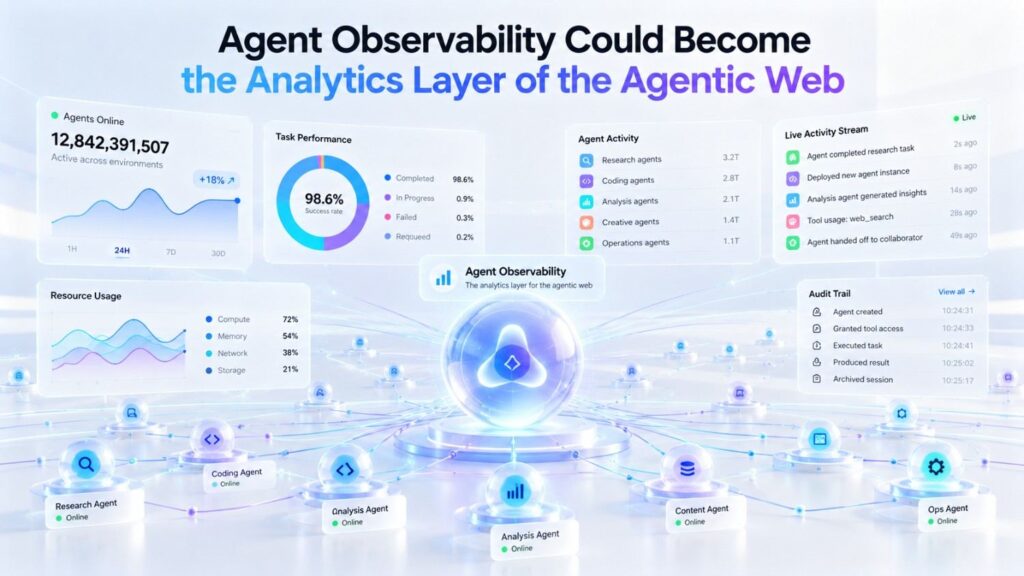
Agent Observability Could Become the Analytics Layer of the Agentic Web
Traditional digital analytics answers questions such as how many people visited a website, which page converted best, or where users abandoned a process.
Agent analytics will need to answer very different questions.
Which agent started this workflow?
Which tools did it use?
Which other agents did it contact?
What information did it receive?
Why did it choose a particular action?
How much did the workflow cost?
Which permissions were used?
Which model made the decision?
Was a human required to approve it?
Can the entire process be reconstructed after an incident?
As businesses move from a small number of assistants to networks of agents, these questions become essential.
The greater the level of autonomy, the more valuable observability becomes.
Agent Economics May Matter as Much as Agent Intelligence
A technically impressive agent can still be a bad business investment.
Imagine an agent that saves an employee five minutes but spends $8 on model inference, tool calls, search queries, and external services.
At small scale, that cost may be easy to ignore.
At one million tasks, it becomes a major operating expense.
MIT researchers are already studying this problem.
In June 2026, MIT researchers described a system called Murakkab that aims to improve complex agent workflows by optimizing how models and tools are selected. The goal is to reduce wasted computation, energy, and cost.
This points to one of the most important enterprise metrics for agentic AI:
cost per completed business outcome.
Cost per token is useful for engineers.
Cost per resolved customer issue, processed invoice, completed engineering ticket, or successful procurement request is far more useful for business leaders.
The Agentic Web Could Create a Machine-to-Machine Economy
Once agents can discover one another, communicate, verify identity, and operate with delegated authority, payments become a natural next layer.
Imagine an agent that needs access to a specialized dataset for only a few seconds.
The agent could find the provider, verify its reputation, purchase access, use the data, and continue working.
No salesperson would need to schedule a demo.
No employee would need to enter a credit card.
No annual software contract would necessarily be required.
This could create a much more granular software economy.
Instead of paying $50 per user every month for access to a large software package, an agent might purchase tiny pieces of capability only when needed.
The exact prices could vary dramatically, but the model could look something like this:
A few cents for identity verification.
A few cents for a specialized data lookup.
A larger fee for an advanced model call.
A higher fee for a complex research or compliance workflow.
The specific examples are hypothetical, but the broader change is important.
Software could increasingly be purchased by machines for use by other machines.
Project NANDA’s roadmap already identifies agentic commerce and knowledge pricing as areas worth exploring.
SaaS Discovery Could Change
Today’s software market is built mainly around people.
Companies buy advertisements, rank in Google, create landing pages, send sales emails, host demos, negotiate contracts, and persuade buyers to sign up.
Agents could compress parts of this process.
A business agent might discover another software agent through a directory, inspect its capabilities, verify its reputation, test it inside a sandbox, calculate expected costs, and begin using it through an API or agent protocol.
If that model grows, the traditional software homepage becomes less important for some transactions.
Machine-readable capabilities become more important.
That could eventually create something similar to SEO for AI agents.
What Agent Optimization Might Look Like
Software companies may eventually need to describe themselves not only in persuasive marketing language but also in structured data that autonomous systems can understand.
An agent may need to know exactly what tasks a service can perform, which protocols it supports, how much an action costs, which authentication methods it accepts, where information is processed, how long data is stored, and what permissions are required.
It may also need to know uptime history, available regions, security certifications, version information, and how quickly access can be revoked.
This is very different from ordinary website copy.
Humans need stories, benefits, explanations, and brand trust.
Machines need structured facts.
Future digital strategy may require both.
Security Changes When Software Stops Answering Questions and Starts Taking Actions
A chatbot giving a wrong answer can create problems.
An autonomous agent taking the wrong action can create much bigger problems.
MCP-enabled systems, for example, may connect AI models to tools that can create, edit, delete, or send information. Anthropic’s own guidance warns users to evaluate permissions carefully when working with tools capable of taking actions.
Agent security therefore cannot stop at protecting the underlying AI model.
Businesses also need to protect the action layer.
An attacker may not need to steal a model or break into a database.
They may only need to persuade an agent to perform an authorized action for the wrong reason.
That makes prompt injection, tool permissions, identity, delegation, transaction limits, and human approval part of the cybersecurity perimeter.
Human Approval Needs to Be Designed Into the Workflow
The phrase “keep a human in the loop” is often used when discussing autonomous AI.
That principle is sensible, but it is too vague to function as an operating model.
Businesses need to decide exactly where people should enter the workflow.
Consider a purchasing agent.
The agent could search suppliers automatically, request quotes, compare prices, inspect delivery times, and draft a purchase order without human involvement.
A purchase under $500 might be approved automatically.
A purchase over $10,000 might require manager approval.
Changing a supplier’s bank information could always require human verification.
Adding a completely new supplier might require a procurement review.
The human does not need to supervise every small step.
The human should appear at the point where authority, risk, or financial impact becomes meaningful.
That is a far more scalable model.
What Boston Companies Should Do Right Now
Most companies do not need to build their own internet-scale agent protocol.
They do, however, need to prepare for a world where more software systems communicate and act automatically.
Start by Mapping Business Actions Rather Than Chatbot Ideas
Instead of asking where a chatbot could be added, companies should begin by identifying repetitive actions that already move between several systems.
Invoice processing is one example.
Customer support is another.
Other strong candidates include supplier checks, scheduling, document review, compliance monitoring, sales operations, software testing, internal reporting, and research.
These workflows are more useful starting points because agentic AI creates value by completing work, not simply by answering questions.
Separate Low-Authority Work From High-Authority Work
Reading a product catalog is not equivalent to sending money.
Summarizing a company policy is not equivalent to changing that policy.
Scheduling an internal meeting is not equivalent to signing a contract.
Companies should categorize agent actions by impact.
Once that work is complete, teams can automate low-risk processes quickly while adding stronger controls around high-risk activities.
Build an Internal Agent Registry
Even if global agent directories are still evolving, companies can create their own internal inventory.
Every agent should have a clear owner.
Its purpose should be documented.
The organization should know which model it uses, which tools it can access, which data it can read, which actions it can take, and which human is responsible for approving important decisions.
Companies should also record cost, version, deployment status, incident history, and the process required to shut the agent down.
This becomes increasingly important as the number of agents grows.
If a company eventually operates 500 agents and cannot identify who owns 200 of them, it has already created a governance problem.
Measure Completed Work Rather Than Adoption
Agent deployments should not be judged mainly by how many employees opened the tool.
Businesses should measure outcomes.
How many customer problems were fully resolved?
How many invoices were processed accurately?
How many engineering tasks were completed?
How often did the agent need human help?
How often did people reverse an agent’s decision?
How much did each successful workflow cost?
Those metrics reveal whether agentic AI is creating actual economic value.
The Agentic-Web KPI Dashboard Boston Companies Should Build
| Metric | Why it matters |
| Tasks initiated | Shows workload volume |
| Tasks completed | Measures actual output |
| Successful completion rate | Measures reliability |
| Human escalation rate | Shows dependence on people |
| Human reversal rate | Reveals incorrect decisions |
| Cost per completed task | Measures economics |
| Average tool calls per task | Reveals inefficient workflows |
| Agent-to-agent calls | Measures orchestration complexity |
| Permission failures | Highlights architecture problems |
| Security exceptions | Measures risk |
| Average execution time | Measures operating speed |
| Failed identity checks | Reveals trust issues |
| Unauthorized-action attempts | Measures control effectiveness |
| Average agents involved per workflow | Tracks system complexity |
Executives do not need to understand every technical detail behind agent architectures.
They do need to understand whether autonomous systems are reliable, safe, and financially useful.
Boston Startups Should Be Careful About Building Another Generic Agent
Generic AI assistants will be difficult to defend over time.
Large model providers can add new features quickly.
Enterprise software companies can bundle agents into products they already sell.
Startups may find more durable opportunities deeper in the stack.

Security, identity, discovery, testing, observability, memory, governance, payments, human approval systems, and industry-specific workflow infrastructure can all become more valuable as the agent population grows.
A useful strategic principle follows from that:
Build around the problems created by abundant agents rather than simply building another agent.
The market for agent infrastructure can grow even when individual agent products change.
Boston’s Regulated Industries Could Become an Advantage
Boston’s concentration in health care, biotech, financial services, scientific research, and advanced industry can sometimes slow the adoption of new technology.
In the Agentic Web era, that difficulty may become an advantage.
A company that learns how to make autonomous systems work safely around medical information, financial approvals, scientific workflows, and industrial operations is solving harder problems than a company building a low-risk consumer application.
Those solutions can often move into less regulated markets later.
The reverse is not always true.
Security controls designed for a casual consumer application may not be strong enough for a hospital, bank, or industrial environment.
Boston therefore has a chance to build infrastructure that is useful precisely because it was tested in difficult conditions.
The Real Moat May Be Trust
Foundation models will continue to improve.
Inference costs will change.
New agent frameworks will appear.
Today’s most popular interface may disappear.
Trust is harder to replace.
Businesses will pay for systems that help them answer difficult questions.
Can this agent act safely?
Can we prove what happened?
Can we stop it immediately?
Can we control its authority?
Can another organization verify its identity?
Can regulators understand the decision trail?
Can customers control their own data?
Can we reconstruct the entire workflow after an incident?
Companies that solve these problems could become infrastructure providers for a much larger AI economy.
MIT Is Studying Populations of Agents, Not Just Individual Agents
One of the most interesting parts of MIT’s broader work is research on large populations of AI agents.
MIT Media Lab researchers have already explored simulations involving millions of LLM-guided agents.
This matters because systems behave differently when they become very large.
Ten cooperating agents mainly create an engineering challenge.
Ten million interacting agents can begin to look like an economic or social system.
Agents may compete for resources, copy strategies, form temporary groups, overwhelm services, or create unexpected feedback loops.
An action that seems safe for one agent can become dangerous when a million agents perform it at the same time.
This is another reason the Agentic Web should not be understood as simply a larger version of today’s chatbot market.
At scale, population behavior becomes part of system design.
Internet-Scale Agents Could Produce Internet-Scale Traffic
Human browsing has natural limitations.
People sleep.
People read slowly.
People cannot inspect thousands of webpages every second.
Agents do not share those constraints.
MIT research has noted that machine systems can access far more online resources than a person could realistically inspect while completing the same task.
That could eventually change internet traffic itself.
A company’s next customer may arrive as software.
Its next supplier may be selected by software.
Its prices may be compared by software.
Its documentation may be read mainly by software.
Its API may become more important than its homepage.
That is a major change in digital strategy.
The Web May Move From Pages to Capabilities
The first web was largely about organizing documents.
Search engines made those documents easier to find.
Social platforms organized people and content.
Cloud platforms organized computing resources.
The Agentic Web may increasingly organize capabilities.
Can a service book this shipment?
Can it verify this identity?
Can it check this regulation?
Can it translate this document?
Can it analyze this dataset?
Can it run this experiment?
Can it negotiate this purchase?
The valuable digital object shifts from information that can be read toward work that can be performed.
That change could reshape how software is distributed and purchased.
What the Agentic Web Could Mean for SEO and Digital Marketing
The rise of agents does not mean human marketing disappears.
Instead, businesses may eventually serve two different audiences.
Human buyers still need stories, proof, brand trust, clear explanations, and persuasive content.
Agents need structured facts.
A future Boston software company may therefore maintain polished landing pages for human visitors while also publishing machine-readable information about its capabilities.
Traditional SEO asks what a person is searching for.
Agent optimization may ask whether a requesting system can understand, evaluate, verify, and use a company’s service automatically.
That could make digital marketing more technical.
BostonBizScene’s Agentic-Web Opportunity Map
Based on MIT’s NANDA research, MCP, A2A, and the broader development of multi-agent systems, several infrastructure categories are beginning to emerge.
| Opportunity | Core business problem |
| Agent discovery | Finding the right agent |
| Agent identity | Proving who an agent is |
| Capability verification | Proving what an agent can do |
| Permission management | Controlling allowed actions |
| Agent gateways | Securing machine interactions |
| Observability | Tracking decisions and actions |
| Agent testing | Measuring reliability |
| Reputation | Measuring historical trust |
| Payments | Supporting machine transactions |
| Cost optimization | Reducing workflow costs |
| Memory infrastructure | Maintaining useful state |
| Industry agents | Executing specialized workflows |
| Sandboxes | Testing risky capabilities safely |
| Governance | Connecting autonomy with policy |
| Civic infrastructure | Connecting resident agents to public services |
These categories should not be treated as a ranking.
Some will mature earlier than others, and the eventual market structure could change considerably.
The main lesson is that a very large amount of economic value may exist around the agent rather than inside the agent itself.
The Biggest Mistake Would Be Assuming One Company Will Own Everything
The early internet could easily have developed as a collection of closed networks that could not communicate easily.
Open standards helped produce something much larger.
The same tension is now appearing in agentic AI.
A single platform that controls identity, discovery, communication, tools, payments, and marketplaces may offer convenience, but it can also create strong lock-in.
A completely fragmented ecosystem creates the opposite problem because connecting systems becomes too difficult.
The challenge is finding a workable middle ground based on interoperability.
That is why MCP, A2A, NANDA, and similar efforts matter.
MIT Sloan framed the issue in 2026 as a question of who will own the AI-agent economy, noting that Project NANDA is attempting to establish open infrastructure before the market becomes heavily consolidated.
What Business Leaders Should Watch Over the Next 24 Months
The most useful signal will not be the number of agent demos launched.
Business leaders should watch whether agents begin communicating reliably across vendor boundaries.
They should watch whether standardized identity systems emerge, whether agent directories become widely used, and whether companies begin exposing agent-ready services alongside traditional APIs.
Machine-readable reputation will also be worth watching.
So will agent payment systems, security gateways, observability platforms, and governance software.
Another important signal will be the behavior of insurers, regulators, hospitals, banks, and large enterprises.
If these organizations begin treating autonomous software as a distinct operational category rather than a feature inside ordinary applications, the Agentic Web will have entered a much more serious phase.
Boston should be watched closely because some of these ideas are already moving from MIT research into enterprise and civic experiments.
A Practical 90-Day Plan for Boston Companies
Businesses do not need to wait for a trillion-agent internet before preparing for agentic systems.
A focused 90-day program can create useful experience without giving software unlimited authority.
Days 1-30: Map the Agent Surface
Begin by identifying workflows that already move across multiple systems.
Document the APIs, databases, applications, and sensitive information involved.
List actions that could create financial, legal, security, or customer risk.
Companies should also create an inventory of AI systems already being used internally.
This exercise often reveals that employees have already created informal agent-like workflows using automation tools, scripts, or AI assistants.
Days 31-60: Build One Bounded Workflow
Choose a process where an agent can produce measurable value without receiving broad authority.
Give the system access only to the tools it actually needs.
Define permissions clearly.
Log every action.
Place human approval at the most important decision point.
Then measure the cost per completed task.
The goal should not be to create the most impressive demonstration.
The goal should be to determine whether the workflow works reliably.
Days 61-90: Test Failure and Interoperability
Once the workflow works under normal conditions, deliberately test situations where it might fail.
Test expired credentials.
Test inaccurate information.
Test unavailable tools.
Test duplicate actions.
Test unexpected instructions.
Test identity failure.
Test how quickly the agent can be shut down.
If another agent is involved, test what happens when that agent provides incorrect information or falsely claims a capability.
Organizations that test failure early will learn much more than those that only demonstrate perfect scenarios.
The Bigger Story: Boston Could Help Build the Infrastructure for an Internet Full of Digital Actors
The first major wave of generative AI was mainly about creation.
AI generated text, images, code, summaries, and answers.
The next wave is increasingly about execution.
AI can search, book, buy, route, monitor, compare, approve, and coordinate.
Once software can act, identity becomes essential.
Once agents communicate, they need shared protocols.
Once they meet unfamiliar agents, they need discovery and trust.
Once they exchange money, economic infrastructure becomes necessary.
Once companies operate thousands of autonomous systems, observability becomes critical.
Once millions of agents interact, population behavior becomes part of the problem.
Once those agents touch the real world, governance becomes unavoidable.
That is why MIT researchers are thinking beyond individual assistants.
Project NANDA is asking a much larger internet-design question:
What infrastructure must exist if autonomous software becomes a major population on the network?
The trillion-agent figure should therefore be interpreted carefully.
It is not evidence that the internet will definitely contain exactly one trillion active AI agents by a specific year.
It describes a possible scale that future infrastructure may need to support.
BostonBizScene’s calculations help explain why that possibility is not mathematically absurd.
At today’s global population, one trillion agents represents roughly 122 agents for every person.
When agents can be temporary, specialized, organizational, machine-owned, or automatically created by other software, their population does not need to remain close to the number of humans.
The infrastructure problems begin long before the world reaches one trillion agents.
At billions of agents, discovery becomes difficult.
As the population grows, identity and reputation become increasingly important.
At very large scale, efficiency, security, interoperability, payments, and governance become foundational requirements.
Boston has an unusual opportunity because several of these problems are already being studied in Cambridge while Massachusetts is investing in AI research, computing capacity, public-sector adoption, and commercialization.
The most important Boston companies of the Agentic Web era may therefore not be the ones that build the most human-looking assistant.
They may be the companies that solve the deeper problems.
How should autonomous systems find one another?
How can software prove its identity?
How can businesses verify what an agent is allowed to do?
How should millions of machine actions be monitored?
How can agents exchange information and money securely?

How should humans remain in control when software operates at machine speed?
The modern web became powerful because shared infrastructure allowed billions of people, services, websites, and applications to connect.
MIT researchers are now exploring what the internet will need when another enormous population joins that network.
That population may not be human.
It may be software.
If the number of autonomous agents grows from millions to billions and eventually toward trillions, the infrastructure underneath them could become one of the largest new technology markets Boston has seen in decades.
Research Methodology and Notes
BostonBizScene’s analysis uses publicly available information available through September 25, 2026.
The research draws from MIT Media Lab’s Project NANDA materials and publications, the NANDA/NEST network statistics, MIT Agentic Web event materials, MIT research on large agent populations and workflow efficiency, Linux Foundation announcements related to A2A and MCP, Anthropic’s MCP material, Massachusetts government AI investment records, and U.S. Census Bureau population data.
All calculations labeled BostonBizScene Original Analysis were produced specifically for this article from published source figures.
The global trillion-agent calculation divides one trillion by the U.S. Census Bureau’s estimated global population of approximately 8.2086 billion on September 25, 2026.
The Boston scenario analysis uses the Census Bureau’s July 1, 2025 population estimate of 672,973.
The MIT Agentic Web roundtable analysis counts named organizations across the four groups listed in the public August 3, 2026 event agenda. Each group’s percentage represents its number of named organization slots divided by the total of 30 listed slots.
The NANDA/NEST ratios were calculated using published minimum figures of 2,300 registered agents, 75 projects, 6,000 participants, and 18 regions. Because several source numbers were shown with a “+” sign, the calculated ratios should also be treated as minimum or approximate values.
The scenarios showing 10, 100, 122, or 1,000 agents per person are not predictions. They are sensitivity analyses designed to demonstrate how quickly agent populations can grow when agents become specialized, temporary, or automatically created.
Likewise, references to possible future markets such as reputation systems, agent payments, discovery optimization, identity infrastructure, and agent analytics represent strategic analysis based on emerging technical requirements. They should not be interpreted as claims that any one business model or protocol is guaranteed to dominate.
That distinction is important because the Agentic Web is still being built.
What is becoming increasingly clear, however, is that the infrastructure problems surrounding autonomous software are no longer difficult to imagine.
They are already beginning to appear.