
For the last few years, most business conversations about artificial intelligence have started with a chat box. An employee types a question, the AI produces an answer, and the employee decides what to do next. The system might summarize a document, draft an email, explain a spreadsheet, or suggest how to respond to a customer.
That was an important first step, but it did not change the basic structure of work. The human employee still had to take the answer, open another system, make a decision, complete the task, record what happened, and move on to the next item.
That model is now beginning to change.
A new generation of enterprise AI systems is being designed to do more than answer questions. These systems can research accounts, update CRM records, handle support cases, launch marketing campaigns, screen candidates, investigate technology incidents, process medical coding work, use business software, and hand tasks to other agents or people when they reach a decision they should not make alone.
That shift matters because it moves AI from the edge of business operations into the workflow itself.
A chatbot might tell a restaurant operator that lunch sales have declined. A digital worker can potentially detect the decline, identify the right customer group, prepare a campaign, create the audience, and help execute that campaign through the restaurant’s existing software.
A chatbot might explain why a software incident probably happened. An operational agent can investigate the issue, gather evidence, apply an approved remediation process, verify whether the fix worked, and escalate the case if the problem falls outside its authority.
A chatbot can suggest which billing code may fit a clinical record. Autonomous coding software can process eligible records without requiring a human coder to manually handle every standard case.
The difference is not simply that the AI is getting smarter. The more important change is that software is beginning to receive permission to perform parts of the work.
That movement from answering questions to completing work could become one of the biggest changes in enterprise software since the rise of cloud applications.
Boston is emerging as an especially useful place to study that transition.
BostonBizScene analyzed a hand-built dataset of 11 Greater Boston companies with products connected to enterprise AI agents, digital workers, orchestration, agent infrastructure, or agent security. The sample includes application companies such as HubSpot, Klaviyo, Toast, Bullhorn, Dynatrace, Tulip, and CodaMetrix, along with companies building orchestration, infrastructure, governance, and security layers, including Pegasystems, DataRobot, Subconscious, and Snyk.
The most interesting conclusion from this analysis is not simply that Boston has a growing number of AI-agent companies. The stronger finding is that many Boston companies are attaching AI to well-defined business systems and giving it carefully limited responsibilities.
In other words, Boston is not mainly building a fantasy of one universal AI employee that can run an entire company. Its stronger pattern is much more practical: put AI inside an existing workflow, give it access to the right tools and data, define what it can and cannot do, and measure whether it can complete a specific kind of work.
The Short Version: Boston Enterprise AI Is Moving From Conversation to Execution
The easiest way to understand the change is to think about enterprise AI as a progression.
Chatbots answer. Copilots help. Agents act. Digital workers take ownership of defined pieces of work.
That does not mean companies are removing humans from every process. In many cases, the opposite is happening. Human employees are becoming supervisors, reviewers, exception handlers, decision makers, and owners of the rules under which AI operates.
The software takes over more of the repetitive execution between those human decisions.
Boston-area companies are already showing what this looks like in real products.
HubSpot has been expanding Breeze across customer service, prospecting, data work, and other CRM functions. Its Prospecting Agent can research accounts and assist with personalized outreach, while Customer Agent can handle customer conversations and support tasks. HubSpot said in its February 2026 earnings call that more than 8,000 customers had activated Customer Agent during 2025 and more than 10,000 had activated Prospecting Agent. The company also said its Data Agent was being used to automatically enrich customer information.
Klaviyo is moving in a similar direction inside marketing and customer service. Its Composer agent can help create campaigns and flows, while Customer Agent works directly with customer interactions and can connect with additional business systems.
Toast is bringing agentic AI into restaurants. Its AI-powered Marketing Agent is designed to help operators move from identifying a demand problem to creating audiences and campaigns that can address it.
Bullhorn has gone even further in its language by explicitly calling some of its products Digital Workers. Those systems can perform parts of candidate matching, outreach, screening, prospecting, verification, auditing, and transcription.
Dynatrace is applying the same principle to technology operations. Its autonomous agents can assist with incident triage and remediation, moving observability software beyond explaining problems and toward resolving them.
Tulip applies the digital-worker idea to manufacturing. Its AI agents can make decisions and take actions inside defined manufacturing workflows.
CodaMetrix offers another important example because its technology does not need to look like a chatbot at all. Its software autonomously converts clinical documentation into medical coding inside healthcare revenue-cycle workflows.
Behind these application products, other Boston companies are building the systems needed to make AI workers reliable. Pega is developing orchestration for agents and workflows. DataRobot describes its platform around the idea of an agent workforce. Cambridge-based Subconscious is working on infrastructure for long-running agents, while Boston-headquartered Snyk is building security controls around agentic software development.
Together, these companies show that Boston is building several layers of the same emerging market. Some companies are building the workers themselves, while others are building the coordination, runtime, monitoring, governance, and security systems required to put those workers into production.
What Is an Enterprise AI Agent?
The phrase “AI agent” is now used so broadly that it can mean almost anything. One company may use the term for a simple question-answering assistant, while another may use it for software that can access several systems, make decisions, complete tasks, and run continuously without waiting for a new prompt.
For business leaders, the label is less important than the amount of authority the software has.
A useful way to think about enterprise AI is as an autonomy ladder.
| Level | Type of AI | What the system does | Human role |
| 1 | Chatbot | Answers questions | Human performs the work |
| 2 | Copilot | Creates drafts, recommendations, or analysis | Human reviews and executes |
| 3 | Action agent | Takes a defined action inside a tool | Human sets permissions and rules |
| 4 | Workflow agent | Handles several connected steps toward an outcome | Human manages exceptions |
| 5 | Digital worker | Continuously owns a bounded category of work | Human supervises goals, risk, and unusual cases |
The important change is not that companies jump immediately from Level 1 to Level 5. In practice, most businesses will increase autonomy gradually.
What changes is the amount of execution authority transferred from the employee to the software.
A Chatbot Produces Information
Consider a simple sales example.
A manager asks an AI system, “Which companies should we contact this week?”
A chatbot might return ten suggestions and explain why each company appears promising.
That saves research time, but the manager or salesperson still needs to validate the companies, identify the right contacts, research the accounts, prepare outreach, update the CRM, schedule follow-ups, and track what happens.
The AI reduced some thinking time, but it did not remove much workflow.
A Copilot Produces Work for a Human to Finish
A copilot goes further.
Instead of only suggesting companies, it may research each account, prepare a short summary, identify likely contacts, draft personalized emails, and recommend changes to CRM records.
That removes more manual effort, but the employee is still responsible for moving the work through the system.
The AI is helping the employee perform the task rather than owning the task.
An Agent Crosses the Action Boundary
The next stage begins when the AI is allowed to use tools.
It might update a CRM record, send an approved email, create a task, call an external service, schedule a follow-up, trigger a workflow, retrieve information from another system, or pass a case to another agent.
At that point, the AI is no longer just producing information about work. It has become part of the operating process.
This is the key boundary between many copilots and agents.
A Digital Worker Owns a Defined Job
The most advanced model is software that takes responsibility for a narrow business outcome.
Bullhorn provides a useful example. Its Digital Workers are not positioned as general-purpose assistants. They are designed around actual recruitment activities such as candidate matching, outreach, screening, verification, and prospecting.
That changes the management question.
Instead of asking whether the AI produces a good answer, a staffing company can ask how much eligible recruiting work the system can complete accurately before human intervention becomes necessary.
That is a much more useful business metric.
BostonBizScene Original Research: Mapping Greater Boston’s Emerging AI Worker Stack
To understand what is actually happening in Boston, BostonBizScene built a focused dataset rather than counting every company that uses the phrase “agentic AI.”
The research was frozen on September 24, 2026.
The purpose of the dataset is not to create a complete census of every company in Massachusetts using AI. Instead, the goal is to identify companies with clear public evidence that they are building products capable of taking actions, running workflows, coordinating agents, supporting autonomous work, or controlling agent behavior.
Our Methodology
A company was included when it met three conditions.
First, the company had to be headquartered in Greater Boston or have a clearly documented headquarters in the region. For this analysis, Greater Boston includes Boston, Cambridge, Somerville, and Waltham.
Second, the company needed a publicly documented product connected to enterprise agents, autonomous work, agent orchestration, agent infrastructure, or agent governance.
Third, the product had to show evidence of going beyond a basic generative chatbot. The system needed to perform actions, automate workflow steps, support long-running agents, coordinate other systems, or control how agents behave.
Because the sample is based on public product evidence, it should be treated as a purposive market sample rather than a statistically complete measure of the entire Boston AI ecosystem.
That limitation is important. The value of the dataset comes from identifying structural patterns among companies with clearly documented products, not from claiming that these 11 companies represent every agent company in the region.
The 11-Company Boston Enterprise Agent Dataset
| Company | Location | Product or capability examined | Layer in the agent stack |
| HubSpot | Cambridge | Breeze Customer, Prospecting, and Data agents | Digital worker/application |
| Klaviyo | Boston | Composer and Customer Agent | Digital worker/application |
| Toast | Boston | Toast IQ Marketing Agent | Digital worker/application |
| Bullhorn | Boston | Amplify Digital Workers | Digital worker/application |
| Dynatrace | Boston | Autonomous incident agents | Digital worker/application |
| Tulip | Somerville | Manufacturing AI Agents | Digital worker/application |
| CodaMetrix | Boston | Autonomous medical coding | Digital worker/application |
| Pegasystems | Waltham | Agentic Process Fabric | Orchestration/control |
| DataRobot | Boston | Agent Workforce Platform | Enterprise agent platform |
| Subconscious | Cambridge | Long-horizon agent inference | Infrastructure |
| Snyk | Boston | Agentic Development Security | Security/governance |
The companies differ greatly in age, customer base, industry, and technical approach, but the combined sample reveals several patterns that are useful for Boston business leaders.
Original Finding #1: Almost Two-Thirds of the Sample Is Already at the Application Layer
Seven of the 11 companies in our sample are primarily applying agent-like systems directly to business work.
That equals 63.6% of the dataset.
Boston Enterprise Agent Companies by Product Layer
| Layer | Number of companies | Share of sample |
| Digital worker/application | 7 | 63.6% |
| Orchestration/platform | 2 | 18.2% |
| Agent infrastructure | 1 | 9.1% |
| Security/governance | 1 | 9.1% |
Visual View
Digital worker/application
█████████████ 63.6%
Orchestration/platform
████ 18.2%
Infrastructure
██ 9.1%
Security/governance
██ 9.1%
This matters because many technology markets begin with infrastructure.
The first wave often creates the underlying models, APIs, frameworks, developer tools, and computing layers. Only later do companies become good at translating those building blocks into software that solves a specific business problem.
Our Boston sample suggests the region has already moved well into that application stage.
Companies are applying agents to sales, marketing, service, recruitment, restaurant operations, technology operations, manufacturing, and healthcare.
The market question is therefore becoming more practical.
Instead of asking, “Can an AI agent use a tool?” companies are beginning to ask, “Which job should the agent own, and under what rules?”
That is a more mature question.
Original Finding #2: Every Application-Layer Company in the Sample Is Attached to a Bounded Business Domain
The strongest pattern in our dataset appears when we look at where the seven application-layer companies operate.
Every one of them is tied to a defined business function or industry.
Domain Focus of Boston’s Application-Layer Agent Companies
| Company | Main operating domain |
| HubSpot | CRM, sales, and customer service |
| Klaviyo | B2C marketing and customer service |
| Toast | Restaurants |
| Bullhorn | Staffing and recruitment |
| Dynatrace | IT operations |
| Tulip | Manufacturing and frontline operations |
| CodaMetrix | Healthcare coding |
None of these companies is primarily trying to sell one universal AI employee that can do anything inside a company.
Instead, each system works inside a narrower environment where the data, tools, objectives, and rules are easier to define.
That pattern suggests an important lesson for Boston companies considering agent deployments.
The fastest path to useful automation may not be giving every employee a general-purpose agent.
It may be finding one expensive workflow that has clear inputs, clear rules, clear systems, and a measurable definition of completion.
Why Bounded Work Is Easier to Automate
Agents become much easier to manage when their operating world is limited.
A restaurant marketing agent does not need to understand everything that happens inside a restaurant. It needs access to relevant sales information, customer data, campaign tools, approved offers, and operational signals.
A medical coding system does not need to function like a hospital administrator. It needs to process clinical documentation under coding rules and recognize when a case should move to human review.
A recruiting agent does not need authority over an entire staffing business. It can own specific activities such as sourcing, outreach, screening, verification, or follow-up.
Boundaries reduce the number of situations the system must understand and the number of mistakes it can make.
They also make the business case easier to measure because companies can compare the agent’s performance with the existing workflow.
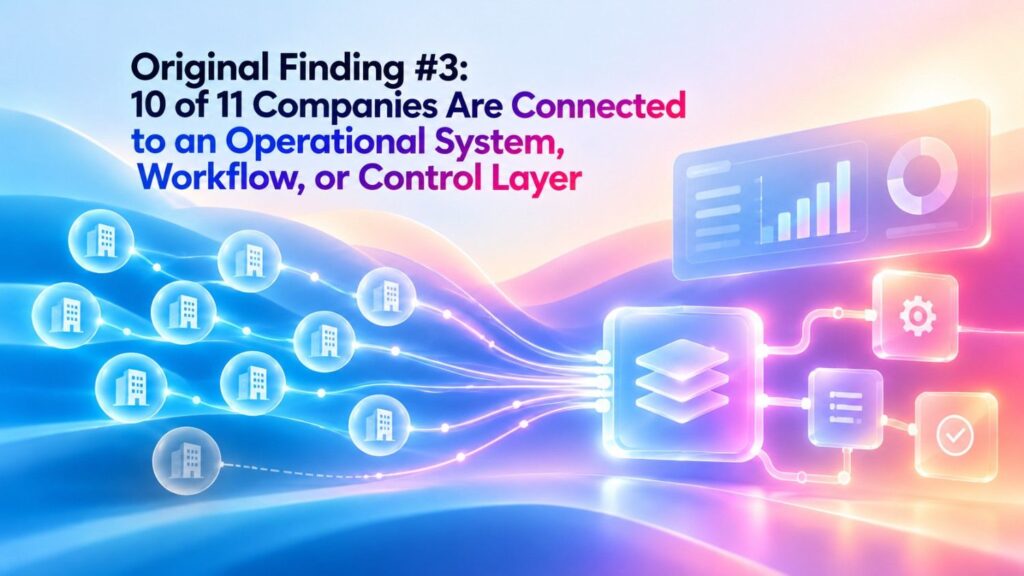
Original Finding #3: 10 of 11 Companies Are Connected to an Operational System, Workflow, or Control Layer
Another strong pattern appears when we look at where these products live inside the enterprise.
Ten of the 11 companies in the sample are closely connected to an existing business system, workflow environment, operational data layer, or control layer.
Subconscious is the main exception because it operates deeper in the infrastructure stack.
HubSpot’s agents work around CRM data and customer workflows.
Klaviyo’s agents work with marketing and customer data.
Toast’s agent is connected to restaurant operations.
Bullhorn’s Digital Workers operate inside staffing workflows.
Dynatrace agents work from observability and technology operations data.
Tulip agents operate inside manufacturing systems and applications.
CodaMetrix works inside healthcare coding workflows.
Pega coordinates people, agents, systems, rules, and processes.
DataRobot provides tools for building and governing enterprise agents.
Snyk applies controls around agent activity in software development.
That gives us 10 companies out of 11, or 90.9%, that are closely tied to an operating environment rather than existing as an isolated chat experience.
Why the Operating System Matters
A powerful language model with no trusted access to business systems remains mostly a conversational interface.
It can explain a customer account, but it may not be able to change the record.
It can describe why an invoice appears wrong, but it may not be able to retrieve the invoice, compare it with policy, resolve the error, update the accounting system, and record the result.
The move from chatbot to digital worker therefore depends on much more than model intelligence.
The agent needs business context.
It needs access to tools.
It needs clearly defined permissions.
It needs rules.
It needs a place to record its actions.
In higher-risk workflows, it also needs a reliable method for giving control back to a person.
The language model may provide reasoning, but the surrounding business system determines whether that reasoning can turn into useful work.
Original Finding #4: Boston’s Agent Shift Is Not Being Driven Only by Young Startups
Another useful pattern appears when we look at the maturity of the companies involved.
At least five companies in the sample are publicly traded: HubSpot, Klaviyo, Toast, Dynatrace, and Pegasystems.
That means Boston’s agent ecosystem is not simply a collection of very young startups trying to create an entirely new software category.
Several established enterprise software companies are transforming products they have spent years building.
This could become an important advantage.
A new startup may build an extremely capable agent, but an established enterprise platform may already know the customer’s accounts, records, users, workflows, permissions, integrations, policies, and historical activity.
That context can make it much easier to turn AI into safe, useful action.
Existing Platforms Already Own the Workflow
HubSpot has spent years building systems around customer relationships.
Klaviyo already sits inside marketing operations.
Bullhorn is deeply connected to staffing workflows.
Toast is embedded inside restaurant operations.
Pega has decades of experience around process automation and decisioning.
When these companies add agents, they are not starting from an empty screen. They are adding intelligence and execution to systems that already know where the work happens.
That may prove more important than having the most impressive standalone AI demo.
HubSpot Shows How CRM Is Becoming an Agent Workspace
HubSpot is one of the clearest examples of how an established Boston-area software platform can evolve toward agentic work.
Its Breeze products extend across several parts of the customer relationship.
Prospecting Agent can research potential buyers and support personalized outreach.
Customer Agent can handle customer questions and service conversations.
Data Agent can research and enrich customer information.
The common element is that these systems operate close to the CRM.
That proximity gives the agents access to context about companies, contacts, conversations, meetings, activities, and other customer events.
CRM Is Starting to Move From Recording Work to Performing Work
Traditional CRM systems were mainly databases of human activity.
A salesperson sent an email and recorded it.
A support employee solved a problem and updated a ticket.
A marketer changed a contact field.
The software stored what employees had done.
Agentic CRM begins to reverse part of that relationship.
The CRM can increasingly identify work, gather information, prepare actions, and perform some tasks on behalf of the employee.
Data enrichment is a simple example.
Instead of waiting for employees to manually research every company or contact, the platform can continuously improve CRM records in the background.
That does more than save typing.
It changes the system from a passive database into an active participant in customer operations.
Klaviyo Is Moving Toward a More Autonomous B2C CRM
Klaviyo is following a similar path inside consumer marketing and customer service.
The company has introduced AI agents that work around the same customer data used for campaigns, segmentation, messaging, and service.
Its Composer agent can help create marketing campaigns and flows, while Customer Agent handles customer conversations and uses business context to respond.
The important point is not simply that Klaviyo added AI.
The more important change is that several forms of work can now happen around a shared customer record.
Shared Context Makes Agents More Useful
A marketing agent becomes more valuable when it knows what happened during a recent support interaction.
A service agent becomes more useful when it understands what the customer purchased, what campaign they received, and what they have done recently.
That shared context reduces the need for isolated AI systems.
It also gives established platforms an advantage because they already own much of the data the agent needs.
This is another reason Boston’s existing software companies are interesting.
They are not adding AI to an empty environment. They are adding execution capabilities to systems that already contain years of business context.
Toast Shows What a Digital Worker Can Look Like in a Vertical Market
Toast may provide one of the clearest examples of agentic AI for small and midsize businesses.
Restaurant operators already manage a complex combination of labor, inventory, guests, pricing, delivery, payroll, promotions, and margins.
They do not necessarily need another analytics dashboard.
They need some of the work to disappear.
Toast’s Marketing Agent is designed around that idea.
The system can help identify a business problem, such as weaker demand, and then assist with creating customer segments and campaigns aimed at improving the result.
That moves the software closer to an operational worker.
The Best Agent May Be the One Users Barely Notice
This points toward a future in which some of the most valuable AI products are not highly conversational.
A restaurant owner may not want to spend ten minutes chatting with an AI assistant about why lunch traffic is weak.
The operator may simply want the software to detect the problem, identify a sensible customer group, prepare an appropriate offer, create the campaign, apply approved brand rules, and show what happened afterward.
In that model, conversation is useful only when needed.
The outcome becomes the product.
Bullhorn Has Started Calling the Model What It Is: Digital Workers
Bullhorn is especially interesting because the company has embraced the phrase “Digital Workers” directly.
Its Amplify platform includes AI capabilities related to candidate matching, outreach, screening, prospecting, verification, auditing, and transcription.
That framing is useful because it shifts attention away from the chatbot interface and toward the job being completed.
Bullhorn also shows how conversation and execution can work together.
A conversational layer can allow an employee to describe what needs to happen, while specialized workers handle the underlying tasks.
The chat interface becomes the place where work is assigned rather than the place where all work is completed.
Enterprise Software Interfaces Could Change Dramatically
Today, employees often open software and move through menus, tabs, forms, filters, and dashboards.
Agentic software could reduce some of that manual navigation.
Instead of opening several screens to find candidates, review profiles, create outreach, schedule activity, and update records, a recruiter may eventually describe the desired outcome.
For example:
“Find candidates who match these requirements, verify the key information, begin approved outreach, screen the responses, and bring me the strongest five.”
That is a very different relationship with software.
The employee is managing work rather than operating every step of the interface.
Dynatrace Is Moving IT AI From Diagnosis Toward Remediation
Technology operations are another natural market for enterprise agents.
IT teams deal with alerts, logs, infrastructure changes, performance issues, traces, dependencies, incidents, and remediation tasks every day.
Traditional observability software helps teams understand what went wrong.
Agentic observability tries to move further by participating in the resolution.
Dynatrace’s autonomous agents for incident triage and remediation show how this transition can work.
The system can use operational data to investigate incidents, determine what is happening, and assist with or perform approved responses.
The Value Comes From Closing the Loop
Imagine a monitoring system that detects 10,000 problems.
Now imagine an AI assistant that explains all of them.
That is useful, but humans still own the queue.
The operational value rises when the software can investigate the issue, determine whether an approved fix applies, execute the fix, confirm whether the system recovered, record what happened, and escalate the cases it cannot safely resolve.
This is the pattern companies should watch.
The enterprise value of agents often comes from closing the workflow rather than making the explanation better.
Tulip Shows Why Manufacturing Agents Need Tight Boundaries
Tulip applies the digital-worker idea to manufacturing environments.
Its AI Agents are designed to operate inside workflows where data, procedures, equipment, and quality requirements already exist.
Manufacturing makes the importance of boundaries especially clear.
A factory is not an open-ended environment.
It has operating procedures.
It has safety requirements.
It has production goals.
It has equipment limitations.
It may also have regulatory obligations.
An AI system operating inside that environment needs more than good reasoning. It needs a clear job description, trusted data, specific tools, defined escalation rules, and a record of the actions it took.
Enterprise Agents Need Structure Around Intelligence
This is one of the most important lessons from the Boston dataset.
Raw intelligence is not enough.
A reliable enterprise agent needs a structured environment that tells it what job it owns, what information it may use, what actions it may take, and when a person must become involved.
The more consequential the workflow, the more important that structure becomes.
CodaMetrix Shows That Digital Workers Do Not Need to Look Like Chatbots
CodaMetrix is one of the most useful examples in this article because it challenges the common image of an AI worker.
Many people imagine a digital worker as a human-like assistant sitting inside a chat box.
Autonomous medical coding looks completely different.
Clinical documentation enters the system.
The software determines coding for eligible work.
The completed coding flows back into the operational process.
Humans can then focus more heavily on exceptions, complex cases, policy changes, quality checks, and situations that require judgment.
This May Be What Mature Agentic AI Looks Like
A mature digital worker may not require constant prompting.
It may not need a personality.
It may not need a chat window.
The system simply receives eligible work, completes what it can within its rules, sends unusual cases to people, and records what happened.
That is much closer to business process automation than consumer chatbot behavior.
It may also be where some of the largest enterprise value is created.
Pega Is Building a Control Layer for an Agent Workforce
As companies deploy more agents, a different problem emerges.
Someone or something has to coordinate them.
Pega is approaching this through orchestration.
Its Agentic Process Fabric is designed to connect AI agents, people, systems, workflows, and business rules.
This becomes important as companies move from one experimental agent to dozens or hundreds of production agents.
One Agent Is Simple. Two Hundred Agents Are an Operating Model.
A company with one AI agent can manage permissions manually.
A company with 200 agents faces much harder questions.
Which agent may access payroll information?
Which one can issue a refund?
Which one can change customer data?
What happens when two agents make conflicting recommendations?
Where is the final decision stored?
Who is responsible for stopping an agent?
How does an employee know which system currently owns a case?
How does an auditor reconstruct what happened three months later?
These are no longer model-quality questions.
They are governance and operations questions.
Orchestration platforms may therefore become essential as enterprises increase the number of agents they use.
DataRobot Is Treating Agents as a Workforce That Needs Management
DataRobot is approaching the same market from the platform side.
The company describes its technology around the idea of an Agent Workforce Platform, with tools for building, deploying, operating, and governing enterprise agents.
That language is significant.
If companies begin treating agents as a workforce, they will need systems that manage more than model selection.
They will need deployment controls, monitoring, policy management, evaluation, cost controls, logs, and governance.
Agentic AI Can Extend Beyond Office Work
DataRobot’s work around autonomous inspections also demonstrates that the digital-worker model is not limited to email, documents, and CRM records.
Agentic systems can support robotic inspections, field operations, and other workflows that interact with physical environments.
This expands the market substantially.
The same core problem still applies: AI receives information, decides what to do, uses tools, performs or coordinates an action, and records the result.
Subconscious Shows Why Long-Running Agents Need New Infrastructure
A chatbot conversation may last a few seconds.
A serious business agent may need to operate through dozens, hundreds, or potentially thousands of steps.
That creates a different infrastructure problem.
The agent may need to plan, retrieve data, use tools, check its own work, recover from errors, wait for another system, and continue later.
Cambridge-based Subconscious is working on infrastructure for this type of long-running agent behavior.
Long-Horizon Work Changes AI Economics
Every additional reasoning step can cost money.
Every tool call adds latency.
Every retry uses more compute.
Every validation step adds overhead.
A digital workforce therefore creates an optimization problem that ordinary chatbots often do not.
Companies may eventually need to measure agent infrastructure with the same seriousness they use for cloud computing.
The question will not simply be whether the agent can complete the task.
The question will also be whether it can complete the task reliably and economically.
Snyk Shows Why Digital Workers Create a New Security Problem
Giving AI access to tools creates value, but it also creates risk.
A chatbot that gives the wrong answer may confuse a user.
An agent that takes the wrong action may change data, modify software, send information externally, affect production systems, or create other real consequences.
That difference turns security into a central part of enterprise-agent design.
Snyk’s work around agentic software development is aimed at controlling what coding agents can use, what actions they perform, and what they generate.
Permissions Become Part of AI Quality
Businesses often focus heavily on accuracy.
They ask whether the model understands the task and produces correct answers.
For agents, another question matters just as much:
What happens when the system is wrong?
If an AI drafts the wrong email, a human may catch it before sending.
If the same system can change production code automatically, the consequences are more serious.
That means the smartest agent should not automatically receive the broadest permissions.
Good enterprise-agent design separates intelligence from authority.
Human-in-the-Loop Should Be Designed Into the Workflow
Agentic AI is sometimes described as if companies must choose between human control and full automation.
That is a false choice.
The more useful question is where human judgment should enter the workflow.
Different decisions deserve different levels of automation.
Low-risk, reversible actions can receive more autonomy.
High-risk, irreversible, financially important, legally sensitive, or safety-related actions require tighter controls.
Think in Terms of Decision Boundaries
A customer-service agent might answer a shipping-status question without approval but escalate before issuing a large refund.
A marketing agent might prepare a campaign automatically but require approval before changing a large advertising budget.
An IT agent might restart an approved service but stop before modifying an unfamiliar production configuration.
A medical coding system might autonomously process cases that meet defined standards while routing unusual cases to specialists.
This is why the best unit of agent design is often not the agent itself.
It is the decision boundary.
Companies need to decide where autonomy ends and human responsibility begins.
The Five Pieces Every Serious Digital Worker Needs
Companies evaluating agentic AI should look beyond the demonstration.
A polished demo can make almost any system appear capable because the conditions are carefully controlled.
Production environments are much harder.
A useful digital worker needs several components working together.
Context: What Does the Worker Know?
The agent needs enough information to perform its job, but it should not receive unlimited access.
A sales agent may need CRM records, approved product information, account history, pricing rules, and recent customer interactions.
It probably does not need access to payroll files.
Good agent design starts by limiting context to what the job actually requires.
Tools: What Can the Worker Do?
Businesses should create a clear inventory of the tools available to each agent.
Can it read records?
Can it create new records?
Can it edit existing information?
Can it delete data?
Can it send a message?
Can it spend money?
Can it call another agent?
Can it execute code?
Each additional capability increases both the value and the risk of the system.
Authority: Which Actions Can Happen Without Approval?
Access to a tool should not automatically mean permission to use every feature inside that tool.
An agent may be allowed to draft a refund recommendation without being allowed to issue the refund.
Another may be allowed to create a marketing campaign but not activate it.
Authority should be linked to business risk.
Controls: How Does the Company Detect Failure?
Agents need monitoring.
They need logs.
They need escalation rules.
They need audit trails.
They need security controls.
They need a clear method for being stopped when behavior becomes unsafe or unexpected.
Businesses must be able to answer not only, “What did the AI say?” but also, “What did the AI actually do?”
Measurement: How Do You Know the Worker Is Valuable?
This is where many AI programs remain weak.
Usage is not enough.
Prompts are not enough.
Login counts are not enough.
Even time saved can be misleading if the work still needs extensive human correction.
Businesses should measure completed outcomes.
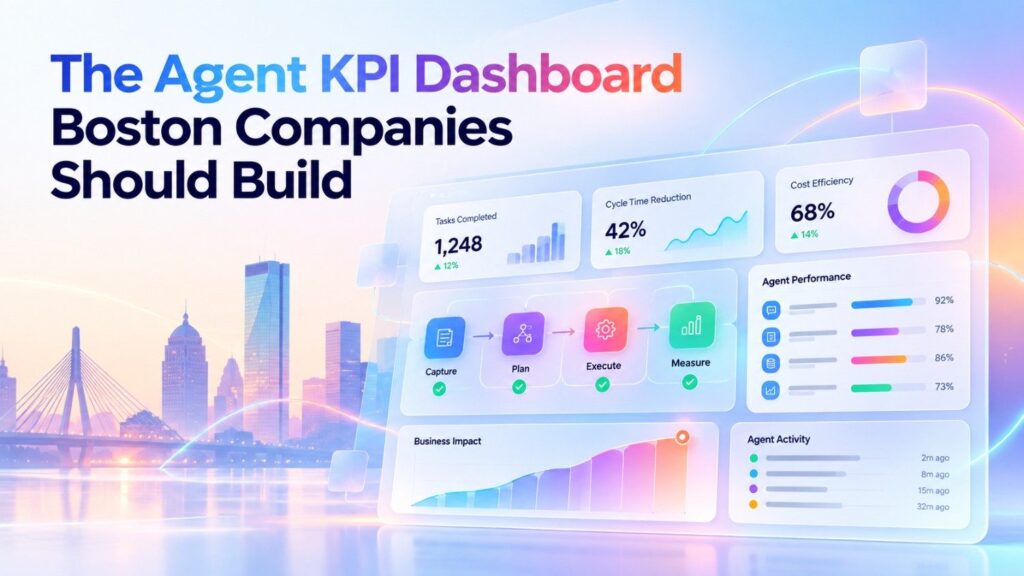
The Agent KPI Dashboard Boston Companies Should Build
Digital workers require a different measurement model from traditional SaaS.
If the software is beginning to perform work, companies should evaluate it according to the work completed.
| Metric | Formula or question | Why it matters |
| Eligible work volume | How many cases could the agent handle? | Defines the opportunity |
| Autonomous completion rate | Completed without human intervention ÷ eligible cases | Measures true autonomy |
| Human touch rate | Cases requiring human action ÷ agent-run cases | Shows remaining workload |
| Exception rate | Exceptions ÷ attempted cases | Reveals workflow weakness |
| Error rate | Incorrect completed actions ÷ completed actions | Measures reliability |
| Rework rate | Cases corrected or reopened ÷ completed cases | Detects hidden failures |
| Cycle time | Time from start to completion | Measures speed |
| Cost per completed unit | Total agent cost ÷ completed units | Measures economics |
| Escalation quality | Were the correct cases sent to people? | Tests decision boundaries |
| Business outcome | Revenue, downtime, denials, placements, conversions, or another core result | Connects AI to value |
Resolved Work May Become the Most Important Metric
Imagine two customer-service agents.
Agent A handles 100,000 conversations but resolves only 10% without human help.
Agent B handles 20,000 conversations but resolves 80%.
Conversation volume makes Agent A look larger.
Completed work makes Agent B look more valuable.
That is why companies should move beyond measuring activity.
Support teams should care about resolution.
IT teams should care about remediation.
Healthcare teams should care about correctly processed cases.
Sales teams should care about qualified pipeline and completed follow-up.
Marketing teams should care about campaigns that actually reach the intended outcome.
The central question becomes:
How much useful work reached an acceptable end state?
A Practical 90-Day Enterprise Agent Plan for Boston Companies
Businesses do not need to redesign the entire company around autonomous AI in one project.
A focused 90-day deployment is usually a better starting point.
The goal should be learning where the technology can safely own work rather than maximizing autonomy as quickly as possible.
Days 1-15: Choose One Workflow
Do not begin by choosing an AI model.
Begin with a business problem.
Look for repetitive work that still requires enough judgment or context that simple automation has struggled to handle it.
The workflow should have a clear beginning and a clear end.
“Improve customer service” is too broad.
“Handle order-status questions and approved address changes, then escalate unusual cases” is much better.
Days 16-30: Map the Job Before Building the Agent
Study how an experienced employee performs the work today.
Identify the systems they use.
Document the decisions they make.
Record the exceptions.
Identify approval steps.
Write down what the employee is never allowed to do without authorization.
You are effectively creating a job description for the digital worker.
Days 31-45: Start With Minimum Necessary Authority
Begin conservatively.
Let the agent read before it can write.
Let it draft before it can send.
Let it recommend before it can approve.
Allow low-value transactions before high-value transactions.
Give it reversible actions before irreversible ones.
Autonomy should expand only after the company has evidence that the system is reliable.
Days 46-60: Run in Shadow Mode
Before the agent takes real actions, let it process live cases in parallel with experienced employees.
Compare the decisions.
Measure disagreement.
Study the edge cases.
Look for missing data.
Improve instructions and workflow design.
This phase often reveals an uncomfortable truth: the biggest problem is not always the AI.
The real problem may be inconsistent processes, missing data, conflicting rules, or unclear ownership.
Days 61-75: Allow Bounded Production Actions
Once performance becomes reliable, move the safest cases into production.
Keep detailed logs.
Route uncertain cases to employees.
Review failures quickly.
Do not let serious errors disappear inside monthly reports.
Treat every meaningful failure as evidence that the workflow, data, permissions, or agent instructions need improvement.
Days 76-90: Measure the Economics
Now calculate whether the system is actually useful.
Measure completed work.
Measure human touches.
Measure cycle time.
Measure error and rework rates.
Measure infrastructure and software costs.
Then compare those results with the previous process.
The goal at the end of 90 days should not be a presentation saying, “We launched an AI agent.”
The goal should be a much more useful statement:
“We now know exactly which part of this workflow AI can safely and economically own.”
Start With the Workflow Where the Company Is Already Losing Time or Money
Businesses often select AI projects because a demo looks impressive.
That is usually the wrong starting point.
The better place to begin is operational pain.
Look for areas where employees repeatedly copy information between systems.
Look for queues that grow faster than teams can clear them.
Look for work that sits overnight even though the required data already exists.
Look for expensive specialists spending large amounts of time on predictable administrative tasks.
Look for customer requests that take too long because an employee must retrieve information from several different systems.
Look for processes where one missing piece of information repeatedly stops the entire workflow.
These are often stronger agent opportunities than highly visible but low-value experiments.
The largest agent markets may emerge from tasks people have complained about for years.
Do Not Use AI to Automate a Broken Process Faster
There is an important warning.
Agentic AI can sometimes hide bad process design because the technology is flexible enough to work around unclear workflows.
Traditional automation usually forces a business to define the steps.
An AI agent may be able to improvise around ambiguity.
That flexibility can be useful, but it can also allow weak processes to survive.
If five departments disagree about who owns a decision, giving the decision to an AI system does not solve the ownership problem.
If customer data is unreliable, the agent may simply act faster on unreliable information.
If critical rules exist only inside one experienced employee’s head, the AI cannot consistently follow them.
If the company cannot define what a successful result looks like, it cannot properly evaluate the system.
Some of the best agent deployments will therefore begin as process-improvement projects.
The company fixes the workflow first and automates it second.
Why Boston May Be Especially Well Positioned for Enterprise Agents
The Boston dataset points toward a broader regional advantage.
Greater Boston already has strong companies working in difficult operating environments such as healthcare, manufacturing, enterprise software, cybersecurity, restaurants, staffing, infrastructure, and customer systems.
These are areas where useful AI must understand processes rather than simply generate text.
Boston also has established companies with deep customer relationships and mature software platforms.
HubSpot understands customer workflows.
Pega understands business processes.
Bullhorn understands staffing.
Toast understands restaurant operations.
Tulip understands manufacturing.
CodaMetrix understands healthcare coding.
That history matters because enterprise agents need more than a powerful model.
They need domain knowledge.
They need integrations.
They need customer trust.
They need business rules.
They need historical data.
Most importantly, they need a place where they can actually perform work.
Companies that already own those environments may have a structural advantage.
The Bigger Opportunity Is Not Simply Replacing Employees
The phrase “digital worker” naturally creates concern about job replacement.
Some roles and task mixes will change.
However, the more immediate enterprise question is usually narrower.
Which parts of a job should be performed by software, and which parts should remain human?
A recruiter may spend less time manually searching databases and more time judging candidates, advising clients, and building relationships.
A restaurant operator may spend less time manually configuring promotions and more time deciding how the brand should grow.
A developer may spend less time fixing repetitive issues and more time reviewing architecture, security, and difficult engineering decisions.
A medical coder may spend less time processing routine records and more time managing complex cases, quality control, exceptions, and policy changes.
This does not eliminate the employee.
It changes the shape of the job.
AI handles more high-volume execution.
People spend more time on ambiguity, judgment, responsibility, creativity, relationships, negotiation, and unusual situations.
That hybrid model is a more realistic near-term picture of enterprise AI than the idea of a fully autonomous company.
The Company Org Chart May Eventually Include Software Roles
The language used by Boston companies is already moving in this direction.
Digital workers.
Agent workforce.
Autonomous operations.
Agentic orchestration.
Digital team members.
These terms suggest that software is moving beyond the traditional feature model.
Traditional software has functions.
Agentic software may increasingly have responsibilities.
That creates a new management problem.
Companies may eventually need an internal registry that lists every production agent, its owner, its purpose, the tools it may access, the data it can see, the actions it can take, its spending authority, its human escalation path, and its performance history.
This begins to look less like a traditional software inventory and more like an organizational chart for machine workers.
The CIO of the future may therefore manage more than applications and infrastructure.
The technology organization may also manage a population of semi-autonomous software workers operating inside those applications.
The Real Enterprise AI Battle Will Be About Completed Work
The first generative AI wave rewarded systems that could produce impressive answers.
The next phase will be measured differently.
Did the invoice get processed correctly?
Did the customer problem get resolved?
Did the candidate get screened?
Did the CRM record get updated?
Did the marketing campaign launch?
Did the technology incident get fixed?
Did the medical record get coded accurately?
How often did an employee have to intervene?
How much did each completed unit of work cost?
These questions are harder than asking whether a model can write a good paragraph.
They are also far more relevant to business performance.
That is why enterprise AI agents matter.
They push artificial intelligence out of the demonstration environment and into the operating model.
Final Takeaway: Boston Is Building AI That Does the Work
The biggest shift in enterprise AI is not simply that chatbots are becoming more intelligent.
The deeper change is that software is gaining the ability to act.
Boston offers a useful view of that transition because the region’s agent ecosystem already stretches across application workers, orchestration, enterprise platforms, infrastructure, security, and governance.
Our 11-company dataset reveals three especially important patterns.
First, seven of the 11 companies, or 63.6%, are already applying agentic systems directly to business work.
Second, every one of those seven application-layer companies is tied to a clearly defined business function or industry rather than a universal AI-worker idea.
Third, 10 of the 11 companies, or 90.9%, are connected to an existing operational system, workflow, infrastructure layer, or control environment rather than operating as disconnected chat experiences.
Those findings offer a practical lesson for Boston businesses.
Do not begin an enterprise-agent strategy by asking which chatbot employees should use.
Begin by asking where work gets stuck.
Find the workflow with clear inputs, repeated actions, measurable outcomes, and expensive human effort.
Understand the systems an experienced employee uses.
Define which decisions can safely be delegated.
Decide where a person must remain responsible.
Then build the agent around that job.
The companies that gain the most from enterprise AI will not necessarily be the ones that deploy the largest number of bots.
They will be the companies that learn how to divide work intelligently between people and software.
Boston’s enterprise technology companies are already beginning to show what that model looks like.
The chatbot was the introduction.
The next chapter is software that can actually help finish the work.