

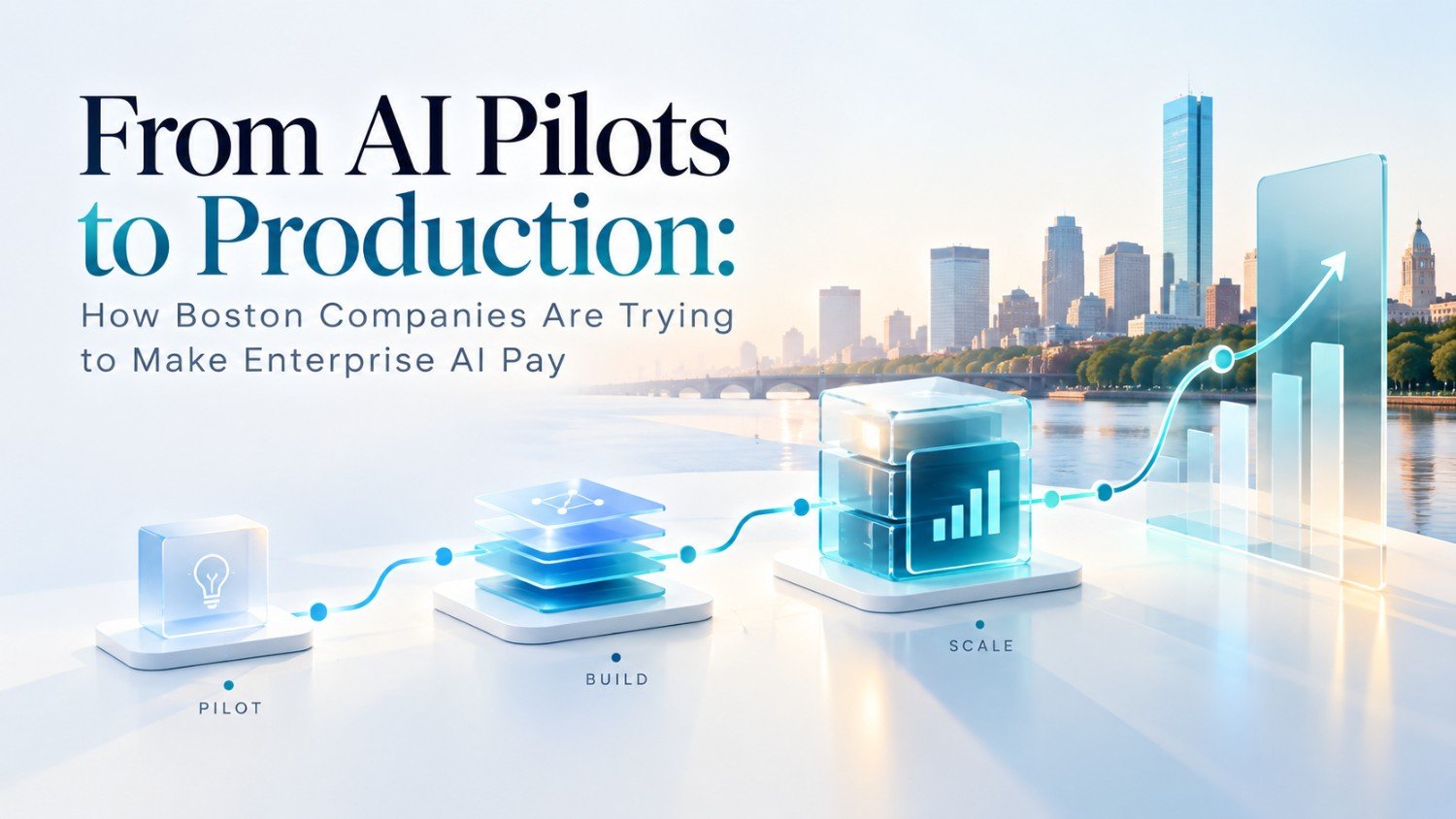
Enterprise AI has reached an awkward moment.
For the past three years, it has been easy for companies to show that artificial intelligence can do interesting things. A team could connect a large language model to company documents, build a chatbot, automate part of a support workflow, help programmers write code, summarize meetings, or produce a polished demonstration for senior leaders.
The harder question has always been much less exciting.
Does any of this actually make money?
Or, at the very least, does it save enough money, create enough capacity, improve enough work, or remove enough delay to justify what the company is spending?
That question is becoming much harder to avoid in 2026. McKinsey’s latest global AI survey found that 80% of respondents say AI improves individual productivity, yet only 37% report some enterprise-level EBIT impact. Just around 6% qualify as what McKinsey calls AI high performers, meaning they attribute at least 5% of EBIT to AI and describe the effect as significant.
Those numbers tell an important story.
Employees can become faster without the company becoming much more profitable.
Boston offers an unusually useful place to study that gap because the region has nearly every version of the enterprise AI problem at once. It has large healthcare systems, insurers, biotechnology companies, software businesses, universities, regulated industries, enterprise AI startups, cybersecurity companies, and government organizations trying to put AI into real work.
Some Boston-area organizations are now publishing enough production data to see what separates an interesting AI pilot from an AI system that changes an operating metric.
Boston Children’s Hospital says more than 50 AI-enabled automations have reclaimed around 60,000 hours and more than $7 million in redeployed labor. MassMutual has reported a 30% improvement in developer productivity and huge reductions in some service times. HubSpot says 100% of its engineers now use AI, while time to first feedback on pull requests has fallen 90%. Moderna has moved from internal experimentation toward hundreds of specialized GPTs. Boston-based 7AI says its autonomous security agents have completed millions of investigations in production. Maven AGI is publishing production data from more than 90 enterprise customer deployments.
The important story is therefore no longer that Boston companies are experimenting with AI.
The more interesting question is how they are trying to make AI pay.
And our analysis suggests that the answer has less to do with finding a magical model than many companies may expect.
It has much more to do with choosing the right work.
The Short Version: Boston’s AI Story Is Moving From Access to Economics
For the first stage of enterprise generative AI, success was often measured by access.
How many employees have Copilot?
How many people use ChatGPT?
How many teams have completed a pilot?
How many internal AI tools have been built?
Those numbers still matter, but they are becoming weak measures of business value.
A company can have thousands of employees using AI without changing its cost structure, revenue, customer experience, development speed, or ability to handle more work.
That distinction is now showing up in broader research. Deloitte’s 2026 enterprise AI study found that 66% of organizations report productivity and efficiency gains from AI and 40% report lower costs. But only 20% report increased revenue, even though 74% hope AI will eventually produce revenue growth.
The usage layer is growing faster than the economic layer.
Boston’s strongest public examples suggest that companies are starting to close that gap by moving through three stages.
First, they give people AI tools.
Second, they attach those tools to real workflows.

Third, they measure whether those workflows become cheaper, faster, more scalable, or more effective.
That third step changes almost everything.
BostonBizScene Original Research: How We Built the Boston Enterprise AI Production Dataset
For this article, BostonBizScene reviewed publicly available 2025 and 2026 material from Boston and Massachusetts organizations where AI had moved beyond a simple demonstration.
Our primary evidence set focuses on seven organizations or Boston-based AI providers with unusually useful public production data:
| Organization | Boston connection | AI area studied | Public production evidence |
| Boston Children’s Hospital | Boston | Clinical and operational AI | 50+ automations, 60,000 hours reclaimed |
| MassMutual | Massachusetts/Boston presence | Software, service desk, customer operations | Developer and service-time metrics |
| Mass General Brigham | Boston | Clinical documentation and workflow AI | Measured documentation and after-hours work changes |
| Moderna | Cambridge | Enterprise generative AI | Large internal adoption and specialized GPT creation |
| HubSpot | Cambridge-founded, major Boston presence | Engineering, operations and GTM | Company-wide adoption plus operating metrics |
| 7AI | Boston | Cybersecurity agents | Millions of autonomous investigations |
| Maven AGI | Boston | Customer-service agents | Production dataset spanning 90+ enterprise deployments |
The goal was not to build a ranking of the “best” AI company.
That would create false precision because each organization works in a different industry and publishes different information.
Instead, we looked for five kinds of evidence.
1. Production evidence
Is the system being used in real work rather than only being tested?
2. Workflow depth
Does the AI only generate information, or can it participate in an actual process?
3. Measured operating outcomes
Does the organization report changes in time, volume, resolution, capacity, productivity, or another business metric?
4. Scale
Has the AI expanded beyond a tiny group?
5. Economic connection
Can the operating result reasonably be connected to cost, capacity, revenue, risk, or another financial outcome?
When we calculate numbers from published figures, we label them as BostonBizScene calculations. These are not metrics claimed by the organizations themselves.
That distinction matters because enterprise AI reporting is still inconsistent. A “resolution,” “productivity improvement,” “automation,” “conversation,” and “hour saved” can mean very different things at different companies.
The dataset should therefore be read as evidence of emerging operating patterns rather than as a perfect apples-to-apples benchmark.
Finding #1: The Best Boston AI Results Start With Work That Already Has a Number Attached to It
The clearest pattern in our research is almost surprisingly simple.
The strongest AI projects tend to begin with work that can already be measured.
Support tickets have resolution times.
Software teams have pull requests and deployment speed.
Call centers have call length.
Clinical teams have documentation time.
Security teams have investigation time.
Administrative teams have labor hours.
Once a workflow has an existing number attached to it, it becomes much easier to decide whether AI is improving anything.
MassMutual Shows Why Baselines Matter
MassMutual is one of the clearest examples.
At a 2026 enterprise AI event, the company reported a 30% gain in developer productivity, an IT help-desk resolution-time reduction from roughly 11 minutes to one minute, and customer-service calls falling from around 15 minutes to roughly one or two minutes for the workflows discussed.
The numbers become more useful when converted into relative changes.
Chart 1: Selected MassMutual Workflow Changes
| Workflow | Before | After | BostonBizScene calculated change |
| IT help-desk resolution | 11 min | 1 min | 90.9% less time |
| Customer-service call example | 15 min | 1–2 min | 86.7%–93.3% less time |
| Developer productivity | Baseline | +30% | 30% reported gain |
The help-desk calculation is especially useful.
Moving from 11 minutes to one minute does not merely make an employee feel more productive. It changes the throughput of the operation.
If the volume of work remains constant, the organization potentially needs far fewer minutes of human attention per resolved issue. If staffing stays constant, the same team may be able to handle much more work.
That creates a bridge from AI performance to business economics.
And that bridge is what many AI pilots never build.
The Wrong Question Is “How Much Time Does AI Save?”
Time saved sounds like the obvious metric for AI.
But it can be dangerously misleading.
Imagine an AI assistant saves an employee 30 minutes writing a report. If the employee spends the extra 30 minutes reading email, the company has not necessarily created 30 minutes of economic value.
The business has created theoretical capacity.
What happens to that capacity next determines whether the value becomes real.
Capacity Is Not the Same Thing as Savings
Companies should separate at least three concepts.
Time saved means a task takes less time.
Capacity created means an employee or system can handle more work.
Financial value captured means the organization turns that capacity into an economic result.
Those are three different stages.
This is one reason the Boston Children’s data is so interesting.
Finding #2: Boston Children’s Shows What Happens When AI Savings Are Connected to Labor Value
Boston Children’s Hospital provides one of the strongest public enterprise AI cases in the region.
The organization says more than 50 AI-enabled automations across clinical and operational workflows have reclaimed about 60,000 hours and produced more than $7 million in redeployed labor value. It also reports more than 40 diagnoses of rare conditions that had previously remained unresolved.
Those numbers let us do several useful calculations.
Chart 2: What Boston Children’s Public AI Numbers Imply
| Published measure | Value |
| AI-enabled automations | 50+ |
| Hours reclaimed | ~60,000 |
| Redeployed labor value | $7M+ |
| Previously unresolved rare-condition diagnoses | 40+ |
BostonBizScene Calculation: Labor Value Per Reclaimed Hour
Using the minimum published labor value:
$7,000,000 ÷ 60,000 hours = about $116.67 per reclaimed hour
Because the published financial figure is stated as more than $7 million, the actual implied value per hour could be higher.
That figure should not be treated as an employee wage.
It is better understood as the value Boston Children’s assigns to labor capacity that can be redirected to other work.
BostonBizScene Calculation: Hours Reclaimed Per Automation
Using 50 automations as a conservative denominator:
60,000 hours ÷ 50 = about 1,200 hours per automation
Again, the hospital reports more than 50 automations, so the actual average across every automation would be somewhat lower if the denominator is larger.
Still, the calculation provides a useful planning benchmark.
An enterprise does not necessarily need hundreds of spectacular AI projects.
A relatively small portfolio of workflows can become meaningful if each one removes enough repeated work.
Chart 3: The Boston Children’s Value Chain
AI AUTOMATION
↓
REPEATED TASK TIME REMOVED
↓
~60,000 HOURS RECLAIMED
↓
LABOR CAPACITY REDEPLOYED
↓
$7M+ REPORTED VALUE
This is a much stronger value story than saying thousands of employees have access to an AI assistant.
The measurement ends at an operational or economic outcome rather than at adoption.
Original Finding #3: Production AI Is Becoming a Workflow Redesign Problem, Not a Prompting Problem
One of the biggest differences between an AI demonstration and production AI is the amount of the workflow the system can touch.
A chatbot that answers questions is useful.
A system that can find the right information, understand the request, access the correct business system, take an approved action, check the result, document what happened, and escalate exceptions is much more economically interesting.
That is why the current move toward AI agents matters.
The important word is not “agent.”
The important word is action.
Boston’s Customer-Service AI Market Shows the Difference
Boston-based Maven AGI argues that customer-service organizations should measure autonomous resolution rather than ticket deflection.
The distinction is important.
A deflected ticket means a human agent did not receive it.
That does not prove the customer’s problem was solved.
Maven defines a stronger resolution test around whether the issue was completed without escalation, remained closed over a defined period, and avoided negative customer feedback. Its 2026 field report is based on production data from more than 90 enterprise deployments. The company says the top-performing deployments reach roughly 80% to 93% autonomous resolution by month six, while one fintech deployment reached 90% within three weeks.
These are vendor-reported results and should be evaluated in that context.
But the measurement philosophy is useful regardless of vendor.
Chart 4: Deflection vs. Resolution
| Metric | What it tells you | What it can hide |
| Tickets answered | AI produced a response | Wrong or incomplete answers |
| Deflection | Human queue was avoided | Repeat contacts |
| Containment | Conversation stayed with AI | Customer may still be unhappy |
| Resolution | Problem was actually completed | Harder to measure, but closer to value |
This principle applies far beyond customer support.
Do not measure whether AI participated.
Measure whether the work finished.
Finding #4: HubSpot’s AI Program Suggests Adoption Matters Most When It Becomes Infrastructure
HubSpot offers another useful Boston-area example because it has publicly described several stages of its internal AI transformation.
By May 2026, HubSpot said 94% of employees were using AI weekly and employees had created more than 3,900 AI agents.
Those are enormous adoption numbers.
But HubSpot’s more important data comes from what happened after adoption.
The company says 100% of its engineers now use AI. It reports a 73% increase in lines of code updated per engineer and a 90% reduction in time to first feedback on pull requests. Earlier in the program, when AI engineering adoption reached 80%, HubSpot reported a 51% improvement in engineering velocity.
That progression is worth examining.
Chart 5: HubSpot’s Shift From Adoption to Operating Metrics
AI ACCESS
↓
30% EARLY ENGINEERING ADOPTION
↓
MEASURE PRODUCT RELIABILITY
↓
80% ENGINEERING ADOPTION
↓
51% ENGINEERING VELOCITY IMPROVEMENT
↓
100% ENGINEERING AI USE
↓
73% MORE LINES OF CODE UPDATED PER ENGINEER
↓
90% FASTER TIME TO FIRST PR FEEDBACK
Source: HubSpot’s May 2026 internal AI transformation series.
The interesting part is not merely that adoption increased.
HubSpot says it checked reliability data when its first coding copilot reached around 30% adoption. After finding no negative effect on product reliability, it expanded access.
That is a useful production pattern:
deploy → measure → verify → scale
rather than:
buy → announce → hope
HubSpot Is Also Connecting AI to Revenue Work
The company says its agent-first go-to-market program now generates more than 10,000 meetings per quarter through personalized outreach and reports a 13% increase in win rate for deals where its guided-selling system is used.
These figures come directly from HubSpot, so independent causality cannot be established from the public material alone.
Still, they show a major shift in enterprise AI measurement.
AI is moving from “How many employees used it?” toward “What happened to the funnel?”
That is where enterprise AI gets financially interesting.
Original Finding #5: Boston’s Strongest Public AI Returns Cluster Around High-Frequency Work
Look across the examples in our dataset and another pattern appears.
The clearest returns tend to come from work that happens again and again.
Customer calls happen thousands of times.
Support tickets arrive every day.
Security alerts never stop.
Developers open pull requests constantly.
Doctors document patient visits continuously.
Hospitals process invoices and schedules repeatedly.
Repeated work creates something AI economics badly needs: volume.
Why Volume Changes the ROI Equation
Suppose an AI tool saves five minutes.
If the task happens 20 times per year, the value is tiny.
If it happens two million times per year, five minutes is enormous.
The basic equation is:
Value opportunity = time or cost removed per task × number of tasks
Then companies have to subtract AI operating costs, integration costs, human review, errors, maintenance, and other expenses.
That is why spectacular demos often have weak economics.
They may perform difficult work that hardly ever happens.
A boring task repeated 500,000 times can be worth much more.
7AI Shows the Power of High-Volume Autonomous Work
Cybersecurity may be one of the clearest examples.
Boston-based 7AI says that by May 2026 its AI agents had completed more than seven million security investigations in production. The company also reported 3x quarterly customer growth and a 6.5x expansion in its channel pipeline over three quarters.
Five months earlier, in December 2025, 7AI reported more than 650,000 completed investigations and more than 2.5 million alerts processed. At that time, the company said customers were saving between 30 minutes and 2.5 hours per investigation in the relevant deployments.
We should not simply multiply seven million investigations by that earlier time-saving range because workloads and customers can differ.
That would create a false precision that the public evidence does not support.
But the increase in cumulative investigation volume is still notable.
Chart 6: 7AI’s Reported Production Investigation Scale
December 2025 650,000+ completed investigations
May 2026 7,000,000+ completed investigations
May total is more than 10.7× the December figure.
BostonBizScene calculation: 7,000,000 ÷ 650,000 ≈ 10.77.
This does not mean the business grew 10.77 times during that period. The figures are cumulative production volumes reported on different dates.
What it does show is how quickly autonomous work can accumulate when the task is frequent.
Security operations generate a constant stream of work.
That creates fertile ground for AI economics.
Finding #6: Boston Healthcare Is Showing Why Human Review Does Not Kill AI ROI
There is a common belief that AI only produces strong economics when people are removed from the process.
Boston healthcare offers evidence that the reality can be more nuanced.
Human review can remain important while AI still removes large amounts of work around the human decision.
Mass General Brigham’s Documentation Research
Mass General Brigham reported research on a hybrid documentation system that combined ambient technology with human scribes. The study found nearly a 42% decrease in after-hours work and a 66% reduction in documentation delays.
Another multi-site study co-led by Mass General Brigham and UCSF found that clinicians who used AI ambient documentation in more than half of visits experienced reductions of about 13 minutes per day in EHR use and 16 minutes in documentation time, representing relative decreases of approximately 3% and 10%.
The individual time changes may appear modest compared with the dramatic numbers from customer service or cybersecurity.
But healthcare runs at enormous scale.
Small changes multiplied across large clinical workforces can become substantial.
Chart 7: Selected Mass General Brigham Documentation Evidence
| Measure | Reported result |
| After-hours work in hybrid documentation study | ~42% decrease |
| Documentation delays | ~66% decrease |
| EHR use in multi-site AI scribe study | ~13 minutes/day lower |
| Documentation time | ~16 minutes/day lower |
| Relative documentation-time reduction | ~10% |
The important point is that AI does not have to replace the doctor.
It needs to change the amount of lower-value work surrounding the doctor.
That is a very different investment thesis.
Boston Companies Should Stop Measuring AI by Headcount Replacement
Headcount reduction is one possible economic outcome from automation.
It is not the only one, and in many Boston industries it may be the wrong first target.
Healthcare systems may use recovered time to see more patients.
Cybersecurity teams may use it to investigate threats that were previously ignored.
Software teams may ship faster.
Biotechnology companies may run more analysis.
Insurance companies may handle service requests more quickly.
A company therefore needs to ask what scarce resource the AI is creating more of.
Sometimes that resource is labor.
Sometimes it is expert attention.
Sometimes it is response speed.
Sometimes it is development capacity.
Sometimes it is customer-service capacity.
Sometimes it is the ability to process an amount of information that humans could not realistically process alone.
That last category is particularly important in biotechnology.
Finding #7: Moderna Shows Why AI ROI Can Come From Compressing Critical Paths
Moderna’s use of generative AI is useful because the company operates in work where time can have enormous economic value.
The company began building its own internal AI tool, mChat, in 2023. OpenAI’s published case study says the system reached more than 80% employee adoption. Moderna later deployed ChatGPT Enterprise more broadly. Within two months, the company had created 750 GPTs, 40% of weekly active users had built GPTs themselves, and users averaged around 120 ChatGPT Enterprise conversations per week.
Again, usage alone does not prove ROI.
But one specific workflow shows why the strategy matters.
OpenAI reports that Moderna used AI to accelerate work on Target Product Profiles, documents that can require teams to review evidence packs as large as 300 pages. A core analytical step that once took weeks could, according to Moderna, be completed in hours in some cases.
That changes the economic question.
Saving several hours on a low-value task is useful.
Removing days or weeks from a workflow sitting on the critical path of drug development can be much more important.
There Are Two Kinds of Enterprise AI Value
The Boston cases suggest it is useful to divide value into two broad categories.
| Value type | Example | Economic logic |
| Volume value | Tickets, alerts, calls, documentation | Small saving × huge repetition |
| Critical-path value | Clinical planning, drug development, complex analysis | Shorter delay × very high-value outcome |
Many companies focus almost entirely on the first.
Boston’s biotech and healthcare economy makes the second especially important.
Original Finding #8: AI Adoption Becomes More Valuable When Workers Can Build Their Own Tools
There is another striking similarity between Moderna and HubSpot.
Both moved beyond centrally built AI applications.
Employees began making their own.
Moderna reported 750 GPTs within two months of its enterprise rollout, with 40% of weekly active users creating GPTs.
HubSpot says employees have created more than 3,900 AI agents.
This matters because a central AI team can never fully understand every small workflow inside a large company.
Employees already know where the friction lives.
The problem is that uncontrolled employee-built automation can also create security, quality, duplication, and governance problems.
That creates a new enterprise challenge.
The winning architecture may not be “centralize everything” or “let everyone build anything.”
It may be a shared platform with controlled local creation.
The Platform Pattern
HubSpot describes building common infrastructure for agent access, data, tools, actions, and context rather than rebuilding those capabilities separately for every use case.
Boston Children’s similarly describes moving away from fragmented point solutions toward a secure enterprise AI layer that can support workflows across clinical, research, and administrative teams.
That gives us another important pattern.
BAD SCALING MODEL
Team A → separate AI stack
Team B → separate AI stack
Team C → separate AI stack
Team D → separate AI stack
STRONGER SCALING MODEL
Shared AI foundation
/ | | \
Team A Team B Team C Team D
The second approach can spread governance, identity, monitoring, access controls, data connections, and evaluation methods across many use cases.
That lowers the cost of the next AI project.
And that may eventually matter as much as the return from the first project.
The Real ROI Number Is the Cost of the Next Deployment
Enterprise leaders often calculate AI ROI one use case at a time.
That makes sense early.
But once an organization creates reusable infrastructure, the economics change.
The first production system may require expensive work:
data integration,
security review,
identity management,
model evaluation,
logging,
legal review,
workflow redesign,
employee training,
and monitoring.
If every future deployment repeats those expenses from zero, scale becomes difficult.
If the foundation can be reused, the marginal cost of launching another workflow falls.
That is how AI begins to behave more like a platform investment than a software subscription.
Capgemini’s 2026 scaling report makes a similar argument at the global level, saying enterprises are increasingly shifting toward repeatable deployment patterns and shared control layers as agents spread across organizations.
Finding #9: The Most Important AI Metric May Be Cost Per Completed Outcome
Companies often measure AI using technical numbers.
Tokens.
Latency.
Prompts.
Model accuracy.
API calls.
Those numbers matter to engineering teams.
But executives need something closer to a unit-economic measure.
For customer service, that might be:
cost per resolved issue
For cybersecurity:
cost per completed investigation
For healthcare administration:
cost per processed case
For software:
cost per production-ready change
For sales:
cost per qualified meeting or opportunity
For finance:
cost per completed reconciliation
Once the unit is clear, AI becomes much easier to evaluate.
A Simple Production AI Equation
A useful simplified formula is:
AI economic value = additional revenue + avoided cost + capacity value + risk value − total AI cost
Total AI cost should include much more than model fees.
It can include software licenses, token use, integration engineering, data work, monitoring, governance, human review, security, change management, retraining, failures, and vendor costs.
Ignoring those costs creates imaginary ROI.
Ignoring capacity and revenue can understate ROI.
Both mistakes are common.
Finding #10: Token Costs Are Becoming a Real Operating Issue
As AI moves from occasional chat to autonomous workflows, consumption can grow dramatically.
McKinsey’s 2026 survey found that roughly 20% of respondents say AI operating costs, including token costs, have constrained their organizations’ AI use.
This makes usage measurement increasingly important.
A pilot can look cheap because only 50 people are testing it.
The economics may look completely different when 10,000 workers use it continuously or autonomous agents run thousands of operations every hour.
Boston companies moving into production therefore need a FinOps model for AI.
They need to know not only whether AI works, but how much each completed outcome costs.
Why Cheaper Models Will Not Solve Everything
Model costs will probably continue to fall.
But usage can rise faster than unit prices fall.
An agent does not necessarily make one model call.
It might reason, search, call a tool, inspect the result, retry, validate an answer, generate another request, and repeat the cycle.
The economic unit therefore cannot simply be “cost per token.”
It needs to become “cost per completed business result.”
That is a much harder measurement.
It is also much more useful.
Original Finding #11: Boston’s Public Evidence Favors Narrow Workflows Over General AI Transformation
When we reviewed the strongest measurable Boston-area examples, most economic evidence came from specific workflows rather than broad claims about transforming the entire company.
This is an important strategic lesson.
Companies frequently start AI programs with very large ambitions:
“Transform customer experience.”
“Reinvent the company.”
“Become AI first.”
“Automate knowledge work.”
Those phrases may be directionally useful.
They are terrible pilot definitions.
A production project needs something closer to:
Reduce average help-desk resolution time.
Decrease documentation delay.
Increase first-contact resolution.
Reduce security investigation time.
Increase software delivery throughput.
Shorten a defined analytical process.
That difference sounds small.
It is enormous.
Chart 8: Where Measurable Boston AI Value Is Showing Up
| Broad function | Concrete workflow | Metric visible in public evidence |
| IT | Help-desk resolution | Minutes per resolution |
| Engineering | Development workflow | Productivity, PR feedback speed |
| Healthcare | Clinical documentation | Documentation time, after-hours work |
| Customer service | Autonomous support | Resolution rate |
| Cybersecurity | Alert investigation | Investigations completed, investigation time |
| Hospital operations | Repeated administrative work | Labor hours reclaimed |
| Biotechnology | Product-development analysis | Weeks or days compressed |
This table tells executives where to look.
Look for repeated work with a measurable starting point.
Why So Many AI Pilots Get Stuck Before Production
Moving a model into production creates problems a demonstration can hide.
A demo can use clean data.
Production gets messy data.
A demo can handle a carefully selected request.
Production gets every weird request customers and employees can create.
A demo can have an engineer watching it.
Production has to work at 2 a.m.
A demo can ignore cost.
Production generates a bill.
A demo can tolerate manual work behind the curtain.
Production eventually exposes it.
A demo can impress executives with a fluent answer.
Production needs to finish the job correctly.
These are different engineering and management problems.
The Global Data Shows Boston Is Not Alone
The Boston pattern fits what broader enterprise research is now finding.
McKinsey reports that 40% of respondents at organizations with more than $1 billion in annual revenue say they are scaling AI agents, compared with 27% the previous year. Yet the percentage reporting enterprise-level financial impact has remained around 37%.
BCG reported in September 2026 that measured average ROI on generative AI and AI-agent deployments among surveyed IT buyers had risen to 13.8%. Companies classified as high maturity reported around 19% ROI, while lower-maturity groups were near 8% to 9%. BCG also found that companies were narrowing their AI portfolios and concentrating spending on fewer, higher-impact use cases.
That narrowing may be healthy.

The industry spent several years asking how many AI ideas companies could generate.
The next phase may be about how many they can kill.
Boston Companies Need a Better AI Pilot Funnel
A good enterprise AI program should not try to move every pilot into production.
That would be wasteful.
The point of a pilot is partly to discover what is not worth scaling.
A disciplined funnel might look like this.
Stage 1: Find a Painful Workflow
Choose work where the problem is already visible.
Employees should not need a presentation explaining why it matters.
If the current workflow is slow, expensive, repetitive, error-prone, frustrating, or impossible to scale, the business case is easier.
Stage 2: Establish the Baseline Before Adding AI
Measure the current workflow first.
How long does it take?
How many people touch it?
How many cases arrive?
How many cases reopen?
What is the error rate?
How much does each outcome cost?
What is customer satisfaction?
Without this baseline, ROI becomes storytelling.
Stage 3: Define the Finished Outcome
Do not define success as “AI generated an answer.”
Define the business result.
The claim was processed.
The ticket was resolved.
The document was approved.
The code reached production.
The investigation was completed.
The patient note was finalized.
Stage 4: Put the AI Into the Actual Workflow
If employees must copy information between five systems to use the AI, the economics will remain weak.
The system needs enough context and access to change the work itself.
Stage 5: Measure Errors Alongside Speed
Fast and wrong can be worse than slow and correct.
MassMutual’s emphasis on responsible AI and HubSpot’s decision to compare reliability among teams using and not using coding AI point toward the same principle: quality has to be measured with productivity.
Stage 6: Scale Only After the Unit Economics Make Sense
This is where many companies reverse the order.
They buy enterprise access first and search for value later.
A stronger sequence is to prove value in a measurable workflow, learn what infrastructure is reusable, then expand.
What a Boston Enterprise AI ROI Dashboard Should Actually Show
Executives do not need another dashboard showing prompt volume.
They need a dashboard connecting AI activity to operating outcomes.
A practical version could look like this.
| Category | Metric | Why it matters |
| Volume | Tasks processed by AI | Shows scale |
| Completion | Tasks fully completed | Separates action from activity |
| Quality | Error/rework rate | Prevents fake productivity |
| Escalation | Human handoff rate | Shows remaining labor |
| Speed | Median completion time | Measures cycle-time change |
| Cost | AI cost per completed outcome | Measures unit economics |
| Capacity | Human hours released | Shows operational leverage |
| Customer | CSAT/FCR/conversion | Protects experience |
| Revenue | Incremental pipeline or sales | Connects AI to growth |
| Reliability | Failure/incident rate | Shows production health |
A company does not need every metric for every workflow.
But every production AI system should have at least one number that a CFO, COO, or business-unit leader cares about.
A Better Way to Calculate AI Labor Savings
Companies should also be careful with labor-value calculations.
A common formula looks like this:
hours saved × employee hourly cost = savings
That is often too aggressive.
If no labor cost is removed and no additional output is produced, the company may have created capacity without capturing all of it financially.
A more useful framework separates the value into layers.
Layer 1: Gross capacity created
Hours removed from the old workflow.
Layer 2: Capacity actually reused
How much of that time moves into productive work.
Layer 3: Financial capture
How much creates lower cost, higher output, additional revenue, better retention, or another measurable benefit.
This makes ROI conversations more credible.
It also prevents executives from announcing millions of dollars of “savings” that never appear anywhere in the business.
What Boston’s Evidence Suggests About the Best First AI Projects
If a Boston company is still deciding where to move from pilot to production, our analysis suggests looking first at workflows with four qualities.
The task happens frequently.
The output can be checked.
The current process has measurable cost or delay.
The AI can access enough context or systems to complete meaningful work.
That combination appears repeatedly in the stronger production examples.
Customer service has it.
Security operations has it.
Software development has it.
Administrative healthcare has it.
Clinical documentation often has it.
Document-heavy insurance and financial workflows often have it.
The model does not have to be perfect.
The economics need to be measurable.
Where Boston May Have an Advantage
Boston is not likely to beat every other AI hub by producing the most consumer chatbots.
That may not matter.
The region is unusually dense with industries where small improvements can have high value.
Healthcare work is expensive.
Biotechnology work is expensive.
Financial and insurance work is expensive.
Security work is expensive.
Engineering work is expensive.
Scientific work is expensive.
Many of these workflows also have regulatory, data, accuracy, and operational constraints that make them difficult to automate.
Those constraints can slow deployment.
They can also create stronger businesses once someone learns how to operate safely inside them.
This may help explain why so much of Boston’s emerging AI story revolves around infrastructure, enterprise agents, security, healthcare, science, observability, and specialized workflow automation rather than only general-purpose consumer apps.
The Massachusetts Government Rollout Adds Another Large Experiment
The public sector is now part of the same story.
In February 2026, Massachusetts announced an enterprise deployment of ChatGPT across the executive branch, beginning with the Executive Office of Technology Services and Security and expanding through a phased rollout to additional agencies. The state emphasized a protected environment, workforce training, privacy rules, and human oversight.
This will be worth watching because government offers an enormous set of document-heavy and administrative workflows.
But access alone will not answer the ROI question.
The most useful future data will be operational.
Did permit processing become faster?
Did employees spend less time searching policies?
Did procurement cycles shrink?
Did constituent response times improve?
Did translation become cheaper?
Did the state handle more cases without adding equivalent labor?
Those metrics will tell us much more than login numbers.
Original Finding #12: The Next Enterprise AI Bottleneck Is Measurement
The technology bottleneck is not disappearing.
Models still make mistakes.
Integration remains difficult.
Data can be messy.
Security matters.
Governance matters.
But another bottleneck is becoming increasingly obvious.
Many organizations do not have strong enough measurement systems to know whether AI works.
That is a major problem.
BCG’s 2026 work on AI value argues that stronger performers track financial results through to business impact rather than stopping at technical or adoption metrics.
McKinsey similarly found that AI high performers are more likely than other organizations to have formal processes for measuring AI impact and are much more likely to redesign workflows around the technology. Nearly three-quarters of the high-performing group report fundamental workflow redesign, compared with around one-quarter of other respondents.
Measurement is therefore not something companies should add after deployment.
It needs to be designed into the system.
The 90-Day Production AI Plan for Boston Companies
For a company with dozens of experiments and no clear financial result, the best next step may not be another pilot.
It may be a cleanup.
Days 1–30: Inventory Everything
List every significant AI tool, pilot, agent, automation, and team-level experiment.
For each one, identify the business owner, workflow, monthly volume, current baseline, AI cost, human time involved, risk level, and success metric.
Projects without an owner or measurable outcome should immediately receive more scrutiny.
The goal is not to punish experimentation.
It is to distinguish learning projects from production investments.
Days 31–60: Select Three Production Candidates
Pick only a few.
Choose workflows with enough volume and economic importance to matter.
Build a baseline before changing anything.
Then define a clear target.
Do not use “improve productivity.”
Use something like:
reduce average handling time by 20% without lowering customer satisfaction;
cut documentation delays by 30%;
increase completed investigations per analyst by 50%;
reduce cost per resolved support case by 25%.
Now the project can fail or succeed in a meaningful way.
That is healthy.
Days 61–90: Connect the Workflow and Measure the Whole System
Integrate the AI with the systems required to do real work.
Measure human review.
Measure retries.
Measure mistakes.
Measure escalations.
Measure model and infrastructure costs.
Measure time saved.
Then calculate cost per completed outcome before and after AI.
At the end of 90 days, leadership should be able to make one of three decisions:
scale it,
redesign it,
or stop it.
Stopping a weak AI project should be considered good management.
The Biggest Mistake Would Be Scaling Bad Economics
There is intense pressure inside companies to demonstrate AI progress.
That pressure can encourage bad decisions.
A team builds a pilot.
Senior leadership likes it.
The vendor offers an enterprise contract.
Employees are excited.
The company expands access.
Only later does finance ask whether the workflow changed.
That order is backwards.
Scale makes good unit economics better.
It also makes bad unit economics more expensive.
If an AI workflow loses $2 every time it completes a task, automating one million tasks does not create innovation.
It creates a $2 million problem.
Boston’s Next AI Winners May Be the Companies That Measure Better
Enterprise AI discussions are still heavily focused on model intelligence.
Which model reasons better?
Which benchmark is higher?
Which agent can operate longer?
Those questions matter.
But businesses compete through economics.
The company that uses a slightly weaker model inside a deeply integrated, measurable, carefully redesigned workflow may produce much more value than the company using the smartest model as a general chatbot.
This is especially true as frontier models become available to more companies.
Model access will become less rare.
Operational knowledge will not.
Clean internal data will not.
Workflow integration will not.
Customer trust will not.
Governance will not.
Institutional knowledge will not.
The ability to measure real outcomes will not.
Those may become the deeper competitive advantages.
The Bigger Story: Enterprise AI Is Turning Into Operations
The first phase of generative AI was about possibility.
The second was about adoption.
The third is increasingly about operations.
Boston Children’s is measuring reclaimed labor.
MassMutual is measuring resolution time and developer productivity.
Mass General Brigham is measuring documentation burden.
HubSpot is measuring engineering velocity, pull-request feedback, meetings, and win rates.
7AI is measuring autonomous investigation at massive volume.
Maven AGI is pushing customers toward autonomous resolution rather than simple deflection.
Moderna is looking at how AI can compress important analytical work.
Different industries.
Different tools.
Different risks.
But the direction is remarkably similar.
AI is slowly moving from a feature people use to a system companies operate.
Final Takeaway: The AI Pilot Era Ends When Finance Can See the Result
Boston companies do not need more proof that artificial intelligence can write text, analyze documents, generate code, summarize meetings, search knowledge, or answer questions.
That case has largely been made.
The hard part starts now.
Enterprise AI has to survive security review.
It has to connect to old systems.
It has to work with imperfect data.
It has to handle strange edge cases.
It has to earn employee trust.
It has to avoid damaging customer experience.
It has to be monitored.
It has to be governed.
And eventually, somebody needs to show what changed because the AI exists.
Boston’s early production evidence suggests that the strongest route to that answer is not to begin with the model.
Begin with the work.
Find a workflow that is expensive, slow, repeated, measurable, or sitting on an important critical path. Establish the baseline. Decide what “finished” means. Put AI into enough of the workflow to change that outcome. Measure quality and cost alongside speed. Then scale only after the economics survive contact with production.
That is not as dramatic as announcing an enterprise AI transformation.
It is much more useful.
Because the next stage of enterprise AI will not be won by the companies that run the most pilots.
It will be won by the companies that can explain, in plain numbers, what their AI actually does for the business.