
AI agents are starting to change the way companies think about software because, unlike traditional applications that mostly follow predefined instructions, agents can make decisions, choose tools, call different systems, hand work to other agents, and take actions with far less direct human control.
That shift creates a new kind of operational problem. A normal application usually follows a fairly predictable path, so when something goes wrong, engineering teams can inspect logs, metrics, traces, database errors, and infrastructure alerts to understand where the failure happened and how to fix it.
AI agents are much harder to understand because the software itself is now making decisions inside the workflow.
An agent may choose one model instead of another, search a database, call a CRM, delegate part of a task to another agent, retry an action several times, or decide that a certain tool is the best way to complete the request. Even when two users ask similar questions, the system may take completely different paths depending on context, prompts, available tools, model behavior, and previous steps.
This creates a simple but very large enterprise problem: companies need a reliable way to understand what their AI agents are doing, why they are doing it, how much those actions cost, whether the results are correct, and whether those systems are operating safely.
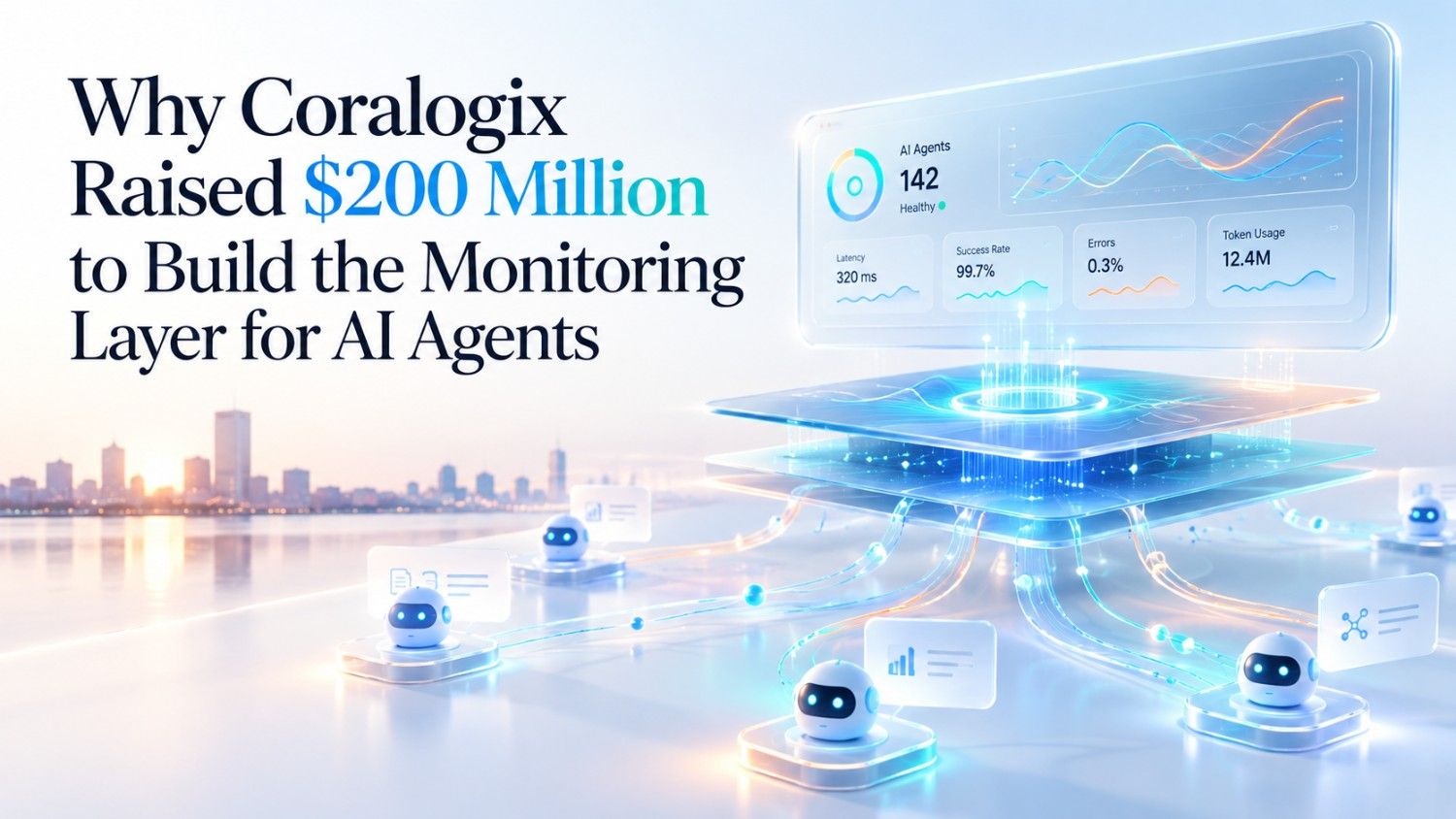
That is the broader context behind Coralogix’s decision to raise $200 million in Series F funding on June 3, 2026, in a round led by Advent and CPPIB, with Greenfield and Brighton Park Capital also participating. The financing brought the company’s total reported funding to approximately $550 million, while TechCrunch reported a $1.6 billion post-money valuation.
The size of the round is important, but the timing is even more revealing because Coralogix had already raised $115 million in Series E funding in June 2025, less than one year earlier. At that point, the company said it already served more than 4,000 customers and had started making AI observability a major part of its next phase of growth.
The question, therefore, is not simply why another observability company raised a large amount of money.
The more interesting question is why investors are willing to put hundreds of millions of dollars behind a company that wants to monitor, evaluate, secure, and eventually help control AI agents.
The answer is that observability is becoming far more important as software becomes more autonomous.
The Short Version: Coralogix Is Betting That AI Agents Need Their Own Control Layer
The easiest way to understand the Coralogix strategy is to stop thinking about observability as a collection of dashboards that engineers open after something breaks and instead think about it as a real-time control system for software that can make decisions on its own.
Traditional observability was designed to help engineering teams understand whether an application, server, database, network, or cloud service was performing correctly. Those tools could tell a team that latency had increased, memory usage was too high, a service was failing, or a database query had become unusually slow.
AI agents introduce a much more difficult set of questions because the infrastructure can be technically healthy while the agent is still producing a bad business outcome.
A company may need to know whether an agent selected the correct tool, whether it misunderstood the user’s request, whether it used an unnecessarily expensive model, whether it exposed sensitive data, whether it became stuck in a repeated loop, or whether it delegated a task to another agent that was not authorized to perform the action.
Coralogix’s AI Center now brings together monitoring, evaluation, guardrails, AI security posture management, agent discovery, tracing, cost visibility, and monitoring for external coding agents, which shows how quickly the definition of observability is expanding beyond traditional infrastructure monitoring.
The company is effectively betting that enterprises will need a dedicated layer between autonomous AI systems and the rest of the business, with that layer providing visibility, policy enforcement, security, cost control, and evidence about what happened inside each workflow.

This is a much larger opportunity than simply selling another monitoring dashboard.
The $200 Million Round Looks Different When You Put It on a Timeline
Looking at the Series F in isolation makes the funding round appear like a straightforward growth financing, but the strategy becomes much easier to understand when Coralogix’s recent moves are placed in chronological order.
December 2024: Coralogix Acquires Aporia
Coralogix acquired Aporia in December 2024, bringing in a company that had already spent years working on AI observability, model monitoring, guardrails, reliability, and AI safety.
That acquisition now looks increasingly important because it gave Coralogix a much faster route into AI monitoring than building an entirely new product category from the ground up.
Instead of treating artificial intelligence as one more source of logs or metrics, Coralogix gained technology and expertise focused specifically on understanding the behavior of AI systems.
March 2025: AI Center Launches
Only a few months later, Coralogix launched its AI Center, which brought AI monitoring more directly into the company’s broader observability platform.
The product was designed to help teams understand model performance, response quality, security risks, costs, and application behavior while linking those signals back to the surrounding software environment.
This was an important strategic move because it showed that AI was no longer being treated as a minor feature or optional integration.
It was becoming a separate operating layer within the Coralogix platform.
June 2025: Coralogix Raises $115 Million
In June 2025, Coralogix raised $115 million in Series E funding, while also stating that its valuation had exceeded $1 billion and that more than 4,000 customers were using its platform.
The company made AI a central part of the story around that financing, which suggested that the next stage of growth would involve more than simply expanding its existing log management and observability business.
June 2026: Coralogix Raises Another $200 Million
Less than twelve months later, Coralogix announced another financing round, this time for $200 million.
That round increased the company’s reported total funding to approximately $550 million and gave it substantially more capital to expand a product strategy increasingly centered on AI, automation, and observability infrastructure for autonomous systems.
September 2026: The Product Surface Keeps Expanding
By September 2026, Coralogix’s AI product documentation described a much broader platform that included AI monitoring, guardrails, continuous evaluations, AI security posture management, AI asset discovery, coding-agent monitoring, and deeper visibility into usage, governance, cost, and audit activity.
The pattern is clear when these moves are examined together.
Coralogix is not simply adding AI features to an observability platform.
It is trying to redefine what an observability platform needs to become in a world where software increasingly acts with some level of autonomy.
Original Finding #1: Coralogix Increased the Size of Its Next Funding Round by About 74%
BostonBizScene compared Coralogix’s two most recent publicly announced funding rounds to understand how aggressively the company has increased its capital base.
| Round | Announcement | Capital Raised |
| Series E | June 2025 | $115M |
| Series F | June 2026 | $200M |
The Series F was approximately 73.9% larger than the Series E.
Funding Round Size
Series E $115M ███████████
Series F $200M ████████████████████
This increase is especially notable because the rounds were separated by less than one year, meaning Coralogix returned to the market very quickly and raised substantially more capital the second time.
The funding increase does not mean that all of the money will be spent directly on AI observability, because Coralogix still operates a large infrastructure monitoring, log management, and security business.
However, the company’s own positioning around the Series F strongly emphasized observability infrastructure for the AI era, including environments in which human operators and autonomous agents increasingly work together.
There is another useful number to examine.
The $200 million Series F represents approximately 36.4% of the $550 million in total funding Coralogix says it has raised.
Earlier capital $350M ███████████████████████████████████
2026 Series F $200M ████████████████████
Total $550M
That means more than one-third of the company’s total reported financing arrived through this single round, which gives Coralogix considerable resources to expand products, hire talent, make acquisitions, and compete with larger observability companies.
Methodology
BostonBizScene used the publicly announced values of the June 2025 and June 2026 rounds.
The calculations are straightforward:
Funding round increase = ($200M – $115M) ÷ $115M = 73.9%
Series F share of total funding = $200M ÷ $550M = 36.4%
These figures should be interpreted as financing analysis rather than as evidence of revenue growth, profitability, or market share because Coralogix does not publicly disclose enough financial data to make those conclusions.
Why AI Agents Break Traditional Monitoring
Traditional software usually behaves according to fairly predictable rules because developers define the logic in advance and the application follows those rules when a request arrives.
Even complex cloud software can usually be represented as a chain of services, databases, APIs, queues, and infrastructure components.
A simple example might look like this:
User
↓
Application
↓
API
↓
Database
↓
Response
When something goes wrong, observability systems help engineers determine where the request slowed down, which service returned an error, which database query caused the problem, or which infrastructure component became overloaded.
AI agents make that process much more difficult because the path through the system can change dynamically.
A modern agent may look more like this:
User
↓
Agent
├── Model A
├── Search Tool
├── CRM
├── Database
├── Agent B
│ ├── Model B
│ └── Internal API
└── Payment System
↓
Decision
↓
Action
The workflow is no longer simply executing a predefined series of instructions.
The agent may be deciding which steps are necessary while the task is already running.
That means observability needs to capture not only whether the technical components worked, but also whether the sequence of decisions made sense.
The Most Dangerous AI Failure May Look Like Success
One of the biggest weaknesses of traditional monitoring is that it assumes technical success is a good proxy for application success.
That assumption becomes dangerous with AI agents.
Imagine a sales agent that is asked to give a customer a 10% discount.
The agent calls the correct pricing API, receives a successful response, writes the updated value to the database, and returns confirmation to the user.
Every traditional technical signal could look perfectly healthy.
The API returns HTTP 200.
The database query succeeds.
Latency remains normal.
Infrastructure usage stays within expected limits.
No error appears anywhere.
However, if the agent accidentally interpreted the request as a 100% discount, the business process has clearly failed even though the infrastructure worked exactly as designed.
This is why agent observability requires a new category of measurement.
Companies need to know not only whether the tool call succeeded but whether the tool should have been called, whether the input was correct, whether the result matched the original goal, and whether the final outcome made sense.
Agent Monitoring Has to Watch Five Things at Once
A useful framework for understanding AI observability is to divide the problem into five different layers.
Layer 1: Infrastructure
Companies still need traditional infrastructure visibility because agents ultimately depend on servers, databases, networks, APIs, queues, storage systems, and cloud services.
Latency, memory, availability, error rates, and database performance remain important.
Agent observability does not replace conventional monitoring.
It adds new layers on top of it.
Layer 2: Model Performance
Companies also need to understand what is happening inside model interactions.
That includes request volume, token use, response times, model versions, provider failures, context size, and inference cost.
These metrics are becoming increasingly important because AI systems can become expensive even when they remain technically functional.
Layer 3: Agent Behavior
The next layer involves understanding what the agent actually did during the workflow.
Teams need visibility into tool calls, agent handoffs, retries, routing choices, delegation, repeated loops, and workflow sequencing.
This is where traditional infrastructure monitoring becomes insufficient because the important question is no longer whether the tool worked.
The important question is whether the agent made the correct decision to use it.
Layer 4: Output Quality
Teams also need a way to judge whether the final answer or action was correct.
This may involve measuring hallucinations, factual accuracy, policy compliance, relevance, toxicity, sensitive data exposure, or whether the output actually solved the user’s problem.
Quality is difficult because it cannot always be measured through simple technical signals.
That is why AI observability platforms are increasingly adding evaluations and scoring systems.
Layer 5: Business Outcome
The final layer is the one executives should care about most because it connects AI behavior to business performance.
A company may have an agent that works reliably, produces accurate answers, and completes tasks quickly, but the system is still not valuable if every workflow costs more than the business value it creates.
The strongest AI observability systems will eventually need to connect technical behavior with measures such as revenue impact, time saved, successful task completion, customer satisfaction, employee productivity, and operational cost.
Original Finding #2: The Agent Monitoring Market Is Converging Around a Common Set of Requirements
BostonBizScene reviewed public product documentation from Coralogix, Datadog, Dynatrace, and New Relic to identify the capabilities that repeatedly appear across modern AI observability platforms.
The goal was not to rank the companies or determine which product is best.
The objective was to understand what the broader market increasingly considers essential when monitoring agents.
| Monitoring Need | Coralogix | Datadog | Dynatrace | New Relic |
| Agent/workflow tracing | Documented | Documented | Documented | Documented |
| Tool-call visibility | Documented | Documented | Documented | Documented |
| Cost/token monitoring | Documented | Documented | Documented | Documented |
| Quality evaluation | Documented | Documented | Documented | Documented |
| Security/safety analysis | Documented | Documented | Documented | Documented |
| OpenTelemetry support | Documented | Documented | Documented | Documented |
| Multi-agent visibility | Documented | Documented | Documented | Documented |
The most important finding is not that several observability companies now support AI agents.
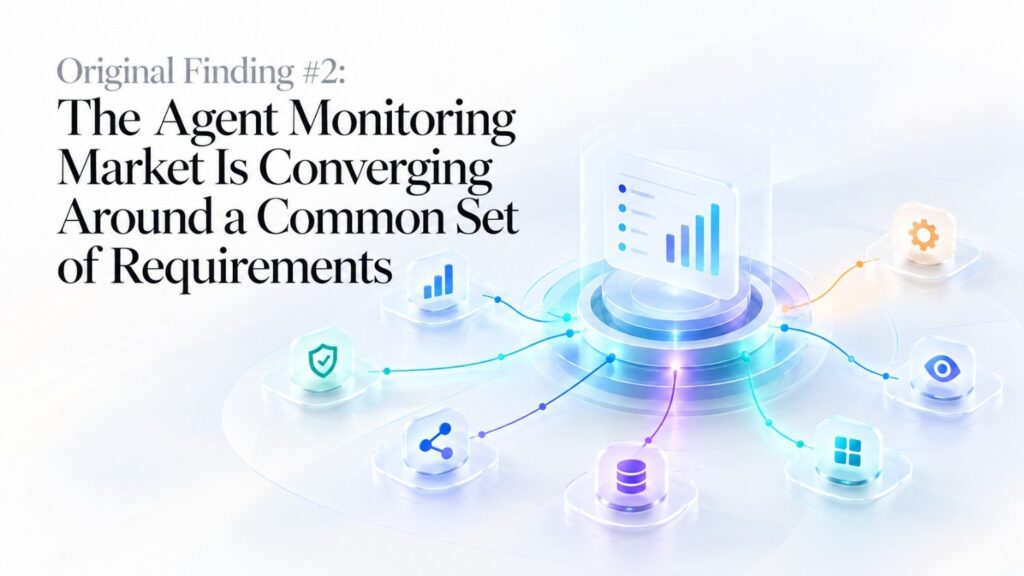
The more important signal is that they are increasingly converging on the same categories of data.
Seven Signals Appear Repeatedly
Agent traces ████████████████████
Tool calls ████████████████████
Latency/errors ████████████████████
Token/cost data ████████████████████
Quality ████████████████████
Safety/security ████████████████████
Open telemetry ████████████████████
This suggests that a minimum viable observability stack for AI agents is beginning to emerge.
Over time, tracing, tool visibility, cost tracking, quality measurement, and security controls may become as ordinary as logs and application performance monitoring are today.
OpenTelemetry Could Make This Market Much Bigger
The growth of OpenTelemetry may accelerate this shift because enterprises do not want every AI framework, model provider, and agent platform to generate completely different forms of monitoring data.
A large company may use OpenAI, Anthropic, Amazon Bedrock, internal models, LangGraph, coding agents, retrieval systems, internal APIs, and custom orchestration tools at the same time.
Without common standards, every application could require separate instrumentation.
OpenTelemetry offers a path toward a shared format for recording important generative AI activity, including model calls, tool operations, prompts, responses, token usage, and related events.
That matters because standardization usually makes infrastructure markets easier to scale.
Competition Could Move Higher in the Stack
If many vendors eventually become capable of collecting similar telemetry through open standards, the competitive advantage may move away from basic data collection.
The real differentiation could increasingly come from what observability platforms do after the data arrives.
Can the platform determine why an agent failed?
Can it identify suspicious reasoning?
Can it detect unnecessary tool calls?
Can it connect an incorrect answer to the exact upstream cause?
Can it automatically stop unsafe behavior?
Can it provide enough historical context for another AI system to investigate the problem?
Can it connect technical behavior to business results?
These questions help explain why Coralogix is investing in evaluations, guardrails, discovery, security posture, and agent-specific monitoring rather than stopping at basic tracing.
Coralogix Is Trying to Move From Observing AI to Controlling AI
This may be the most strategically important part of the company’s direction because there is a major difference between observing a system and influencing what that system is allowed to do.
Traditional observability is mainly passive.
It records activity and helps people understand what happened.
AI guardrails introduce an active control mechanism because they can inspect prompts, responses, and actions before those interactions are completed.
That means the system can potentially block, modify, or flag activity that violates company policies.
The role of observability begins to change.
It moves from being the camera that records what happened to becoming part of the safety system that influences what can happen.
A modern agent-management loop could therefore look like this:
OBSERVE
↓
EVALUATE
↓
ALERT OR BLOCK
↓
INVESTIGATE
↓
IMPROVE
↓
OBSERVE AGAIN
That closed loop is much more valuable than a static dashboard because it connects visibility to action.
AI Discovery Solves Another Problem: Companies May Not Know How Much AI They Have
Before a company can monitor its AI systems, it first needs to know where those systems exist.
This may sound simple, but it becomes difficult inside a large enterprise.
One team may use OpenAI directly.
Another group may have built a LangGraph application.
Developers may use Claude Code, Codex, Cursor, or GitHub Copilot.
The marketing department may have connected an AI tool to customer data.
An internal application may call a model that the central security team does not even know is being used.
This creates a form of AI sprawl similar to what happened during the early years of cloud computing.
Coralogix’s AI security posture and discovery capabilities are designed to identify models, agents, and AI integrations across company systems so teams can understand what exists before trying to govern it.
That capability could become increasingly important because enterprises cannot secure or monitor assets they do not know about.
Coding Agents May Create an Observability Market of Their Own
Coding agents are another major part of this shift because they increasingly do more than simply suggest a few lines of code.
Modern tools can inspect repositories, write files, modify functions, run tests, debug errors, and work across multiple development steps with limited supervision.
That creates new operational questions for engineering leaders.
How much code did the agent generate?
How much was accepted?
How often did developers need to rewrite it?
Did the agent introduce bugs?
Did it increase deployment speed?
Did it reduce incident resolution time?
How many tokens did it use?
How much did each successful change cost?
Coralogix has started documenting support for observing external coding tools and connecting those activities to engineering outcomes.
That signals another important transition.
Companies are moving from asking whether developers use AI to asking whether AI actually improves engineering output.
Original Finding #3: AI Observability Is Moving From Technical Health Toward Economic Measurement
BostonBizScene grouped the metrics increasingly associated with agent monitoring into four broad categories.
| Measurement Layer | Examples |
| Technical health | Errors, latency, availability |
| AI consumption | Tokens, model calls, inference cost |
| AI behavior | Tool calls, handoffs, agent decisions |
| AI outcome | Quality, safety, business impact |
Traditional observability focused heavily on the first category.
Agent observability increasingly requires all four.
SYSTEM HEALTH
████████████████████
AI CONSUMPTION
████████████████████
AI BEHAVIOR
████████████████████
BUSINESS OUTCOME
████████████████████
The direction is important because observability is slowly moving from measuring machines to measuring work.
That makes the category much more strategically important to executives.
Why Cost Monitoring Could Become One of the Biggest Features
AI systems introduce a different economic model from most traditional software because each additional reasoning step, model request, tool call, retry, or large context window may increase operating cost.
Consider an agent that normally requires four model calls to complete a task.
If a bad prompt or poorly designed workflow causes the same agent to use twelve calls, the task may still complete successfully, but the model cost can increase dramatically.
The infrastructure may remain healthy.
Users may not notice anything.
The application may report no errors.
However, the economics have quietly deteriorated.
When that behavior happens across hundreds of thousands of workflows, small inefficiencies can become large financial problems.
This is why AI observability increasingly overlaps with FinOps.
Cloud teams once asked which servers were wasting money.
AI teams may soon ask which reasoning paths, models, prompts, and tool sequences are wasting money.
Datadog’s Public Numbers Show How Quickly AI Telemetry Is Growing
Coralogix does not publish enough detailed product usage information for outside analysts to estimate its AI observability growth directly, but public data from Datadog provides a useful external signal for the broader market.
During its first-quarter 2026 earnings call, Datadog said more than 6,500 customers were sending data through at least one AI integration, while those customers represented around 80% of the company’s annual recurring revenue.
The company also said the number of spans entering its LLM Observability product had nearly tripled quarter over quarter.
Earlier, Datadog had reported that more than 1,000 customers were using its LLM Observability product and that span volume had risen roughly tenfold during a six-month period.
These numbers cannot be used to estimate Coralogix’s revenue or adoption.
However, they provide an important market signal.
AI telemetry is becoming a real and rapidly growing workload inside major observability platforms.
Original Finding #4: Agentic AI Creates a Telemetry Multiplication Effect
One of the most important characteristics of agentic AI is that observability volume can increase dramatically even when the number of user requests stays the same.
Consider three hypothetical architectures that each handle 10,000 user requests.
Simple AI Application
If each request requires one model interaction:
10,000 requests × 1 model call = 10,000 monitored interactions
Basic Agent
Now assume each request requires three model calls, two tool calls, and one retrieval operation.
That creates approximately six monitored operations for each task.
10,000 requests × 6 operations = 60,000 monitored operations
Multi-Agent Workflow
Now assume an orchestrator coordinates multiple agents and each workflow produces six model calls, four tool calls, two retrieval operations, and two agent handoffs.
That produces approximately fourteen monitored operations per request.
10,000 requests × 14 operations = 140,000 monitored operations
Illustrative Telemetry Expansion
Simple LLM app 10,000 ██
Basic agent 60,000 ████████████
Multi-agent 140,000 ████████████████████████████
This is a BostonBizScene scenario model rather than reported Coralogix customer data.
The purpose is to show how architectural complexity changes the observability burden.
As agents perform more steps, the number of places where latency, cost, security, reasoning, or tool failures can occur also increases.
Methodology
The model uses three hypothetical architectures and counts significant workflow operations.
It does not include application logs, infrastructure metrics, database activity, or system-level telemetry, which means actual monitoring volume in production environments could be considerably higher.
The analysis should therefore be interpreted as a demonstration of workflow complexity rather than a forecast of market size.
Why Full-Fidelity Data Could Matter More in the Agent Era
Coralogix has long emphasized an architecture built around processing large volumes of telemetry while allowing organizations to retain extensive historical data without forcing every event into a traditional high-cost indexing model.
That approach becomes increasingly interesting when AI agents enter production environments.
A human engineer investigating a problem often knows approximately what to search for.
An autonomous investigation system may require much broader context.
It may need to examine recent traces, old incidents, previous deployments, infrastructure metrics, model calls, tool activity, security events, and long-term performance patterns before it can identify the cause of a problem.
If observability becomes a memory system for AI operations, access to rich historical context may become significantly more valuable.
Observability Data May Become the Memory AI Operations Agents Need
The relationship between AI and observability may ultimately work in both directions.
Companies obviously need observability to understand their agents.
However, agents may also need observability systems to understand the companies they are operating inside.
Imagine asking an autonomous SRE agent why checkout latency increased during the morning.
A useful answer may require information from traces, deployment history, database performance, cloud configuration, logs, previous incidents, and historical baselines.
Without that context, the agent is effectively guessing.
This creates a powerful feedback loop:
AI AGENTS
↓
create more telemetry
↓
OBSERVABILITY PLATFORM
↓
creates operational context
↓
AI OPERATIONS AGENTS
↓
use context to investigate and act
That makes observability strategically important in two different ways.
It becomes the system used to monitor agents and the system agents themselves use to understand the operational environment.
Boston Is Becoming an Interesting Battleground for This Market
Coralogix’s Boston presence adds another layer to the story because the city already has deep experience in enterprise software, cybersecurity, infrastructure, developer tools, data systems, robotics, and artificial intelligence.
Dynatrace, another large observability company with a strong Boston-area presence, has also been expanding heavily into AI observability and agentic operations.
That creates an interesting concentration of companies working on the infrastructure needed to make autonomous software reliable.
Boston has seen this pattern before.
The region often performs well when a technology category moves beyond the early demo stage and enterprises begin demanding security, governance, reliability, integration, and operational control.
Agentic AI appears to be moving rapidly toward that stage.
Boston’s Advantage May Be Enterprise Complexity
Boston may not need to compete directly with Silicon Valley for every consumer-facing AI product.
The city’s stronger opportunity may be in complex enterprise environments where AI systems need to operate under tighter rules.
Healthcare organizations cannot allow agents to handle sensitive workflows without strong controls.
Financial institutions need auditability and permissions.
Cybersecurity systems need clear decision trails.
Industrial organizations need reliability.
Biotechnology companies need rigorous governance around data and experimentation.
These are environments where observability becomes especially valuable because the cost of an uncontrolled AI action can be much larger than the cost of a poor chatbot answer.
Boston’s strength may therefore lie in building the infrastructure that makes autonomous software safe enough for serious enterprise use.
Original Finding #5: Human Oversight Is Still a Major Part of Agentic AI
Enterprise adoption data suggests that companies are not moving immediately toward fully autonomous agents with no human oversight.
A more realistic transition happens in stages.
| Stage | AI Role | Human Role |
| 1 | Suggest | Decide |
| 2 | Prepare action | Approve |
| 3 | Act within narrow rules | Review exceptions |
| 4 | Operate independently | Audit |
| 5 | Coordinate other agents | Govern policies |
Observability becomes more important as organizations move down this table.
When a human checks every action, the employee acts as the final safety layer.
When an agent performs thousands of actions without direct review, software has to replace much of that oversight.
That is why monitoring, evaluation, guardrails, permissions, and governance are starting to merge into the same enterprise architecture.
The Big Shift Is From Dashboards to Machine-Readable Observability
For most of the history of observability software, the main user was a human engineer.
Products were therefore designed around dashboards, charts, alerts, query interfaces, incident views, and visual analysis.
AI agents do not necessarily need those interfaces.
An operations agent may need structured access to telemetry through APIs, command-line tools, or machine-readable protocols.
It needs to retrieve traces, compare baselines, inspect historical incidents, identify deployments, query logs, understand dependencies, and potentially initiate remediation.
This means the interface to observability may become just as important as the underlying data.
The future observability platform may need to serve two audiences at the same time.
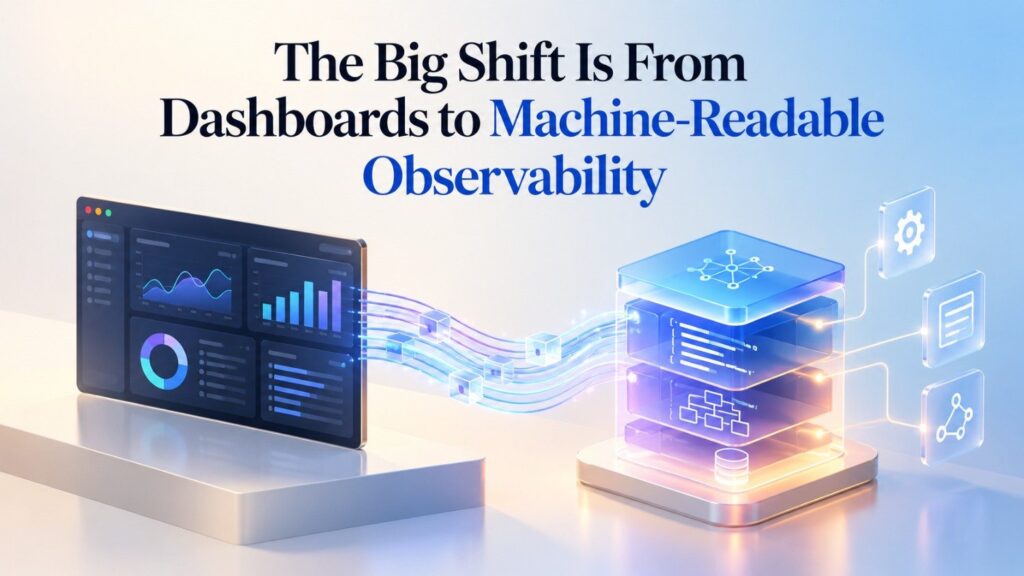
Human engineers still need clear dashboards and investigation tools.
AI agents need structured, compact, queryable operational context.
That is a significant product shift.
A Better KPI Dashboard for Companies Deploying AI Agents
Boston companies should avoid relying only on infrastructure metrics when evaluating AI agents.
A useful executive dashboard should combine reliability, economics, quality, and risk.
Reliability
| KPI | What It Tells You |
| Workflow success rate | Whether the entire task completed |
| Tool error rate | Whether external actions failed |
| Agent handoff failure rate | Whether delegation is working |
| P95 workflow latency | How long complex tasks take |
| Loop or retry rate | Whether agents are becoming stuck |
Economics
| KPI | What It Tells You |
| Cost per successful task | Real unit economics |
| Tokens per completed task | Model efficiency |
| Tool calls per task | Workflow complexity |
| Cost by model | Whether premium models are justified |
| Cost of failed workflows | Money spent without value |
Quality
| KPI | What It Tells You |
| Correctness score | Whether outputs are right |
| Hallucination rate | Unsupported output frequency |
| Escalation rate | How often humans intervene |
| Rework rate | How often output needs correction |
| User acceptance rate | Whether users accept results |
Risk
| KPI | What It Tells You |
| Prompt injection attempts | Security pressure |
| PII leakage incidents | Data exposure |
| Guardrail intervention rate | Frequency of blocked behavior |
| Unauthorized tool attempts | Permission failures |
| High-risk approval rate | Human control burden |
The most mature companies will eventually connect these four groups to business outcomes.
That is where AI observability becomes an executive discipline rather than simply an engineering practice.
The Most Important Metric May Be Cost Per Correctly Completed Task
One of the easiest mistakes in AI operations is focusing too heavily on token costs.
Token usage is important, but it does not tell the full economic story.
Imagine Agent A costs $0.20 per task while Agent B costs $0.35.
At first, Agent A appears more efficient.
However, suppose Agent A successfully completes only 70% of tasks while Agent B successfully completes 95%.
The economics begin to change.
For 1,000 tasks:
Agent A
1,000 × $0.20 = $200 model cost.
700 tasks succeed.
The direct model cost per successful task is approximately $0.29.
Agent B
1,000 × $0.35 = $350 model cost.
950 tasks succeed.
The direct model cost per successful task is approximately $0.37.
Agent A still looks cheaper until the cost of failure is added.
If each failed task requires ten minutes of employee rework worth $6, Agent A creates 300 failed tasks and approximately $1,800 in rework.
Its effective cost becomes roughly $2,000.
Agent B creates only 50 failed tasks, which produces approximately $300 in rework.
Its effective cost becomes roughly $650.
The lesson is straightforward.
The cheapest model is not necessarily the cheapest system.
Companies need to measure cost per correctly completed business task.
Boston Companies Should Instrument Agents Before Giving Them More Authority
One of the biggest mistakes companies can make is building autonomous systems first and adding observability afterward.
That approach already created problems during the cloud era, when organizations frequently launched distributed applications before building the monitoring needed to operate them reliably.
The risk is even greater with agents because those systems are capable of making decisions and taking actions.
Before an agent reaches production, companies should be able to reconstruct what happened during an important workflow.
Teams should capture the original task, the agent responsible, model calls, tool calls, retrieval activity, important decisions, policy evaluations, human interventions, token usage, latency, total cost, and final outcome.
If engineers cannot explain what an agent did after something goes wrong, the system probably has too much autonomy for the amount of visibility surrounding it.
A Practical 90-Day AI Observability Plan
Companies do not need to build a massive AI governance program on day one, but they should create visibility before scaling autonomous workflows.
Days 1-30: Build the AI Inventory
Start by identifying all meaningful AI applications across the organization, including customer-facing systems, internal agents, coding tools, automation workflows, model providers, and experiments connected to sensitive data.
Each system should have a clear owner.
Teams should document what data the agent can access, what tools it can use, what actions it can take, and which systems it can modify.
The first goal is simply to know what exists.
Days 31-60: Instrument the Full Workflow
The next step is adding telemetry across the entire workflow rather than monitoring only the model call.
Teams should capture agent steps, model usage, retrieval operations, tool calls, latency, failures, cost, routing choices, and delegation activity.
Open standards such as OpenTelemetry can help make this data easier to move between tools and platforms.
Days 61-90: Connect Telemetry to Business Outcomes
Once the workflow is visible, teams should choose one important business process and measure whether the agent actually improves it.
That workflow might involve customer support, security investigations, claims processing, document review, coding, sales research, or software debugging.
Measure the human process first.
Then measure the AI process.
Compare time, cost, quality, rework, escalation, and task completion.
Leadership does not need to know only how many tokens the company consumed.
It needs to know what those tokens accomplished.
What CTOs Should Ask Their Teams
The most useful question is not whether the company has AI monitoring because that usually produces an unhelpful yes-or-no answer.
A better question is whether the engineering team can reconstruct exactly what an agent did during a failed task.
If the answer is yes, ask whether the team can identify whether the failure came from the model, prompt, data source, retrieval system, tool call, orchestration logic, another agent, or a permission problem.
Then ask whether the company can determine the cost of that failure.
Finally, ask whether the same class of failure could be automatically detected or prevented next time.
Those questions reveal far more about the maturity of an agentic system than simply asking whether monitoring exists.
What Investors Should Watch Next
Coralogix now has significant capital, but funding alone will not determine which companies dominate the AI observability market.
Several signals matter more.
How Quickly AI Observability Becomes a Dedicated Budget
The category becomes significantly more valuable when enterprises stop treating agent monitoring as an experimental engineering project and begin assigning permanent budget to it.
Whether Existing Customers Adopt AI Products
Coralogix already has thousands of observability customers.
If those companies increasingly deploy agents, Coralogix has an opportunity to sell additional AI monitoring capabilities into accounts that already use its platform.
Large competitors such as Datadog, Dynatrace, and New Relic have the same advantage.
Whether Guardrails Become Part of Observability
Monitoring and policy enforcement have historically been different product categories.
Agentic AI may bring them together because enterprises need both visibility and control.
If customers prefer a single platform that can observe an agent, evaluate its behavior, and block unsafe actions, observability vendors could expand into a much larger market.
Whether Agents Become Major Consumers of Observability Data
This may be the most important long-term signal.
If AI operations agents begin querying production telemetry continuously, observability systems may no longer serve mainly human engineers.
They may become core information systems used directly by autonomous software.
The Competitive Battle Will Not Be About Who Has the Prettiest Dashboard
Agent observability is likely to become crowded because nearly every major observability vendor is expanding into the category.
Datadog has Agent Observability.
Dynatrace has expanded its AI and agent monitoring products.
New Relic is building AI Agent Monitoring and agentic operational capabilities.
Coralogix has its AI Center.
Specialized startups are also building around tracing, evaluation, testing, security, prompts, governance, and model behavior.
The real competitive advantage may therefore emerge somewhere deeper.
It could come from architecture.
It could come from lower data costs.
It could come from better evaluations.
It could come from stronger security.
It could come from deeper integration across infrastructure and AI telemetry.
It could come from the ability to give autonomous agents better operational context than competing platforms.
The market is still developing, but the direction is becoming easier to see.
The Bigger Story: Observability Is Becoming a Control Plane for Digital Workers
The most important part of Coralogix’s $200 million funding round is what it says about how enterprise software is changing.
For decades, observability existed mainly because humans needed help understanding increasingly complicated systems.
Agentic AI adds a second requirement.
Machines now need to understand other machines.
A coding agent needs access to repositories, deployments, tests, and production signals.
A security agent needs logs, vulnerabilities, cloud configurations, identity events, and network activity.
An SRE agent needs a detailed view of the entire production environment.
A customer-service agent may need billing data, order information, account history, and operational status.
A large part of that context already lives inside observability platforms.
That creates a unique strategic position for companies such as Coralogix because they already sit close to some of the richest operational data inside modern enterprises.
Original Finding #6: The Observability Stack Is Moving From Three Layers to Six
Traditional observability is often described through three major telemetry types:
logs,
metrics,
and traces.
Agentic AI requires additional layers of context.
BostonBizScene’s analysis suggests that enterprise AI operations are increasingly forming around at least six layers.
| Layer | Main Question |
| Logs | What happened? |
| Metrics | How much and how often? |
| Traces | Where did the request travel? |
| Agent trajectory | What decisions were made? |
| Evaluations | Was the behavior correct and safe? |
| Business outcome | Did the work create value? |
This is not an official technical standard.
It is an analytical framework based on how AI observability products are evolving.
The progression can be represented like this:
BUSINESS OUTCOME
▲
EVALUATION
▲
AGENT TRAJECTORY
▲
TRACES
▲
METRICS
▲
LOGS
Traditional telemetry remains essential.
However, it increasingly becomes the foundation beneath additional layers that explain the behavior and value of autonomous systems.
Why This Matters Beyond Coralogix
It would be easy to treat the Series F as another large AI funding announcement, but the more useful interpretation is that it reflects a shift in where enterprise AI infrastructure spending may be heading.
The first wave of investment focused heavily on foundation models.
The next wave focused on applications built on top of those models.
The next infrastructure layer is increasingly about operating those applications safely at scale.
That includes monitoring, testing, evaluation, security, governance, permissions, cost management, auditability, agent communication, and operational context.
The more autonomous AI becomes, the more important these supporting systems become.
Boston Could Build the Infrastructure Around Autonomous Enterprise Software
Boston has historically been strong when new technology moves from early experimentation into serious enterprise adoption.
Agentic AI may create another version of that opportunity.
The impressive demo is easy to understand.
An agent writes code, books an appointment, investigates a security incident, analyzes a market, or handles a customer request.
The harder questions come later.
What happens when thousands of employees use agents?
What happens when agents can spend money?
What happens when they modify production code?
What happens when they access customer data?
What happens when one agent delegates work to another?
What happens when there is no employee watching every decision?
Those problems require infrastructure, security, governance, and monitoring.
Those are areas where Boston already has deep technical experience.
Final Takeaway: Coralogix Is Raising Money for a World Where Software Has to Be Watched Like a Workforce
Coralogix’s $200 million Series F becomes easier to understand when AI agents are viewed less like ordinary software features and more like a new class of digital workers.
Workers perform tasks, use tools, consume resources, make mistakes, operate under permissions, and need their performance measured.
AI agents increasingly do the same.
As companies give those systems more authority, they need infrastructure capable of explaining what happened, measuring whether the work was successful, calculating how much it cost, identifying risk, and preventing dangerous behavior.
That is the market Coralogix is trying to capture.
The company acquired Aporia in late 2024, launched its AI Center in early 2025, raised $115 million in June 2025, and then raised another $200 million in June 2026 while continuing to expand into evaluation, guardrails, AI security posture, discovery, cost tracking, and coding-agent observability.
The competition is moving quickly because Datadog, Dynatrace, New Relic, and many specialized startups are chasing the same fundamental opportunity.
Autonomous software requires a much richer form of visibility than traditional applications.
The next phase of enterprise AI may therefore be decided not only by who builds the smartest agent, but also by who builds the infrastructure that makes large numbers of agents observable, measurable, secure, affordable, and controllable.

Coralogix is raising heavily because it wants to become one of the companies providing that infrastructure.
If AI agents eventually become a meaningful digital workforce inside large enterprises, the systems responsible for monitoring and controlling that workforce could become one of the most important layers in the entire software stack.