

Artificial intelligence in biotech is moving into a new phase.
For the last several years, much of the excitement around AI drug discovery focused on models. Companies built systems that could predict protein structures, rank drug targets, generate molecules, analyze images, or estimate whether a molecule might bind to a protein.
Those tools can be valuable. But they normally answer one question at a time.
The next wave is different.
A growing group of Boston-area companies is trying to build AI systems that can handle parts of the scientific process itself. These systems can gather evidence, decide what analysis to run, design molecules, propose experiments, use specialized software, interpret results, and sometimes send the next experiment directly to laboratory equipment.
In other words, AI is starting to move from prediction to action.
That change matters enormously for Boston.
The region already has one of the deepest combinations of biotech companies, pharmaceutical R&D groups, university laboratories, computational biology researchers, wet-lab infrastructure, hospitals, and life-science investors anywhere in the world. If AI agents become an important layer of drug research, Boston has an unusually strong opportunity because the city already controls much of what agents need most: scientific expertise, experimental infrastructure, clinical knowledge, and proprietary biological data.
Our analysis of ten Boston-area companies and platforms suggests something even more interesting.
The biggest opportunity may not be creating a single artificial scientist capable of replacing an entire research organization. The more realistic near-term opportunity is building specialized agents around the expensive decision loops that determine whether a drug program moves forward.
That means deciding what experiment should happen next.
It means finding evidence that changes a clinical trial.
It means generating better molecules after experimental failure.
It means connecting computational predictions with physical laboratories.
And eventually, it means creating R&D systems that learn continuously instead of repeatedly handing work from one team to another.
That transition is already visible across Greater Boston.
The Short Version: Boston Is Building Agents Around the Drug Development Loop
An AI chatbot answers questions.
An AI model makes predictions.
An AI agent can take a goal, break that goal into steps, use tools, examine results, and decide what should happen next.
That distinction becomes especially important in biotechnology because discovering a medicine is not one prediction problem.
Drug development contains thousands of connected decisions. Researchers review scientific papers, evaluate disease biology, choose targets, design molecules, plan experiments, analyze data, compare results, investigate failures, design more experiments, prepare regulatory documents, design clinical trials, select patients, and continuously decide whether programs deserve more money and time.
Traditional software usually helps with one piece of that process.
Agentic systems are starting to connect the pieces.
Boston companies are now working at several points across this chain. Delineate is building agents aimed at clinical-trial design and evidence aggregation. AIRA Health is using specialized agents across clinical strategy, regulatory intelligence, statistics, and medical writing. Lila Sciences is pursuing scientific agents connected to autonomous laboratories. Generate has publicly described work around an internal “Agentic Science Platform.” Atinary has opened self-driving laboratories in Boston where AI can design, execute, analyze, and learn from physical experiments.
Meanwhile, companies including Nabla Bio, Converge Bio, TandemAI, Receptor.AI, and BostonGene are building various combinations of generative design, biological modeling, experimental feedback, computational workflows, and decision systems that move drug research toward greater automation.
The important point is that these systems are not all doing the same thing.
Some automate thinking.
Some automate searching.
Some automate molecule design.
Some automate experiments.
Some automate development decisions.
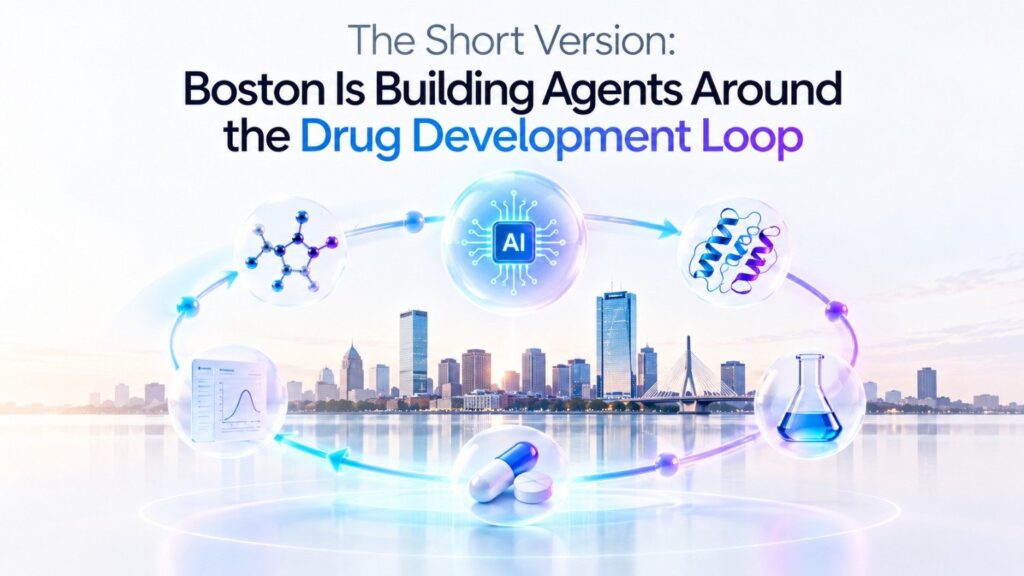
The most powerful systems increasingly connect several of these functions.
What Does an AI Agent Actually Mean in Biotech?
The term “AI agent” is being used so widely that it can quickly become meaningless.
A company adding a chatbot to a scientific database does not automatically have an autonomous scientist. A generative model that creates protein sequences is not necessarily an agent either.
For this article, we use a stricter definition.
An agentic biotechnology system should be able to perform at least several steps of a workflow without requiring a human to manually issue a new instruction after every step.
That might include retrieving information, choosing a tool, running an analysis, interpreting the output, comparing several options, and recommending what should happen next.
The highest level goes further.
An agent can make a decision that causes another scientific action.
For example:
Hypothesis → experimental design → experiment → measurement → analysis → next experiment.
That is much closer to a genuine scientific loop.
The Five Levels of Biotech AI Automation
To make comparisons clearer, BostonBizScene created a five-level framework.
| Level | Type of system | What it does |
|---|---|---|
| 1 | AI assistant | Answers questions or summarizes information |
| 2 | Specialized model | Predicts structures, properties, outcomes, or designs |
| 3 | Workflow agent | Performs several connected digital tasks |
| 4 | Decision agent | Uses results to recommend or initiate the next scientific action |
| 5 | Closed-loop system | Connects reasoning, software, experimental execution, measurement, and learning |
This classification is intentionally conservative.
It prevents every machine-learning tool from being labeled an agent simply because agentic AI is fashionable.
Our Original Research: Mapping Boston’s Emerging Biotech-Agent Stack
To understand what is actually happening in Boston, we created a dataset covering ten companies with a meaningful Greater Boston presence and publicly described AI systems involved in pharmaceutical research or development.
The dataset was constructed from company websites, company announcements, accelerator profiles, funding releases, product descriptions, partnership announcements, and publicly available information current through October 4, 2026.
The companies were:
| Company | Boston-area presence | Main automation layer |
|---|---|---|
| Lila Sciences | Greater Boston | Scientific agents + autonomous labs |
| Generate | Somerville | Generative biology + agentic science infrastructure |
| Atinary | Boston | Self-driving laboratories |
| Nabla Bio | Cambridge | AI drug design + experimental feedback |
| Converge Bio | Boston / Tel Aviv | Generative biology workflows |
| TandemAI | Cambridge AI lab | Computational drug discovery + wet lab |
| Receptor.AI | Cambridge | Agentic discovery decision engine |
| Delineate | Boston | Clinical-development evidence agents |
| AIRA Health | Boston | Clinical-trial design agents |
| BostonGene | Waltham | AI decision support for drug development |
This is not intended to represent every AI-biotech company in Massachusetts.
Instead, we selected companies where there was public evidence of automation moving beyond a generic prediction model and toward either multi-step workflows, experimental loops, or consequential R&D decisions.
What We Measured
Each company was reviewed across five dimensions.
We looked at whether its technology could gather or interpret scientific information, perform multi-step computational workflows, affect scientific decisions, connect to proprietary experimental or clinical data, and close a feedback loop by using one result to influence the next action.
We also mapped where the company operated in the drug-development process.
The stages were:
Scientific knowledge → target discovery → molecule design → experimental validation → preclinical development → clinical strategy → clinical trials.
The purpose was not to declare one company “better” than another.
A clinical-trial agent and an autonomous chemistry lab solve completely different problems.
Instead, the analysis helps show where agentic automation is actually appearing.
Original Finding #1: Boston’s Agent Opportunity Is Spread Across the Entire R&D Chain
The first finding was that agentic biotech in Boston is not concentrated only in early discovery.
That is important.
Much of the public conversation around AI drug discovery still revolves around finding targets or generating molecules. Our dataset shows Boston companies moving into later, more operational parts of pharmaceutical R&D as well.
Boston Agentic-Biotech Activity by Primary Workflow
Early scientific reasoning        ███████  7
Molecule / therapeutic design     ██████   6
Experimental feedback             █████    5
Physical lab automation           ███      3
Development decisions             █████    5
Clinical-trial planning           ██       2
The categories overlap because one company can operate across several workflows.
The pattern is more important than the exact count.
Boston is developing an agent stack, not merely an AI molecule-design cluster.
Why This Matters
There is a major business difference between automating molecule generation and automating the broader development process.
Generating one million possible molecules is increasingly easy.
Deciding which ten deserve experiments is harder.
Running those experiments reliably is harder again.
Interpreting the results correctly can be harder still.
Then somebody has to determine whether the evidence justifies another experiment, another year of development, or tens of millions of dollars in clinical spending.
Those decision points are where agents could become extremely valuable.
Lila Sciences: The Most Ambitious Version of the Scientific-Agent Thesis
Lila Sciences represents perhaps the clearest Boston-area example of the idea that AI agents should not simply read scientific knowledge.
They should generate new knowledge.
The company emerged publicly with $200 million in committed seed capital and later expanded its Series A to $350 million, bringing the announced capital across those two rounds to $550 million. Lila said that capital would support scientific agents, autonomous science infrastructure, and what it calls AI Science Factories.
That is an unusually large amount of capital for a young scientific platform.
But the scale of the goal is equally unusual.
From AI Trained on Science to AI That Does Science
Traditional scientific AI learns from existing information.
A protein model might learn from known protein sequences and structures. A chemistry model might learn from known molecules. A language model can learn from scientific papers.
The problem is that existing information contains the limitations of previous experiments.
Lila’s approach is based around agents connected to autonomous laboratories capable of generating new experimental observations.
The company has described AI Science Factories where laboratory instruments operate alongside AI systems. It is also working with NVIDIA’s BioNeMo Agent Toolkit and has argued that scientific agents should be able to reason across fields and test hypotheses through physical experimentation.
That creates a very different architecture.
Instead of:
Existing scientific data → model → prediction
the system can move toward:
Model → hypothesis → experiment → new data → improved model → new hypothesis.
That loop is much more important.
Why Lila’s Model Could Matter for Biotech
Biology contains enormous amounts of knowledge that do not exist in public databases.
Some experiments have never been performed.
Some molecules have never been created.
Some combinations have never been tested.
Some failures remain inside pharmaceutical companies.
A model trained only on existing published information therefore has an unavoidable ceiling.
An AI system attached to physical experimentation can potentially push past that ceiling by actively generating the information it needs.
That is why autonomous laboratories are important to the agent story.
The laboratory becomes part of the AI system.
Atinary: What Happens When an Agent Can Control the Laboratory
Atinary provides a more concrete example of physical R&D automation.
The company opened its Self-Driving Labs facility in Boston in 2026. The facility includes autonomous platforms designed to connect experimental design, robotic execution, measurement, analysis, and learning.
The company describes this as a Design-Make-Test-Analyze-and-Learn loop.
That loop is worth understanding because it shows what “agentic” means once AI enters the physical world.
The Old Laboratory Loop
A scientist might traditionally design an experiment, configure equipment, run it, wait for results, clean the data, analyze the outcome, discuss the results, and then choose another experiment.
Every transition consumes time.
The actual physical experiment may take only a fraction of the full cycle.
Humans are often the integration layer.
The Self-Driving Version
A self-driving laboratory tries to connect these steps.
Software chooses experimental conditions.
Robotics executes the experiment.
Analytical equipment measures the result.
Software processes the data.
Optimization algorithms determine what experiment provides the most useful next piece of information.
The cycle begins again.
Atinary says its Boston facility uses equipment and technology involving companies including ABB, Agilent, Bruker, Chemspeed, and Mettler-Toledo.
This does not mean scientists disappear.
It changes what scientists spend their time doing.
Instead of manually operating every iteration, researchers can define objectives, constraints, safety boundaries, and scientific strategy while the system executes more of the repetitive search.
Original Finding #2: Experimental Throughput Could Become More Important Than Model Size
Our second major finding comes from comparing the architecture of the companies rather than their funding.
The companies positioned closest to closed experimental loops included Lila, Atinary, Generate, Nabla Bio, and TandemAI.
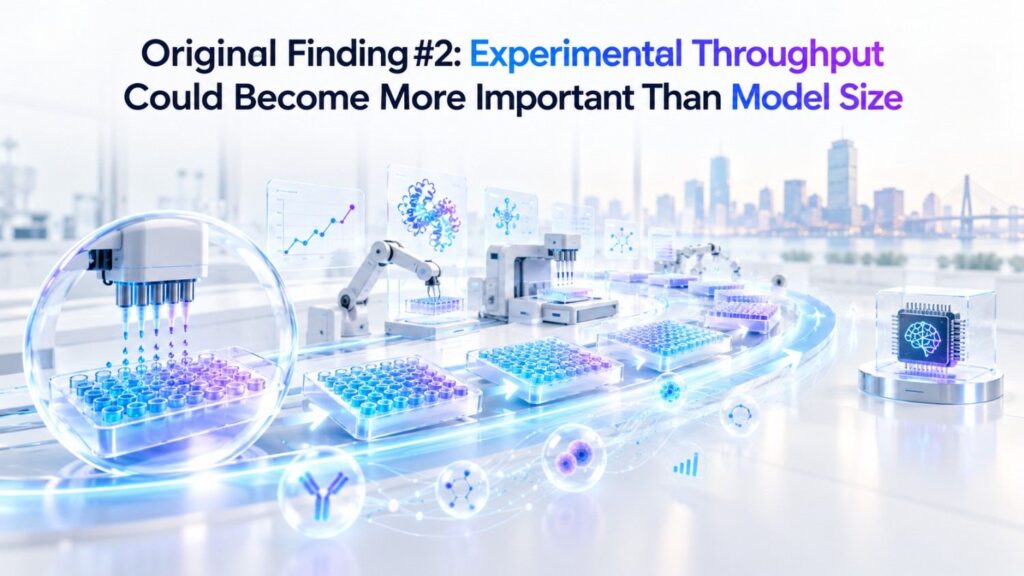
All five combine computational intelligence with some form of physical experimentation or wet-lab capability.
That pattern is unlikely to be accidental.
Why Models Eventually Need New Data
Suppose two biotech companies have access to similar foundation models.
Company A mainly trains on public datasets.
Company B can design 10,000 experiments, execute them, analyze the outcomes, and feed proprietary results back into its models.
Over time, the second company can potentially create a data advantage.
The key asset stops being the starting model.
It becomes the learning system.
That suggests an important change in biotech competition.
OLD AI ADVANTAGE

Better algorithm
      ↓
Better prediction
      ↓
Competitive advantage


EMERGING AGENTIC ADVANTAGE

Better model
      ↓
Better experimental choice
      ↓
More useful experiments
      ↓
More proprietary data
      ↓
Better model
      ↓
Better experimental choice
      ↺
The second system compounds.
That is potentially much harder for competitors to copy.
Generate Is Quietly Moving Toward Agentic Science
Generate is usually described as a generative-biology company rather than an AI-agent startup.
But its recent direction makes it highly relevant.
Generate’s existing platform already operates as a feedback loop between computational protein generation, physical creation, measurement, and learning. The company says it has generated, built, and tested more than 42,000 proteins.
That alone makes it important to the agentic story.
Then another signal appeared.
In 2026, Generate advertised a senior product role responsible for defining and scaling what it explicitly called its Agentic Science Platform.
The job description said the platform would build infrastructure and tools enabling AI agents across discovery and clinical development. It also referred to orchestration, data interfaces, evaluation frameworks, external tools, and the translation of scientific workflows into scalable agentic systems.
Hiring advertisements are not product launches.
But they are often useful signals about what companies are trying to build internally.
Why Generate Has an Unusual Starting Advantage
An agent without useful tools cannot accomplish much.
Generate already has several layers that scientific agents would need.
It has computational models.
It has protein-design capabilities.
It has experimental infrastructure.
It has proprietary biological measurements.
It has therapeutic programs.
And it has a feedback loop connecting computational design to physical biology.
That means the agent does not have to be the scientific engine itself.
It can become the orchestration layer across existing engines.
That distinction could become extremely important across biotech.
Converge Bio: Productizing AI Across Several Discovery Tasks
Converge Bio represents another part of Boston’s market.
The Boston- and Tel Aviv-based company raised a $25 million Series A in January 2026, bringing its announced funding to $30 million. It said more than a dozen pharmaceutical and biotech customers were using its solutions across target discovery, antibody design, and protein manufacturing optimization.
Converge trains generative systems on biological languages including DNA, RNA, and protein sequences and has built products around different drug-development tasks.
The interesting feature here is not simply generative AI.
It is specialization.
Biotech Agents May Become Teams of Specialists
A single enormous model may not be the most practical architecture for pharmaceutical R&D.
Imagine instead that a company has:
a literature agent,
a target-discovery agent,
a protein-design agent,
a developability agent,
a biomarker agent,
and an experimental-planning agent.
Each system can be optimized for a narrower scientific job.
An orchestration layer can then move information among them.
That looks increasingly similar to how pharmaceutical companies already operate, except parts of the specialist workflow become software.
Converge’s strategy of building dedicated systems around several biological problems provides one possible foundation for this kind of architecture.
Nabla Bio: The Feedback Loop Is the Valuable Part
Nabla Bio is based in Cambridge and combines computational drug design with large-scale human-relevant experimental testing.
The company says it owns the data, AI systems, and integrated wet/dry-lab infrastructure needed to design and test therapeutics as one engine.
This is significant because generative models frequently face a hidden problem.
Generating something is easy.
Generating something that works in biology is much harder.
Drug Design Is a Multi-Objective Problem
A therapeutic protein cannot simply bind strongly to a target.
It may also need the right specificity.
It needs acceptable stability.
It needs to be manufacturable.
It should avoid unwanted immune reactions.
It must function in biological conditions.
Eventually, it needs to perform in patients.
Improving one characteristic can damage another.
That is why the design-test-redesign loop matters.
Nabla’s approach combines generative design with experimental measurement so models can learn from physical results.
The company expanded a collaboration with Takeda in 2025 under a deal that included double-digit millions in upfront and research funding and potential success-based payments exceeding $1 billion.
Commercial partnerships of this size suggest large pharmaceutical companies are willing to pay for systems capable of improving real discovery programs rather than simply producing impressive AI demonstrations.
Receptor.AI: Making the Agent the Decision Layer
Receptor.AI offers one of the most direct examples of the agent becoming a decision engine.
In June 2026, the Cambridge company announced StratAI, which it describes as an agentic decision engine sitting at the center of its PharmaSphere drug-discovery ecosystem.
According to Receptor.AI, StratAI can operate across program-level strategy, experiment selection, and molecule-level decisions while adapting as new evidence becomes available.
That points toward a particularly important market.
The Next Bottleneck May Be Decision Quality
AI has made several parts of discovery dramatically faster.
Researchers can predict structures faster.
They can generate chemical structures faster.
They can search scientific information faster.
Automation can screen experiments faster.
But increasing the number of experiments does not automatically create better medicines.
Someone still needs to decide what information matters.
If AI produces 100,000 molecules instead of 1,000, scientists may simply inherit a larger prioritization problem.
Agents become valuable when they reduce the search space.
The goal is not maximum activity.
The goal is better choices.
TandemAI Shows Why Computation and Wet-Lab Work Are Converging
TandemAI maintains an AI laboratory in Harvard Square and combines artificial intelligence, physics-based computational methods, high-performance computing, chemistry, and biology capabilities.
The company says it serves more than 80 clients, employs more than 350 people globally, and maintains research operations spanning computation and experimental science.
In late 2025, TandemAI announced a $22 million Series A extension and said it had raised more than $80 million since its founding. The company also reported that its integrated discovery engine had contributed to more than ten differentiated candidates that were in or approaching clinical development.
The broader lesson is important.
Drug-discovery AI is becoming less separated from laboratory operations.
The competitive unit increasingly looks like:
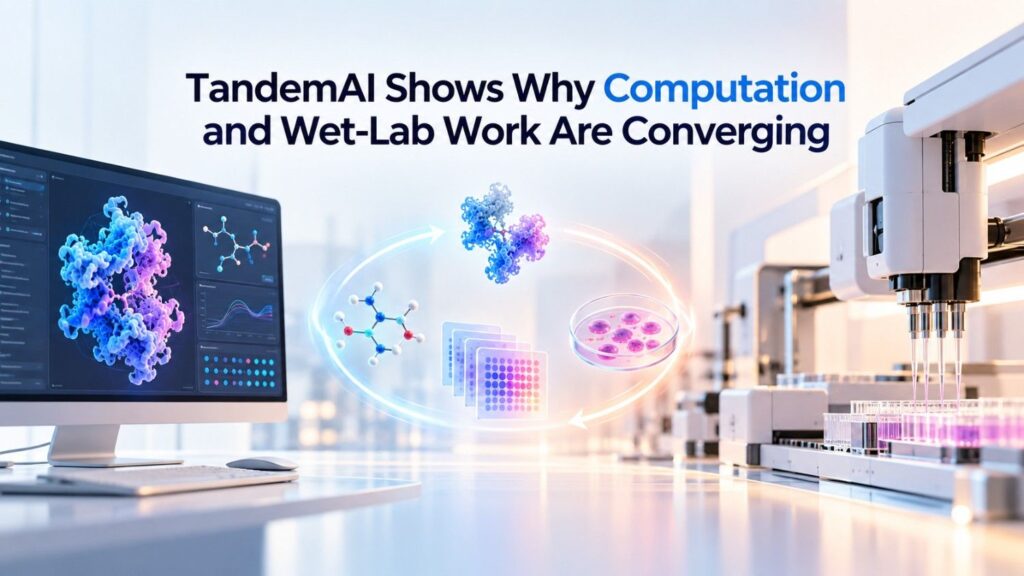
software + scientific models + wet lab + data + workflow integration.
Agents can then coordinate those resources.
Original Finding #3: Boston’s Most Defensible Agent Companies Sit Closest to Proprietary Data
Our third finding emerged when we classified the companies by the main data available to their AI systems.
Some primarily work with published research and public biological data.
Others operate directly on experimental data, proprietary molecule data, pharmaceutical development data, or clinical datasets.
The second group appears structurally better positioned to create long-term differentiation.
Public Knowledge Versus Proprietary Feedback
| Data position | Ease of copying | Potential agent moat |
|---|---|---|
| Public papers | High | Low |
| Public biological databases | High | Low–Medium |
| Customer workflow data | Medium | Medium |
| Proprietary experimental results | Low | High |
| Repeated closed-loop experimental data | Very low | Very high |
| Longitudinal clinical-development data | Very low | Very high |
This is not a claim that proprietary data automatically creates a good company.
Bad experiments simply create proprietary bad data.
The quality of the feedback matters.
But agents make proprietary data particularly valuable because an agent can use previous outcomes to influence future actions.
Every completed loop can improve the next loop.
This Could Become Boston’s Structural Advantage
Boston is unusually strong in places where proprietary scientific data is produced.
There are wet laboratories.
There are pharmaceutical R&D centers.
There are biotechnology companies.
There are hospitals.
There are clinical-trial operations.
There are research universities.
There are contract-development and manufacturing businesses.
There are specialized scientific instruments.
Agents need access to tools and feedback.
Boston has unusually dense access to both.
Delineate: AI Agents Move Into Clinical Development
The agentic transition does not end when a drug candidate leaves the laboratory.
In many ways, development becomes even more expensive after that point.
Clinical teams have to study previous trials, analyze competing programs, understand patient populations, compare endpoints, investigate dose relationships, review published evidence, examine patents, and make decisions that can determine the future of an entire program.
Delineate is attacking this layer.
The Boston company describes itself as building agents for accelerated clinical-trial design. Its systems process scientific research into structured datasets that can support development decisions.
Y Combinator reports that Delineate works with two large pharmaceutical companies and has increased the number of studies processed in some projects by 15 times compared with industry-standard approaches, while reducing certain evidence-review workflows from months to weeks.
Those are company-reported results and should be interpreted accordingly.
But the workflow is exactly where agents can make sense.
Why Clinical Evidence Is an Agent Problem
Evidence review requires many separate operations.
A researcher must find relevant studies.
They must determine whether each study is actually comparable.
Important numbers can be trapped inside charts.
Terminology varies.
Patient populations differ.
Endpoints differ.
Doses differ.
Some results appear only in conference presentations or patents.
A general chatbot is not enough.
An effective clinical-development agent needs to search, extract, structure, compare, validate, and preserve provenance.
That is a workflow.
AIRA Health: Specialized Agents Become a Clinical-Development Team
Boston-based AIRA Health provides another example.
The company announced nearly $2 million in pre-seed funding in April 2026 alongside Colligo, its AI platform for clinical-trial and protocol development.
AIRA describes the system as using specialized agents across clinical strategy, regulatory intelligence, biostatistics, and medical writing.
That architecture matters because it points toward a likely future for enterprise biotech AI.
Instead of asking one chatbot every question, teams may interact with multiple domain-specific agents operating under shared controls.
Clinical Trials Are Well Suited to Narrow Agents
Consider how many specialist roles contribute to a protocol.
Medical experts evaluate the disease.
Statisticians plan the analysis.
Regulatory specialists think about agency expectations.
Clinical operations teams think about execution.
Medical writers construct documents.
Data teams structure evidence.
Agents do not have to replace these people to create value.
Reducing repetitive searching, comparison, document preparation, and cross-checking could already remove weeks from development.
The economic value can be substantial because late-stage drug development is extremely expensive.
BostonGene: Agents Do Not Need to Look Like Chatbots
BostonGene is another useful example because it illustrates a broader point.
Some of the most important “agent-like” systems may never be marketed using the word agent.
BostonGene describes its platform as an AI decision layer for drug development, combining biological information and computational methods to support therapeutic strategy, biomarker analysis, patient selection, and clinical-development decisions.
The Waltham company announced a $150 million Series B in 2022 and has since continued signing collaborations with pharmaceutical companies.
In February 2026, for example, BostonGene announced a collaboration with Daiichi Sankyo involving AI-driven multimodal analysis for an antibody-drug-conjugate development program.
The larger point is that agentic biotech should be defined by workflow behavior rather than branding.
If a system gathers complex information, creates decision-ready analysis, updates conclusions as evidence changes, and affects the next development decision, it sits on the same automation curve.
Original Finding #4: Boston’s Agent Market Is Splitting Into Four Business Models
When we grouped the ten companies by how they appear likely to create commercial value, four broad models emerged.
Model One: Build Drugs
Companies use AI internally to create their own therapeutics.
The economic goal is drug ownership.
Generate is closest to this model, although partnerships can also play a role.
The upside can be enormous because a successful therapeutic is worth far more than a software subscription.
The downside is equally obvious.
Drug development is expensive, slow, and risky.
Model Two: Build the R&D Engine for Other Companies
Companies provide discovery capabilities to pharmaceutical partners.
Nabla Bio, Converge Bio, TandemAI, and Receptor.AI fit various versions of this model.
Customers can gain access to specialized AI and experimental capabilities without rebuilding the entire infrastructure internally.
The provider can earn research funding, software revenue, milestones, royalties, or combinations of these.
Model Three: Sell the Agent Layer
Delineate and AIRA are closer to the software end of the spectrum.
These businesses can automate knowledge-heavy pharmaceutical processes without owning a full physical laboratory.
That can mean lower capital requirements and potentially faster deployment.
The challenge is defensibility.
General AI platforms are improving quickly.
Specialized startups therefore need deep workflow integration, reliable domain data, strong evaluation systems, and measurable customer outcomes.
Model Four: Sell Autonomous Research Infrastructure
Atinary sits closest to this category.
The product is not simply an AI prediction.
It is infrastructure that connects AI with physical experimentation.
Lila could eventually participate in a much broader version of this market as it opens parts of its autonomous science platform to external customers.
Lila has said it is welcoming commercial partners onto its scientific-agent and autonomous-science platform.
That could create something resembling cloud infrastructure for experimental science.
Original Finding #5: The Human Bottleneck Is Moving Up the Stack
Automation rarely removes every bottleneck.
It moves the bottleneck somewhere else.
This is already happening in AI-enabled biotechnology.
If models generate molecules faster, experimental testing becomes a bottleneck.
If laboratories run experiments faster, interpretation becomes a bottleneck.
If agents interpret evidence faster, decision approval may become the bottleneck.
If decision systems move faster, organizational processes may become the bottleneck.
How the Bottleneck Moves
Molecule generation
      ↓ automated

Experiment selection
      ↓ automated

Experiment execution
      ↓ automated

Data analysis
      ↓ automated

Decision recommendation
      ↓ automated

Human judgment / governance
      ↓

NEW BOTTLENECK
This means the role of scientists is unlikely to disappear simply because agents become more powerful.
Instead, scientists may spend less time doing repetitive execution and more time defining problems, evaluating unusual results, designing objectives, setting limits, challenging assumptions, and deciding which risks are acceptable.
That is a much more realistic view of near-term autonomous science.
Why Boston Is Structurally Well Positioned
Boston’s advantage in biotech AI is not that the city has better access to large language models.
Everyone can access powerful models.
The advantage is everything around the models.
Boston Has the Tools Agents Need to Use
A useful agent requires tools.
In software engineering, those tools might be code repositories, terminals, browsers, and deployment systems.
In biotech, the tool environment is much larger.
Agents may need molecular databases, scientific papers, protein-design systems, chemistry software, electronic lab notebooks, laboratory information-management systems, robotic equipment, sequencing platforms, imaging systems, clinical databases, regulatory documents, and statistical tools.
Boston already contains dense concentrations of those systems and the people who know how to use them.
The Wet Lab Is an Important Local Advantage
Cloud software can be built nearly anywhere.
Wet-lab feedback is harder to decentralize.
Physical experimentation requires space, equipment, reagents, scientific staff, safety procedures, sample handling, quality systems, and specialized operations.
That makes Boston’s physical biotechnology infrastructure strategically important.
The emergence of facilities such as Atinary’s Boston self-driving lab demonstrates how the city’s existing lab ecosystem can become infrastructure for the agentic era.
Pharma Customers Are Nearby
Agent startups also need demanding customers.
Boston offers a large population of biotech companies as well as major pharmaceutical R&D operations across Greater Boston.
That makes it easier to discover painful workflows.
The best enterprise agents will probably not start with a vague goal such as “automate science.”
They will start with something specific.
Reduce the time required to review a therapeutic class.
Improve antibody design.
Choose better experiments.
Find trial evidence.
Design protocols faster.
Optimize laboratory conditions.
These are narrower problems, but they have obvious economic value.
What Boston Biotech Leaders Should Automate First
Companies interested in agents should not begin by asking, “Where can we use AI?”
That question is too broad.
A better starting point is identifying expensive loops.
Find Work That Repeats
Look for processes where experienced employees repeatedly collect similar information, run similar analyses, move data among several tools, prepare the same kinds of documents, or make decisions using a relatively stable set of inputs.
Those workflows are strong candidates.
Find Decisions With Clear Feedback
An agent becomes more valuable when the organization can tell whether its recommendations were useful.
Experimental optimization is powerful because the next experiment creates feedback.
Evidence analysis can be measured through accuracy and completeness.
Clinical-document workflows can be evaluated against expert output.
Without feedback, improvement becomes difficult.
Start With Bounded Autonomy
Pharmaceutical companies should resist the temptation to jump immediately from manual work to full autonomy.
A safer sequence is:
observe → recommend → act with approval → act automatically inside limits.
During the first stage, the agent watches what researchers do.
Next, it suggests actions.
Then it can execute actions after human approval.
Only after performance has been measured should companies consider allowing autonomous execution within tightly defined boundaries.
The KPI Dashboard for Biotech Agents
AI-agent programs should not be judged by how impressive the demo looks.
They should be judged by R&D outcomes.
| Metric | Why it matters |
|---|---|
| Time per decision cycle | Shows whether work actually moves faster |
| Experiments per learning cycle | Measures experimental efficiency |
| Useful information per experiment | Better than simply counting experiments |
| Human hours per workflow | Shows real labor leverage |
| Agent error rate | Critical for scientific reliability |
| Human override rate | Reveals whether users trust recommendations |
| Reproducibility | Essential for scientific use |
| Cost per completed workflow | Connects technology to economics |
| Time to candidate decision | Measures discovery acceleration |
| Protocol-development time | Important for clinical agents |
| Percentage of work requiring manual correction | Reveals hidden automation costs |
One metric deserves particular attention:
useful learning per experiment.
Running more experiments is not automatically progress.
A good agent should choose experiments that reduce uncertainty.
Reliability Will Be the Hard Part
Scientific agents face a much higher bar than ordinary workplace assistants.
A marketing agent making a mediocre suggestion may waste an hour.
A scientific agent making a bad recommendation can waste months of laboratory work or influence decisions involving millions of dollars.
That changes product design.
Provenance Must Be Built In
Scientists need to know where a conclusion came from.
If an agent recommends changing a clinical endpoint, users need to see the underlying evidence.
If it extracts a value from a paper, researchers should be able to trace that value to the source.
If it proposes an experiment, scientists need to understand the assumptions.
Black-box confidence will not be enough.
Agents Need Permission Boundaries
Not every agent should be allowed to perform every action.
A literature agent can search widely.
An experimental agent might be permitted to create a proposed protocol but not execute it.
A laboratory agent may operate equipment only inside predefined parameter ranges.
Clinical agents may produce recommendations while requiring human approval for consequential decisions.
The more powerful agents become, the more important the control layer becomes.
Original Finding #6: The Control Layer Could Become a Major Boston Software Opportunity
One conclusion from our analysis is that the biotechnology-agent market may create an important second-order opportunity.
Every company does not need to build the scientific agent itself.
Some of the biggest opportunities may sit underneath the agents.
Scientific organizations will need systems for:
agent identity,
permissions,
data access,
tool access,
audit logs,
validation,
version control,
evaluation,
human approval,
experiment provenance,
security,
and regulatory documentation.
That resembles what happened when cloud computing became widespread.
The applications received much of the attention.
But enormous companies were built in infrastructure, security, monitoring, and developer tools.
Scientific agents may create the same pattern.
The Biggest Mistake Would Be Creating Generic Biotech Agents
A startup entering this market should be careful.
“AI agent for biotech” is not a sufficiently specific product.
Biotechnology is too broad.
A medicinal chemist and a clinical statistician do completely different work.
A protein scientist needs different tools from a regulatory writer.
An autonomous chemistry system has different safety constraints from an evidence-search agent.
The strongest startups will probably own one painful workflow first.
Then they can expand.
Delineate begins with evidence-heavy clinical development.
AIRA begins with trial and protocol work.
Atinary begins with experimental optimization.
Converge operates across specific biological design problems.
Nabla focuses on therapeutic protein design and testing.
Each has a defined entry point.
That is strategically healthier than attempting to create one chatbot that supposedly knows everything about biology.
What Happens When These Systems Connect?
The most interesting possibility is not any single agent.
It is connecting them.
Imagine a future drug program.
A scientific agent reviews disease biology.
Another proposes promising targets.
A design model produces therapeutic candidates.
A prioritization agent chooses which candidates deserve testing.
A laboratory agent designs the experiment.
Robotics performs the work overnight.
Measurement systems return the data.
Another agent analyzes the result.
The molecule-design system generates a new version.
Later, development agents organize the evidence and help design the clinical program.
None of these components requires artificial general intelligence.
They require reliable systems that can communicate.
That is why interoperability may become one of the defining issues of biotech AI.
Boston Could Become the Place Where AI Agents Meet Physical Science
San Francisco remains extremely strong in foundation models, software talent, venture capital, and general agent infrastructure.
Boston does not need to beat San Francisco at building general-purpose AI models.
Its opportunity is different.
Boston can specialize in the point where general intelligence meets specialized science.
That includes experimental systems.
Therapeutic design.
Biological data.
Clinical medicine.
Scientific instruments.
The deeper agents move into those environments, the more important domain infrastructure becomes.
Boston already has it.
What Investors Should Watch
The agent label itself should not impress investors.
Several harder questions matter more.
Does the company own a workflow with measurable economic value?
Can the agent perform actions, or does it simply generate text?
Does the system have access to proprietary feedback?
Can performance be evaluated objectively?
Does the product become better as customers use it?
Is the company deeply integrated into existing scientific tools?
How expensive is human review?
What happens when the agent is wrong?
Can the system expand from one workflow into adjacent workflows?
Those questions will separate real scientific infrastructure from AI features that become easy to copy.
What Boston Startups Should Build Next
There are still large gaps.
Agents could help manage the enormous transfer of information between discovery biology and translational teams.
They could continuously compare internal experimental findings with new external scientific publications.
They could identify contradictory results before teams commit additional resources.
They could automate portions of assay development.
They could coordinate outsourced experiments.
They could monitor preclinical evidence and prepare structured development packages.
They could help companies manage the huge amount of evidence created before regulatory submissions.
But the best startup ideas will probably come from scientists already experiencing these problems.
The opportunity is not replacing a scientist.
It is removing the coordination tax surrounding science.
The Larger Economic Story
Biotechnology has historically increased productivity by improving individual tools.
Better sequencing.
Better microscopes.
Better robotics.
Better assays.
Better computational models.
Agents introduce another possibility.
Instead of improving one tool, they can improve how tools are coordinated.
That can change the economics of R&D in a deeper way.
Suppose an experiment itself becomes twice as fast.
That helps.
But imagine that the entire loop from question to experiment to result to next decision becomes twice as fast.
The effects compound across a program.
That is why the real metric for scientific agents should be cycle time.
Original Finding #7: The Winner May Be the Company With the Fastest Reliable Learning Loop
This leads to the most important conclusion from our research.
The central competitive race in agentic biotech may not be:
Who has the smartest AI model?
It may be:
Who can convert uncertainty into reliable experimental learning fastest?
That changes what matters.
Models matter.
But so do tools.
Experiments matter.
But so does experiment selection.
Data matters.
But so does data quality.
Agents matter.
But so do controls.
The companies able to integrate these pieces can create something more valuable than a standalone model.
They can create a learning machine.
What to Watch Through 2027
Several signals will tell us whether the Boston biotech-agent market is moving from experimentation toward production.
First, watch whether pharmaceutical partnerships expand from narrow pilot projects into multi-program deployments.
Second, watch whether companies begin publishing measurable reductions in full R&D cycle times rather than isolated model benchmarks.
Third, watch laboratory automation.
The more computational agents can safely initiate physical experiments, the closer autonomous science becomes to a practical operating model.
Fourth, watch clinical development.
Automating drug discovery receives much of the attention, but improving trial design could create enormous financial value because clinical programs consume so much time and capital.
Finally, watch the infrastructure underneath agents.
Security, identity, permissions, evaluation, auditability, data provenance, and scientific tool integration could become major markets of their own.
Final Takeaway: Boston Is Building the Operating System for a More Autonomous Biotech Industry
AI agents are unlikely to wake up tomorrow and autonomously discover, develop, test, and approve a new medicine.
That is the wrong way to think about this market.
The transformation will happen workflow by workflow.
Literature analysis becomes partially autonomous.
Then evidence synthesis.
Then molecule prioritization.
Then experiment planning.
Then experimental execution.
Then interpretation.
Then clinical-development workflows.
Each step removes another manual handoff.
That is what makes Boston particularly interesting.
The region already contains the models, laboratories, biotech companies, pharmaceutical teams, hospitals, scientists, clinical expertise, experimental equipment, and capital needed to connect those workflows.
Lila Sciences is pushing toward scientific agents connected to AI Science Factories. Atinary is demonstrating self-driving physical laboratories. Generate is building agentic infrastructure around an existing generative-biology engine. Nabla Bio connects therapeutic design with experimental testing. Converge Bio is productizing specialized generative biology workflows. Receptor.AI is putting an agentic decision layer across drug discovery. TandemAI combines computation with wet-lab execution. Delineate and AIRA are moving agents downstream into clinical-development work. BostonGene shows how AI can become a decision layer around translational and clinical strategy.
None of these companies has solved autonomous drug development.
They do not need to.
The more important shift is already underway.
AI is moving from producing scientific answers to participating in scientific workflows.
From prediction to planning.
From planning to action.
From action to feedback.
And from feedback to the next decision.
That creates a very different kind of biotechnology company.
The biggest winners may not be the companies that generate the most molecules, run the largest models, or attach the word “agent” to the most products.
They will be the companies that create the shortest, safest, and most productive loop between scientific question, real-world evidence, and the next intelligent action.
Boston is unusually well positioned to build that loop.