

Boston has no shortage of artificial intelligence startups. What is becoming more interesting in 2026 is who is paying to build them.
The money behind Boston AI is coming from several very different places. Longtime Boston venture firms are backing young software companies. MIT-connected funds are helping researchers turn technical work into businesses. Life sciences investors are funding AI drug discovery. Large global funds are writing checks for companies that already need hundreds of millions of dollars. Corporate investors are showing up in robotics, healthcare, infrastructure, and scientific AI.
That mix matters because it tells us something important about Boston’s AI economy.
Boston is not developing around one type of AI company. It is becoming a market for AI infrastructure, scientific AI, physical AI, healthcare AI, enterprise software, robotics, consumer AI, and specialized industry tools at the same time.
The wider startup numbers already show Boston’s strength. Carta data covering July 2025 through June 2026 placed Boston third among U.S. startup markets, with $10.79 billion invested in companies headquartered in the metro. Boston also ranked third specifically for AI, accounting for 8.3% of AI capital tracked on Carta.
But those broad numbers do not answer the question founders actually care about:
Which investors are writing the checks, what kinds of Boston AI companies are they funding, and what does that tell us about how to raise capital here?
BostonBizScene built a company-level dataset to answer that question.
Our analysis identified at least $1.79 billion in disclosed 2026 funding across 19 Greater Boston companies where AI is central to the business or technology, through September 24, 2026.
More importantly, the numbers show a venture market that is far more concentrated, global, and specialized than the simple “$1.79 billion” headline suggests.
The Short Version: Boston AI Capital Is Local at the Beginning and Increasingly Global at Scale
There is no single venture firm funding Boston’s AI boom.
That may be the most important finding.
Boston has a strong group of local and locally rooted investors including General Catalyst, Flybridge, Underscore VC, E14 Fund, MassVentures, Volition Capital, Venture Guides, Battery Ventures, .406 Ventures, RA Capital, HarbourVest, and Advent. But when Boston AI companies begin raising $100 million, $200 million, or $400 million rounds, national and international investors become much more visible.
Suno’s 2026 financing was led by BOND. Walden Robotics’ giant seed round was co-led by Toyota-linked investors and Deviation Capital. Northzone led Blitzy’s $200 million round. Breakthrough Energy Ventures led the $58 million launch financing for Physical Superintelligence. Andreessen Horowitz and Bessemer Venture Partners backed Neo with $100 million at launch.
Boston, in other words, does not need every large AI investor to be headquartered in Massachusetts.

It needs enough great companies to make outside investors come to Boston.
That is already happening.
BostonBizScene Original Research: At Least $1.79 Billion in Core AI Funding
We identified 19 companies headquartered in Boston, Cambridge, or Newton that announced qualifying financing between January 1 and September 24, 2026.
Using disclosed amounts and treating Suno’s “more than $400 million” Series D as a conservative $400 million floor, the companies raised at least $1.791 billion.
The median financing was $55 million. The average was about $94.3 million.
Those two numbers already show how unusual the market is. The average is almost twice the median because a few enormous financings pull the total upward.
Chart 1: Boston’s Core-AI Funding Total Through September 24, 2026
| Measurement | BostonBizScene result |
| Qualifying Greater Boston AI companies | 19 |
| Disclosed funding represented | At least $1.791B |
| Median financing | $55M |
| Average financing | $94.3M |
| Capital in five largest financings | $1.31B |
| Share represented by top five | About 73.1% |
| Capital represented by top three | $910M |
| Share represented by top three | About 50.8% |
| Cambridge share of disclosed capital | About 60.0% |
| Boston share of disclosed capital | About 37.2% |
Source: BostonBizScene analysis of publicly announced company financings. Percentages use $400 million as the conservative value for Suno’s disclosed “over $400 million” financing.
The headline number is useful.
The concentration underneath it is more useful.
Five transactions represented almost three quarters of all the money in our strict dataset.
That changes how founders should think about the Boston AI funding market.
How BostonBizScene Built the Dataset
“AI funding” is much harder to measure than it sounds.
Many software companies now describe themselves as AI companies. Healthcare businesses add AI features. Consumer products offer AI coaching. Biotechnology companies use machine learning somewhere in the research process. Even companies that began before the current AI boom are rebuilding products around generative AI.
Counting every company that uses AI would produce a very large number, but it would not tell us much about Boston’s actual AI startup market.
We therefore used a stricter method.
What We Counted
A company had to satisfy three main tests.
First, it had to be headquartered in Greater Boston when the relevant financing was announced. For this analysis, our observed dataset covers Boston, Cambridge, and Newton.
Second, AI had to be central to what the company sells or to the technical advantage behind the company. An ordinary software business that recently added an AI assistant would not automatically qualify.
Third, the financing had to be publicly announced between January 1 and September 24, 2026, with an amount we could verify.
We counted disclosed equity financings and launch rounds. We did not count grants, debt by itself, acquisition prices, rumored rounds, or financing discussions that had not closed.
Why This Method Matters
Take Lila Sciences.
Lila is one of the most important AI-for-science companies associated with Cambridge, but its $350 million Series A was announced on October 10, 2025, not 2026. The company was reportedly discussing another very large financing in 2026, but a financing discussion is not the same as a closed transaction.
We therefore did not put that rumored capital into the 2026 total.
OpenEvidence presents a different problem. The medical AI company has deep Cambridge roots, but it moved its headquarters to Miami in 2025. Its $250 million January 2026 round is therefore meaningful to the story of Boston-created AI companies, but we did not count it as current Boston-headquartered funding.
Those decisions may reduce the headline number, but they make the analysis more useful.
The WHOOP Test Shows How Much Definitions Matter
WHOOP announced a $575 million Series G in March 2026 at a $10.1 billion valuation. The Boston company increasingly uses AI in coaching and personalized health products, but WHOOP remains a broader wearable and health platform rather than what we classify as an AI-native company.
So WHOOP is excluded from our strict dataset.
Add WHOOP, however, and Boston’s 2026 AI-related funding number rises from roughly $1.79 billion to $2.37 billion.
Chart 2: How the Definition Changes the Headline
| Definition | Funding represented |
| Strict core-AI / AI-native dataset | At least $1.79B |
| Broader AI-enabled dataset including WHOOP | At least $2.37B |
| Difference created by one classification decision | $575M |
That is a 32% increase over the strict base simply from adding one company.
This is why readers should be careful when they see broad headlines claiming that a city has raised a specific amount of “AI funding.” The first question should be: What exactly counted as an AI company?
The Boston AI Funding Map for 2026
Here is the company-level dataset behind our analysis.
Amounts represent announced financing, not the amount contributed by any individual investor. That distinction is critical because companies usually disclose the size of a round but not exactly how much each investor contributed.
Table 1: Greater Boston Core-AI Financings Tracked by BostonBizScene
| Company | Location | 2026 financing used | Main disclosed lead or investors | What it is building |
| VoiceRun | Cambridge | $5.5M | Flybridge; RRE; Link Ventures | Voice AI infrastructure |
| Tomorrow.io | Boston | $210M | Stonecourt, HarbourVest; later extension included Pitango and Harel | AI weather intelligence |
| Unreasonable Labs | Cambridge | $13.5M | Playground Global; AIX Ventures; E14; MS&AD | AI and physical systems |
| JuliaHub | Cambridge | $65M | Dorilton Capital; General Catalyst and others | Scientific computing and AI |
| Blitzy | Cambridge | $200M | Northzone; PSG, Battery, Flybridge, Venture Guides and others | Autonomous software development |
| Suno | Cambridge | >$400M | BOND; IVP, Forerunner, USV, Alkeon, Quiet | Generative music |
| Coralogix | Boston | $200M | Advent and CPP Investments; Greenfield, Brighton Park | Observability and AI infrastructure |
| Walden Robotics | Cambridge | $300M | Toyota-related investors and Deviation Capital; NVIDIA and others | Physical AI and robotics |
| Neo | Boston | $100M | Andreessen Horowitz and Bessemer; Craft and Merlin | AI-native business software |
| ShipIn Systems | Newton | $52M | Proofpoint Capital, Bling Capital, Tokio Marine and others | AI for maritime operations |
| VibeIQ | Boston | $22.5M | Volition Capital; Venture Guides | AI for product decisions |
| Transfyr | Cambridge | $25M | General Catalyst; Lux, Breakout, Underscore and others | Physical AI for scientific work |
| Legato | Boston | $12M | Neotribe, Listen, Village Global | AI hearing technology |
| Blue Voice | Boston | $6M | SignalFire and Las Olas VC | AI policy guidance |
| Physical Superintelligence | Cambridge | $58M | Breakthrough Energy Ventures; Dragon Global, Susa, SV Angel and others | AI systems for physics |
| Elucid | Boston | $55M | Strategic medtech investor, IAG Capital, Elevage | AI cardiovascular imaging |
| Superluminal Medicines | Boston | $60M | BVF; Deep Track, Perceptive, RA Capital, NVIDIA and others | AI-enabled drug discovery |
| Subconscious | Cambridge | $5.1M | MassVentures; Foothill, Underscore, E14 and others | Infrastructure for long-running AI agents |
| Ekai | Cambridge | $1.7M | Misneach; C10 Labs | AI-native startup |
The companies look very different from one another.
That is precisely the point.
Boston’s AI funding boom is not simply twenty companies chasing the same enterprise chatbot market.
Original Finding #1: Five Companies Account for About 73% of the Capital
The most important number in our analysis may be 73%.
Suno, Walden Robotics, Tomorrow.io, Blitzy, and Coralogix collectively account for about $1.31 billion of the $1.79 billion strict dataset.
Chart 3: The Largest Boston AI Financings in Our 2026 Dataset
Suno $400M+ ████████████████████
Walden Robotics $300M ███████████████
Tomorrow.io $210M ███████████
Blitzy $200M ██████████
Coralogix $200M ██████████
Neo $100M █████
JuliaHub $65M ███
Superluminal $60M ███
Physical Superintelligence
$58M ███
Elucid $55M ███
ShipIn Systems $52M ███
All remaining deals <$30M each
Bars are rounded for readability. Suno is shown at the conservative $400 million floor.
The three biggest rounds alone account for roughly 50.8% of the strict total.
That tells founders, investors, service providers, and policymakers to avoid one dangerous mistake: treating the total funding number as though it were spread evenly across the ecosystem.
It is not.
A Two-Speed AI Funding Market Is Emerging
The five largest transactions averaged roughly $262 million.
The other 14 companies together raised about $481 million, or roughly $34 million each on average.
Those are almost different capital markets.
At one end, Boston has early companies raising $1.7 million, $5 million, $6 million, $12 million, or $25 million.
At the other end, investors are willing to place nine-figure bets on a small group of companies they believe could become major technology platforms.
For founders, that means comparing your round to the biggest Boston AI announcements can be misleading.
A $5 million seed round can be perfectly healthy even when another company calls a $300 million financing a seed round.
Original Finding #2: The Word “Seed” Is Becoming Less Useful in AI
Walden Robotics announced $300 million in seed financing.
VoiceRun raised $5.5 million in seed financing.
Blue Voice raised $6 million.
Transfyr launched with a $25 million seed.
Physical Superintelligence launched with $58 million in seed funding.
These companies are all described with an early-stage label, yet their capital requirements are radically different.
A founder who hears that “Boston seed rounds are getting huge” could draw the wrong conclusion.
The reality is more interesting.
Capital Need Matters More Than the Stage Name
A software startup may initially need engineers, cloud credits, and several months to reach customers.
A robotics startup may need hardware teams, testing facilities, supply chains, simulation, manufacturing, compute, and physical deployment.
A physics company may need specialized infrastructure and expensive researchers.
An AI drug discovery business can face long development cycles before commercial revenue appears.
The stage label does not capture those differences.
What Founders Should Benchmark Instead
Rather than asking, “How big are seed rounds in Boston?”, founders should ask a more useful set of questions.
How much capital is needed to reach the next point where risk falls sharply? What must the company prove before another investor can confidently fund it? How much dilution does that require? What milestone makes the next financing materially easier?
For an enterprise AI startup, the milestone could be repeatable customer deployment.
For scientific AI, it could be a validated technical result.
For physical AI, it could be reliable real-world performance.
For healthcare AI, it could involve clinical evidence, regulatory progress, strategic partnerships, or adoption.
Those milestones are more important than whatever letter gets attached to the round.
Original Finding #3: Scientific and Physical AI Are Boston’s Largest Capital Category
One of Boston’s biggest advantages becomes clearer when the companies are grouped by what they actually build.
We divided the 19-company strict dataset into five broad categories. Classification involves judgment, so these groups should be read as an analytical framework rather than an official industry taxonomy.
Chart 4: Where Boston AI Capital Is Going
| BostonBizScene category | Companies | Capital represented | Share |
| Scientific and physical AI | 6 | $671.5M | 37.5% |
| Enterprise AI and infrastructure | 6 | $512.3M | 28.6% |
| Consumer and creative AI | 1 | $400M+ | 22.3%+ |
| Health and life sciences AI | 3 | $127M | 7.1% |
| Specialized vertical/industrial AI | 3 | $80.5M | 4.5% |
| Total | 19 | $1.791B+ | 100% |
Boston’s largest bucket is scientific and physical AI.
That group includes companies such as Walden Robotics, Tomorrow.io, JuliaHub, Transfyr, Physical Superintelligence, and Unreasonable Labs.
This is very Boston.
Boston’s AI Market Reflects Boston’s Existing Strengths
Boston has spent decades building world-class research institutions, biotechnology companies, robotics companies, healthcare systems, scientific software, engineering businesses, and enterprise technology.
AI is now being inserted into that existing machine.
Transfyr, for example, is trying to capture the physical work performed in laboratories and turn it into machine-readable information for scientists, automation systems, and robotics. Its $25 million seed was led by General Catalyst.
Physical Superintelligence launched in Cambridge with $58 million to develop AI systems around physics and physical engineering.
JuliaHub raised $65 million around scientific computing and simulation.
Walden Robotics is a physical-AI bet large enough to attract Toyota, NVIDIA, Boeing-linked capital, and other strategic investors.
This is a very different AI ecosystem from one built almost entirely around marketing software or general consumer applications.
Science Plus Healthcare Makes the Pattern Even Stronger
If scientific/physical AI and health/life-sciences AI are combined, they represent roughly $798.5 million, or almost 45% of the strict dataset.
That matters because Boston’s existing life sciences economy is itself enormous.
MassBio reported that Massachusetts-headquartered biopharma companies raised $3.45 billion in venture capital during the first half of 2026, up 25% from the same period a year earlier. It also found that the average Series A rose to $79.6 million while the average seed round fell to $4.65 million.
AI founders in Boston therefore sit next to a capital market that already understands difficult science, long development cycles, regulated products, and technical risk.
That may become one of the city’s most important advantages.
Original Finding #4: Cambridge Captured About 60% of the Capital in Our Dataset
AI funding is not distributed evenly across Greater Boston either.
The ten Cambridge companies in our dataset account for approximately $1.074 billion, or 60% of the strict total.
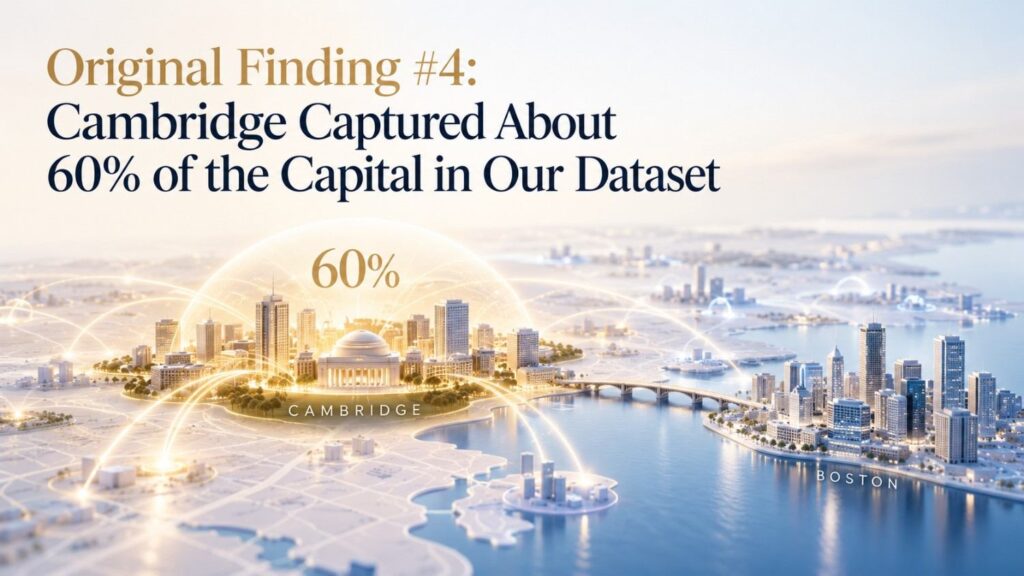
Eight Boston-headquartered companies account for approximately $665.5 million, while Newton-based ShipIn Systems represents another $52 million.
Chart 5: Funding by Headquarters in the BostonBizScene Sample
Cambridge $1.074B ██████████████████████████████ 60.0%
Boston $665.5M ███████████████████ 37.2%
Newton $52.0M ██ 2.9%
This does not mean Cambridge is automatically a better place to start an AI company.
The result is partly driven by enormous rounds from Suno, Walden Robotics, and Blitzy.
But it does show the extraordinary amount of capital being pulled into the small geography around MIT, Kendall Square, and the broader Cambridge research community.
The MIT Effect Is About More Than Spinouts
MIT’s influence is visible through founders, researchers, talent, technical communities, investors, and organizations built specifically to move research into companies.
E14 Fund is perhaps the clearest example.
The MIT-affiliated fund says it normally invests at the point where founders move from early science and engineering work toward building products for a real market. Its typical first institutional investment ranges from roughly $500,000 to $5 million, with money reserved for follow-on rounds.
In our 2026 dataset, E14 appears in financings for both Unreasonable Labs and Subconscious.
That is not the biggest dollar total in the market.
It represents something just as important: the first institutional layer that helps technical work become a fundable company.
Original Finding #5: No Single Venture Firm Controls Boston’s AI Pipeline
Another interesting pattern appears when we count disclosed investor participation.
Among the investors publicly named in our 19-company dataset, we found a broad group of repeat participants, but none appeared in more than two tracked companies.
That suggests Boston’s AI funding network is highly syndicated.
Table 2: Repeat Investors in the Strict Dataset
| Investor | Disclosed appearances | Capital represented by rounds it joined* |
| Menlo Ventures | 2 | $700M |
| AE Ventures | 2 | $365M |
| NVIDIA / NVentures | 2 | $360M |
| Venture Guides | 2 | $222.5M |
| Flybridge | 2 | $205.5M |
| Link Ventures | 2 | $205.5M |
| General Catalyst | 2 | $90M |
| SV Angel | 2 | $83M |
| Underscore VC | 2 | $30.1M |
| E14 Fund | 2 | $18.6M |
*”Capital represented” means the total size of financings in which the investor was disclosed as a participant. It does not mean the investor itself contributed that amount. Individual investor check sizes are generally private.
That distinction matters enormously.
If Menlo participated in a $400 million financing and a $300 million financing, it would be wrong to say Menlo invested $700 million.
We can only say it participated in rounds representing $700 million of aggregate financing.
Why Syndicates Matter to Founders
A founder should not think about fundraising as finding one magical investor.
Boston’s funding network often looks more like a chain.
A highly specialized local investor may understand the company first. Another fund may help validate the market. A strategic investor may bring industry access. A national venture fund may lead the next round. Later, large growth investors may provide enough capital to build internationally.
This is one reason relationships established during pre-seed and seed rounds can matter long after the first financing closes.
The Boston Venture Firms Founders Should Understand
The raw company data becomes more useful when we look at what different investors actually appear to do.
These firms are not interchangeable.
A founder should not pitch the same company in the same way to every fund.
General Catalyst: Boston Roots With Global AI Reach
General Catalyst has a major Cambridge office and now invests across a very broad global technology portfolio. Its current portfolio includes major AI companies such as Anthropic, and the firm describes AI as a transformation that will affect industries across the economy.
Within our Boston dataset, General Catalyst appeared in JuliaHub’s $65 million Series B and led Transfyr’s $25 million seed round.
That pairing is revealing.
JuliaHub sits around scientific computing, modeling, simulation, and engineering.
Transfyr sits at the intersection of AI, laboratories, sensors, physical work, and scientific automation.
What That Means for Founders
Technical depth alone is not enough.
A company approaching a firm of this scale needs a credible explanation for how technical differentiation becomes a very large business.
A founder should be able to move smoothly between two discussions.
The first is: Why is the technology unusually difficult or defensible?
The second is: Why can solving that problem create a company large enough to matter to a major venture fund?
The best Boston AI companies increasingly need both answers.
Flybridge: An Early Boston AI Network With a Clear Agentic Bet
Flybridge describes itself as rooted in Boston and New York and is explicitly organizing part of its investment thinking around agentic business applications and AI-native products.
The firm led VoiceRun’s $5.5 million seed round and was also an investor in Blitzy’s $200 million growth financing.
That is a useful combination.
VoiceRun is an early infrastructure company.
Blitzy represents the other end of the curve: a heavily funded platform aimed at making software development far more autonomous.
Flybridge has also been active in Boston’s technical AI community, including events around putting AI agents into production.
What That Means for Founders
An early-stage AI software founder approaching Flybridge should probably spend less time explaining that “AI is a big market.”
The investor already knows that.
The harder question is what sits between the model and the business result.
Does the company own an important workflow?
Can an AI system reliably take action rather than simply generate an answer?
Can the startup develop a distribution advantage before model providers absorb the feature?
Can customers measure the economic result?
Those questions separate an AI demonstration from an investable software company.
Underscore VC: Boston B2B Software at Pre-Seed and Seed
Underscore VC describes itself as a Boston-based early-stage firm investing in B2B software at pre-seed and seed. It says roughly half of its capital is invested locally and that about 30% of its founders have emerged from Boston academic institutions.
Within our dataset, Underscore participated in both Transfyr and Subconscious.
Those are very different companies, but both involve infrastructure that could become important underneath future AI systems.
Subconscious, created around MIT research, announced $5.1 million across pre-seed and seed financing to build infrastructure for long-running AI agents.
What That Means for Founders
For very early B2B AI companies, the pitch should explain the wedge with extreme clarity.
Do not begin with a giant slide about the size of the worldwide AI market.
Begin with one expensive problem.
Show who owns it inside the customer.
Show what happens today.
Show what the AI system changes.
Show how quickly the buyer can see value.
A smaller market entry point with strong evidence is often more believable than a huge theoretical market with no clear first customer.
E14 Fund: The MIT-to-Startup Bridge
E14 Fund occupies a distinctive position because it is officially affiliated with MIT and specifically focuses on MIT-connected founders.
The fund says it is often the first institutional investor and targets companies moving from difficult scientific or engineering work toward products with real commercial demand. Its main early checks can reach $5 million, while smaller fellowship investments support even earlier projects.
Its portfolio already contains companies across AI, robotics, healthcare, software, and deep technology.
Why E14 Matters More Than Its Check Size
The hardest financing is often not the $100 million round.
It is the first credible institutional check.
At that point, a researcher may have unusual technology but no sales organization, no polished go-to-market system, and limited proof that customers will buy.
An MIT-linked fund that understands the transition from research to company formation can help close that gap.
For Boston, this kind of capital is strategic infrastructure.
MassVentures: Capital Where Commercial Markets May Still Be Too Early
MassVentures plays a different role.
It focuses specifically on Massachusetts-based companies and says deep tech is at the center of its investment strategy. Its venture program targets academic spinouts and seed-stage deep-tech companies and provides help around early customer traction, product development, commercialization, and hiring.
In our dataset, MassVentures led Subconscious’s early rounds.
Its role extends beyond ordinary equity investing.
The organization’s START program provides non-dilutive funding to companies translating federally supported research into businesses. In August 2026, MassVentures announced $4.5 million in grants for 26 Massachusetts startups working across AI, robotics, biotech, quantum, clean energy, and other technical fields.
Since 2012, the START program says it has awarded $46.2 million to 157 companies that went on to raise more than $5 billion.
What Founders Often Miss
Equity venture capital should not automatically be the first dollar a deep-tech founder raises.
If some technical risk can be removed with grants, research funding, or other non-dilutive capital, founders may be able to reach institutional venture investors with more leverage and less dilution.
That is especially important in robotics, climate technology, scientific AI, healthcare, and other capital-heavy areas.
Volition Capital: AI After the Company Has Something to Scale
Volition Capital led VibeIQ’s $22.5 million growth financing.
VibeIQ is building an AI-native product decision platform for apparel and consumer brands, helping teams make decisions about what products to develop and bring to market.

This investment represents another part of Boston’s AI market.
Not every AI company begins with a research breakthrough.
Some create value by using AI to rebuild an expensive, messy business process.
The Growth-Stage Question Is Different
A young AI startup can raise partly on technical promise.
Growth-stage investors increasingly need evidence.
Can the company win customers repeatedly?
Are customers expanding?
Does the product become embedded in a workflow?
Are gross margins sustainable after model and infrastructure costs?
Does the company have a believable path toward efficient growth?
For founders approaching growth investors, the AI model itself becomes only part of the story.
The business machine starts to matter just as much.
Venture Guides and Battery Ventures: Enterprise AI Capital With Boston Offices
Venture Guides is headquartered on Causeway Street in Boston and focuses on early-stage cloud infrastructure, security, AI, and data companies.
It appeared twice in our tracked financings: Blitzy and VibeIQ.
Battery Ventures also maintains a major Boston office and invests broadly across application software, infrastructure software, industrial technology, and other technology categories. It participated in Blitzy’s $200 million financing.
These firms help show how Boston’s existing enterprise-software investment base can migrate naturally into AI.
The business problems did not disappear because generative AI arrived.
Companies still need security, infrastructure, reliable software, industry-specific workflows, customer acquisition, and strong economics.
AI simply changes how those products can be built.
.406 Ventures: A Boston Specialist Where AI Meets Healthcare and Security
.406 Ventures deserves attention even though it does not lead one of the 19 financings in our strict sample.
The Boston firm marked its twentieth anniversary in September 2026 and says it has raised more than $1.3 billion across its funds. Its current focus is early-stage healthcare, data and AI, and cybersecurity.
That combination is particularly relevant to Boston.
AI adoption creates new security problems.
Healthcare AI creates unusual requirements around data, trust, regulation, integration, and clinical workflow.
Data infrastructure remains necessary underneath nearly every serious enterprise AI deployment.
.406 sits directly where those markets overlap.
For founders, this is another reminder that the investor with the strongest fit may not be the investor whose name appears most frequently in giant funding headlines.
RA Capital: When AI Becomes a Life Sciences Tool
Boston’s AI boom cannot be separated cleanly from biotechnology.
RA Capital, which has a major Boston office and specializes in healthcare and life sciences, participated in Superluminal Medicines’ $60 million Series B.
Superluminal combines machine learning, computational methods, protein dynamics, structural biology, and experimental work to develop medicines.
That type of company needs a very different investor conversation from an AI sales assistant.
A life-sciences investor does not simply need to believe that a model is impressive.
It needs to understand the biology, development program, clinical path, competitive landscape, capital requirements, and potential commercial value.
Boston has a deep pool of investors capable of having that conversation.
That is one reason AI-driven biology may become a particularly durable part of the city’s AI ecosystem.
Advent and HarbourVest Show That Boston Also Has Large-Scale Capital
Boston’s venture ecosystem is sometimes discussed as though local capital is mostly early-stage university money.
That picture is incomplete.
Advent established its first office in Boston in 1984 and remains a major global private-equity investor with a Boston presence. It co-led Coralogix’s $200 million Series F alongside CPP Investments.
HarbourVest has been headquartered in Boston for more than four decades. In 2026 it also announced a $4.75 billion direct co-investment program containing more than $500 million specifically earmarked for growth opportunities including AI and healthcare innovation.
HarbourVest participated as a lead investor in Tomorrow.io’s initial $175 million 2026 Series F financing.
Boston Has More Than One Type of Capital
This matters because an ecosystem capable of creating large AI companies needs several layers.
Researchers need pre-company support.
Young founders need pre-seed and seed capital.
Growing software companies need Series A and B investors.
Capital-heavy science companies may require unusually large early rounds.
Mature companies need growth investors capable of providing $50 million, $100 million, or more.
Boston has participants across this chain.
The weakness is not a complete absence of capital.
The harder challenge is connecting the right founder to the right layer at the right time.
Original Finding #6: At Least $435 Million of Our Dataset Came From Rounds With a Boston-Area Lead or Co-Lead
We also tested how much of the strict dataset was associated with a lead or co-lead investor with a meaningful Boston-area base.
To stay conservative, we counted only the actual financing event where the local lead was disclosed. For example, Tomorrow.io’s initial $175 million tranche counts because Boston-headquartered HarbourVest was among the leads; its later $35 million extension does not enter this particular calculation.
Using that method, financing events representing approximately $434.8 million had at least one Boston-area lead or co-lead.
That equals roughly 24.3% of the $1.79 billion strict dataset.
This does not mean Boston investors contributed $434.8 million. We do not know their exact checks.
It means Boston-based or Boston-rooted firms were in lead positions on transactions representing almost a quarter of the disclosed capital we tracked.
The Bigger Checks Still Pull Heavily From Outside Boston
The other side of the result is more important.
Most dollars were represented by financings led entirely or partly by investors outside the region.
That is not a weakness.
In a healthy startup ecosystem, promising companies should be able to import capital.
Silicon Valley money can fund Cambridge companies.
European venture funds can fund Boston software.
Corporate capital from Japan can finance Massachusetts robotics.
Specialized healthcare funds can finance Boston computational biology.
The goal should not be to keep every financing local.
The goal should be to make Boston companies important enough that the world’s investors compete to fund them.
The Outside Investors Writing Some of Boston’s Biggest AI Checks
Several of the largest transactions illustrate that dynamic.
BOND and Suno
Suno announced more than $400 million in Series D financing led by BOND, with participation from IVP, Forerunner, Union Square Ventures, Alkeon, Quiet Capital, and existing investors.
Suno is unusual within the Boston market because it is a major consumer generative-AI company.
One company represents more than 22% of our entire strict dataset.
That makes Suno an important reminder that Boston should not be reduced to biotech and robotics.
Toyota, Deviation Capital and Walden Robotics
Walden Robotics raised $300 million at launch in one of the largest transactions in our dataset.
Toyota-related investors and Deviation Capital co-led the financing, with NVIDIA, Boeing, Samsung Ventures, Prologis Ventures, CoreWeave Ventures, Menlo, and others participating.
That investor list tells a story.
Physical AI can attract not only traditional venture funds but companies and strategic investors that understand factories, logistics, computing infrastructure, aerospace, and industrial systems.
Boston is unusually well positioned for that intersection.
Northzone and Blitzy
Blitzy’s $200 million financing was led by Northzone, with an unusually wide syndicate that included PSG, Battery Ventures, Flybridge, Link Ventures, NFX, Picus, Venture Guides, and strategic investors.
The round illustrates how enterprise AI financing can evolve once a company is no longer being judged as a small experimental startup.
At that point, the conversation becomes about category ownership.
Can the platform become a major part of how software is created?
Can it scale distribution?
Can it turn technical performance into an economic advantage large customers will pay for?
Andreessen Horowitz, Bessemer and Neo
Neo launched with $100 million from Andreessen Horowitz and Bessemer Venture Partners, with additional participation from Craft and Merlin.
The significance is not simply the amount.
When firms of that scale are willing to back Boston startups immediately, founders no longer need to assume that relocating to San Francisco is necessary simply to access top-tier capital.
Location still matters for networks, hiring, and customer access.
But capital itself is increasingly willing to travel.
Chart 6: Boston AI Funding Was Extremely Uneven by Month
Funding totals also varied sharply through the year.
For Tomorrow.io, we assign its initial $175 million financing to February and its $35 million extension to May.
Monthly Disclosed Funding in the Strict Dataset
January $5.5M ▏
February $175.0M █████████
March $13.5M █
April $65.0M ███
May $235.0M ████████████
June $600.0M ██████████████████████████████
July $400.0M ████████████████████
August $117.5M ██████
September $179.8M █████████
June alone represents about one third of the strict total because Suno and Coralogix announced major financings during the month.
July represents another 22% because of Walden Robotics and Neo.
This is another reason not to interpret one strong quarter as proof that every Boston AI company suddenly has easy access to money.
A handful of large transactions can dramatically change monthly or quarterly totals.
What Boston AI Founders Should Learn From the Data
The numbers become useful only when they change behavior.
The biggest lesson is that founders should stop treating “Boston venture capital” as one market.
It is several markets sitting on top of one another.
Start With the Type of Risk You Need an Investor to Underwrite
A software founder and a scientific founder may both call their companies “AI startups,” but their investors are underwriting different risks.
For enterprise software, the main questions may include customer demand, distribution, reliability, differentiation, gross margin, and retention.
For scientific AI, the technical validity of the underlying system may matter much more.
For healthcare, clinical evidence and regulation can become central.
For robotics, capital requirements and reliable performance in the physical world matter.
For consumer AI, growth, engagement, brand, intellectual property questions, and platform behavior may matter.
Choosing investors purely from a generic list of “top Boston VCs” therefore wastes time.
Table 3: Match the Investor to the Problem
| Company type | First proof investors need | Boston-area capital to research | Likely later-stage capital need |
| AI infrastructure | Technical performance plus developer/customer adoption | Flybridge, Underscore, Venture Guides, .406, Battery | Large software and growth funds |
| MIT deep tech | Defensible science plus commercial use | E14, MassVentures, General Catalyst | Deep-tech and global growth funds |
| Physical AI/robotics | Real-world reliability and economic advantage | E14, MassVentures, GC, specialized Boston investors | Strategic corporates and large frontier-tech funds |
| Healthcare AI | Clinical/business evidence, trust, workflow fit | .406, RA Capital, healthcare specialists | Healthcare growth and strategic investors |
| AI biotech | Scientific validation and development path | RA Capital, GC and life-science specialists | Large biotech funds and strategic pharma |
| Enterprise vertical AI | Customer ROI and repeatable sales | Underscore, Flybridge, Venture Guides, Volition | Growth-equity and large software investors |
This table is not an official investment mandate for any firm.
It is BostonBizScene’s interpretation of publicly stated strategies and observed deal patterns.
Build the Fundraising Story Around Risk Removal
One of the weakest AI pitches says:
“We are in a trillion-dollar market, AI is changing everything, and our team is moving quickly.”
Every serious AI investor has heard a version of that pitch.
A stronger fundraising story shows exactly what uncertainty has already been removed.
For Enterprise AI, Show That the Workflow Matters
Investors increasingly know that it is possible to build impressive AI demonstrations quickly.
What they need to know is why your company will survive after the demonstration.
A useful pitch shows the existing workflow, its cost, where humans lose time, what the product changes, and the result for the buyer.
If your agent saves 30 hours but the buyer does not care about those 30 hours, the metric is weak.
If the agent helps resolve work that previously cost the company $100,000 each month, the economic story is much clearer.
For Scientific AI, Translate the Science Into Milestones
Technical founders sometimes assume sophisticated investors will automatically understand why the research matters.
Do not make them do that work.
Explain what is difficult today.
Explain the technical insight.
Explain what has been demonstrated.
Then connect the next $5 million, $25 million, or $50 million to a specific reduction in risk.
The investor should understand exactly what will be true after the money is spent that is not true today.
For Physical AI, Explain the Real Cost Structure Early
Hardware, robotics, and physical systems can absorb capital quickly.
Do not pretend the company has software economics if it does not.
Investors will eventually discover the true capital requirement.
A much stronger approach is to explain why the physical component is necessary, where the cost curve moves over time, how deployment scales, and which pieces of the system become more capital efficient as the company grows.
Walden’s $300 million seed is an extreme example, but it demonstrates the principle: some AI businesses simply require more capital to attack the problem they have chosen.
Build a Two-Layer Investor Strategy Instead of a Giant VC List
Founders often create fundraising spreadsheets containing 150 investors and then send nearly identical messages to all of them.
That approach creates activity.
It does not necessarily create leverage.
The Boston data suggests a better strategy.
Layer One Should Be High-Fit Investors
These are the investors who can understand the company before the evidence becomes obvious.
An MIT research spinout might start with E14, MassVentures, or another specialist.
A B2B infrastructure founder may focus on Underscore, Flybridge, Venture Guides, .406, or specialized software funds.
An AI-biotech startup should build relationships with investors that can evaluate the biology as well as the software.
The first layer should be small enough that the founder can customize every conversation.
Layer Two Should Be Scale Capital
The second group contains funds that become more relevant after technical or commercial risk has fallen.
That may include General Catalyst, Bessemer, Andreessen Horowitz, Northzone, major growth firms, large healthcare funds, strategic corporations, or international investors.
The mistake is pitching layer two too early without a reason.
A large fund needs a large potential outcome.
If the company is not yet able to explain that outcome convincingly, the founder may burn a valuable relationship before the business is ready.
Do Not Confuse Famous Investors With the Right Investors
A well-known logo on the cap table can help.
But investor fit can matter far more.
Imagine a founder building an AI system for laboratory automation.
One investor understands consumer social apps exceptionally well.
Another has spent years around scientific tools, biotech companies, robotics, laboratory buyers, and university commercialization.
The second firm may provide more value even if the first has a larger brand.
Ask What the Investor Can Help Unlock
Can the investor introduce the first five customers?
Can it help recruit the head of engineering?
Does it know follow-on investors?
Can it evaluate the technical claims?
Does it understand the buying cycle?
Does it have relationships with hospitals, manufacturers, pharmaceutical companies, financial institutions, retailers, or other buyers in your market?
Does it know what your next investor will need to see?
Those questions are much more useful than asking which fund has the most followers online.
Boston’s Biggest Advantage May Be the Connection Between Capital and Customers
One reason Boston AI could become unusually durable is that many of the industries being transformed by AI already have a major presence in the region.
Healthcare is here.
Biotechnology is here.
Robotics is here.
Cybersecurity is here.
Financial services are here.
Enterprise software is here.
Universities and research laboratories are here.
Large industrial and defense organizations are nearby.
That gives local AI companies an opportunity San Francisco-style pure software ecosystems do not always have in the same density: founders can build close to domain experts and potential early customers.
Venture Capital Works Better When Commercial Proof Is Nearby
A founder building an AI system for hospitals can learn from hospitals.
A startup automating scientific work can recruit scientists and find laboratories.
A robotics company can hire engineers who have already worked on hard physical systems.
A biotechnology founder can build around researchers, pharmaceutical executives, specialist lawyers, clinical experts, and experienced life-science investors without leaving the region.
This can shorten the distance between technical invention and commercial proof.
That is exactly the evidence many venture investors ultimately need.
The Early-Stage Funding Gap Still Deserves Attention
The headline rounds make Boston AI look extremely well funded.
That does not mean early-stage fundraising is easy.
MassBio’s broader biotech data is instructive. Its 2026 snapshot found that the average Massachusetts Series A grew to $79.6 million while the average seed round fell from $7.65 million to $4.65 million.
That suggests more money can coexist with tighter early-stage financing.
Our AI dataset shows something similar.
There are spectacular $200 million to $400 million transactions, but there are also companies raising $1.7 million, $5.1 million, $5.5 million, and $6 million.
Big Funding Headlines Can Hide a Difficult First Round
Once investors believe a company can become a winner, capital can become abundant.
Before that belief exists, money may remain scarce.
This is why Boston institutions that support company formation matter so much.
MassVentures says its programs are designed in part to close early commercialization gaps. E14 focuses on translating MIT-linked technical work into companies. Underscore emphasizes pre-seed and seed B2B software. Flybridge maintains strong early-stage Boston networks.
These may be smaller checks than a $400 million Series D.
But without the first $2 million, there may never be a $400 million round.
What Boston’s AI Funding Pattern Means for Investors
The data also provides a useful message for venture firms.
Boston’s opportunity is broader than simply looking for “the next AI app.”
Some of the most distinctive companies combine AI with a domain that is already unusually strong in Massachusetts.
Scientific AI May Be Harder to Copy
An AI tool built around a generic office task can face rapid competition because new products are inexpensive to launch.
Scientific, healthcare, and physical AI can have different barriers.
The company may require rare data.
It may require years of domain knowledge.
It may integrate with physical equipment.
It may need clinical evidence.
It may depend on difficult scientific models.
It may need regulatory approval.
Those obstacles make building the company harder.
They can also make successful companies harder to copy.
Boston Investors Have a Chance to Specialize
Boston does not need to imitate every venture trend coming from San Francisco.
A local fund could build a deep advantage by becoming exceptionally good at one intersection: AI and healthcare, AI and biology, AI and robotics, AI security, scientific agents, enterprise automation, or industrial AI.
The region already supplies many of the researchers and customers needed to support those strategies.
What Business Leaders Can Learn From Venture Capital Activity
The funding data matters even if you are not raising venture capital.
It provides a map of where sophisticated investors believe major technology markets may emerge.
That does not mean investors will always be correct.
It does mean their choices can help identify areas worth watching.
Large Financing Can Accelerate Competition Quickly
If a startup suddenly raises $100 million or $200 million, assume it is not planning to remain a small niche provider.
It may hire a large sales team.
It may enter new industries.
It may lower pricing.
It may acquire companies.
It may spend aggressively on brand and distribution.
It may recruit employees from incumbents.
A Boston business buying AI software should therefore monitor funding activity around its vendors and potential vendors.
Capital changes competitive behavior.
Venture Funding Can Also Be a Hiring Signal
A newly funded company often needs engineers, salespeople, product leaders, recruiters, marketers, finance staff, and operators.
Funding data can therefore become useful for job seekers and service providers.
A $25 million seed round for a technical Cambridge company may be a stronger hiring signal than a mature company quietly adding another AI feature.
Law firms, recruiters, agencies, cloud providers, accountants, real-estate companies, consultants, and other service providers can use the same information.
Funding is often the moment when a company goes from building quietly to spending.
The Biggest Risk: Mistaking Capital Raised for Business Success
There is an obvious danger in a funding article.
Money raised is easy to measure.
Value created is much harder.
A $300 million financing does not prove that a company will succeed.
A $5 million company is not automatically weaker.
In some businesses, raising less money can be an advantage.
The Better Question Is What the Capital Produces
For each heavily funded Boston AI startup, watch what happens after the announcement.
Does revenue grow?
Do real customers deploy the product?
Does the technology work reliably outside a demonstration?
Does the company create a durable data advantage?
Does it improve margins?
Does it retain customers?
Does it attract strong employees?
Can it raise the next round because the business improved rather than because the AI market stayed hot?
Those indicators eventually matter more than the original financing.
Another Risk: Too Much Capital Can Push Startups Toward the Wrong Strategy
Large rounds create freedom.
They also create expectations.
A company that raises $200 million may begin making decisions appropriate for a business that has already found a huge repeatable market.
If that market is not actually proven, high spending can hide product problems rather than solve them.
This is especially relevant during an AI boom because expectations can move faster than customer behavior.
A founder should therefore know why each dollar is being raised.
More money is not automatically better money.
Boston’s AI Investors Are Starting to Form a Full Capital Stack
Looking across all of the data, Boston’s funding system can be understood as a series of layers.
At the research end are institutions, university programs, government-linked capital, E14, MassVentures, and highly technical seed investors.
Next come early-stage software and deep-tech firms such as Flybridge, Underscore, .406 Ventures, Venture Guides, and other specialists.
Then there are large multistage firms such as General Catalyst and Battery.
Boston also contains enormous pools of private capital through firms such as Advent and HarbourVest.
Life sciences adds another specialized capital network through firms including RA Capital and many other biotechnology investors.
Finally, global funds and corporate investors can enter when the company becomes large enough.
The Capital Stack Is More Important Than Any Single Fund
This is the deeper reason Boston’s AI ecosystem looks stronger in 2026.
A startup ecosystem does not become durable because one venture firm decides AI is exciting.
It becomes durable when founders can move from research to seed funding, from seed to product, from product to customers, and from customers to large-scale capital without leaving the ecosystem every time the business changes stage.
Boston is increasingly capable of doing that.
Original Finding #7: Boston’s AI Market Is Importing Capital Instead of Depending Only on Local Capital
The presence of BOND, Northzone, Bessemer, Andreessen Horowitz, Toyota, Breakthrough Energy Ventures, Playground Global, SignalFire, Lux Capital, BVF, and many other outside investors is not evidence that Boston’s own investors are missing the market.
It is evidence that Boston companies have become investable to a much wider pool of capital.
That distinction matters.
A region with only local investors can eventually hit a financing ceiling.
A region whose strongest startups can attract capital from anywhere does not face the same limit.
The Bay Area remains much larger in AI venture capital. Carta’s data put the Bay Area at 51.5% of tracked AI dollars versus Boston’s 8.3%.
Boston does not need to match that number to build important companies.
It needs to exploit the things it does unusually well.
The 2026 funding data suggests those strengths are becoming easier to see.
The Boston Founder Playbook for Raising an AI Round in 2026
A founder preparing to raise should turn this market map into a practical process.
Step One: Decide What Kind of AI Company You Actually Are
Do not start with investor names.
Start with the nature of the company.
Are you infrastructure?
Enterprise software?
Robotics?
AI biology?
Medical technology?
Scientific software?
Consumer AI?
Industry-specific automation?
The answer determines which investors can evaluate the company intelligently.
Step Two: Define the Risk This Round Will Remove
A fundraising target should be connected to a business milestone.
Instead of saying, “We want to raise $12 million because similar AI companies are raising $12 million,” explain what $12 million buys.
Perhaps it funds 20 months of runway, six enterprise deployments, a key clinical study, a robotics pilot, the first production system, or enough usage to establish repeatable economics.
Capital connected to milestones creates a stronger story.
Step Three: Build Evidence Before Building the Deck
A beautiful deck cannot repair weak evidence.
Founders should spend more time collecting customer behavior, technical benchmarks, deployment data, retention, revenue, pilot conversion, performance results, letters from customers, and other proof.
Investors can disagree with your forecast.
It is harder for them to ignore evidence that a customer already changed behavior because of your product.
Step Four: Create a Short High-Fit Investor List
Start with perhaps 15 to 30 firms where the fit is genuinely strong.
Research their current investments.
Understand their stage.
Know whether they lead.
Look at their normal check size.
See who at the firm actually invests in your area.
Find portfolio companies that create conflicts.
If a fund focuses on pre-seed B2B software, do not send it a generic biotech pitch.
If an investor writes $500,000 first checks, do not approach it as the sole lead for a $100 million financing.
Step Five: Build the Syndicate Before You Need It
One pattern in the Boston data is repeat syndication.
Many rounds include several investor types.
That gives founders a useful model.
The lead does not need to provide everything.
One investor may understand the technology.
Another can open enterprise doors.
A strategic investor may understand manufacturing.
A life-science fund may understand clinical development.
A global fund may bring later-stage capital.
The strongest cap table is often designed around complementary value rather than identical logos.
Step Six: Start Future-Round Relationships Early
If you are raising seed today, identify the firms that could plausibly lead Series A or B.
Do not pitch them aggressively before the company is ready.
Build familiarity.
Send meaningful progress when appropriate.
Let them watch the company remove risk.
Then, when the next financing begins, the investor is not meeting you for the first time.
That can dramatically shorten a future process.
A Tactical Investor-Fit Scorecard for Boston AI Founders
Before asking for a meeting, score each investor against the following questions.
| Question | Why it matters |
| Does the firm invest at our current stage? | A great investor at the wrong stage is still the wrong investor today. |
| Has it backed companies with similar technical risk? | This reduces the amount of education needed. |
| Can it write the check we need? | Avoid processes that can never produce a viable round. |
| Does it normally lead, follow, or both? | Your syndicate structure depends on this. |
| Does it know our customers? | Customer access can be worth more than publicity. |
| Can it help with the next financing? | Strong investors expand future financing options. |
| Is there a competitive portfolio conflict? | AI markets are becoming crowded quickly. |
| Does the partner personally understand the thesis? | Firm fit matters less if the actual decision-maker is not engaged. |
| Can we explain why this investor specifically should care? | If not, the outreach is probably too generic. |
This exercise takes time.
It also prevents founders from spending weeks pitching firms that were never likely to invest.
What BostonBizScene Will Be Watching Next
The most important question is no longer whether Boston has an AI ecosystem.
It clearly does.
The questions now concern what kind of ecosystem it becomes.
Does Scientific AI Keep Winning More Capital?
Our strict dataset puts scientific and physical AI at 37.5% of represented dollars.
If that share remains high, Boston could develop a distinctive position around AI systems that interact with science and the physical world rather than only digital information.
Do More AI Companies Reach the $100 Million Round?
The market already contains several.
What matters next is whether this becomes a broader pattern or remains concentrated in a few unusual companies.
If a larger group begins moving from $10 million and $30 million financings toward $50 million, $100 million, and $200 million rounds, that would signal a maturing ecosystem.
Can Boston Keep Its Companies?
OpenEvidence demonstrates why headquarters data matters.
Boston can create extraordinary companies, but the economic value to the region changes if those companies later move.
Talent, research, capital, customers, office costs, taxes, and founder networks can all influence those decisions.
The ecosystem therefore has two jobs: create companies and give them enough reason to keep scaling here.
Will Early-Stage Funding Keep Up With Mega-Rounds?
This may be the most important long-term question.
A city cannot sustain an AI boom if all the money goes to companies that have already proven themselves.
It needs hundreds of experiments underneath the obvious winners.
Programs from MassVentures, MIT, E14, local seed funds, university communities, angel investors, and early venture firms are therefore just as important to watch as the nine-figure rounds.
The Bigger Story: Boston’s AI Boom Is Being Funded by a Network, Not a Single Venture Capital Center
The simplest version of this article would be a list of venture capital firms.
That would miss the more important story.
Boston’s AI economy is being funded by a network.
Local seed firms are part of it.
MIT-linked investors are part of it.
Massachusetts public capital is part of it.
Boston software investors are part of it.
Biotechnology funds are part of it.
Growth-equity investors are part of it.
Global venture firms are part of it.
Corporate strategic investors are part of it.
And as Boston’s companies become larger, the geographic location of the investor matters less than the company’s ability to attract the right capital for the next stage.
Our analysis found at least $1.79 billion across 19 core-AI Greater Boston companies in 2026 through September 24. Five rounds represented about 73% of that total. Cambridge companies accounted for roughly 60%. Scientific and physical AI represented the largest category, with 37.5% of disclosed capital.
Those numbers describe a market that is large but concentrated.
They also show a market with unusual depth.
Boston does not appear to be winning AI capital by building hundreds of identical applications.
Its more distinctive advantage is emerging where artificial intelligence meets difficult work: science, physical systems, healthcare, infrastructure, engineering, and complex enterprise operations.
That may ultimately be more important than the size of any one year’s funding total.
Final Takeaway: Boston Does Not Need One Dominant AI Investor
The venture firms funding Boston’s AI boom are not following one playbook.
General Catalyst is participating in large technical platforms and scientific AI.
Flybridge is backing the shift toward agentic software.
Underscore is working at the early B2B layer.
E14 connects MIT research with company creation.
MassVentures helps technical founders cross commercialization gaps.
Volition is providing growth capital.
Venture Guides, Battery, and .406 add enterprise software, infrastructure, security, and data experience.
RA Capital connects AI with life sciences.
HarbourVest and Advent demonstrate the region’s ability to support much larger transactions.
Then investors from California, New York, Europe, Japan, and elsewhere arrive when Boston companies become compelling enough.
That may be the healthiest structure possible.
The goal of a startup ecosystem should not be to make every dollar local.
It should be to create companies so valuable that capital has to come to them.
In 2026, that is increasingly what Boston’s AI market looks like.
BostonBizScene Research Note
This analysis covers publicly disclosed financings announced from January 1 through September 24, 2026. Our strict dataset includes Boston, Cambridge, and Newton companies where artificial intelligence is central to the product or underlying technology. It excludes undisclosed financings, debt-only transactions, grants from the core venture total, acquisitions, rumored or unclosed rounds, and companies no longer headquartered in the region at the time of financing.
Financing amounts describe total announced rounds. They should never be interpreted as the amount contributed by a named lead or participant unless that investor separately disclosed its check. Suno’s financing was publicly described as more than $400 million; BostonBizScene uses $400 million as a conservative floor for calculations, meaning several totals in this analysis should technically be read as at least the stated amount.
Categories such as “scientific and physical AI” and “enterprise AI and infrastructure” are BostonBizScene analytical classifications rather than official industry categories. All original percentages, concentration measures, geographic calculations, monthly totals, category totals, medians, averages, and sensitivity analyses were calculated from the company-level dataset reproduced above.