


Boston has spent decades building one of the deepest biotechnology ecosystems in the world, but the structure of that ecosystem is now beginning to change in a meaningful way. Artificial intelligence is no longer sitting on the edge of biotech as a useful software tool that helps scientists search databases or analyze results. It is moving much deeper into the scientific process itself, influencing how researchers design proteins, identify drug targets, select experiments, study biological systems, interpret clinical signals and decide which ideas deserve more time and capital.
Money is beginning to follow that shift, although the funding picture is much more complicated than the headline numbers suggest. BostonBizScene reviewed publicly announced financing activity through October 3, 2026, focusing on Greater Boston companies where artificial intelligence, machine learning, computational biology or AI-driven scientific infrastructure plays a meaningful role in the technology being funded. We then separated traditional venture rounds from public-market financing, extensions of older rounds and conditional commitments so that the numbers would not be artificially inflated.
The result gives us a clearer view of what is actually happening in Boston’s AI-biotech market. Our high-confidence dataset identifies at least $513 million across seven qualifying financing events in 2026 when Generate Biomedicines’ $400 million initial public offering is included. Once that IPO is removed, however, the amount of private capital in the dataset falls sharply to approximately $113 million.
That gap is one of the most important findings in this entire tracker because it shows how easy it is to misunderstand an emerging market by looking only at total dollars. Boston’s AI-biotech funding environment is not simply experiencing a broad flood of private venture money. Instead, 2026 has so far produced one very large public-market event surrounded by a smaller collection of targeted private financings across drug discovery, biological infrastructure, scientific AI, clinical measurement and experimental platforms.
The type of companies attracting funding also tells us something important about where investors believe value may be created next. The strongest activity is not concentrated around companies that merely add an AI feature to an existing biotech workflow. Capital is increasingly moving toward businesses that connect computation to proprietary biological data, physical experimentation, therapeutic development, scientific infrastructure or clinical evidence.
That makes the 2026 Boston AI-biotech funding story far more interesting than a simple list of startup rounds.
The Short Version: Boston Is Funding AI That Connects Directly to Biology
BostonBizScene’s high-confidence dataset identifies seven qualifying financing events worth approximately $513 million through October 3, 2026. That number includes Generate Biomedicines’ $400 million IPO, which means it should not be interpreted as $513 million of venture capital or private startup investment.
Generate’s IPO alone represents roughly 78% of all the capital in our tracked dataset, which significantly changes how the overall number should be understood. Once the IPO is removed, approximately $113 million remains across six private financings or strategic investment events.
The median financing across the full dataset is $20 million, while the average is roughly $73.3 million. That unusually large difference is caused almost entirely by Generate’s IPO. When the analysis is limited to private events, the average falls to approximately $18.8 million and the median falls to roughly $16.75 million.

Those numbers give a much more realistic picture of the funding environment faced by private companies. Boston AI-biotech is attracting meaningful capital, but the market is selective, concentrated and heavily influenced by a small number of large events rather than being evenly funded across dozens of startups.
Boston AI-Biotech Funding in 2026 at a Glance
| Metric | BostonBizScene finding |
|---|---|
| High-confidence financing events tracked | 7 |
| Capital counted | $513M |
| Public-market capital | $400M |
| Private capital counted | $113M |
| Median financing, all events | $20M |
| Average financing, all events | $73.3M |
| Median private financing | $16.75M |
| Average private financing | $18.8M |
| Share of tracked capital from Generate IPO | 78.0% |
| Share captured by three largest events | 90.6% |
| Core AI-biotech capital under our strict definition | $488.5M |
| Broader scientific and clinical AI capital | $24.5M |
These figures matter because a headline claiming that more than half a billion dollars has flowed into Boston AI-biotech could easily give readers the wrong impression. Most founders in this market are not raising hundreds of millions of dollars, and the private financing environment looks dramatically different once the IPO is removed.
The largest private financing we identified was Alloy Therapeutics’ $40 million Series E, followed by Converge Bio’s $25 million Series A and ProFound Therapeutics’ initial $20 million investment from the Gates Foundation. The funding is therefore meaningful, but it is being distributed across a relatively small number of companies and business models.
The more useful question is not simply how much money Boston AI-biotech companies have raised. The more useful question is where investors are placing those dollars and what those decisions reveal about the direction of the market.
How We Built the BostonBizScene AI-Biotech Funding Tracker
A serious AI-biotech funding tracker needs clear rules because almost every modern biotech company now uses some form of software, data science or machine learning. If we counted every biotechnology business that mentioned artificial intelligence somewhere on its website, the category would quickly become so broad that the resulting analysis would have little value.
For that reason, BostonBizScene applied a stricter methodology designed to identify companies where AI is closely connected to the technology, scientific workflow or business model being funded.
Our Geographic Rule
For the main dataset, a company needed to be headquartered in Greater Boston or clearly operate as a Boston-area or co-headquartered business. That allows Boston, Cambridge, Somerville, Watertown, Waltham and nearby communities to qualify when the company has a meaningful local presence.
We did not count a financing merely because a company had one employee in Boston, worked with a Massachusetts pharmaceutical company or received money from a local investor. The purpose of the tracker is to understand companies that belong meaningfully to the Greater Boston innovation ecosystem.
This distinction is important because Boston attracts companies from all over the world that open small local offices to gain access to biotech talent, research institutions and pharmaceutical partners. Those expansions matter, but they should not automatically be treated as Boston startup financings.
Our AI Rule
Artificial intelligence needed to play a meaningful role in the technology being funded rather than appearing as a secondary tool or marketing phrase. A biotechnology company did not qualify simply because its scientists used machine learning somewhere inside the organization.
Companies received stronger inclusion when AI or machine learning was central to areas such as drug design, biological modeling, experimental planning, scientific discovery, clinical measurement, protein engineering, data interpretation or technology platforms that connect computational systems with physical laboratory work.
This approach produces a smaller dataset, but it also makes the analysis more useful.
We Created Two Confidence Layers
The first group contains what we classify as core AI-biotech companies, where artificial intelligence and biology are tightly connected to the company’s value proposition. That group includes Generate Biomedicines, Alloy Therapeutics, Converge Bio, ProFound Therapeutics and Outpost Bio.
We also created an adjacent scientific and clinical AI category for businesses that clearly matter to biology, medicine or scientific research but do not fit neatly inside conventional AI drug discovery. Beacon Biosignals and Unreasonable Labs fall into this broader group because their platforms extend into clinical measurement and general scientific intelligence.
This layered approach avoids pretending that there is a perfect border between biotech, diagnostics, scientific software, medicine and AI research. In reality, the most interesting companies are often operating across several of those areas at the same time.
We Count 2026 Capital Rather Than Repeating Historical Round Sizes
This rule is particularly important because startup financing announcements are often misunderstood when a company extends an earlier round.
Beacon Biosignals announced in April that its Series B had been increased to more than $97 million, but the company had previously announced an $86 million Series B. Rather than recording another $97 million in 2026, our tracker counts approximately $11 million of incremental capital represented by the increase.
Without that adjustment, the same financing would effectively be counted twice and the final funding total would become artificially inflated.
We applied the same principle to investment commitments. ProFound Therapeutics announced a Gates Foundation commitment worth up to $35 million, including an initial $20 million investment. Our headline dataset therefore counts $20 million and treats the additional $15 million as possible future capital rather than money that has already been received.
Partnerships Are Not the Same as Financing Rounds
Partnership values can become enormous in biotechnology, particularly when pharmaceutical companies announce collaborations containing research payments, development milestones, regulatory milestones and future commercial royalties.
Those headline numbers can sometimes reach hundreds of millions or even billions of dollars, but they should not automatically be treated as startup funding. Much of that value may depend on future events that have not happened and may never happen.
For this reason, BostonBizScene excludes headline partnership values from the funding total unless a clearly disclosed investment qualifies under our methodology.
That approach produces a lower figure, but it produces a much more credible one.
The Boston AI-Biotech Funding Tracker
The table below shows the working dataset behind our analysis.
| 2026 date | Company | Capital counted | Type | Boston-area connection | Main AI-biotech focus |
|---|---|---|---|---|---|
| Jan. 13 | Converge Bio | $25M | Series A | Boston / Tel Aviv | Generative AI drug discovery |
| Feb. 26 | Generate Biomedicines | $400M | IPO | Somerville | Generative biology and protein therapeutics |
| Mar. 2 | Outpost Bio | $3.5M | Pre-seed | Boston / London | AI models of human microbiology |
| Mar. 10 | Unreasonable Labs | $13.5M | Funding round | Cambridge / Palo Alto | AI for scientific discovery |
| Apr. 6 | Beacon Biosignals | ≈$11M incremental | Series B extension | Boston | AI-powered neural data and precision medicine |
| Apr. 15 | Alloy Therapeutics | $40M | Series E | Greater Boston | AI-enabled biotech infrastructure |
| Aug. 27 | ProFound Therapeutics | $20M initial | Strategic investment | Cambridge | Proteomics, targets and agentic AI |
Total capital counted: approximately $513 million.
Generate Biomedicines’ offering was based on the sale of 25 million shares at $16 each, resulting in expected gross proceeds of approximately $400 million before underwriting discounts and expenses. The company’s filings identify its principal executive offices in Somerville, making the transaction one of the most important public-market financing events in Boston’s AI-biotech ecosystem in 2026.
Converge Bio announced a $25 million Series A led by Bessemer Venture Partners. Its platform uses generative AI across areas such as target discovery, antibody design and protein manufacturing optimization, positioning the business as a scientific AI company that can work directly with pharmaceutical and biotechnology customers.
Outpost Bio raised a $3.5 million pre-seed round led by Seedcamp and Merantix, with participation from OpenSeed VC and Defined Capital. The company is building a platform that combines automated experiments with AI models of human-derived microbial communities, creating a direct link between physical experimentation and computational learning.
Unreasonable Labs launched from stealth with $13.5 million in financing led by Playground Global alongside AIX Ventures, E14 Fund and MS&AD Ventures. Its system is designed to support scientific discovery across several fields, including biology, chemistry and materials science, which is why we classify it as adjacent scientific AI rather than strict AI-biotech.
Beacon Biosignals increased its Series B from a previously announced $86 million to more than $97 million. Because the earlier financing had already been announced, our 2026 calculation counts only the approximate $11 million increase rather than repeating the entire round.
Alloy Therapeutics announced a $40 million Series E and said part of the financing would support the continued development of the AI and data layer connecting its broader drug-development infrastructure. ProFound Therapeutics, meanwhile, received an initial $20 million investment from the Gates Foundation under a larger commitment worth up to $35 million.
Taken together, these transactions show that Boston AI-biotech is not being funded through one single model. Public markets, venture capital, strategic investment and mission-driven funding are all playing a role.
Chart: Where the $513 Million Went
The concentration of capital becomes much easier to understand when the financing events are placed next to one another.
Generate Biomedicines   $400.0M  ████████████████████████████████████████
Alloy Therapeutics       $40.0M  ████
Converge Bio             $25.0M  ██▌
ProFound Therapeutics    $20.0M  ██
Unreasonable Labs        $13.5M  █▎
Beacon Biosignals        $11.0M  █
Outpost Bio               $3.5M  ▍
The chart immediately shows why the headline total needs context. Generate alone dominates the dataset, while every other financing is dramatically smaller.
That does not make the smaller rounds unimportant because the companies are at completely different stages of development. Generate had reached the public markets, while Outpost Bio was still raising pre-seed capital. Treating those checks as though they represented identical investor decisions would create a misleading picture of the market.
The more valuable analysis comes from separating company stage, financing type and business model.
Original Finding #1: One IPO Represents Roughly 78% of All Tracked Capital
Generate Biomedicines raised approximately $400 million through its February IPO, making it by far the largest transaction in our 2026 tracker.
Against the $513 million total, the calculation is straightforward:
$400 million ÷ $513 million = approximately 78.0%
That means all six remaining events combined represent only about 22% of total tracked capital.
Funding Concentration
| Capital group | Amount | Share |
|---|---|---|
| Generate Biomedicines IPO | $400M | 78.0% |
| All other tracked events | $113M | 22.0% |
| Total | $513M | 100% |
This is why funding trackers should never rely on total capital alone. A city can appear to be experiencing a dramatic financing boom even when the majority of private startups are still operating in a difficult fundraising market.
Generate’s IPO is extremely important for Boston, but it tells us something different from a Series A or seed round. It shows that an AI-driven biotech company from the local ecosystem can reach the public markets at meaningful scale.
For an early-stage founder, however, the event does not mean venture capital has suddenly become easy to obtain. The private financing data tells a much more selective story.
Generate Biomedicines Changes the Entire 2026 Funding Picture
Generate deserves special attention because its IPO represents something Boston’s AI-biotech ecosystem has been trying to build toward for years. The company has moved beyond being a private scientific platform and into the public markets as a clinical-stage generative biology business.
Generate uses an integrated computational and experimental system to design protein therapeutics. The important idea is that the company is not simply selling software to scientists. It is using computation as part of a system designed to create actual medicines.
That distinction matters because the economics of building a drug company are very different from the economics of building a software company. Scientific models can help choose better candidates and improve research productivity, but the resulting programs still need to survive manufacturing, preclinical work, clinical testing, regulation and commercialization.
Why the IPO Matters Beyond the $400 Million
Venture ecosystems eventually need paths to liquidity and public-market scale. Private financing can support companies for many years, but a mature ecosystem cannot depend entirely on one venture round after another.
Generate’s IPO therefore matters for Boston beyond the amount of money raised. It provides another example of an AI-heavy biotech business moving from private scientific development into the public markets.
That transition also changes how the company will be evaluated. Investors may continue to care about model quality, data and scientific productivity, but public markets will increasingly focus on pipeline progress, clinical results, cash requirements, development risk and commercial potential.
Artificial intelligence can improve the drug-development process, but it does not remove the fundamental economics of biotechnology.
Eventually, the science still has to work.
Original Finding #2: The Private Funding Market Is Far Smaller Than the Headline Total Suggests
When Generate’s IPO is removed, the shape of the market changes immediately.
The remaining six events total approximately $113 million in private financing and strategic investment.
Alloy Therapeutics       $40.0M  ████████████████████
Converge Bio             $25.0M  ████████████▌
ProFound Therapeutics    $20.0M  ██████████
Unreasonable Labs        $13.5M  ██████▊
Beacon Biosignals        $11.0M  █████▌
Outpost Bio               $3.5M  █▊
The average private event in the dataset is approximately $18.8 million, while the median is about $16.75 million. Those figures provide a much more realistic picture of the fundraising environment faced by private AI-biotech companies during 2026.
Public Versus Private Capital
| Funding type | Tracked amount | Share |
|---|---|---|
| Public-market IPO | $400M | 78.0% |
| Private financing and investment | $113M | 22.0% |
These numbers do not suggest that Boston’s AI-biotech market is weak. They suggest that investors are being selective and are deploying capital into companies with specific scientific, data or infrastructure advantages.
The enormous private rounds that defined parts of the 2020 and 2021 biotech market are not appearing evenly across the current AI-biotech landscape.
That means founders increasingly need to prove that AI is creating measurable value rather than merely making the company’s story sound more modern.
Original Finding #3: The Three Largest Transactions Capture More Than 90% of All Capital
Generate’s $400 million IPO, Alloy Therapeutics’ $40 million Series E and Converge Bio’s $25 million Series A together account for approximately $465 million.
Against the total of $513 million, that means the three largest events represent approximately 90.6% of all tracked capital.
Capital Concentration by Rank
| Group | Capital | Share of total |
|---|---|---|
| Largest event | $400M | 78.0% |
| Largest two | $440M | 85.8% |
| Largest three | $465M | 90.6% |
| Remaining four | $48M | 9.4% |
This level of concentration has an important implication for anyone studying startup ecosystems. A city can appear extremely well funded even when most individual companies remain capital constrained.
Average financing size therefore becomes much less useful when one or two transactions dominate the market. Median deal size, number of financings and concentration levels provide a better view of what founders are actually experiencing.
Alloy Therapeutics Shows Why Infrastructure Can Be as Valuable as Individual Drugs
Alloy Therapeutics’ $40 million Series E is particularly interesting because the company’s business model does not depend entirely on one drug candidate.
Instead, Alloy is building biotechnology infrastructure that can support many drug-development programs across antibodies, genetic medicines, cell therapy, pharmacology, preclinical development, manufacturing and other areas.
Artificial intelligence is becoming part of that wider system.
The company said its Series E would help expand discovery capabilities, downstream development services and the AI and data layer connecting its infrastructure. Investors included 8VC, JIC Venture Growth Investments, Echo Capital and family offices, while existing backers include organizations such as Mubadala Capital, Founders Fund, Presight Capital and Alexandria Venture Investments.
Why the Infrastructure Model Matters
Traditional biotech often requires each company to assemble its own combination of technology, research staff, vendors, laboratory systems and development partners.
That can create enormous duplication.
A shared infrastructure model can potentially reduce some of that duplication by giving multiple companies access to specialized capabilities that would be expensive to build independently.
Artificial intelligence makes this model even more interesting because data, operational experience and scientific learning can potentially accumulate across many projects, depending on how the company manages ownership and permissions.
If the system improves as more programs move through it, infrastructure can become increasingly difficult for competitors to reproduce.
That means the next generation of AI-biotech winners may include not only companies that invent medicines but also companies that make the entire drug-development system more productive.
Converge Bio Represents the Platform Model: Sell AI Directly Into Pharmaceutical R&D
Converge Bio’s $25 million Series A represents a different strategy.
Rather than depending entirely on internal therapeutic programs, the company is building an AI platform that pharmaceutical and biotechnology customers can use across different parts of drug discovery and development.
Its financing brought total capital raised to approximately $30 million and was led by Bessemer Venture Partners, with participation from TLV Partners, Vintage Investment Partners, Saras Capital and several individual technology executives.
At the time of the round, Converge said more than a dozen pharmaceutical and biotechnology customers were using the technology across areas such as target discovery, antibody design and protein manufacturing optimization.
Why This Business Model Could Be Attractive
Drug development is expensive, slow and risky. A company that develops its own medicines can create enormous value if those drugs succeed, but it must also finance years of scientific and clinical work before the outcome is known.
A platform company can potentially begin generating revenue earlier by working with customers that already have research programs.
That can reduce dependence on one internal asset and allow the company to learn across several different scientific projects.
The challenge is that customers eventually need to see measurable value. Impressive model architecture is not enough.
The software has to improve real work.
It needs to help scientists move faster, make better decisions, reduce unnecessary experimentation or produce candidates that would have been difficult to identify using older methods.
ProFound Therapeutics Shows That AI-Biotech Capital Can Come From Outside Traditional VC
ProFound Therapeutics provides another useful example because its 2026 investment did not come through a normal venture round.
The Gates Foundation committed up to $35 million, beginning with an initial $20 million investment. The work focuses on preeclampsia and eclampsia and combines ProFound’s protein discovery platform with agentic AI to search for biomarkers, therapeutic proteins and new drug targets.
This matters because scientific companies have access to financing structures that ordinary software startups often do not.
Not Every Important Check Has to Be Venture Capital
AI-biotech founders frequently think of fundraising as a predictable sequence of seed, Series A, Series B and later venture rounds.
Scientific companies often have more options.
They may receive funding from foundations, pharmaceutical partners, government programs, strategic investors and research collaborations alongside traditional venture capital.
That can be especially valuable because biotechnology programs may take many years to mature, creating long periods during which a company needs capital before commercial revenue becomes meaningful.
For founders working in areas with major public-health or global-health importance, a mixed funding strategy can reduce dependence on repeated equity rounds and create more flexibility around how the company develops.
Outpost Bio Highlights the Growing Importance of Proprietary Biological Data
Outpost Bio’s $3.5 million pre-seed round is tiny compared with Generate’s IPO, but its architecture may reveal one of the most important long-term trends in AI-biotech.
The company is building AI models around the human microbiome while combining those models with automated experiments using human-derived microbial communities.
The crucial point is that Outpost is not simply training models using information collected somewhere else. Its system can help create new experimental data and then feed that information back into the computational process.
That creates a repeated learning cycle.
Why Proprietary Data Could Become a Bigger Moat Than the Model
Many AI companies can access similar public scientific papers, databases and foundational models. Those resources are becoming easier to obtain over time.
Far fewer companies can repeatedly generate high-quality experimental data that competitors cannot easily access.
That difference can become extremely important.
A model advantage may disappear when a better open-source system becomes available. A company that owns specialized datasets, experimental infrastructure and an integrated learning process can be much harder to copy.
Outpost is still an early-stage company, so its pre-seed financing should not be treated as proof that the entire business model will succeed.
The architecture, however, is strategically important because it reflects a larger shift across scientific AI.
The most defensible companies may be the ones that control not only the model but also the process that continually produces better data.
Original Finding #4: Boston’s AI-Biotech Capital Is Moving Toward Closed Learning Loops
When we classified the companies according to how closely their computational systems interact with physical or clinical data, a clear pattern emerged.
Generate connects computational design with experimental biology.
Outpost combines AI models with laboratory experiments.
Alloy connects data, machine learning and real drug-development infrastructure.
ProFound combines computational methods with large-scale protein measurement and biological assays.
Beacon uses AI to interpret real neural signals generated through EEG.
These are not simply companies building software that reads existing scientific information.
Many are building systems where computation interacts repeatedly with the physical world.
The underlying process can be simplified into one sequence:
predict → test → measure → learn → predict again
The Emerging Boston AI-Biotech Stack
| Layer | What it does | Examples in tracker |
|---|---|---|
| Model | Generates predictions or designs | Converge, Generate |
| Proprietary data | Produces differentiated evidence | Outpost, ProFound |
| Experimental layer | Tests computational predictions | Generate, Alloy, Outpost |
| Clinical measurement | Captures biological signals from patients | Beacon |
| Development infrastructure | Helps move discoveries toward medicines | Alloy, Generate |
This pattern helps explain why Boston is particularly interesting in AI-biotech.
The region does not necessarily need to build the world’s largest general-purpose AI model.
Its advantage may come from connecting artificial intelligence to physical science, medical research, drug development, hospitals, laboratories and biological data.
That is a very different competitive game from consumer AI or general enterprise software.
Beacon Biosignals Shows That AI-Biotech Extends Beyond Drug Design
Beacon Biosignals belongs in a broader category than companies that directly design therapeutic molecules, but its role in the ecosystem is still important.
The company’s technology combines EEG measurement with analytics and AI to turn complex brain activity into information that can be used in neuroscience, clinical development and precision medicine.
In April 2026, Beacon announced that its Series B had been expanded beyond $97 million. Because it had previously announced an $86 million Series B, our dataset conservatively counts only the approximate $11 million increase as new 2026 financing.
New investors in the extended financing included JSL Health, Palo Santo VC, Kicker Ventures and Samsung Next, while earlier participants in the round included Innoviva, GV, General Catalyst, S32, Casdin Capital and others.
Why Clinical Measurement Belongs in the AI-Biotech Conversation
The impact of AI on biotechnology is not going to stop at designing molecules.
Clinical development generates enormous quantities of difficult biological information, and some of that information remains hard to measure, standardize or interpret.
Companies that improve those measurements can become important infrastructure for drug developers because better biological signals may help researchers identify patient subgroups, understand whether treatments are working and design more informative clinical studies.
For Boston, this creates a natural bridge between several of the region’s strongest industries, including biotechnology, medicine, neuroscience, clinical research and artificial intelligence.
Unreasonable Labs Shows How Scientific AI Could Expand Beyond Biotechnology
Unreasonable Labs is deliberately placed in our adjacent scientific AI category rather than the strict AI-biotech core.
The Cambridge- and Palo Alto-linked company raised $13.5 million in financing led by Playground Global, with participation from AIX Ventures, E14 Fund and MS&AD Ventures.
Its ambition is broader than drug discovery because the platform is designed to generate scientific hypotheses across chemistry, biology, materials science and related fields.
That breadth makes the company difficult to describe as a conventional biotech startup, but it may point toward an important direction for the market.
AI for Science Could Become a Larger Category Than AI for Biotech
Today, investors frequently separate AI drug discovery, AI chemistry, AI materials science and other scientific AI categories.
Those borders may become weaker over time.
A sufficiently capable scientific intelligence system could potentially work across several disciplines at once.
Insights from chemistry could influence biology.
Materials science could affect drug delivery.
Engineering could improve laboratory automation.
AI systems are particularly good at connecting information that historically sat inside different departments and research fields.
Boston is well positioned for that development because its ecosystem combines strong institutions across biology, engineering, medicine, physics, chemistry and computation.
That multidisciplinary density could make the region unusually fertile ground for broader scientific AI companies.
Original Finding #5: Almost 95% of Tracked Capital Is Connected to Core AI-Biotech Companies
We divided the seven qualifying events into a strict core group and a broader adjacent group.
The core group contains Generate Biomedicines, Alloy Therapeutics, Converge Bio, ProFound Therapeutics and Outpost Bio.
Together, those companies account for approximately $488.5 million of the $513 million tracked total.
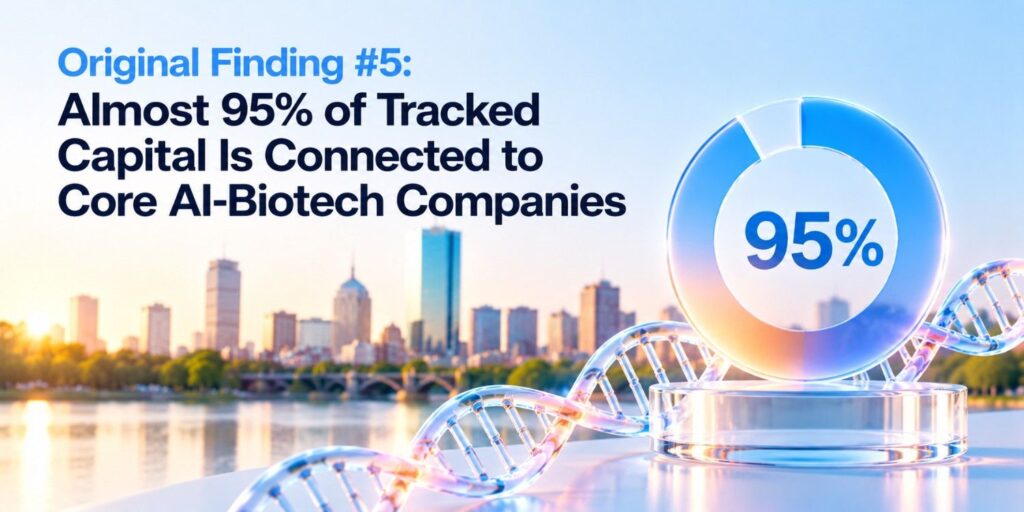
The remaining approximately $24.5 million belongs to Beacon Biosignals and Unreasonable Labs, which sit in the broader scientific and clinical AI category.
Funding by BostonBizScene Classification
| Classification | Capital | Share |
|---|---|---|
| Core AI-biotech | $488.5M | 95.2% |
| Adjacent scientific and clinical AI | $24.5M | 4.8% |
| Total | $513M | 100% |
Generate obviously has a large influence on that calculation, but the pattern does not disappear completely when the IPO is removed.
Without Generate, the strict core still represents approximately $88.5 million of the remaining $113 million in private capital, equal to roughly 78% of the private funding in our dataset.
The message is therefore fairly consistent.
Investors are putting meaningful money into companies where AI is tightly connected to biological research, therapeutic discovery, experimental systems or drug-development infrastructure.
Original Finding #6: Protein and Therapeutic Design Remain Central to Boston’s Funding Story
Boston’s wider AI ecosystem includes cybersecurity, robotics, enterprise software, developer tools and consumer technology.
Its AI-biotech ecosystem looks very different.
Protein engineering, therapeutic discovery and biological measurement occupy a major share of the funding landscape.
Generate’s platform focuses heavily on protein therapeutics.
Converge supports areas including antibody design.
ProFound searches the human proteome for new proteins, targets and biomarkers.
Alloy operates across antibodies, multispecifics and several other biologic modalities.
This concentration makes sense because Boston already has enormous expertise in protein science, drug discovery and therapeutic biology.
AI is therefore being added to an existing regional strength rather than creating an entirely new industry from nothing.
Why This Matters for Founders
Startup ecosystems usually become strongest when new technologies attach themselves to deep pools of existing expertise.
A founder building a general software product can operate in many places.
A founder building a therapeutic platform may need computational scientists, molecular biologists, clinical advisers, pharmaceutical partners, experienced biotech executives and laboratory infrastructure.
Boston already has many of those resources.
The long-term opportunity is therefore not simply to become an AI hub that happens to contain biotech companies.
The larger opportunity is to use AI to increase the productivity of one of the world’s most concentrated biotechnology ecosystems.
Who Is Funding Boston’s AI-Biotech Market?
Another important finding from the dataset is that the investor base does not resemble one traditional life-science venture network.
Technology investors, specialist healthcare funds, corporate investors, international capital and philanthropic organizations all appear across the financing events.
Selected 2026 Investors
| Company | Important disclosed 2026 backers |
|---|---|
| Converge Bio | Bessemer Venture Partners, TLV Partners, Vintage Investment Partners, Saras Capital |
| Outpost Bio | Seedcamp, Merantix Capital, OpenSeed VC, Defined Capital |
| Unreasonable Labs | Playground Global, AIX Ventures, E14 Fund, MS&AD Ventures |
| Beacon Biosignals extension | JSL Health, Palo Santo VC, Kicker Ventures, Samsung Next |
| Alloy Therapeutics | 8VC, JIC Venture Growth Investments, Echo Capital, family offices |
| ProFound Therapeutics | Gates Foundation |
| Generate Biomedicines | Public-market investors through IPO |
There is relatively little overlap between those investor groups, which is important in itself.
AI-biotech is pulling capital from several different financial ecosystems rather than relying only on traditional biotech venture firms.
A company may appeal simultaneously to software investors, deep-tech funds, healthcare specialists, strategic corporate investors and foundations.
That can expand the available capital base, but it also creates a more complicated fundraising environment.
Different investors may value different parts of the same company.
A software investor may focus on model quality, recurring revenue and platform scalability.
A life-science investor may concentrate on biological validation, therapeutic programs and clinical risk.
A deep-tech investor may care most about the integrated technical system.
A strategic pharmaceutical investor may focus on whether the platform can improve a particular research workflow.
Founders therefore need a company story that makes sense across several different investor perspectives without becoming inconsistent.
Bessemer’s Converge Investment Shows Technology Capital Moving Deeper Into Biology
Bessemer Venture Partners led Converge Bio’s $25 million Series A, which is noteworthy because Bessemer is widely known across technology investing rather than being viewed only as a traditional biotechnology investor.
Its involvement reflects a wider change in the market.
AI drug discovery increasingly sits between software and biotechnology rather than fitting neatly into one category.
For founders, that creates access to a wider investor universe, but it also raises an important strategic question about where the company’s value actually accumulates.
Is the long-term moat the AI model?
Is it proprietary biological data?
Is it customer integration?
Is it a drug pipeline?
Is it experimental infrastructure?
Or does the advantage come from combining all of those elements into one system?
The strongest AI-biotech businesses will eventually need a clear answer because investors are becoming less willing to treat the presence of AI itself as sufficient differentiation.
Alloy’s Investor Group Shows How Global the Capital Base Is Becoming
Alloy’s Series E included 8VC, JIC Venture Growth Investments and Echo Capital alongside family offices, while its earlier backers include investors connected to the United States, the Middle East and other regions.
That international mix reflects the economics of modern biotechnology.
Drug development is global.
Pharmaceutical partners operate internationally.
Manufacturing networks span several markets.
Research talent moves across borders.
Artificial intelligence adds another layer of global competition.
Boston founders should therefore avoid thinking about fundraising purely as a Boston-versus-San-Francisco question.
Their realistic investor universe may include New York, California, Europe, Asia and the Middle East, particularly when the company is building infrastructure or platforms that can serve international pharmaceutical markets.
Why Lila Sciences Still Matters Even Though It Is Not in the 2026 Total
Lila Sciences is one of the most important companies in Boston’s scientific AI ecosystem, but it is deliberately excluded from our 2026 financing total.
That distinction matters because the company announced a major Series A milestone in 2025 and later said its completed Series A reached $350 million, bringing total capital raised to approximately $550 million.
Those are enormous numbers, but they are not 2026 financing events.
Moving them into this year’s dataset simply because Lila remains one of Boston’s most important AI-for-science companies would make the tracker less accurate.
The Comparison Is Still Extremely Useful
Lila’s historical financing provides helpful context because its approximately $550 million of reported cumulative funding from seed and Series A stages is larger than our entire $513 million 2026 tracked dataset.
It is also far larger than the approximately $113 million in private capital identified across our current high-confidence 2026 dataset.
That comparison shows how uneven scientific AI financing can be.
One exceptional company can completely reshape a year’s statistics.
For that reason, BostonBizScene looks at medians, averages, financing type and concentration rather than relying only on headline totals.
Chart: Why Average Funding Can Be Misleading
2026 all-event average             $73.3M
2026 all-event median              $20.0M

2026 private-event average         $18.8M
2026 private-event median          $16.75M
The full-market average of $73.3 million tells us very little about what a typical private AI-biotech company experienced during 2026 because the figure is heavily distorted by Generate’s IPO.
The private median of approximately $16.75 million gives a much more realistic view of the financing environment.
This is a useful rule for startup research more broadly.
Whenever average funding appears unusually high, the first question should be whether one or two unusually large transactions are driving the number.
What We Deliberately Excluded From the Tracker
A useful dataset is defined not only by the companies it includes but also by the companies it deliberately leaves out.
Several Boston-area biotech financings sit close to the edge of our definition.
CREATE Medicines
CREATE Medicines raised $122 million in a Series B in May 2026 to advance its in-vivo immune programming pipeline.
The company is clearly an important Cambridge biotechnology business, but the financing announcement focuses on therapeutic development rather than presenting AI as the defining technology being financed.
For that reason, we do not include it in the strict AI-biotech total.
That does not mean CREATE never uses computational methods.
It simply means our methodology requires stronger evidence that artificial intelligence is central to the funded platform or business model.
Atavistik Bio
Atavistik Bio announced a $40 million extension to its Series B in March, bringing total proceeds in that round to $160 million.
The Cambridge company is scientifically sophisticated and heavily computational, but automatically including every modern biotech with advanced computational capabilities would quickly turn this tracker into a general Boston biotech funding list.
That is not the purpose of the analysis.
ai3Bio
Watertown-based ai3Bio launched in September with $48 million in Series A financing.
The company is developing technologies aimed at autoimmune disease, but its name alone is not enough to justify inclusion in an AI-biotech funding tracker.
Company names do not qualify businesses.
The underlying technology does.
Biolevate
Biolevate raised €30 million in September and announced a Boston office as part of its expansion.
The company is highly relevant to the broader life-sciences AI market, but the financing announcement identifies it as a Paris-based business expanding into Boston rather than an established Boston-headquartered startup.
For that reason, it belongs in a Boston ecosystem expansion tracker rather than in the core local funding total.
This type of discipline matters because geographic funding reports can easily become inflated when companies with minor local footprints are treated as fully Boston-based.
Original Finding #7: Boston Is Developing Several AI-Biotech Business Models at the Same Time
The companies in our dataset are not pursuing one standard business model, and that diversity may be more important than the total funding number.
Some are building their own therapies.
Others are selling AI platforms to pharmaceutical companies.
Some are building infrastructure.

Others are developing scientific measurement systems or proprietary data loops.
That variety suggests Boston’s AI-biotech ecosystem is still experimenting with several possible paths to value creation.
Model 1: Build AI-Designed Medicines
Generate provides the clearest example of the therapeutics model.
The company uses its platform to create and advance its own drug programs, giving it direct ownership of the potential upside if those programs succeed.
That model can create enormous value, but it also carries enormous capital requirements because drugs must move through expensive development and clinical testing.
Model 2: Sell AI Into Drug Discovery
Converge represents the platform model.
Instead of depending only on internal drugs, the company works with pharmaceutical and biotechnology customers that can use its technology inside their own research programs.
That approach can potentially create revenue earlier and distribute scientific risk across many customers.
Model 3: Build Shared Biotechnology Infrastructure
Alloy is creating infrastructure that other biotech businesses can use.
Artificial intelligence becomes part of a wider development system rather than the entire product.
This model can allow the company to participate in many therapeutic programs instead of placing all its value on one pipeline.
Model 4: Own the Data-Generation Loop
Outpost combines AI models with automated experiments.
The long-term advantage may come from the company’s ability to create proprietary biological information that continuously improves the system.
Model 5: Measure Biology More Effectively
Beacon represents another category.
The company is not primarily designing therapies.
It is making complex biological signals easier to measure and interpret, which can become valuable to researchers, clinicians and drug developers.
Model 6: Discover New Biological Targets
ProFound is searching the human proteome for previously overlooked proteins, biomarkers and therapeutic opportunities while now integrating agentic AI into that process.
Model 7: Build General Scientific Intelligence
Unreasonable Labs sits above a single scientific market.
Its ambition is to help generate scientific discoveries across several disciplines rather than focusing entirely on one branch of biology.
Over time, these business models may begin to overlap.
A software company may build wet-lab capabilities.
A therapeutic company may license its platform.
An infrastructure business may launch internal drug programs.
A data company may become a discovery company.
That fluidity is likely to remain one of the defining features of AI-biotech for several years.
Original Finding #8: The Most Valuable Asset May Be the System That Produces Better Data
Much of the public discussion around AI-biotech focuses on models, but our funding dataset points toward something broader.
The model may not always be the scarce resource.
High-quality biological data can be harder and more expensive to obtain.
Generate has built experimental testing into its platform.
Outpost creates proprietary microbial data.
ProFound uses protein measurement and biological assays.
Alloy combines computational systems with real drug-development infrastructure.
Beacon gathers biological signals from human brain activity.
Together, these companies suggest that the most defensible AI-biotech platforms may be those that continually create new information rather than depending entirely on existing public datasets.
That changes how investors and founders should think about technological advantage.
The key question is not simply whether a company has an excellent model.
The stronger question is whether the company has a system that becomes more valuable every time another experiment, patient measurement or drug-development program passes through it.
Why the Wet Lab Is Becoming Part of the AI Product
Software can produce a protein design extremely quickly, but that does not prove the protein will behave correctly in a living system.
Biology still has to answer that question.
This creates one of the most important differences between conventional software AI and scientific AI.
The physical world becomes part of the learning system.
Companies need assays, instruments, samples, laboratory automation, experimental workflows and scientists capable of testing what computational systems produce.
That infrastructure is expensive, but the expense can also make the business more defensible because competitors cannot always reproduce a well-integrated experimental system as easily as they can reproduce a software interface.
Boston’s Existing Infrastructure Becomes an AI Advantage
Boston already contains universities, research hospitals, biotechnology companies, pharmaceutical operations, contract research organizations, experienced executives and deep pools of scientific talent.
Much of that infrastructure would be irrelevant in a general consumer software market.
In AI-biotech, it can become a significant competitive advantage.
The region does not merely need more machine-learning engineers.
It needs people who understand how machine learning interacts with biology, chemistry, clinical development and laboratory science.
That combination is far rarer.
What This Funding Data Means for Boston AI-Biotech Founders
The current funding market rewards much more than a fashionable AI story.
Founders increasingly need to show where artificial intelligence connects to measurable scientific or economic value.
Prove Why AI Changes the Workflow
It is no longer enough to say that an algorithm can predict something.
Investors want to understand what becomes faster, cheaper or more likely to succeed because the AI exists.
Does the system reduce the number of experiments required?
Does it improve candidate quality?
Does it discover targets that older methods miss?
Does it help scientists test more hypotheses?
Does it shorten the time between idea and validation?
The benefit needs to reach a real workflow rather than remain inside a technical presentation.
Build a Data Strategy From the Beginning
Founders should be able to explain where training, validation and experimental data will come from over time.
Public datasets can help a startup get started, but they rarely create a durable advantage by themselves.
The more important question is how the company will generate or acquire information that competitors cannot easily reproduce.
Every customer engagement, experiment or development program should ideally strengthen the company’s information advantage.
Decide Whether You Are a Platform Company or a Drug Company
Many founders try to present themselves as both without fully acknowledging the financial consequences.
A therapeutic company needs money for preclinical work, manufacturing, regulatory filings, toxicology studies and clinical trials.
A platform company may instead focus on software infrastructure, customer acquisition, workflow integration and recurring commercial relationships.
The models can overlap, but their economics are different.
Investors will increasingly expect companies to explain which path creates the majority of long-term value.
Measure Scientific Productivity
AI-biotech companies need metrics that go beyond normal software engagement numbers and beyond traditional biotech milestones.
Useful measures can include design-to-test cycle time, experimental success rates, cost per validated hypothesis, number of viable candidates generated, customer program expansion, quality improvement across repeated learning cycles and capital required to reach each scientific milestone.
The exact KPI will vary from company to company.
The principle is that AI must eventually produce measurable improvements in scientific productivity.
What Investors Should Ask Before Funding an AI-Biotech Startup
Investors face the opposite challenge.
AI-biotech companies can present extremely sophisticated scientific stories, but technological sophistication does not automatically create a durable business.
One useful framework is to evaluate several questions together.
Where Does the Proprietary Data Come From?
If competitors have access to exactly the same information, any model advantage may shrink quickly.
Strong companies should have a credible strategy for generating, acquiring or learning from differentiated data.
How Is the Model Experimentally Validated?
Biological predictions ultimately need biological evidence.
A company that can test predictions quickly and cheaply may be able to improve much faster than a competitor with a slow experimental cycle.
What Happens When AI Models Become Cheaper and Better Everywhere?
Foundation models are advancing rapidly, which means some capabilities that appear unique today may eventually become widely available.
An AI-biotech startup therefore needs to survive a world in which general model quality improves across the market.
Proprietary data, laboratory infrastructure, clinical programs, customer integration and specialized workflows can provide that protection.
Does AI Improve the Economics?
This is the business question that ultimately matters.
A technically impressive system has limited commercial value if it does not reduce cost, save time, improve success rates or create better scientific output.
Investors should look for evidence that the technology changes the economics of a meaningful workflow.
What Does the Company Actually Own When the AI Works?
This may be the most important question of all.
Does the company own a drug?
A molecule?
A dataset?
A subscription relationship?
A patent?
A clinical program?
A royalty stream?
The answer determines how scientific success becomes financial value.
Why Boston’s AI-Biotech Funding Market Could Become Much Larger
The current dataset is still small enough that one large financing announcement could materially change nearly every statistic in this article.
That does not weaken the analysis.
It accurately reflects the stage of the market.
Boston already has major scientific AI companies that raised substantial capital before 2026, including Lila Sciences and Generate Biomedicines.
Those companies show that the ecosystem’s capital base extends well beyond the transactions included in this year’s tracker.
The larger question is what happens as more AI-biotech companies begin producing convincing scientific, commercial and clinical results.
If even a small number demonstrate that AI can meaningfully improve drug-development productivity, capital may enter the market much more aggressively.
The Next Funding Wave May Look Different From the Last Biotech Boom
The biotechnology boom of 2020 and 2021 rewarded many companies for strong platforms, ambitious pipelines and promising early science.
The next AI-biotech funding cycle may demand more evidence.
That does not mean companies need approved medicines before raising meaningful capital.
It means investors may increasingly want proof that the technology is improving something that can be measured.
That could mean a better molecule, a faster experimental cycle, a higher validation rate, a proprietary dataset, a paying pharmaceutical customer, a stronger clinical signal or a lower research cost.
The standard is gradually shifting from “we use AI” toward “AI changes the economics or scientific productivity of this process.”
That is a much healthier test.
A Better KPI Dashboard for AI-Biotech Startups
Traditional SaaS metrics do not fully capture these companies, and conventional biotech milestones are not sufficient either.
Founders and investors may need a hybrid scorecard that combines scientific progress with commercial and operational performance.
| Area | Useful question |
|---|---|
| Data | Is proprietary biological data growing? |
| Models | Does performance improve across learning cycles? |
| Experiments | How quickly can predictions be tested? |
| Discovery | Are better candidates reaching validation? |
| Economics | Is the cost per useful result falling? |
| Customers | Are pharmaceutical partners expanding usage? |
| Pipeline | Are internal therapeutic programs progressing? |
| Capital | How much cash is required per milestone? |
| Defensibility | What becomes harder to copy over time? |
| Translation | Is computational progress producing biological progress? |
The final metric may be the most important because AI-biotech companies ultimately succeed only when computational progress produces something meaningful in the physical world.
The software has to change biology.
What Boston Should Build Next
The funding data suggests several areas where the Boston ecosystem may still have significant room to grow.
Better Biological Data Infrastructure
AI systems need clean, structured and scientifically useful data.
Companies that make biological information easier to generate, organize, permission, compare and learn from could become important infrastructure providers for the entire industry.
Automated Experimentation
If AI systems can design experiments instantly but laboratories still need weeks to perform them manually, the learning loop remains slow.
Laboratory automation can remove that bottleneck and allow scientific systems to operate at a much higher speed.
AI-Native Clinical Development
Drug discovery receives much of the attention, but clinical development consumes enormous amounts of time and capital.
Better trial design, biomarker selection, patient matching, endpoint measurement and operational planning could therefore create companies that are just as important as AI drug-design businesses.
Scientific Agent Infrastructure
As AI systems gain the ability to perform longer and more complex research tasks, scientific organizations will need better systems for permissions, validation, monitoring, audit trails and recovery.
Many of the control problems currently appearing in enterprise AI agents are likely to appear inside scientific agents as well.
The consequences of failure, however, may be much more serious in a laboratory or clinical setting.
Tools That Connect AI Models to Instruments
Scientific AI becomes far more powerful when computational systems can safely interact with laboratory equipment, robotics and measurement tools.
Boston has the engineering and life-science talent needed to build that connection.
The Biggest Opportunity Is Not Replacing Scientists
The strongest version of the AI-biotech thesis is not that laboratories will suddenly run without human researchers.
Biology remains too difficult, uncertain and context-dependent for such a simplistic idea.
The more realistic opportunity is to increase the amount of useful science each skilled person can perform.
A scientist may be able to evaluate many more designs.
A research team may be able to eliminate weak ideas earlier.
A small biotech company may gain access to capabilities that once required a much larger organization.
A clinical development team may be able to extract more information from each patient measurement.
The economic impact comes from increasing the productivity of expensive, specialized scientific work rather than simply removing humans from the process.
That fits Boston particularly well because the region already has a deep scientific workforce.
Artificial intelligence can amplify that workforce.
Original Finding #9: Boston’s Advantage Is Moving From AI Talent to AI Plus Domain Density
Boston is unlikely to dominate every category of software engineering or general artificial intelligence.
It does not need to.
Its more defensible advantage comes from combining AI talent with dense concentrations of biological, medical and pharmaceutical knowledge.
Computational researchers can work close to molecular biologists.
Founders can recruit executives with drug-development experience.
Companies can collaborate with universities and hospitals.
Investors can find advisers who have already taken therapies through clinical development.
Those relationships matter because successful AI-biotech systems need far more than code.
This creates what we would describe as a domain-density advantage.
That type of advantage is harder to copy than another software interface or chatbot.
Original Finding #10: Boston’s Funding Market Is Becoming a Test of Integration
The common pattern across much of our dataset is not simply better artificial intelligence.
It is integration.
Generate integrates computation with experimental biology.
Alloy integrates discovery, data and development infrastructure.
Outpost integrates models with automated experiments.
ProFound combines protein discovery with computational systems.
Beacon combines sensors, biological signals and AI analysis.
That suggests Boston’s strongest AI-biotech companies may not be the businesses with the most impressive isolated model.
They may be the companies that successfully connect the most important parts of the scientific workflow into one integrated learning system.
What to Watch for the Rest of 2026
Several developments could still materially change the 2026 funding picture before the year ends.
A large venture round from one scientific AI company could significantly increase the private capital total.
Another public offering could reshape the headline number again.
A major strategic investment from a pharmaceutical company could create an entirely new category of financing inside the dataset.
Existing companies may also extend current rounds or announce new partnerships containing direct equity investments.
Because the market remains highly concentrated, a relatively small number of transactions can have a very large statistical impact.
That makes careful updating essential.
BostonBizScene will continue separating current-year financing from old rounds, announced cash from future milestone commitments and true Boston companies from businesses that merely open local offices.
Without those distinctions, AI-biotech funding totals quickly become much larger than the underlying market really is.
Final Takeaway: Boston’s AI-Biotech Funding Story Is About Learning Systems, Not Just Bigger Models
Boston’s 2026 AI-biotech funding market appears enormous if the analysis stops at the headline number.
Our high-confidence tracker identifies approximately $513 million across seven qualifying financing events through October 3, 2026, but that figure becomes much more informative once the capital is separated by financing type.
Generate Biomedicines’ $400 million IPO represents approximately 78% of the total. Remove that one transaction and we find roughly $113 million in private financing and strategic investment across six events.
That private market is meaningful, but it is selective rather than enormous.
Alloy Therapeutics raised $40 million to expand technology-enabled biotechnology infrastructure. Converge Bio raised $25 million around an AI platform for drug discovery. ProFound Therapeutics received an initial $20 million to combine protein discovery with agentic AI. Outpost Bio raised $3.5 million around an experimental-data loop for human microbiology, while Beacon Biosignals and Unreasonable Labs show how the opportunity is spreading into clinical measurement and broader scientific intelligence.
The most important pattern is what connects many of these businesses.
Boston is not simply funding software that happens to be used by scientists.
Increasingly, capital is backing systems where computation interacts directly with the physical world.
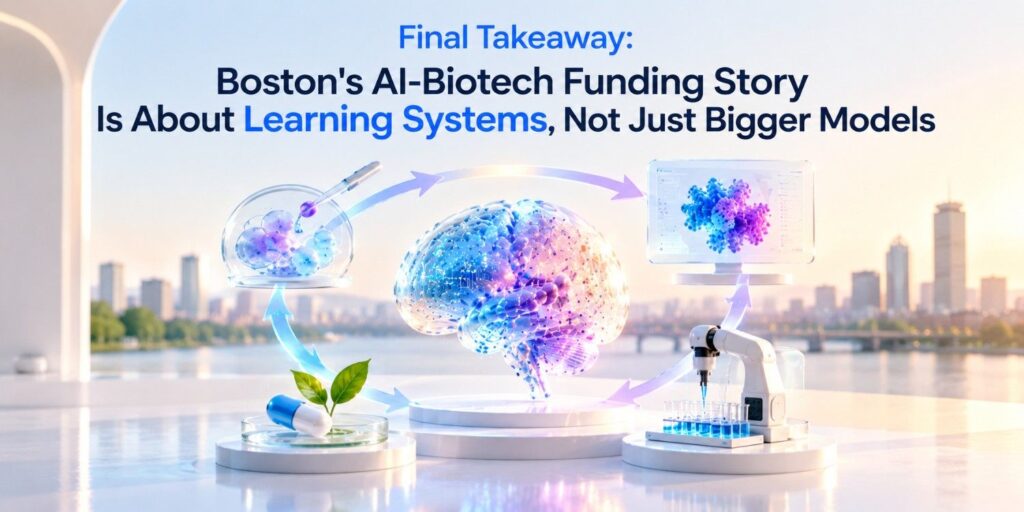
Models generate possibilities, experiments test them, instruments measure the results, new information returns to the system and the next prediction becomes better.
That loop may become one of the defining architectures of Boston’s AI-biotech industry.
It also explains why the opportunity is potentially much larger than AI drug discovery alone.
Boston could become one of the places where artificial intelligence becomes deeply integrated into the entire process of producing scientific knowledge, from hypothesis generation and experimental design to biological measurement, drug development and eventually medicine.
That is the funding story worth watching.