

Artificial intelligence in biotech is moving into a new phase.
For the last several years, much of the excitement around AI in drug discovery focused on individual problems. One company might use machine learning to predict protein structures. Another might analyze pathology images. Another might study gene expression. Another might design small molecules.
That approach can be useful, but biology rarely behaves like a single dataset.
A tumor is not simply a genetic sequence. It is made of cells with different states, proteins, structures and locations. Those cells interact with other cells. They change over time. They react to drugs differently. A mutation that looks important in a sequencing file may have a very different meaning when researchers can also see where the affected cells sit inside a tissue and what those cells are actually doing.
This is why multimodal AI is becoming so important.
Instead of asking an AI system to understand one type of biological information, multimodal systems try to connect several views of the same underlying biology. Those views can include genetics, RNA expression, proteins, pathology images, spatial data, molecular structures, chemistry, patient records and the results of laboratory experiments.
Boston is unusually well positioned for this shift.
The Boston-Cambridge biotech ecosystem already contains companies working across almost every important layer of this new stack. Generate is connecting computational protein design with large-scale physical testing. Cellarity is combining single-cell transcriptomics, multi-omics, chemistry and human-relevant experiments. Manifold Bio is linking AI-designed proteins with high-throughput measurements inside living systems. PathAI is connecting pathology images with molecular and clinical information. Vizgen is bringing spatial genomics, proteins and image analysis together. Valo Health is linking large-scale patient records, statistical genetics, laboratory validation and chemistry. Relay Therapeutics is combining structural imaging, molecular simulations, machine learning and experimental drug discovery.
The bigger story, however, is not that Boston has several companies using multiple kinds of data.
The bigger story is that the city may be building a new type of biotech company: one where computation, biological measurement and experimentation become parts of the same learning system.
That difference matters enormously.
The Short Version: Multimodal AI Is Turning Biology Into a Learning System
The easiest way to understand multimodal AI is to think about how a doctor investigates a difficult medical problem.
A doctor would rarely look at one number and stop. They might consider symptoms, medical history, imaging, blood tests, genetics and what happened after earlier treatments. Each source provides a different piece of information.
Biology works the same way.
A DNA sequence can tell researchers what genetic instructions exist. RNA can show which instructions are being actively used. Proteins tell us more about what cells are actually building. Microscopy shows what cells look like. Spatial technologies reveal where those cells sit relative to one another. Experiments reveal what happens when scientists interfere with the system.
AI becomes much more useful when it can connect these views.
That is especially important because the newest biological technologies are creating enormous datasets that humans cannot inspect manually. Recent research in spatial biology, for example, is increasingly combining tissue images, spatial transcriptomics and single-cell RNA sequencing. A Nature Computational Science paper published on October 5, 2026 introduced CellART, a framework that combines staining images, spatial transcriptomic information and single-cell RNA-sequencing references to resolve and classify individual cells.
Functional genomics is moving in the same direction. High-content CRISPR screening is expanding beyond simple survival measurements toward systems combining genetic perturbations with imaging, single-cell sequencing and spatial information.
The implication is straightforward.
The most useful biological AI models may eventually be the models that can connect what a cell is, what it contains, where it is located, what has been changed inside it, and what happens next.
Boston already has many of the pieces needed to build that system.
What Multimodal AI Actually Means in Biotech
The phrase “multimodal AI” can sound more complicated than it really is.
A modality is simply a type of information.
Text and images are two modalities in consumer AI. In biology, the number of possible modalities is much larger.
Genetics Gives the Starting Instructions
Genetic information tells researchers about DNA variation, inherited risk and potential biological mechanisms.
Statistical genetics can connect genetic variants with disease outcomes. Sequencing can reveal mutations. CRISPR experiments can deliberately modify genes and show what happens afterward.
Yet genetics alone cannot explain everything.
Two cells can contain almost identical DNA while behaving very differently.
Transcriptomics Shows Which Instructions Are Active
RNA measurements help researchers understand which genes are switched on or off.
Single-cell RNA sequencing takes this one step further by measuring these patterns cell by cell rather than averaging signals across a large tissue sample.
That creates a much more detailed picture of disease.
Cellarity, for example, says its platform uses high-dimensional transcriptomics to map disease biology at single-cell resolution. The company then uses AI models to connect those cell states with possible chemical interventions.
Proteomics Shows Another Layer of Function
Proteins actually perform much of the work happening inside biological systems.
Protein data can therefore provide information that DNA or RNA cannot fully capture.
This is one reason spatial biology companies are increasingly combining genomic and proteomic measurements rather than treating the two separately. Following its merger with Ultivue, Cambridge-based Vizgen combines MERFISH spatial genomics with multiplex protein profiling and AI-driven spatial image analysis.
Imaging Shows What Biology Looks Like
Images provide a completely different kind of information.
Pathology slides can show tissue architecture, inflammation, fibrosis, tumor structure and cellular morphology. Cryo-electron microscopy can reveal molecular structure. X-ray crystallography can provide another view of proteins.
Relay Therapeutics uses cryo-EM and ambient-temperature X-ray crystallography to create experimental views of protein conformations. Those experimental datasets then feed into computational simulations designed to model how proteins move.
Spatial Data Adds Location
Location matters enormously in biology.
Two cells may express the same genes but behave differently because they sit in different parts of a tumor.
Spatial technologies preserve that context.
Vizgen’s MERSCOPE technology is designed around spatial genomics at single-cell resolution, while its expanded platform combines transcriptomic, proteomic and AI-powered image analysis capabilities.
Experimental Data Shows What Actually Happens
This may become the most valuable modality of all.
AI can identify patterns in existing observations, but experiments allow researchers to test cause and effect.
Change a gene.
Design a protein.
Treat a cell.
Move a molecule into an animal.
Measure what happens.
Then feed that result back into the model.
That is where AI stops being only an analysis tool and begins becoming part of the scientific process itself.
BostonBizScene Original Research: How Multimodal Are Boston’s AI Biotech Platforms?
To understand whether this shift is actually happening in Boston, BostonBizScene conducted a structured analysis of seven prominent Boston-area AI-biotech and computational drug-discovery platforms.
The sample includes Generate, Manifold Bio, Cellarity, PathAI, Vizgen, Valo Health and Relay Therapeutics.
This is not intended to represent every AI-biotech company in Massachusetts. Instead, we selected companies for which enough public technical information exists to classify the main data types used by their platforms.
Our Methodology
We reviewed company platform descriptions, technical materials and publicly available research information available as of October 6, 2026.
Each company was manually coded across six broad information categories.
| Data or capability category | What counted |
|---|---|
| Genetics / omics | Genetics, transcriptomics, genomic sequencing, multi-omics or closely related molecular profiling |
| Imaging / spatial | Pathology images, spatial biology, microscopy, cryo-EM, X-ray structural imaging or similar visual measurement |
| Protein / biologic | Protein sequence, protein design, proteomics, biologic engineering or detailed protein behavior |
| Chemistry | Small molecules, medicinal chemistry or chemical design |
| Experimental loop | Explicit iterative use of laboratory or in-vivo results to update or guide subsequent computational work |
| Clinical / real-world | Patient records, clinical outcomes or linked real-world patient information |
Importantly, we counted only capabilities explicitly described in the available sources.
If a company almost certainly had access to a particular data type but did not clearly describe its use, we did not give it credit.
That makes the scoring conservative.
The Boston Multimodal Platform Matrix
| Company | Genetics / Omics | Imaging / Spatial | Protein / Biologic | Chemistry | Experimental Loop | Clinical / Real-World | Modalities / Capabilities Counted |
|---|---|---|---|---|---|---|---|
| Generate | — | — | ✓ | — | ✓ | — | 2 |
| Manifold Bio | ✓ | — | ✓ | — | ✓ | — | 3 |
| Cellarity | ✓ | — | — | ✓ | ✓ | — | 3 |
| PathAI | ✓ | ✓ | — | — | — | ✓ | 3 |
| Vizgen | ✓ | ✓ | ✓ | — | — | — | 3 |
| Valo Health | ✓ | — | — | ✓ | ✓ | ✓ | 4 |
| Relay Therapeutics | — | ✓ | ✓ | ✓ | ✓ | — | 4 |
Sources and coding were based on public platform descriptions from each company. Generate describes a continuous generate-build-measure-learn protein engineering loop. Manifold describes NGS-decoded protein barcodes, AI protein design and in-vivo testing. Cellarity describes multi-omics, transcriptomics, chemistry and a lab-in-the-loop framework. PathAI describes pathology imaging linked with molecular and clinical information. Vizgen describes spatial genomics, proteomics and image analysis. Valo describes patient records, statistical genetics, chemistry and experimental feedback. Relay describes structural imaging, machine learning, chemistry and experimental integration.
Original Finding #1: 86% of the Companies We Studied Combine at Least Three Major Biological Information Layers
Six of the seven companies in our sample explicitly combine at least three of the categories in our framework.
That works out to roughly 86%.
Chart: Number of Major Data or Experimental Categories Used
| Company | Categories identified |
|---|---|
| Valo Health | 4 |
| Relay Therapeutics | 4 |
| Manifold Bio | 3 |
| Cellarity | 3 |
| PathAI | 3 |
| Vizgen | 3 |
| Generate | 2 |
Average across the sample: 3.14 categories per company.
That number should not be treated as a scientific measurement of platform quality. A company using four data types is not automatically better than a company using two.
But the pattern is important.
Boston’s leading computational biotech companies increasingly look less like single-purpose AI software businesses and more like integrated scientific systems.
Why This Matters
The earliest generation of biotech AI often worked something like this:
Dataset → model → prediction.
The emerging architecture looks more like:
Multiple datasets → model → experiment → new data → improved model → new experiment.
That second model is much harder to build.
It requires software infrastructure, data infrastructure, wet-lab capability, scientific talent and the ability to design experiments specifically for machine learning.
Boston has unusual strength across all of those areas.
Original Finding #2: Experimental Feedback Is as Common as Omics in Our Boston Sample
Five of the seven companies in our dataset explicitly describe laboratory or in-vivo feedback as an important part of their computational system.
That is approximately 71%.
Five of seven also use genetics, transcriptomics, sequencing or another major omics layer.
Chart: Share of Sample Using Each Data Layer
| Layer | Companies | Share |
|---|---|---|
| Genetics / omics | 5 of 7 | 71% |
| Experimental feedback loop | 5 of 7 | 71% |
| Protein / biologic information | 4 of 7 | 57% |
| Imaging / spatial information | 3 of 7 | 43% |
| Chemistry | 3 of 7 | 43% |
| Clinical / real-world information | 2 of 7 | 29% |
Visualized another way:
Genetics / omics
██████████████ 71%
Experimental loop
██████████████ 71%
Protein / biologic
███████████ 57%
Imaging / spatial
█████████ 43%
Chemistry
█████████ 43%
Clinical / real-world
██████ 29%
The surprising result is not that omics is common.
That would be expected in modern biotech.
The more important result is that experimental feedback appears just as frequently.
Boston’s AI Advantage May Be Its Labs
This changes how we should think about competitive advantage.
A company can buy computing power.
It can license public datasets.
It can use open-source models.
What is much harder to copy is an experimental system that continuously creates useful proprietary biological data.
Generate makes this concept explicit. Its platform is organized around a continuous loop of generating protein sequences, physically building proteins, measuring their characteristics and feeding those measurements back into the learning system. The company says it has generated, built and tested more than 42,000 proteins.
Manifold Bio takes the idea into living systems.
Its mCodes technology attaches peptide barcodes to therapeutic molecules and then uses DNA sequencing to measure them. The company says the system can quantify hundreds of candidate molecules across tissues in a single animal and has a catalog of more than 1,000 mCodes.
These are not simply AI models consuming data.
They are data-generating machines.
Generate Shows What a Closed Biological Learning Loop Looks Like
Generate may be one of the clearest examples of the direction this industry is heading.
The Somerville company describes itself as sitting at the intersection of machine learning, biological engineering and medicine. Its platform studies patterns found across proteins and uses those learned rules to generate new therapeutic proteins.
But the interesting part is what happens after prediction.
The company does not stop at computational design.
Generate, Build, Measure, Learn
Its workflow has four core stages.
Algorithms generate potential protein sequences. Those sequences are physically built as proteins. The proteins are measured. The resulting data then improves the computational engine.
That creates a compounding system.
The first generation of AI drug discovery often treated experimental validation as something that happened after the AI work was finished.
Generate’s architecture treats experimentation as part of the AI system itself.
The distinction is enormous.
If the model proposes 1,000 proteins and the company tests them, the results do more than identify which candidate won.
The 999 failures can also become training information.
Over time, the laboratory is not merely validating the model.
It is teaching it.
Manifold Bio Adds the Missing Variable: The Living Organism
One of the biggest problems in drug discovery is that biology changes when it moves from a simplified experiment into an actual organism.
A molecule that looks excellent in a dish can behave badly in an animal.
It may disappear too quickly.
It may travel into the wrong tissue.
It may fail to cross an important biological barrier.
It may cause unwanted effects somewhere else.
Manifold Bio built its strategy around this problem.
The company argues that even very good AI models are limited by the context of their training data. It therefore combines AI-guided protein design with high-throughput measurement inside living systems.
Hundreds of Molecules Can Be Compared Inside One Animal
Manifold’s mCodes are inert peptide barcodes attached to therapeutic molecules.
The barcodes can be decoded using next-generation sequencing.
That allows researchers to measure many molecules at the same time across different tissues rather than running one animal study for every individual candidate.
This creates an unusually valuable data layer.
Instead of training primarily on protein sequence or laboratory binding measurements, the system can begin learning how designed molecules actually distribute inside an organism.
That matters for AI because better models require better targets.
Predicting whether a protein binds successfully is useful.
Predicting whether a therapeutic reaches the correct tissue, stays there long enough and avoids unwanted organs may be far more valuable.
From Protein Model to Organism Model
Manifold says its longer-term goal is to build a predictive model of living systems that connects molecules, in-vivo behavior and therapeutic outcomes.
That points toward a major future direction for multimodal biotech AI.
Today’s models often represent molecules.
Tomorrow’s models may increasingly represent biological systems.
Cellarity Is Building AI Around Cell State Rather Than a Single Target
Traditional drug discovery often begins by choosing one target.
Cellarity starts from a different place.
The company focuses on what it calls the dynamic cell state.
Instead of asking only which protein should be blocked or activated, Cellarity attempts to understand the broader molecular state of diseased cells.
Its platform integrates multi-omics and uses high-dimensional transcriptomic data to map disease biology at single-cell resolution. Its AI models then predict chemical interventions capable of shifting dysfunctional cellular states toward healthier ones.
Why Single-Cell Data Changes the Problem
Imagine taking RNA measurements from one million cells and averaging them together.
The result might show an increase in a particular signal.
But perhaps only 5% of the cells are driving that increase.
Those cells could represent a rare disease state that is extremely important.
Single-cell technologies make those differences visible.
AI can then search across enormous numbers of cellular states and relationships that would be extremely difficult to reason about manually.
The Lab-in-the-Loop Is the Important Part
Cellarity also describes its system as having an integrated lab-in-the-loop methodology.
Predicted chemical interventions can be tested in human-relevant experimental models. Those results help guide additional optimization.
Again, the pattern repeats.
Data alone is not the product.
The product is the loop.
PathAI Shows Why Images Become Much More Valuable When Linked to Molecular Data
Pathology images contain enormous amounts of biological information.
For decades, much of that information has been interpreted visually by trained pathologists.
AI changes the scale at which those images can be analyzed.
PathAI says its network has contributed more than 32.5 million annotations used to train and validate its algorithms, while its biopharma platform can access more than 50 million slides and samples through PathAI Diagnostics and partner research institutions.
Those numbers are important.
But the multimodal opportunity is even bigger.
An Image Can Become a Molecular Prediction Tool
PathAI describes tools that can make molecular phenotype predictions from standard H&E pathology images.
Its real-world data products can also link quantitative histopathology information with structured clinical and molecular data.
That creates an interesting bridge between modalities.
Expensive molecular tests may reveal something about disease biology.
A pathology image may contain visual patterns related to the same underlying biology.
If a model learns the relationship between the two, an inexpensive, widely available tissue image may eventually help predict molecular characteristics that previously required more complicated testing.
This does not mean imaging replaces sequencing.
It means one modality can help unlock another.
That is one of the most powerful ideas behind multimodal AI.
Vizgen Is Bringing Location Into the Biological Model
Single-cell sequencing solved one important problem by revealing differences between individual cells.
But traditional single-cell methods often lose information about where those cells were originally located.
Spatial biology attempts to preserve it.
Vizgen is one of the companies pushing that shift forward from Cambridge.
Its MERFISH-based systems are designed to measure gene expression inside tissue while retaining spatial information. After combining with Ultivue, the company also has multiplex proteomic profiling and AI-driven spatial image analysis capabilities.
Why Location Changes Interpretation
Consider two immune cells with similar gene-expression profiles.
One sits outside a tumor.
The other has successfully moved deep inside it.
Those two cells may have very different biological importance.
The difference is spatial.
By combining molecular identity with physical location, researchers can investigate interactions that would be impossible to see from a spreadsheet of gene-expression values alone.
This is exactly why the broader research world is moving toward integrated spatial systems.
CellART, published in Nature Computational Science in October 2026, combines staining images, spatial transcriptomics and single-cell RNA-sequencing references in one computational framework.
Multimodal spatial analysis is not an edge case anymore.
It is becoming part of the architecture of modern biology.
Valo Health Starts With Human Data and Works Back Toward the Drug
Valo takes yet another route into multimodal AI.
Instead of beginning primarily with a molecular target, the company starts with human data.
Valo says it has access to more than 17 million de-identified patient records, with some histories spanning 20 to 30 years and linked biobank samples. It applies AI, knowledge graphs, causal inference and statistical genetics to those datasets to identify patient groups, disease mechanisms and possible targets.
That information can then connect with laboratory experiments and chemistry.
Human Data Can Reduce the Distance Between Model and Disease
This approach addresses a basic problem in drug discovery.
A molecule can perform beautifully in a model system and still fail in people.
Starting with human patient information may help researchers focus earlier on mechanisms that appear relevant to actual disease.
Valo combines this patient-level work with statistical genetics and human-tissue validation before moving into its chemistry platform.
Its chemistry system then operates as another closed loop.
Models suggest molecules.
Experiments generate results.
The models are refined.
New compounds are designed.
The architecture again looks less like a linear pipeline and more like an iterative learning machine.
Relay Therapeutics Shows That Even Structural Drug Discovery Is Becoming Multimodal
Proteins are not static objects.
They move.
They bend.
They shift between different shapes.
Those movements can determine whether a drug can bind effectively.
Relay Therapeutics built its Dynamo platform around this concept.
The Cambridge company combines experimental and computational methods to understand protein motion. It uses protein engineering, cryo-electron microscopy and ambient-temperature X-ray crystallography to create experimental datasets describing protein conformations.
Those datasets then feed molecular-dynamics simulations.
Later in the process, Relay combines computational screening, machine learning, medicinal chemistry, structural biology, enzymology and biophysics to identify and optimize compounds.
This illustrates another important point.
Multimodal AI does not always mean genetics plus images.
Sometimes the modalities are different measurements of the same molecule.
An experimental structure provides one view.
A molecular simulation provides another.
Chemical activity data provides another.
Biophysical testing adds another.
The model becomes valuable because it can learn across those different representations.
Original Finding #3: Boston’s Multimodal Companies Are Converging From Different Directions
Our analysis suggests something more interesting than simple similarity.
The companies are not all following the same playbook.
They are approaching multimodal biology from different starting points and gradually moving toward the middle.
Boston’s Convergence Map
| Starting point | Example company | Additional layers being connected |
|---|---|---|
| Protein generation | Generate | Physical production, functional measurement, iterative learning |
| In-vivo protein delivery | Manifold Bio | NGS barcodes, organism-level measurements, AI design |
| Single-cell biology | Cellarity | Multi-omics, chemistry, human models |
| Pathology images | PathAI | Molecular data, clinical data, real-world outcomes |
| Spatial genomics | Vizgen | Proteomics, imaging, spatial analysis |
| Patient data | Valo Health | Genetics, tissue validation, chemistry |
| Protein structure | Relay Therapeutics | Structural imaging, simulation, chemistry, wet-lab testing |
This is important because it suggests the market may not eventually consist of separate categories called “genomics AI,” “imaging AI,” and “protein AI.”
The boundaries are already weakening.
A spatial-genomics company adds proteins.
An imaging company connects molecular data.
A protein-design company builds automated measurements.
A patient-data company builds chemistry.
A structural-biology company builds machine learning.
The endpoint could be a much more integrated scientific platform.
Original Finding #4: The Most Valuable Data May Be Data Generated Because the Model Asked for It
There is an important difference between using data and creating data.
Many AI systems are trained on whatever information already exists.
Scientific AI can do something more powerful.
It can identify uncertainty, propose an experiment and generate exactly the new information needed to improve its understanding.
That creates what computer scientists often call an active learning loop.
In simpler words, the model can help decide what it should learn next.
Why This Could Be a Huge Competitive Advantage
Suppose two companies begin with roughly similar public protein data.
Company A builds a very large model.
Company B builds a slightly smaller model but also runs thousands of carefully selected experiments every month.
Each experiment is chosen because it resolves something the model does not understand.
After several years, Company B may own a dataset that could never have been downloaded from the internet.
Its data reflects its own questions.
Its failures.
Its successful molecules.
Its unusual edge cases.
Its measurement systems.
Its disease programs.
That data can become difficult for competitors to reproduce.
This is why Boston’s physical biotech infrastructure could matter as much as its AI talent.
Lila Sciences Shows Where the Closed Loop Could Eventually Go
The most extreme version of this idea is the autonomous laboratory.
Cambridge-area Lila Sciences describes a system in which AI generates hypotheses, designs experiments, runs those experiments using automated laboratories and learns from the resulting data in real time.
The company describes its AI model as the “brain” and its automated laboratory instruments as the physical system that carries out experiments.
Its platform is broader than biotech alone, spanning areas including therapeutics, materials, chemicals and energy. In therapeutics, Lila says the system can work on areas including mRNA, proteins, antibodies, cell therapies and small molecules.
This is where multimodal AI starts merging with autonomous science.
The model is no longer merely interpreting experiments designed by humans.
The AI is becoming part of the mechanism that decides which experiment happens next.
The Real Multimodal Breakthrough Is Genotype to Phenotype
Biology has always struggled with one enormous question:
How do genetic instructions become actual biological behavior?
DNA contains information.
But disease emerges through many layers between genotype and phenotype.
Genes influence RNA.
RNA influences protein production.
Proteins interact.
Cells change state.
Cells organize themselves inside tissues.
Tissues interact with the immune system.
Drugs interfere with these processes.
Patients respond differently.
Multimodal AI offers a way to connect more pieces of this chain.
New Research Is Already Connecting Genetic Perturbations to Spatial Phenotypes
A 2026 Nature Biotechnology paper on Perturb-DBiT illustrates how quickly the experimental frontier is moving.
The researchers combined large-scale CRISPR perturbation with spatially resolved RNA measurements inside tissue. The system used more than 80,000 guide RNAs in a cancer model while simultaneously studying transcriptomic changes. Researchers also integrated histology images computationally to produce higher-resolution perturbation maps.
Think about what that means.
Researchers are no longer simply asking:
“What genes are expressed here?”
They can increasingly ask:
“What happens if I change this gene, in this cellular environment, in this part of the tissue?”
That is far closer to causal biology.
Why Imaging Could Become One of the Most Important AI Inputs in Biotech
Sequencing has received enormous attention because biological sequences are naturally suited to machine learning.
Images may become just as important.
Microscopy and pathology contain information about morphology, organization and cellular interaction that cannot easily be represented as ordinary sequences.
AI can extract subtle patterns from these images.
More importantly, researchers can connect those patterns with genetics or molecular measurements.
Images Can Become Biological Compression
Imagine an AI model trained on tissue samples for which researchers have both pathology images and expensive molecular measurements.
The system may learn which visual features are associated with particular molecular states.
Once that relationship is strong enough, some information hidden inside expensive assays may become partially predictable from ordinary images.
PathAI is already working on molecular phenotype predictions from H&E images.
Spatial transcriptomics research is similarly fusing histology and molecular information.
The image stops being just a picture.
It becomes another biological sensor.
Why Spatial Biology Is So Important to Boston’s Multimodal AI Story
Genomics tells us what biological information exists.
Spatial biology tells us where biological activity occurs.
That difference is fundamental.
Many diseases involve interactions among multiple cell types.
Cancer is perhaps the clearest example.
Tumor cells interact with immune cells, blood vessels, connective tissue and other parts of their environment.
Knowing that a certain immune-cell population exists is useful.
Knowing whether those cells can penetrate a tumor may be much more valuable.
Spatial technologies make those relationships measurable.
Vizgen’s combination of spatial genomics and multiplex protein profiling is representative of where the field is moving.
Why Multimodal Models Are Harder Than They Sound
Combining several datasets does not automatically create useful multimodal AI.
In fact, poorly integrated data can make a model worse.
Different biological measurement systems have different error patterns.
Sequencing has technical noise.
Imaging has staining and scanner differences.
Clinical records are incomplete.
Animal experiments vary.
Different laboratories follow different protocols.
The model has to distinguish real biology from measurement artifacts.
The Alignment Problem
The most valuable multimodal datasets usually require different measurements to refer to the same biological system.
Researchers might want gene expression, protein measurements and imaging from the same tissue.
But obtaining all three perfectly from the same cells can be difficult.
Some assays destroy the sample.
Others require different preparation techniques.
Some measurements have single-cell resolution while others measure groups of cells.
This creates an alignment problem.
The model must correctly connect information collected in different ways.
More Data Types Can Mean More Ways to Fail
A multimodal model can also learn shortcuts.
Perhaps images from one hospital were scanned differently.
Perhaps samples from one patient group were processed with a different laboratory protocol.
The AI may incorrectly learn that technical difference rather than the disease biology researchers care about.
Multimodal biotech therefore needs unusually careful validation.
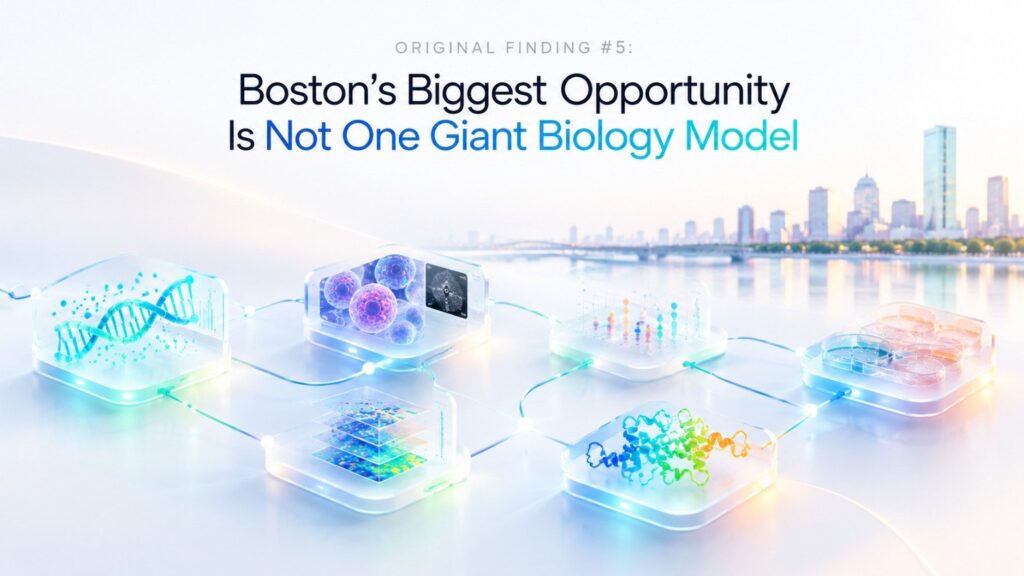
Original Finding #5: Boston’s Biggest Opportunity Is Not One Giant Biology Model
It is tempting to assume that the future belongs to whoever builds the largest biological foundation model.
Our analysis points toward a more complicated answer.
Model size will matter.
But model size alone may not be the defining advantage.
Among the companies we studied, the repeated pattern is model + measurement system + experimental loop.
Generate has protein generation and testing.
Manifold has multiplexed in-vivo measurement.
Cellarity has single-cell data and human-relevant lab models.
Relay has structural biology and experimental chemistry.
Valo connects human data with validation and chemistry.
PathAI has massive pathology datasets linked to molecular and clinical information.
Vizgen builds the instruments and assays that create spatial multi-omics data.
That suggests Boston’s strongest companies may compete through learning velocity rather than model size alone.
The key question becomes:
How quickly can your organization turn a prediction into a high-quality biological measurement and feed that information back into the system?
A New KPI for AI Biotech: Learning Cycles Per Month
Biotech executives often track familiar metrics.
Programs advanced.
Experiments completed.
Candidates selected.
Cash burn.
Months to IND.
Those measurements still matter.
But multimodal AI creates another useful metric.
Learning Cycle Time
A learning cycle begins when a model makes a prediction.
Scientists then build or test something.
The experiment produces data.
The data is cleaned and added to the system.
The model learns.
A new decision is made.
If that process takes six months, the company learns slowly.
If it takes six days, the company can complete many more cycles.
Why This Could Matter More Than Raw Experiment Count
Running 100,000 experiments is not automatically impressive.
The important question is whether those experiments improve the next decision.
A well-designed loop could produce fewer experiments but more information.
That creates an important operating principle for Boston biotech companies:
Do not only automate experiments. Optimize the amount of useful learning generated by each experiment.
What Boston Biotech Leaders Should Measure
For companies building multimodal AI systems, traditional AI metrics such as benchmark accuracy are not enough.
The model ultimately has to improve drug discovery.
A practical operating dashboard should connect computation to biology.
| Metric | What it tells management |
|---|---|
| Prediction-to-experiment time | How quickly AI ideas reach physical testing |
| Experiment-to-training time | How quickly new biological results return to the model |
| Useful data generated per experiment | Whether experiments improve future decisions |
| Prospective prediction accuracy | Whether the model works on new experiments rather than old benchmarks |
| Cross-modal lift | Whether combining modalities improves prediction over the best single modality |
| Failed experiment learning rate | Whether negative results become useful training information |
| Candidate enrichment | Whether AI increases the percentage of tested candidates that meet required properties |
| Experimental reproducibility | Whether the data feeding the model is trustworthy |
| Model-to-program impact | Whether AI changes real R&D decisions |
The most important number may eventually be cross-modal lift.
If adding imaging to genomics does not improve decisions, the additional complexity may not be worthwhile.
More modalities are not automatically better.
Useful modalities are better.
What Boston Startups Should Do Differently
The biggest strategic mistake would be to treat multimodal AI as a software integration project.
It is really an experimental design problem.
Design Experiments for Machine Learning From the Beginning
Many biotech companies produce data for one immediate scientific question.
Later, somebody decides to train AI on it.
That often creates messy datasets.
Measurements change.
Metadata is incomplete.
Negative results disappear.
Experimental protocols vary.
A multimodal company should design its experiments knowing that the results will eventually become training data.
That means standardization matters.
Metadata matters.
Failure data matters.
Controls matter.
Reproducibility matters.
Preserve Negative Results
Biotech historically rewards successful experiments.
AI can learn enormous amounts from unsuccessful ones.
A protein that failed to express is information.
A molecule that entered the wrong tissue is information.
A cell state that did not respond is information.
A chemical modification that destroyed potency is information.
The companies with the best failure datasets may eventually build some of the strongest models.
Capture Raw Data When Possible
A single experimental conclusion may throw away enormous amounts of useful information.
Imagine reducing a microscopy experiment to “positive” or “negative.”
The raw image may contain thousands of additional features that future models could learn from.
The same principle applies to sequencing, instrument traces, pathology slides and many other measurements.
Storage is usually cheaper than recreating an experiment years later.
Why Boston Has a Structural Advantage
Multimodal AI requires something unusual.
It requires excellent machine-learning researchers and excellent experimental scientists to work together.
Boston already has deep communities in both areas.
The region has generations of biotech infrastructure, hospitals, research universities, life-science investors and experienced pharmaceutical talent.
But the key advantage is not simply density.
It is interaction.
A computational scientist can move into biotech.
A molecular biologist can join an AI startup.
A drug-discovery executive can work with a robotics team.
A pathology researcher can collaborate with machine-learning engineers.
Those collisions matter because multimodal biology sits between established disciplines rather than inside one of them.
The Talent Market Will Become More Hybrid
This shift will change hiring.
Pure software engineers will remain important.
Pure experimental biologists will remain important.
But some of the highest-leverage people may be scientists who understand enough of both worlds to connect them.
A computational biologist who understands experimental design can ask better modeling questions.
An experimental scientist who understands machine learning can design more useful data-generation systems.
A platform leader who understands statistics, robotics, biology and drug development can optimize the whole loop rather than one isolated component.
Boston’s educational ecosystem creates a strong supply of exactly these hybrid profiles.
Multimodal AI Will Change How Biotech Facilities Are Designed
The implications extend beyond software and hiring.
Laboratories themselves may change.
Traditional labs were optimized around scientists carrying out experiments.
AI-native labs increasingly need to be optimized around data flow.
Samples must be tracked precisely.
Instruments must connect cleanly with software.
Experimental metadata must be captured automatically.
Robotics must work reliably.
Data should enter analysis systems without weeks of manual cleanup.
Eventually, laboratory design could become part of AI architecture.
Lila’s model of combining AI with autonomous laboratory instrumentation represents the most aggressive version of this concept.
The Competitive Moat Could Shift From Patents to Learning Infrastructure
Patents will remain fundamental in biotech.
But AI-native companies may develop another important defensive advantage.
Their learning system.
Competitors might know that a company uses protein sequences, imaging and experimental feedback.
That does not mean they can reproduce the system.
They would need comparable experiments.
Comparable protocols.
Comparable historical failures.
Comparable instrumentation.
Comparable data quality.
Comparable software.
Comparable biological expertise.
And enough time to accumulate the same feedback.
This creates a compounding advantage.
The company that learns faster today can design better experiments tomorrow.
Better experiments generate better data.
Better data improves the model.
The improved model chooses better future experiments.
The cycle accelerates.
The Biggest Mistake: Collecting Every Possible Modality
The excitement around multimodal AI creates a dangerous temptation.
Collect everything.
Sequence every sample.
Capture every image.
Measure every protein.
Add clinical records.
Run expensive spatial assays.
Store every possible feature.
That can become an enormous waste of money.
The objective is not maximum data volume.
The objective is maximum useful information.
Start With the Decision
Before adding another modality, biotech teams should ask what decision they are trying to improve.
Target selection?
Patient selection?
Protein design?
Tissue delivery?
Lead optimization?
Toxicity prediction?
If adding a modality cannot improve a real decision, collecting it may simply increase cost and complexity.
Measure Incremental Value
Teams should compare models systematically.
Genomics only.
Imaging only.
Genomics plus imaging.
Genomics plus imaging plus proteins.
Then measure whether each additional layer produces meaningful improvement on prospective data.
That is much more useful than simply announcing that a platform is “multimodal.”
What Investors Should Look for
Investors evaluating multimodal AI-biotech companies should look beyond model demonstrations.
The deeper questions concern data economics.
Can the company generate information competitors cannot easily obtain?
Does every R&D program improve the platform?
Can the same experimental infrastructure support multiple programs?
Does the model improve prospectively?
How quickly does experimental feedback arrive?
How expensive is each useful learning cycle?
Does combining modalities create measurable lift?
A company that answers those questions well may have a real platform.
A company that merely combines several public datasets may have sophisticated software but a weaker moat.
What Pharmaceutical Companies Should Do
Large pharmaceutical companies face a different strategic problem.
They already possess huge amounts of multimodal information.
Clinical trial records.
Imaging.
Genomics.
Chemistry.
Assay data.
Animal studies.
Safety results.
Manufacturing data.
The problem is often fragmentation.
Data sits in different systems.
Different teams use different naming standards.
Experimental metadata can be inconsistent.
Negative studies may be difficult to find.
Multimodal AI therefore requires more than buying an AI platform.
Pharma companies need to make their internal scientific history computable.
That could become one of the most valuable AI infrastructure projects in the industry.
What Happens Next: Biology Foundation Models Become More Grounded
Foundation models for biology are advancing quickly.
Many begin with enormous sequence datasets.
That is logical because proteins, DNA and RNA are highly structured forms of information.
But sequence models have an obvious limitation.
Biology happens in the physical world.
The next generation of models will increasingly need grounding.
A protein sequence should connect to measured structure.
Structure should connect to function.
Function should connect to cellular state.
Cellular state should connect to tissue context.
Tissue context should connect to organism-level behavior.
Eventually, those layers should connect to patient outcomes.
That is the full multimodal challenge.
Original Finding #6: Boston Is Building Different Parts of the Same Future Biology Stack
Looking across the companies in our dataset produces an interesting map.
Generate is strong in protein generation and experimental learning.
Manifold is building organism-scale in-vivo measurement.
Cellarity is modeling cell states and chemical interventions.
Vizgen is measuring spatial molecular biology.
PathAI is extracting information from tissue images and linking it with molecular and patient data.
Valo is connecting longitudinal human information to genetics and chemistry.
Relay is combining molecular structure, movement, chemistry and experiments.
Lila is pushing toward autonomous experimental science.
Individually, these are different businesses.
Collectively, they look like parts of a much larger technological transition.
The Emerging Stack
| Biological layer | Boston-area example |
|---|---|
| Human disease and patient history | Valo Health |
| Tissue morphology | PathAI |
| Spatial organization | Vizgen |
| Cell state | Cellarity |
| Protein structure and dynamics | Relay Therapeutics |
| Protein generation | Generate |
| In-vivo biodistribution and behavior | Manifold Bio |
| Automated experimental discovery | Lila Sciences |
This may be the most important original finding in our analysis.
Boston does not need one company to own every modality.
Its ecosystem may become powerful because specialized companies are pushing different levels of biological measurement forward at the same time.
What Boston Business Leaders Should Watch Through 2027
The next stage of multimodal biotech AI will probably be measured less by exciting model demos and more by evidence that integration improves actual R&D.
Watch for prospective validation.
Watch for companies publishing results showing that multimodal systems outperform strong single-modality alternatives.
Watch for tighter integration between spatial biology and pathology imaging.
Watch for more experiments that combine genetic perturbation with rich phenotypic readouts.
Watch for protein-design systems increasingly trained on real in-vivo behavior rather than only biochemical measurements.
Watch for laboratories becoming more automated.
And perhaps most importantly, watch how companies talk about their data.
The strongest platforms will increasingly describe not only how much data they possess, but how their systems continuously create better data.
A Practical Multimodal AI Roadmap for Boston Biotech Companies
A biotech company does not need to build everything at once.
The best strategy is usually to start with one high-value decision.
Suppose the problem is tissue delivery.
The company might begin with protein sequence and in-vivo biodistribution data.
If imaging later adds meaningful information about tissue localization, add imaging.
If transcriptomics helps explain downstream biological effects, add transcriptomics.
Each modality should earn its place.
The platform can then expand around actual evidence rather than technological fashion.
Stage One: Create a Reliable Single-Modality Baseline
Before building a complicated multimodal system, make sure the company knows how well the best single data source performs.
Without that baseline, teams cannot determine whether integration is actually helping.
Stage Two: Add the Most Complementary Modality
Do not add the easiest dataset.
Add the dataset that answers a different biological question.
Genetics plus more genetics may provide less incremental information than genetics plus imaging.
Sequence plus structure may be more useful than simply increasing sequence volume.
Stage Three: Connect Prediction to Experiment
The model should eventually influence what gets tested.
Otherwise the company is still mainly analyzing historical data.
Stage Four: Shorten the Feedback Loop
Automate sample tracking.
Automate data ingestion.
Standardize protocols.
Reduce the delay between experiment completion and model retraining.
Learning speed becomes an operating advantage.
Stage Five: Validate Prospectively
A retrospective benchmark can always contain hidden shortcuts.
The real test is whether today’s model can accurately predict tomorrow’s experiment.
That is where platform claims become scientific evidence.
The Bigger Business Story: AI Could Change the Economics of Biological Information
Traditional biotech economics are dominated by expensive experiments.
Scientists test many ideas.
Most fail.
Successful programs slowly progress.
Multimodal AI does not eliminate experimentation.
It may make experimentation more valuable.
A well-built AI system can decide which experiments are most informative.
One experiment might test a candidate.
A better experiment might simultaneously test a candidate, improve a prediction model and reveal a new biological mechanism.
The same dollar then creates more learning.
This is an important distinction.
The biotech AI revolution may not primarily be about replacing laboratory work.
It may be about increasing the amount of useful knowledge produced by each dollar spent in the laboratory.
Boston’s Real Moat Could Be the Connection Between Computation and Physical Biology
Silicon Valley has extraordinary AI talent.
Other biotech clusters have excellent laboratories.
Boston’s opportunity lies in connecting both worlds unusually tightly.
The city has companies generating molecular data.
Companies building instruments.
Companies creating biological models.
Companies designing drugs.
Companies analyzing patient tissue.
Companies automating experiments.
And companies building AI around all of it.
That creates a powerful local flywheel.
A scientist trained in spatial biology can join an AI therapeutics startup.
An engineer who built laboratory automation can move into autonomous science.
A computational biologist can work alongside medicinal chemists.
A pathologist can help train image models that later connect with molecular biomarkers.
Multimodal biology rewards ecosystems where disciplines collide.
Boston has spent decades building exactly that kind of environment.
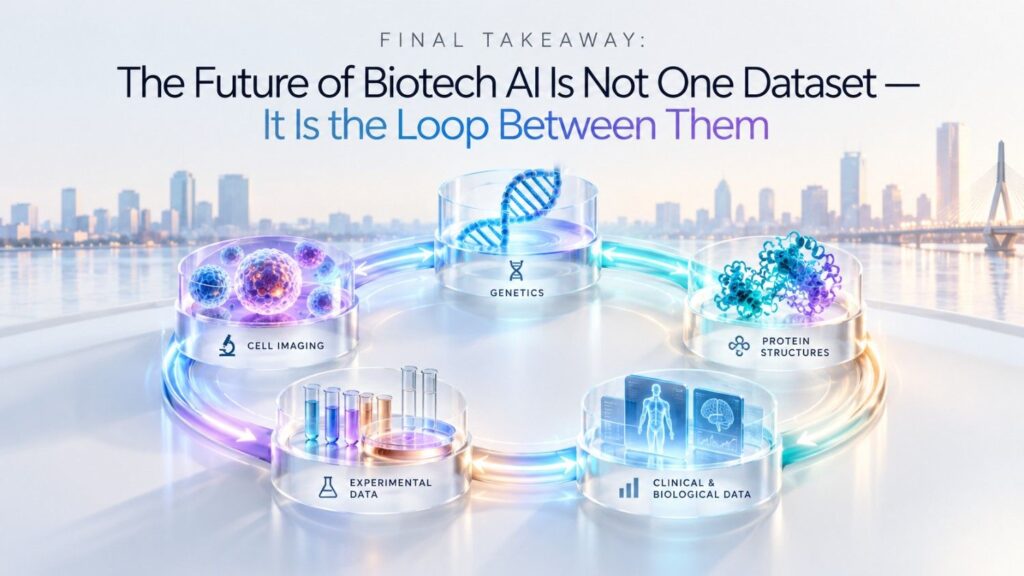
Final Takeaway: The Future of Biotech AI Is Not One Dataset — It Is the Loop Between Them
The first wave of biotech AI proved that machines could learn useful patterns from proteins, genes, images and chemical structures.
The next wave is harder.
AI must connect those signals.
Genetics needs phenotype.
Images need molecular context.
Protein design needs experimental feedback.
Cell-state models need chemical interventions.
Molecular predictions need in-vivo validation.
Patient data needs biological explanation.
And every experiment should ideally make the next prediction better.
Our BostonBizScene analysis of seven Boston-area computational biotech platforms found that six already publicly describe systems spanning at least three major biological information or experimental categories. Five of seven explicitly incorporate iterative experimental feedback, the same number that use major genetics or omics information.
Those numbers come from a small, deliberately selected sample and should not be generalized to the entire Boston biotechnology industry.
But the direction is difficult to miss.
Boston’s AI-biotech companies are not simply collecting larger datasets.
They are beginning to connect data types that used to live in separate scientific worlds.
More importantly, many are connecting those datasets directly to physical experiments.
That is where the real opportunity lies.
The winning biotech AI system may not be the one that has read the most biology.
It may be the one that can ask the best biological question, design the right experiment, measure the answer, learn from the result and immediately decide what to test next.
In that future, genetics, imaging, proteins, chemistry, patient data and experiments are not separate products.
They are different senses used by the same learning system.
And Boston is becoming one of the most interesting places in the world to watch that system being built.