

For years, business software was built around a fairly simple idea: give people better tools so they can complete their work faster. Sales teams received CRMs, banks received lending platforms, developers received better coding environments, doctors received electronic medical records, and security teams received increasingly complex monitoring systems.
Those products improved productivity, but they did not fundamentally change who was doing the work. A person still had to review the information, make the decision, complete the process, and take responsibility for the final outcome.
Artificial intelligence is beginning to change that model.
A new generation of Boston startups is building software that does more than assist employees. These companies are creating systems that can take responsibility for meaningful parts of a workflow, from investigating cyber threats and reviewing medical records to analyzing commercial loans, modernizing software, planning product assortments, and even running scientific experiments.
This is the real promise of vertical AI.
The opportunity is not simply to place a chatbot beside an existing dashboard. The much larger opportunity is to build software that understands a specific type of work deeply enough to execute a growing share of that work on its own.
Boston may be particularly well positioned for this shift because the region has unusually deep clusters in healthcare, biotechnology, financial services, robotics, cybersecurity, engineering, and enterprise software. These industries contain expensive and complicated workflows, which gives local AI startups a large supply of real problems to solve.
That may matter more than building another general-purpose assistant.
The Short Version: Vertical AI Is Moving From Helping With Work to Owning Workflows
The first wave of generative AI inside companies focused mainly on assistance. Employees used AI to summarize documents, draft emails, write code, research topics, prepare presentations, and answer questions.
Vertical AI moves further into the workflow.
Instead of asking, “How can AI help this employee do the job?” companies are starting to ask, “How much of this entire process can software complete without constant human involvement?”
That change may sound subtle, but it has major consequences for the software business.
Traditional SaaS companies generally sell access to software. Vertical AI companies can increasingly sell completed work, faster decisions, higher throughput, lower processing costs, fewer errors, or better business outcomes.
Commercial lending offers a good example. A traditional lending platform may store documents, track applications, display credit data, and help employees manage cases. A vertical AI system can move beyond those support functions and begin reviewing the material, identifying risks, preparing analysis, and completing large parts of the credit workflow.
Boston-based EnFi is pursuing exactly that model. The company has described its platform as an AI credit workforce designed to support end-to-end commercial lending processes.
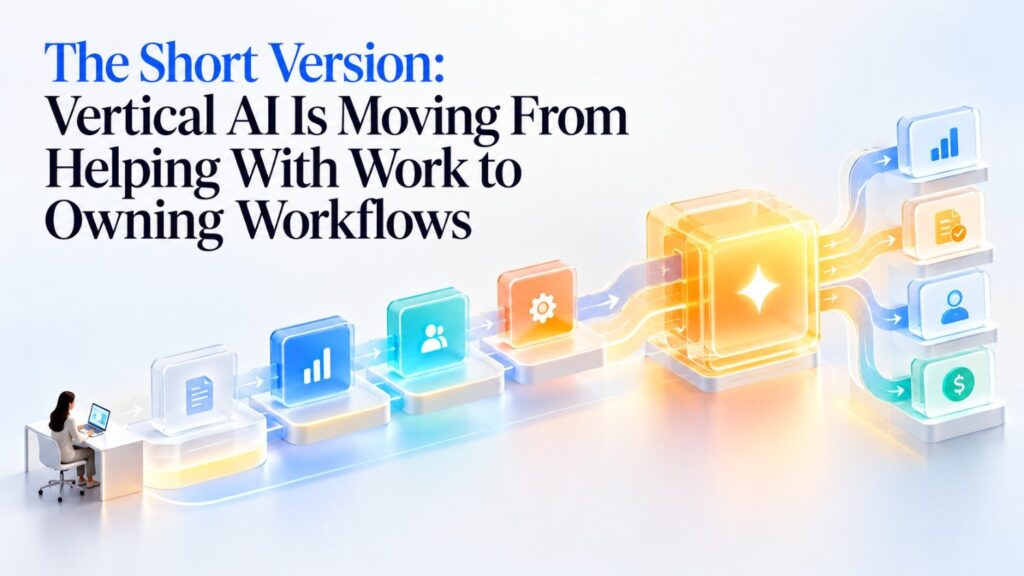
The important change is not simply that the software contains AI.
The important change is that the AI is entering the work itself.
Original Research: We Analyzed 23 Boston AI Companies Built Around Workflows
To understand how far this shift has progressed in Boston, BostonBizScene analyzed publicly disclosed financing activity among Greater Boston AI companies.
Our broader 2026 funding research identified 36 qualifying AI financing events representing more than $2.37 billion in disclosed capital through September 22, 2026.
For this analysis, we applied a narrower test.
A company only qualified if AI was being used to automate, execute, control, or materially reshape a specific business, technical, scientific, or operational workflow.
We did not count generic AI infrastructure companies simply because their tools could be used to build agents. We also excluded companies where AI appeared to be mainly an added feature rather than an important part of how the work itself was completed.
Using that stricter definition, 23 of the 36 companies qualified as workflow-oriented AI businesses.
Together, those 23 companies represented approximately $1.023 billion in 2026 financing.
Chart 1: How Much of Boston’s 2026 AI Market Is Already Workflow-Oriented?
| Metric | BostonBizScene original finding |
| Total qualifying Boston AI financings in broader dataset | 36 |
| Workflow-oriented companies identified | 23 |
| Share of financing events | 63.9% |
| Capital raised by workflow-oriented sample | $1.023B |
| Total capital in broader Boston AI sample | $2.373B |
| Workflow-oriented share of tracked capital | 43.1% |
| Median workflow-oriented financing | $25M |
| Average workflow-oriented financing | $44.5M |
| Companies raising $25M or less | 14 of 23 |
| Capital represented by those smaller rounds | $228.35M |
The most important number may be the share of companies rather than the amount of capital.
Nearly 64% of the financing events in our broader Boston AI dataset involved companies that could be linked to a defined workflow.
That does not mean 64% of every AI startup in Greater Boston is a vertical AI company. The dataset only includes financing events that met our research criteria, so it should not be treated as a complete census of the ecosystem.
It does, however, show where a meaningful share of current startup activity is moving.
AI is getting closer to actual work.
Vertical AI Does Not Always Mean Industry-Specific Software
The phrase “vertical AI” is sometimes used too narrowly.
In some cases, the vertical is clearly an industry. Healthcare AI, insurance AI, legal AI, and maritime AI are obvious examples because the product is designed around one sector.
However, a vertical can also be a business function.
Software development is a function.
Cybersecurity is a function.
Commercial lending is a function.
Product merchandising is a function.
Demand generation is a function.
A company can therefore serve customers across several industries while still going extremely deep into one kind of work.
Boston’s market contains both models.
The Five Workflow Groups in Our Boston Sample
We grouped the 23 companies according to the main type of work they are trying to automate.
| Workflow group | Companies in sample | 2026 capital | Share of workflow sample |
| Software, IT and security | 5 | $464M | 45.3% |
| Health and life sciences | 6 | $261M | 25.5% |
| Science and engineering | 5 | $155.15M | 15.2% |
| Physical and industrial work | 3 | $75.7M | 7.4% |
| Finance, GTM and product operations | 4 | $67.5M | 6.6% |
| Total | 23 | $1.023B | 100% |
These numbers should not be interpreted as a complete estimate of market size because one large financing can significantly change the percentage for an entire category.
The more useful conclusion is that Boston’s workflow AI activity is spread across several important sectors.
The common thread is not the industry. The common thread is the type of work being targeted.
Most of these companies are going after work that is expensive, complex, repetitive, highly technical, or difficult to scale with people alone.
Original Finding #1: Boston’s Biggest Vertical AI Opportunity May Be Expensive Work, Not Simple Work
It is easy to assume that AI automation will begin with the easiest jobs.
Boston’s startup market suggests something more interesting.
Many of the region’s best-funded AI companies are targeting work where the cost of human expertise is already high and where mistakes can be expensive.
Code Metal is working on code translation for mission-critical environments. Blitzy is trying to automate large software-development projects. EnFi is focused on commercial credit work. Layer Health is targeting medical chart review. Gradient AI works on insurance risk and underwriting. Lila Sciences is building systems that can participate in scientific experimentation.
These are not simple processes.
They require context, judgment, domain knowledge, and reliable execution.
That complexity creates risk, but it also creates economic value.
If an AI system saves five minutes on a low-value administrative task, the financial impact may be limited. If the same technology can remove weeks from a software modernization project, speed up loan analysis, increase scientific throughput, or reduce security investigation time, the economics become much more attractive.
That is one reason vertical AI may become more valuable as the workflows become more difficult.
Software Development Is Becoming One of Boston’s Clearest Function-Automation Markets
Software engineering offers one of the clearest examples of AI moving from assistance toward execution.
The first generation of coding AI mainly helped developers write individual lines or functions more quickly. The emerging generation is being designed to manage much larger units of work.
That shift matters because software companies and large enterprises do not ultimately care how many lines of code an AI can suggest.
They care whether a project gets finished.
Blitzy Is Targeting Projects Rather Than Individual Code Suggestions
Cambridge-based Blitzy raised $200 million in May 2026 at a reported valuation of $1.4 billion.
Its ambition is far larger than code completion. The company has described a model in which large numbers of cooperating AI agents work together on major software projects.
That means the unit of automation is changing.
The old unit was a line of code, a function, or a developer prompt.
The new unit may be a migration, a product feature, a software module, or even a significant portion of an enterprise project.
That is a much more important market.
A coding assistant competes for a productivity budget.
A platform that can complete meaningful portions of a software project can compete with engineering headcount, outsourcing contracts, and consulting spend.
Code Metal Is Going After Mission-Critical Modernization
Code Metal provides another version of the same shift.
The Boston company raised a $125 million Series B in February 2026 and focuses on verifiable code translation in industries such as defense, automotive, and semiconductors.
This market is important because large organizations have enormous amounts of legacy software that still works but is expensive to maintain.
Modernizing those systems manually can require months or years of engineering work.
AI creates a possible alternative, but only if the output can be trusted.
A company cannot safely allow a model to rewrite mission-critical software and simply assume that the result is correct.
That is why verification becomes part of the product.
The real opportunity is not just automated code generation.
It is automated code generation combined with testing, validation, traceability, and control.
That combination can turn AI from a developer convenience into an operating system for modernization.
Cybersecurity Is Moving From Alert Software to AI Security Labor
Cybersecurity has spent years creating more information.
Companies collect logs, monitor activity, identify suspicious behavior, and generate alerts. The challenge is that a human security team still has to investigate those alerts.
That investigation layer has become a major bottleneck.
AI agents are now moving directly into that part of the workflow.
Nebulock Shows the Move Toward Autonomous Investigation
Nebulock has positioned its platform around continuous threat hunting.
Rather than waiting for an analyst to manually review every suspicious signal, the system is designed to investigate environments continuously and surface high-confidence findings.
By June 2026, the company said its system had completed more than 300 million agentic investigations and generated more than 4,000 high-confidence findings.
That model is important because security teams do not actually want more alerts.
They want fewer unanswered questions.
They want to know whether something dangerous is happening, what happened, what systems are involved, how serious the threat is, and what should happen next.
The closer software gets to answering those questions automatically, the closer it gets to automating a meaningful part of the security-operations function.
7AI Is Making the Same Bet at a Larger Scale
Boston company 7AI is pursuing a similar idea.
The company raised a $130 million Series A in December 2025 and has described its product as a system of dynamic AI agents that perform security work across enterprise environments.
That financing is not included in our 2026 capital calculation because it was announced in 2025.
It is still strategically relevant because it shows that agentic security is moving well beyond small experimental products.
Investors are placing large bets on the idea that machines can eventually perform a meaningful share of security work that previously required human analysts.
Original Finding #2: Nearly Half of Workflow Capital Went to Software, IT and Security
Software, IT, and security companies accounted for approximately 45.3% of the capital represented in our 23-company workflow dataset.
That figure is heavily influenced by large financings for Blitzy and Code Metal, so it should not be interpreted as proof that these markets are naturally larger than healthcare or science.
However, it reveals an important enterprise pattern.
Companies appear increasingly willing to use AI in difficult workflows when the financial payoff is large enough.
Software engineering and cybersecurity both fit that pattern.
They are expensive functions, they already happen inside digital systems, their outcomes can often be measured, and skilled workers are difficult to hire.
Those characteristics make them unusually strong markets for deeper AI automation.
Commercial Lending Is Becoming an AI Workflow, Not Just a Fintech Feature
Banking software has traditionally been designed to store information and coordinate activity.
A credit platform might organize documents, track a loan application, provide financial data, and show employees where a case sits in the approval process.
Vertical AI changes the role of the software.

Instead of merely organizing the work, the system can begin participating in the analysis itself.
EnFi Is Building an AI Credit Workforce
Boston-based EnFi has described its platform as AI-native infrastructure that deploys agents across commercial lending workflows.
The company raised a $15 million Series A in February 2026.
Commercial lending is well suited to vertical AI because the process contains both structured and unstructured information.
Credit teams may need to review spreadsheets, borrower history, financial statements, business performance, loan documents, industry risk, and past relationships.
Traditional software helps employees collect and organize those materials.
A vertical AI system can go further by reviewing them, identifying unusual patterns, preparing analysis, and drafting parts of a credit recommendation.
The shift is important because the buyer is no longer only paying for software.
The buyer is paying for analytical capacity.
The Business Model Could Shift From Seats to Work
This change has major implications for software pricing.
Traditional SaaS often grows with headcount.
If a company has 20 employees using a system, it buys 20 seats. If it grows to 100 employees, it may buy 100 seats.
Vertical AI changes that logic because the software may eventually perform enough of the work that fewer people need to interact with the application.
That makes per-seat pricing less natural.
Instead, vertical AI companies may charge according to the amount of work completed.
That could mean loans analyzed, records reviewed, investigations completed, documents processed, claims assessed, experiments run, software modules migrated, or other measurable units.
This opens a much larger market.
The company is no longer competing only for the software budget.
It may also compete for labor spend, consulting spend, outsourcing spend, and the cost of work that companies currently cannot complete because they lack capacity.
Healthcare Is a Natural Vertical AI Market Because So Much Work Depends on Unstructured Information
Healthcare organizations generate huge amounts of information.
The difficulty is that much of it is difficult to use.
Important clinical facts may be hidden inside long medical notes, scanned documents, specialist reports, and records stored across several systems.
As a result, healthcare workers often spend large amounts of time simply reading, extracting, checking, and organizing information.
That creates a strong case for vertical AI.
Layer Health Is Automating Chart Review
Boston-based Layer Health focuses on medical chart review.
The company’s platform is designed to extract structured clinical information from complex patient records and support workflows such as quality reporting and clinical registry submission.
This is a strong example of vertical AI because the company is not beginning with a broad chatbot and then searching for healthcare uses.
It begins with a very specific job.
Review the record.
Find the relevant information.
Structure it.
Prepare it for the next step in the workflow.
That approach can create a much stronger product because the system learns the exact rules, exceptions, and data patterns surrounding one type of work.
AcuityMD Is Applying AI to the Commercial Side of MedTech
Vertical AI in healthcare is not limited to clinical workflows.
AcuityMD is focused on the commercial operations of medical-device companies.
The Boston company raised an $80 million Series C in April 2026 and has said that its platform is used by hundreds of medical-device companies.
Its product is designed to help commercial teams understand markets, identify opportunities, and make better decisions around medical-device sales and growth.
This is important because it combines two types of specialization.
AcuityMD understands MedTech as an industry.
At the same time, it goes deep into a specific function inside that industry: commercial operations.
That combination can be difficult for a general-purpose AI company to reproduce.
Insurance Shows Why Domain Data Can Become a Powerful Moat
Insurance is another attractive vertical because underwriting decisions are repeated constantly and depend on large amounts of historical information.
This creates a strong feedback loop.
More decisions produce more data.
More data can improve models.
Better models can improve future decisions.
Gradient AI Is Automating Risk Assessment
Boston-based Gradient AI develops machine learning systems specifically for insurance companies.
Its tools are used across areas such as workers’ compensation, property and casualty, and group health underwriting.
The important advantage is not simply access to machine learning.
The deeper advantage is the surrounding domain knowledge.
Insurance underwriting depends on historical claims, pricing logic, policy structure, industry-specific risk factors, and regulatory constraints.
A general model may be intelligent, but it does not automatically have that context.
This is why vertical AI companies can remain defensible even as general models improve.
The base model becomes one layer.
The harder-to-copy value sits in the data, integrations, workflow rules, and outcome history around it.
Original Finding #3: The Best Vertical AI Markets Share Four Characteristics
After reviewing the companies in our Boston sample, four characteristics appeared again and again.
The strongest markets tend to involve work that is expensive, repetitive, measurable, and rich in domain-specific data.
Vertical AI Opportunity Framework
| Characteristic | Why it matters | Example |
| Expensive | There is already a meaningful budget to capture | Software modernization |
| Repetitive | The workflow happens often enough for automation to matter | Security investigations |
| Measurable | Buyers can calculate whether AI improves results | Loan processing time |
| Domain-rich | Specialized data can create a durable advantage | Insurance underwriting |
A workflow does not need to be easy.
In many cases, difficulty actually improves the opportunity.
If a startup can reliably solve a hard problem that requires specialized knowledge, that difficulty becomes part of the competitive moat.
Science May Become Boston’s Most Distinctive Vertical AI Market
Many cities can build marketing software.
Far fewer cities can easily reproduce Boston’s scientific ecosystem.
Greater Boston has deep research institutions, biotech companies, laboratories, engineering talent, and a large life-sciences workforce.
That combination creates an unusually strong environment for AI systems built around scientific work.
Lila Sciences Wants AI to Run the Scientific Loop
Cambridge-based Lila Sciences is one of the clearest examples.
The company has raised substantial capital to build what it describes as AI Science Factories.
The idea goes far beyond helping scientists search literature or summarize research papers.
Lila is building systems that can generate hypotheses, control instruments, execute experiments, collect results, and use those results to decide what to test next.
That is one of the most ambitious forms of vertical AI because the software is not merely helping a scientist think.
It is entering the experimental loop itself.
Medra Is Combining AI With Physical Laboratory Work
Medra is pursuing a similar direction by combining AI with robotics.
The company is building systems designed to physically execute laboratory experiments.
This creates a closed loop between digital intelligence and real-world scientific work.
The AI can help decide what should happen next, while robotic systems carry out the experiment and return new data.
That structure matters because it gives the system direct access to outcomes.
Instead of making a recommendation and hoping a human later records the result, the system can potentially participate in the entire process.
Why Closed Loops Matter
Closed-loop workflows may become one of the most important competitive advantages in vertical AI.
Imagine an AI system that only gives recommendations.
It tells a human what to do, but the human completes the work somewhere else.
The model may never learn what happened next.
Now imagine a system that recommends the action, executes it, records the outcome, and measures whether the result was successful.
The feedback loop becomes much stronger.
That gives the company better information about what works and what fails.
Over time, that data can improve the product.
The result is a compounding advantage.
The winning vertical AI company may not have the smartest base model.
It may have the best access to the full cycle of work.
Retail and Consumer Goods Show the Same Pattern
Retail may look completely different from science or cybersecurity, but the same vertical AI logic applies.
Before a product reaches a store, teams have to decide what to make, which concepts deserve investment, how products fit together, how much inventory to plan, and whether the expected economics make sense.
Many of those decisions still happen through spreadsheets, slides, meetings, and disconnected systems.
VibeIQ Is Targeting Product Decisions
Boston-based VibeIQ is building software for apparel and consumer-goods companies.
The company focuses on the product-creation and merchandising process.
This is important because generative AI can easily create more ideas, but most brands do not actually suffer from a shortage of ideas.
The harder problem is deciding which ideas should become real products.
That decision depends on margins, inventory, assortment strategy, sourcing, customer demand, timing, and previous performance.
A system that understands those factors can become much more valuable than a tool that simply generates images or product descriptions.
Marketing AI Is Moving Deeper Into Execution
Marketing has been one of the easiest areas in which to demonstrate generative AI.
A model can write an ad, draft a landing page, or produce a campaign idea in seconds.
Those capabilities are useful, but they are becoming widely available.
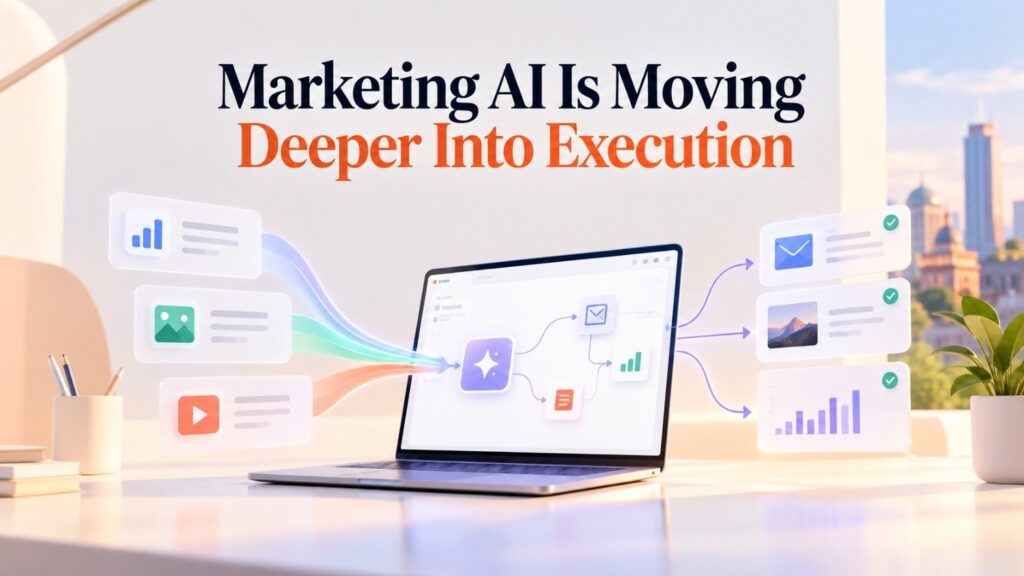
The more valuable opportunity sits deeper in the workflow.
Vector Wants AI to Orchestrate Advertising
Boston company Vector is focused on B2B advertising.
Its broader vision is not merely to help marketers create ads.
It is to use AI to coordinate advertising activity around specific buyers, manage the journey across channels, and connect that activity to pipeline.
That distinction matters.
A simple AI assistant might write five ad variations.
A vertical AI system could potentially identify the right audience, choose the message, launch the campaign, adjust it over time, and measure whether it influenced revenue.
That is a much larger piece of the marketing function.
CRM Could Become an Autonomous System of Record
CRM may be another category that changes dramatically.
Traditional CRMs depend heavily on humans.
Employees enter information, update records, prepare reports, clean data, and remember to keep the system current.
That creates a strange situation in which companies buy expensive software and then pay employees to maintain the software.
AI-native CRM companies are trying to remove that burden.
Day.ai Is Rethinking the CRM Model
Day.ai raised a $20 million Series A in February 2026.
The company’s broader idea is that a CRM should not require employees to spend large amounts of time keeping it up to date.
Instead, AI can observe company activity, organize information, answer questions, identify risks, and prepare follow-up actions automatically.
If that model continues to improve, CRM could eventually become something very different.
It would no longer be a database that people maintain.
It could become an operating system that maintains much of itself.
Physical AI Takes Vertical Automation Into the Real World
Software workflows are easier to automate because the work already happens inside computers.
Physical work is harder.
An AI system controlling machines has to deal with movement, sensors, unpredictable environments, and real-world safety.
Boston has a strong foundation for this type of work because the region already has a large robotics ecosystem and deep research capability.
This matters because physical AI requires more than a language model.
It requires hardware engineering, perception, controls, testing, simulation, and reliable interaction with real environments.
Those capabilities are already present across Greater Boston.
Maritime Operations Are Becoming an AI Market
Boston’s vertical AI opportunity also extends into industries that receive less attention.
ShipIn Systems, for example, applies AI to maritime operations.
Shipping is a good example of a market where AI can create significant value without immediately replacing an entire workforce.
Ships generate operational, visual, and equipment data continuously.
AI systems can help identify safety issues, monitor onboard activity, improve visibility for shore teams, and detect problems earlier.
This shows how vertical AI may spread.
The first step is not always full autonomy.
In many industries, AI will first become the intelligence layer around a workflow.
Once the system earns trust, it can gradually take responsibility for more actions.
Original Finding #4: Smaller Rounds Still Account for Most of the Companies
The largest financing rounds receive most of the attention, but the company count tells a different story.
The five biggest financings in our 23-company workflow sample represented approximately $570 million, or 55.7% of the capital.
However, 14 of the 23 companies raised $25 million or less.
That means roughly 61% of the companies in the dataset were operating with relatively modest financing compared with the largest AI rounds.
Chart 2: Vertical AI Is a Barbell Market
| Group | Companies | Capital | Share of workflow capital |
| Five largest rounds | 5 | $570M | 55.7% |
| Remaining 18 rounds | 18 | $453.35M | 44.3% |
| Rounds of $25M or less | 14 | $228.35M | 22.3% |
This is strategically important for founders.
Building a meaningful vertical AI company does not require raising hundreds of millions of dollars at the beginning.
Most companies in our sample are working with much smaller amounts of capital.
The more important question is whether the product can own enough of the workflow to create measurable value for the customer.
The Best Vertical AI Companies Will Go Much Deeper Than the Interface
A startup can look vertical without truly being vertical.
Imagine a company marketing itself as “AI for accountants.”
If the product is simply a general model with accounting prompts, competitors can copy the experience quickly.
Real vertical depth comes from everything around the model.
The system needs access to the right data.
It needs integrations with existing software.
It needs permissions.
It needs workflow state.
It needs industry-specific rules.
It needs error handling.
It may need audit trails.
It needs to understand when a human should take over.
It also needs a way to measure whether the work was completed correctly.
That is why building a serious vertical AI company is much harder than building a chatbot.
It is also why the strongest companies can become far more defensible.
The Vertical AI Stack Has Five Layers
Boston founders should think about vertical AI as a complete operating stack rather than a single model.
Layer One: Domain Data
The system first needs access to the information required to understand the work.
In insurance, that may include claims and policy history.
In healthcare, it may include medical records.
In lending, it may include financial statements, credit data, and loan documents.
In merchandising, it may include pricing, inventory, margin, and assortment information.
Without the right data, the AI has no reliable view of the workflow.
Layer Two: Domain Reasoning
The system then has to interpret that information correctly.
Reading a financial statement is not the same as understanding whether a borrower is risky.
Reading a patient record is not the same as understanding which clinical facts matter for a specific reporting requirement.
This is where industry knowledge becomes important.
Layer Three: Workflow Integration
The AI must connect with the systems where the work already happens.
If a lending agent cannot interact with the bank’s existing tools, employees still have to move information manually.
If a security agent cannot investigate across the company’s systems, its usefulness is limited.
Integration determines whether the AI can move from advice into execution.
Layer Four: Action
This is the stage where the software actually performs work.
It may update a record, launch an investigation, prepare a loan analysis, generate a completed document, modify software, or run an experiment.
Action is what separates a chatbot from an operational system.
Layer Five: Verification
The final layer may be the most important.
Companies need to know whether the work was completed correctly.
In high-stakes industries, the platform needs testing, audit trails, human review, and clear escalation rules.
Automation without verification is unlikely to earn enterprise trust.
Human-in-the-Loop Does Not Mean the AI Has Failed
There is a common assumption that successful automation should remove humans entirely.
That is rarely the right starting point.
The better goal is to remove unnecessary human effort while keeping human authority where the consequences are significant.
Consider commercial lending.
An AI system could gather financial information, normalize documents, identify unusual patterns, prepare the first analysis, and draft a credit memo.
A human officer might still make the final approval decision.
The system can still create enormous value.
Over time, as reliability improves, more routine cases may be handled automatically while people focus on exceptions.
This pattern is likely to appear across healthcare, finance, cybersecurity, science, and industrial operations.
Human involvement becomes a control layer rather than the mechanism responsible for every individual step.
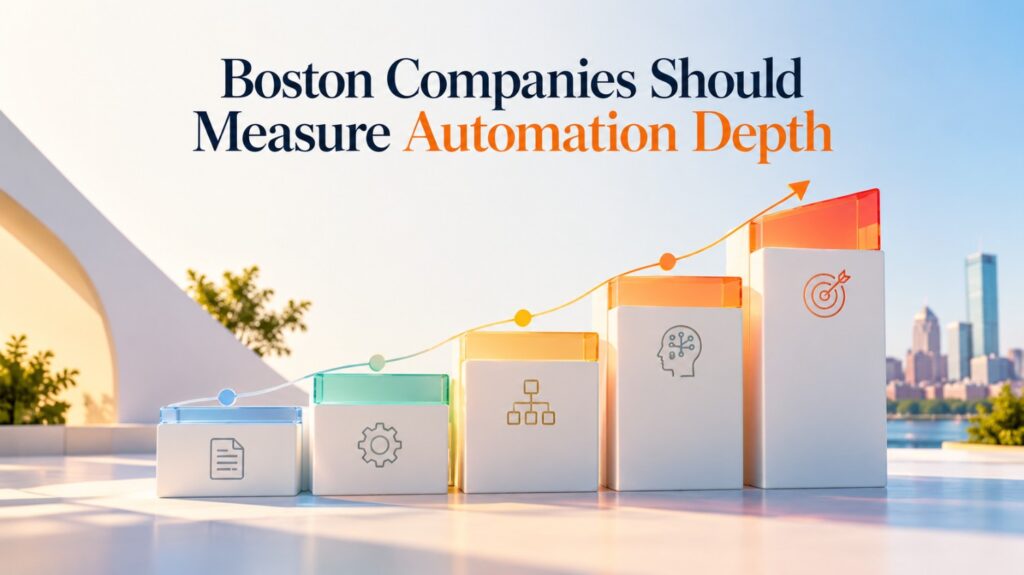
Boston Companies Should Measure Automation Depth
Companies evaluating AI should stop asking only whether a product “uses AI.”
That question is becoming almost meaningless because nearly every software company is adding AI features.
A more useful question is:
How much of the workflow can the system reliably own?
BostonBizScene suggests thinking about automation across five levels.
| Level | AI role | Example |
| Level 1 | Answers questions | Explains a policy |
| Level 2 | Creates output | Drafts a credit memo |
| Level 3 | Executes a task | Updates loan data |
| Level 4 | Runs most of a workflow | Processes a credit review |
| Level 5 | Manages outcomes within controls | Continuously runs the function |
Most enterprise AI products currently sit somewhere between levels two and four.
The biggest economic opportunity is likely to come from systems that can safely move toward level five.
Original Finding #5: Vertical AI Markets Can Be Much Larger Than Their Software Categories Suggest
Traditional software companies usually compare themselves with other software companies.
That may become the wrong way to think about market size.
Imagine an industry that spends $500 million per year on software but $10 billion per year on the people who perform the work supported by that software.
Traditional SaaS mainly competes for the $500 million.
Vertical AI can potentially compete for part of the $10 billion as well.
That does not necessarily mean companies will remove workers.
In many industries, the larger problem is that there are not enough skilled people to complete all the available work.
AI can therefore increase capacity rather than simply reduce headcount.
Banks can evaluate more loans.
Security teams can investigate more threats.
Engineers can modernize more systems.
Scientists can run more experiments.
Healthcare organizations can review more records.
This is why vertical AI should not be viewed only as a cheaper form of SaaS.
The economic opportunity can be much larger.
The ROI Equation Boston Businesses Should Use
Businesses evaluating vertical AI should avoid vague promises around productivity.
The better approach is to measure the workflow directly.
A useful framework is:
Annual AI Value = Labor Time Saved + Additional Output + Error Reduction + Faster Revenue – AI Cost – Oversight Cost
Each part should be linked to real operating data.
If an AI platform saves 4,000 analyst hours each year, calculate the financial value of those hours.
If it increases lending capacity by 25%, measure the additional volume.
If it reduces a security investigation from four hours to 20 minutes, record the difference.
If it helps a merchandising team eliminate weak products before sampling, calculate the avoided cost.
If it reduces a software project from months to weeks, measure both engineering savings and faster time to market.
AI projects become easier to justify when the business case is connected directly to operational results.
The Vertical AI KPI Dashboard
Boston companies testing workflow AI should build a simple dashboard before deployment begins.
| KPI | What it tells you |
| Cost per completed workflow | Whether the system reduces operating cost |
| Human minutes per workflow | How much manual effort remains |
| AI completion rate | How often the AI finishes without escalation |
| Exception rate | How often humans must intervene |
| Error rate | Whether the output is reliable |
| Cycle time | Whether work gets completed faster |
| Output per employee | Whether staff capacity increases |
| Revenue or savings created | Whether the system affects economics |
| Human override rate | Whether employees trust the output |
| Audit completeness | Whether decisions can be reviewed |
The goal is not to ask employees whether the AI feels impressive.
The goal is to measure what changed.
The 90-Day Vertical AI Test Boston Companies Can Run
Companies do not need to redesign an entire department immediately.
A much better starting point is one narrow workflow with a clear beginning and end.
Days 1-30: Map the Existing Work
Choose one repetitive process.
Record every major step.
Identify who performs each action, what software they use, what information they need, how long each stage takes, and where delays usually occur.
Then calculate the current cost per completed workflow.
That baseline is important because without it, the company cannot prove whether the AI created value.
Days 31-60: Give the AI One Clear Responsibility
Do not ask the system to “transform the department.”
Give it one defined job.
It could review the first version of a loan package, investigate one category of security alert, prepare a medical-chart summary, recommend part of a product assortment, or modernize a specific software module.
Keep human approval around high-risk decisions.
Track every failure carefully.
Failures often provide more useful information than successful runs because they reveal where the system still lacks context or control.
Days 61-90: Expand Only After Reliability Improves
Once the AI performs the first responsibility consistently, give it another part of the workflow.
The objective should be to increase the percentage of work completed autonomously without allowing error rates to rise beyond acceptable limits.
This creates a safer path toward automation.
It also prevents companies from buying impressive demos that never become useful production systems.
Why Boston Has a Structural Advantage
Boston will not lead every AI market.
It does not need to.
Vertical AI rewards regions where deep technical knowledge and domain expertise already exist.
Boston has both.
The region contains hospitals, biotechnology companies, banks, asset managers, insurers, robotics laboratories, universities, medical-device companies, defense businesses, and enterprise software firms.
Those organizations produce difficult problems.
They also produce people who understand those problems deeply.
That combination creates unusually strong raw material for vertical AI startups.
A founder does not need to invent a new form of work.
The founder can enter an industry where billions of dollars are already being spent and ask a much more practical question:
Which part of this workflow should software now be able to perform?
The Biotech Slowdown Could Make Automation More Important
Boston’s life-sciences industry has faced real pressure.
Hiring has slowed, funding has become more selective, and some companies have reduced spending.
That environment can actually strengthen the case for AI automation.
When capital is abundant, companies can often solve operational problems by hiring more people.
When capital becomes harder to raise, management teams become more focused on output per employee.
AI then becomes less about experimentation and more about operating efficiency.
A biotech company that can run more experiments without adding the same amount of staff has a meaningful advantage.
The same logic applies across many Boston industries.
What Boston Vertical AI Founders Should Avoid Building
The market is becoming crowded quickly.
That makes generic products more dangerous.
Another chatbot for doctors is not enough.
Another assistant for bankers is not enough.
Another “AI employee” that claims it can handle every department is unlikely to build much domain depth.
Boston founders should look for workflows where they can develop knowledge that a general-purpose AI platform will struggle to reproduce.
The best opportunities often sit inside unattractive processes.
Spreadsheets.
Legacy applications.
PDFs.
Internal approvals.
Regulated decisions.
Medical records.
Industrial equipment.
Specialized datasets.
Complex exceptions.
These workflows may be less exciting to describe in a pitch deck, but they are often much harder to replace.
A Better Founder Question: What Budget Are You Replacing?
Every vertical AI founder should understand which existing budget the product is competing for.
If the answer is another software tool, the market may be limited.
If the answer is several hours of analyst time per case, the economics become more interesting.
If the answer is a six-month consulting project, the opportunity becomes larger.
If the answer is an outsourced business process, it may become larger again.
This is why the strongest vertical AI companies should not think of themselves only as software competitors.
They compete with labor, contractors, consultants, outsourcing providers, and the cost of work that businesses currently cannot complete.
Where Boston’s Next Vertical AI Companies Could Emerge
Several Boston industries remain especially attractive.
Healthcare Administration
Boston has world-class clinical expertise, but healthcare also contains enormous amounts of administrative work.
Prior authorization, revenue-cycle operations, registry reporting, clinical documentation, care coordination, and chart review all involve repeated information processing.
These workflows are difficult enough to require domain knowledge but repetitive enough to benefit from automation.
Financial Operations
Boston’s banking, insurance, asset-management, and investment industries contain many complex back-office processes.
Commercial lending is only one example.
Compliance, reconciliation, investment research, financial modeling, portfolio reporting, and risk operations could all become increasingly AI-native.
Biotech Operations
Drug discovery receives most of the attention, but biotechnology also contains many operational workflows around research.
Protocol preparation, experiment planning, laboratory execution, quality control, regulatory documentation, and scientific data management are all potential automation markets.
The connection between AI and laboratory robotics makes these opportunities even more interesting.
Industrial and Robotics Work
Massachusetts already has a large robotics ecosystem.
The next major opportunity may not be a general humanoid robot.
It may be specialized physical AI designed around a narrow industrial workflow.
Inspection, laboratory work, warehousing, maritime operations, manufacturing, maintenance, and construction all contain tasks that could be gradually automated.
Narrow systems may create meaningful business value long before truly general robots become common.
The Bigger Story: SaaS Is Becoming Labor Software
The deepest change happening in enterprise technology is not the arrival of a chat interface.
It is the gradual disappearance of the boundary between software and labor.
Traditional SaaS stored information.
Then it organized workflows.
Then it added analytics.
Now AI allows software to participate directly in the work.
That changes product design.
It changes pricing.
It changes procurement.
It changes how companies calculate ROI.
Eventually, it may even change how departments are structured.
A business may no longer ask how many software seats it needs.
It may ask how many workflows the system can complete.
Vertical AI Will Likely Create Smaller Teams With Much Greater Output
The most realistic future is not one where companies have no employees.
It is one where each employee can oversee far more work.
A security analyst could supervise hundreds of investigations performed by agents.
A software architect could direct systems completing large amounts of implementation work.
An underwriter could focus on unusual cases while AI handles routine analysis.
A scientist could supervise a much larger portfolio of experiments.
A merchandising team could evaluate more product options without increasing manual work.
This can change company economics dramatically.
Revenue and output may grow without headcount rising at the same pace.
Management Will Change as Well
Managers will also need to develop a new skill.
They will not only manage people.
They will manage systems that perform work.
That means setting permissions, defining thresholds, reviewing exceptions, measuring results, checking errors, and deciding when humans must intervene.
This is closer to operating a production system than using traditional software.
Companies that understand that distinction early may capture much more value from AI.
Vertical AI Buyers Should Demand Proof, Not Demos
Generative AI demos are easy to build.
Reliable operating systems are not.
Before buying a vertical AI product, companies should ask how the system performs under real operating conditions.
How often does it complete the workflow successfully?
What causes it to fail?
How are mistakes detected?
What happens when information is missing?
Can employees review important actions?
Can the platform explain where its information came from?
How much setup does the customer need to complete?
How does the system handle unusual cases?
What measurable result has changed for existing users?
These questions help separate real automation from an impressive interface.
The Companies That Own the Workflow May Own the Most Valuable Data
There is another strategic reason vertical AI is important.
When software participates directly in work, it can collect unusually valuable feedback.
It can see which recommendations were accepted.
It can observe where humans corrected the model.
It can record which exceptions occurred.
It can measure how long each task took.
It can see the final business outcome.
That information can then improve the system.
Over time, the workflow itself becomes a data engine.
This may become a stronger moat than access to any single language model.
Models will change.
Workflow data accumulates.
The Strongest Vertical AI Companies Will Probably Be Model-Agnostic
This leads to one final strategic point.
Vertical AI startups should be careful about building their identity around one underlying model.
The best model today may not be the best model two years from now.
A durable vertical AI company should be able to switch models when necessary.
Its real defensibility should come from data, integrations, workflow knowledge, customer relationships, evaluations, and the execution layer around the model.
The model provides intelligence.
The vertical company provides the system that turns that intelligence into work.
Final Takeaway: Boston’s AI Opportunity Is to Automate Work That Requires Deep Knowledge
Boston does not need to build the most general AI tools in the world.
It may have a more defensible opportunity.
The region can build AI for work that requires deep domain knowledge.
The evidence is already visible.
EnFi is applying AI to commercial lending.
Nebulock and 7AI are moving cybersecurity toward autonomous investigation.
Blitzy and Code Metal are pushing software engineering from assistance toward execution.
Layer Health is targeting medical-chart review.
Gradient AI is applying machine learning to insurance underwriting.
VibeIQ is moving AI into product-development decisions.
Vector is pushing AI deeper into advertising execution.
AcuityMD is applying AI to MedTech commercial operations.
Lila Sciences and Medra are taking automation into physical scientific experimentation.
Our original analysis identified 23 workflow-focused companies among 36 qualifying Greater Boston AI financing events through September 22, 2026. Those 23 financings represented more than $1.02 billion in capital.
The sample is not a complete census of Boston AI, but it is large enough to reveal a clear direction.
Software is moving deeper into the work.
The most important vertical AI systems will not simply tell employees what to do. They will collect information, understand the context, take action, measure the outcome, and escalate the smaller number of cases that still require human judgment.
That is the change Boston companies should be preparing for.
The old software question was simple:
What tool should we give this employee?
The next question is much more important:
What part of this job should the software be able to complete on its own?
The Boston startups that answer that question well may do more than build better software companies.
They may redefine how entire business functions operate.