
For the first few years of the generative AI boom, one product design appeared almost everywhere. A user opened a text box, typed a question, and waited for an AI model to produce an answer. Sometimes the software summarized a document, searched a knowledge base, drafted an email, explained a spreadsheet, or helped someone write code, but the basic relationship between the person and the software stayed familiar. The human asked for help, the software responded, and the human still carried responsibility for completing the actual work.
A different model is now becoming much more visible across Boston’s AI startup ecosystem. The new generation of companies is not only trying to answer an employee’s question, produce a recommendation, or create a first draft. Many are building systems designed to complete meaningful parts of the employee’s job, including cybersecurity investigations, commercial lending workflows, customer support cases, software engineering tasks, clinical research processes, scientific experiments, drone missions, and physical infrastructure operations.
The interface may still contain a chat box, but the chat box is becoming less important than what happens behind it. The real product is increasingly the work completed after the instruction is given, and that shift may prove far more important than the rise of chatbots itself.
Businesses rarely pay large amounts of money simply because software can hold a good conversation. They pay because problems are solved, transactions move forward, customers receive answers, risks are investigated, applications are processed, experiments are completed, systems remain online, and operational work gets finished with less time and fewer resources.
Boston appears unusually well positioned for this transition because the region already has deep clusters in cybersecurity, financial services, healthcare, biotechnology, robotics, industrial technology, enterprise software, universities, and scientific research. These are exactly the sectors where AI must eventually move beyond producing words and begin operating inside complex real-world workflows.
Our analysis suggests that some of Boston’s most interesting AI startups are already moving in that direction. The emerging opportunity is not simply another generation of chatbots with better language models, but a new category of software that increasingly behaves like digital labor.
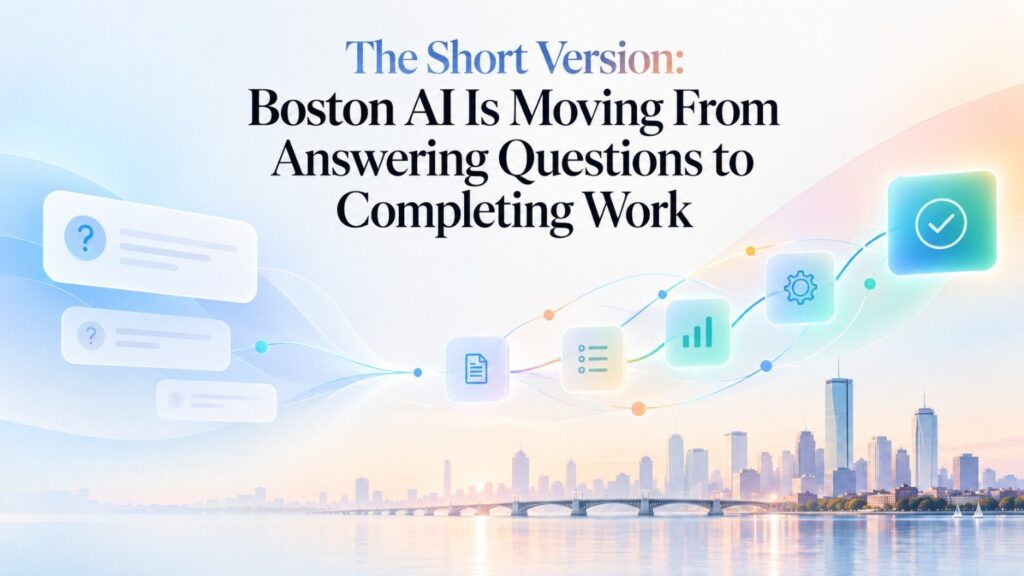
The Short Version: Boston AI Is Moving From Answering Questions to Completing Work
The easiest way to understand the change is to look at AI software in three broad stages. The first generation mainly predicted outcomes, helping companies estimate fraud risk, classify medical records, score insurance claims, forecast customer behavior, or recommend a next action based on available data.
The second generation became conversational. Large language models allowed software to explain information, summarize documents, answer questions, create content, and interact with users through natural language, which made AI dramatically easier for nontechnical employees to use.
The emerging third generation is more operational because it does not stop after producing information. It can receive a goal, gather the data it needs, make several connected decisions, use business software or physical tools, check whether the action worked, and continue until the task is complete or human approval becomes necessary.
That model is much closer to a worker than a chatbot. The distinction matters because the economic value can be dramatically different when software moves from generating suggestions to completing outcomes.
A chatbot that saves an employee five minutes can certainly be useful, but a system that completes a three-hour workflow creates a very different level of value. If the same system can complete thousands of those workflows every day, it begins to affect staffing models, capacity planning, service levels, operating costs, and the way the business itself is organized.
Boston companies including 7AI, EnFi, Maven AGI, OpenHands, Lila Sciences, Delineate, Boost Robotics, Yuma AI, and a growing group of younger startups are attacking different versions of this problem. They do not use the same technology, they do not all describe themselves as agent companies, and they operate at very different levels of autonomy, but they increasingly share a common economic idea.
Instead of simply making the worker faster, they are trying to make the software capable of owning a larger share of the work. That distinction is becoming one of the most important ways to understand Boston’s current AI startup market.
Our Original Research: How We Measured the Shift From AI Tools to AI Workers
Terms such as AI agent, digital worker, copilot, and autonomous AI are now used so widely that the labels themselves are becoming less useful. Almost any software product can now be described as agentic, even when the system does little more than generate text or recommend what a human should do next.
We therefore used a stricter framework for this analysis. Instead of asking whether a startup calls its product an agent, we looked at what the software appears capable of doing inside a real workflow.
Our Four-Level AI Work Model
We grouped products into four levels based on how much responsibility the software appears to take.
| Level | Product behavior | Simple example |
| Level 1: Information | Gives users data or predictions | “This customer has a high risk of leaving.” |
| Level 2: Assistance | Generates or recommends work | “Here is a suggested response.” |
| Level 3: Execution | Performs actions inside a workflow | Sends the response, updates the account and schedules the next action |
| Level 4: Workflow ownership | Handles a multi-step outcome with limited human involvement | Resolves the entire customer case and escalates only exceptions |
The most important dividing line in this model sits between Level 2 and Level 3. Levels 1 and 2 mainly help people make decisions or produce work, while Levels 3 and 4 begin taking action inside the workflow itself.
Before treating a product as execution-oriented, we looked for public evidence that the system could take actions in another application, complete multiple connected steps, change the state of a business process, control equipment, continue operating without repeated prompts, or work toward an outcome rather than simply provide a recommendation.
This creates a much tougher test than simply counting companies that use the word “agent.” It also gives businesses a more useful way to separate AI that assists work from AI that actually performs it.
Dataset One: Y Combinator’s Boston AI Directory
As a starting point, we examined the companies listed by Y Combinator in its Boston artificial intelligence directory in September 2026. YC’s directory gives us a useful outside dataset because it reduces the risk of selecting only companies that support a particular thesis.
The sample includes companies building models, infrastructure, scientific tools, software platforms, and systems that interact directly with operational workflows. Several companies remain focused mainly on data, prediction, or developer infrastructure, while others already show clear signs of deeper execution.
Rindler, for example, is developing a control environment for people running multiple coding agents. Its system is designed to monitor work completed by other agents, surface decisions that need attention, and help a developer manage several concurrent software tasks without manually watching each one.
Degla goes further into physical autonomy by turning high-level goals into multi-drone mission execution. The user does not need to manage every adjustment or change in the mission manually because the system is designed to handle more of the operational decision-making itself.
Boost Robotics is taking the concept into data centers, where autonomous mobile robots can inspect infrastructure and physically interact with equipment. Delineate is applying agents to clinical-trial design, while Yuma AI uses AI systems to work across customer-support workflows and take actions required to resolve tickets.
The useful finding is not that every Boston AI company has become an autonomous worker platform, because that is clearly not the case. The more meaningful finding is that execution-oriented AI is appearing across industries that have very little in common with one another.
Chart 1: Where Execution-Oriented AI Appears in the Boston Sample
| Workflow | Boston example | What moves beyond simple chat |
| Software engineering | Rindler / OpenHands | Agents operate coding sessions and complete development tasks |
| Cybersecurity | 7AI | Investigates security alerts and completes investigations |
| Lending | EnFi | Processes commercial-credit workflows |
| Customer service | Maven AGI / Yuma | Resolves cases and acts across business systems |
| Clinical research | Delineate | Performs research-heavy trial-design work |
| Scientific research | Lila Sciences | Connects AI reasoning with automated experiments |
| Data-center operations | Boost Robotics | Robots inspect and physically interact with equipment |
| Aerospace | Degla | Converts goals into multi-drone missions |
| Fitness coaching | HYBRD | Adjusts plans as conditions and user data change |
| Payments | FlyCode | Automatically manages payment-recovery actions |
The sectors are very different, but the product direction is surprisingly consistent. In each case, the AI is moving closer to the point where work actually happens, and the system is expected to produce an operational result rather than simply return information.
Original Finding #1: The Most Important Variable Is Not Intelligence. It Is Automation Depth
AI companies often compete on model quality, benchmark scores, accuracy, response speed, reasoning ability, or the amount of information their systems can process. Those technical measures matter, but businesses may eventually care much more about a simpler question: how much of the workflow can the software actually complete?
Customer support provides a clear example. A basic AI tool may read a support ticket and summarize it, while a better assistant may draft a response that a human can review and send.
A more capable agent can go much further by identifying the customer, checking account history, searching the knowledge base, determining the likely issue, changing an account setting, processing an allowed action, communicating with the customer, recording what happened, and closing the case when the problem has been resolved.
Those systems may use similar large language models, but economically they are not the same product. One creates text for a worker, while the other produces an operational outcome that would previously have required several minutes or hours of human attention.
A Simple Automation Depth Score
Boston companies evaluating agentic software can use a simple five-point framework to measure how much responsibility the system actually carries.
| Score | Automation depth |
| 0 | AI only provides information |
| 1 | AI recommends the next action |
| 2 | AI performs one approved action |
| 3 | AI completes several connected steps |
| 4 | AI completes most of a workflow but asks for approval at key points |
| 5 | AI owns the workflow and humans primarily handle exceptions |
The goal should not automatically be to reach a score of five because some workflows should always require human approval. Medical, financial, legal, physical, and security-related decisions can create serious consequences when the software is wrong, which means autonomy must be matched carefully to risk.
The value of this score is that it forces companies to describe what the AI really does rather than relying on vague language about deploying agents. A company can then measure whether autonomy is increasing over time and whether the added automation actually improves cost, speed, and quality.
Original Finding #2: The Most Valuable Agents Often Remove Coordination Work
One of the less obvious findings from studying these companies is that agents do not create value only by replacing a single task. They can also remove the coordination work that sits between tasks, and that may be even more important in many enterprise environments.
Large workflows often become slow because information moves between people and systems. One person gathers a document, another reviews it, another enters information into a system, another sends an email, and someone else waits for approval before the process can continue.
Each handoff adds delay, especially when employees work in different departments or use systems that do not communicate well with one another. The actual work may take only a few minutes, while the complete process stretches across several hours or days because someone is waiting on another person to act.
Agents can potentially compress that dead time by moving continuously across the workflow. If the software has permission to gather documents, check rules, update systems, create records, send messages, and escalate unusual cases, there is less waiting between individual steps.
That can matter enormously in businesses where the biggest problem is not how slowly one person performs a task, but how slowly the entire process moves through the organization.
Why This Matters for Boston Industries
Boston has many industries where coordination is expensive. Clinical development involves researchers, vendors, regulatory teams, data systems, laboratories, and outside partners. Lending involves borrowers, analysts, risk teams, documentation, approval processes, and financial systems.
Cybersecurity incidents can involve alerts from multiple tools, analysts, infrastructure teams, and business owners. Scientific experiments may require software, equipment, data pipelines, researchers, and repeated rounds of review.
This means the real value of agentic AI may sometimes come from reducing organizational friction rather than simply reducing employee headcount. A company that cuts ten minutes from one task may create modest savings, but a company that removes two days of waiting from a high-value business process can create much larger value.
7AI Shows What an AI Worker Looks Like in Cybersecurity
Boston cybersecurity startup 7AI provides one of the clearest examples of the worker model because the company is targeting a workflow that traditionally consumes large amounts of human analyst time.
Security teams receive alerts from many different tools, and each warning can require an analyst to gather context, inspect evidence, compare events, determine whether the signal represents a real threat, document findings, and decide whether the incident should be escalated.
That work is repetitive, but it is also important because small mistakes can create serious consequences. 7AI is building agents specifically around this investigation process so the AI can perform more of the repetitive analysis before a human needs to become involved.
The company announced a $130 million Series A in December 2025, bringing its total funding at the time to $166 million. It said enterprises were deploying its agents to autonomously handle security tasks including investigation and triage.
By May 2026, 7AI said its systems had processed more than seven million investigations and were completing investigations end to end. Those operating numbers come from the company, so they should be treated as company-reported figures rather than independently audited market data.
The important point is what the customer is buying. The value is not primarily an AI that can answer questions about cybersecurity, but a system that can complete substantial portions of an investigation that would otherwise consume human analyst capacity.
From Security Software to Security Labor
Traditional security software frequently tells an analyst that something suspicious has happened. The analyst must then figure out what happened, which devices or accounts were involved, whether the event connects to another warning, how serious the threat might be, and what information should be escalated.
An agentic system attempts to answer several of those questions itself and then continue working. That means the economic unit of the product begins to shift away from seats and dashboards toward investigations completed, analyst minutes saved, escalation quality, and the cost of resolving each case.
This may become one of the defining changes in agentic software. Companies will care less about how often employees interact with the interface and more about how much real operational work the system completes without creating additional risk.
EnFi Is Applying the Same Model to Commercial Lending
Commercial lending looks very different from cybersecurity, but the workflow shares a similar structure. Applications arrive with documents, analysts gather information, check lending rules, examine financial statements, calculate ratios, identify risks, prepare credit materials, and move the application toward a decision.
Many of those activities require judgment, but a large portion of the work is also repetitive, document-heavy, and based on well-defined business rules. Boston-based EnFi is building AI agents around that process.
In February 2026, the company announced a $15 million Series A, bringing total funding to $22.5 million. EnFi describes its platform as an AI system capable of supporting end-to-end commercial lending workflows, including work around deal screening, financial spreading, underwriting, and credit analysis.
The important strategic point is that EnFi is not simply placing a conversational interface on top of banking data. It is trying to move through the workflow itself and reduce the amount of manual processing required from bank employees.
That creates value because commercial-credit teams often operate under capacity constraints. If an agent can complete substantial portions of document review and analysis while keeping human decision-makers in control of the final judgment, the bank can potentially process more applications without adding the same amount of analyst labor.
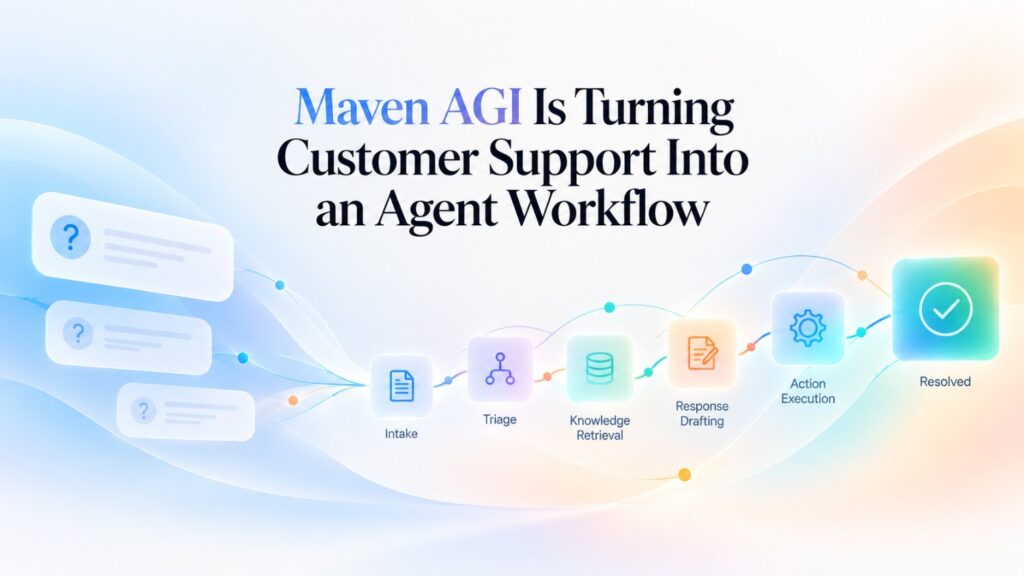
Maven AGI Is Turning Customer Support Into an Agent Workflow
Customer service was one of the earliest markets for chatbots, which also makes it one of the easiest places to see the difference between conversational AI and execution-oriented AI.
A simple support bot answers frequently asked questions. A stronger system solves the customer’s problem by working across internal applications and performing the actions needed to complete the request.
Boston-based Maven AGI describes its platform as an enterprise AI-agent system designed to work across customer-service operations. Its agents can connect with help desks, customer databases, telephony platforms, and other enterprise systems so the software can access both information and actions.
The product direction is important because many support problems cannot be solved with text alone. A customer may need a refund, a reservation change, an account update, a replacement shipment, or some other action inside the company’s systems.
An AI product creates much more value when it can complete that action than when it simply explains what an employee should do. This is why autonomous resolution rate may become a more useful measure than message volume or chatbot engagement.
Why Customer Support Makes the Worker Shift Easy to Measure
Customer support has unusually clear outcomes, which makes it a good testing ground for AI workers. A customer either received the refund or did not, the password was reset or it remained unchanged, the reservation was modified or it was not, and the technical issue was either resolved or escalated.
That makes it possible to measure the AI according to operational results rather than conversational quality. Companies can track autonomous resolution, human intervention, time to completion, customer satisfaction, and cost per resolved case.
Those metrics are much more meaningful because they show whether the AI is actually changing the economics of the support operation.
OpenHands Is Moving Coding From Suggestions to Delegated Work
Coding assistants helped introduce millions of developers to generative AI, but the earliest systems were still mostly suggestion engines. They completed lines of code, generated small functions, or helped explain technical problems while the developer remained responsible for the complete engineering task.
Agentic coding systems are moving toward a different model in which the developer delegates a task rather than asks for a suggestion. The agent can explore the codebase, edit files, run tools, inspect errors, change its approach, and continue working toward the requested outcome.
OpenHands, which grew from an open-source project and has Boston roots, announced an $18.8 million Series A in November 2025 to build an open platform for cloud coding agents. The company’s broader direction reflects an important change in software development because autonomous agents increasingly behave like active participants in the engineering workflow rather than passive assistants.
That creates a new question for businesses. The old measurement was how much faster AI helped a developer write code, while the new measurement is how much engineering work can be delegated while maintaining acceptable quality.
Those questions may sound similar, but they lead to very different product designs, management systems, and economic outcomes.
The Developer May Become a Manager of Agents
This is also why Rindler is interesting. Its product is not mainly focused on building another coding model, but on solving the management problem that appears when a developer starts running many coding agents at once.
Once a developer has several active agents working in parallel, the human can become the bottleneck because every agent may generate updates, questions, failures, and decisions that need attention. Rindler is attempting to create an orchestration layer that surfaces only what actually requires human judgment.
That product is an early signal of where the broader market may be heading. The next important AI interface may not be another chatbot window, but a management dashboard that helps one human supervise a growing number of digital workers.
Original Finding #3: The Human Job May Shift From Doing Work to Managing Exceptions
One of the biggest changes created by execution-oriented AI may be a shift in what human employees actually do.
In a traditional workflow, the employee performs most of the work and software helps along the way. In a more agentic workflow, the software may perform the routine path while the employee handles unusual cases, sensitive decisions, failed integrations, edge cases, and customer situations that fall outside normal policy.
That moves the human closer to an exception manager.
This change matters because exception work is different from routine work. It often requires more judgment, more context, more authority, and stronger communication skills.
A support employee who once answered hundreds of common requests may instead spend most of the day handling the twenty difficult cases that automation could not resolve. A security analyst who once reviewed large numbers of low-value alerts may spend more time on unusual attacks and high-impact incidents.
The same pattern could appear in lending, accounting, software engineering, research, and operations.
Exception Rate Could Become a Core Management Metric
Companies should therefore begin measuring not only how much work the AI completes but what remains after automation.
If an agent automates 80% of a workflow but leaves behind the most difficult 20%, management may need fewer routine operators but more experienced specialists.
That has implications for hiring, training, compensation, staffing ratios, and career paths.
The question is not simply how many tasks the agent can automate. The more strategic question is what kind of human work remains after the routine portion has been automated.
Original Finding #4: A Second Market Is Appearing Around Managing the Workers
Every major computing shift creates secondary infrastructure around the core technology. Cloud computing produced large markets for security, monitoring, deployment, cost management, databases, and infrastructure tooling because businesses needed systems that could manage the growing complexity of cloud operations.
AI workers are beginning to create a similar need. Once a company has ten agents performing business tasks, management becomes important, and once the company has hundreds of agents completing thousands of tasks each day, management becomes an operating requirement.
Companies will need systems for permissions, monitoring, audit logs, evaluation, identity, cost control, routing, memory, testing, exception handling, and human approval. Those categories may become as important to the agent economy as observability and cloud security became to modern infrastructure.
Chart 2: The Emerging AI Worker Stack
| Layer | Basic question it must answer |
| Model | Can the AI reason about the task? |
| Memory | Does it have the right context? |
| Tools | Can it access the systems required to work? |
| Permissions | What is it allowed to do? |
| Orchestration | Which agent should handle each step? |
| Execution | Can the action actually be completed? |
| Observability | What happened and why? |
| Evaluation | Did the agent do the job correctly? |
| Human control | When must a person approve or intervene? |
| Economics | How much did the completed work cost? |
Several young Boston companies are already appearing around these layers. OpenProse is building infrastructure for long-running agent workflows, Rindler focuses on supervising multiple coding agents, and Bytebot is building computer-use infrastructure that allows agents to interact with desktop environments through actions such as keyboard input, mouse movement, and screenshots.
These companies matter because an enterprise full of autonomous software requires much more than a capable language model. It requires an operating environment that makes agent behavior understandable, controllable, auditable, and economically manageable.
Lila Sciences Is Taking the Worker Idea Into the Laboratory
Boston’s most important advantage in agentic AI may appear in areas where the work cannot be completed entirely inside a browser. Scientific research is one of the clearest examples because meaningful progress often depends on physical experiments, laboratory equipment, biological samples, and repeated testing.
Cambridge-based Lila Sciences is attempting to connect AI reasoning with automated laboratories. The company announced a $350 million Series A in October 2025, bringing its reported total capital raised to $550 million.
Its model centers on what the company describes as AI Science Factories, where AI systems can work with automated laboratory equipment to generate experimental data and perform parts of the scientific process.
That approach is fundamentally different from asking an AI chatbot to summarize a research paper. A scientific chatbot talks about an experiment, while a scientific worker helps design, operate, evaluate, or repeat the experiment itself.
Physical Execution Changes the Value of AI
This distinction matters because much of Boston’s economy is built around industries where work touches the physical world. Biology happens in laboratories, healthcare happens around patients, robotics happens around machines, manufacturing happens around equipment, data centers contain real hardware, and aerospace systems move through physical space.
That gives Boston a different possible path from technology ecosystems where the strongest companies are concentrated in pure software or consumer applications. The region may have an advantage in AI systems that combine reasoning with real operational environments.
The result could be a particularly strong market for what might be called embodied enterprise AI, where the intelligence does not stop at the software layer but reaches into physical systems and scientific processes.
Boost Robotics Is Building Workers With Wheels and Arms
Boost Robotics makes the worker concept almost literal because the company is building autonomous mobile manipulation robots for data-center environments.
Its systems are designed to inspect equipment and perform physical tasks that would otherwise require technicians. Those tasks can include checking connections, interacting with hardware, inspecting infrastructure, and addressing problems inside facilities where downtime can be expensive.
This matters because AI agents are often discussed as if they will live entirely inside laptops. That view is too narrow because the same basic architecture can connect reasoning systems to robots, drones, scientific equipment, industrial machines, and other physical tools.
Software Agents and Robots Are Starting to Converge
A software agent might receive a goal such as investigating a security alert, while a lending agent might receive an application to process and a coding agent might receive a software bug to fix.
A robot can receive a similarly structured goal, such as inspecting a row of servers and resolving an equipment problem if the available tools make that possible.
The interface changes, but the operating structure remains similar. There is a goal, a set of tools, a changing environment, a collection of constraints, and a desired outcome that the system must reach through a series of decisions.
That is why Boston’s robotics ecosystem could become much more closely connected with its software-agent ecosystem than it initially appears.
Degla Shows What Happens When the Worker Controls a Fleet
Another Boston-area example, Degla, is applying this model to multi-drone operations. Its system is designed to translate high-level goals into mission execution so users do not need to manually control every step or adjustment.
This example helps clarify the difference between automation and autonomy. Traditional automation usually follows a predefined path where a known event triggers a known response, while an autonomous system must handle situations where the original plan stops working.
If a step fails, the agent may need to decide whether to retry, use another tool, gather more information, skip part of the process, or ask a human for help.
That ability to respond to changing conditions is what makes the worker comparison increasingly useful. The software is not merely replaying a fixed script but making limited operational decisions within defined boundaries.
Original Finding #5: Boston’s Strongest Agent Opportunities Sit Inside Expensive Workflows
Our analysis of these companies suggests another important pattern. Many of the most interesting Boston agent startups are not attacking cheap consumer tasks but expensive workflows where delay, human labor, or mistakes create meaningful financial consequences.
Cybersecurity investigations consume analyst time and create risk when threats are missed. Commercial lending requires skilled employees and can constrain a bank’s capacity to process applications. Clinical development can become extremely expensive when delays accumulate, while software engineering, scientific research, customer support, and data-center operations all contain expensive forms of labor.

This matters because sophisticated AI reasoning is not free. A complex agent may make repeated model calls, retrieve large amounts of context, use external systems, run for long periods, and retry failed actions before completing a task.
Those costs are easier to justify when the work being automated is already expensive.
Chart 3: Why High-Cost Workflows Are Attractive Agent Markets
| Workflow | Cost of delay or manual work | Why agents may fit |
| Cyber investigations | Analyst hours and exposure to threats | Large repetitive investigation volume |
| Commercial lending | Analyst capacity and slower loan decisions | Document-heavy repeatable process |
| Software engineering | Expensive engineering hours | Digital environment with measurable tasks |
| Clinical development | Very high cost of delay | Research-heavy, structured evidence work |
| Customer support | Large labor teams at scale | High volume with repeatable actions |
| Data-center operations | Downtime and technician availability | Repetitive inspection plus physical action |
| Scientific R&D | Scientist time, equipment and failed experiments | Long chains of reasoning and experimentation |
Delineate provides a useful example because clinical research combines expensive labor with expensive delays. The company has argued that saving even a small amount of time in parts of clinical development can create meaningful economic value because the programs themselves are so costly.
The exact dollar value will differ across drugs and companies, but the underlying economic logic is straightforward. AI becomes more valuable when it removes time from workflows where every week of delay or every hour of expert labor already carries a high price.
Original Finding #6: The Best Market May Be the Workflow Between Departments
Most AI discussions focus on individual jobs, but some of the largest gains may come from processes that span several departments.
Consider a customer problem that requires support, billing, operations, and account management. A chatbot can help one employee answer a question, but the customer may still wait while the case passes through several teams.
An agent that has access to the right systems could potentially gather the necessary information, identify which actions are allowed, update the account, create a billing adjustment, notify the relevant team, and return the final answer without every department manually touching the case.
The same pattern appears in lending, cybersecurity, healthcare administration, insurance, procurement, and scientific operations. Many business processes are slow because responsibility moves from team to team.
This creates a strategic opportunity for startups that can automate the workflow across organizational boundaries instead of building another tool for one narrow job.
The hard part is permissions.
A system that works across departments may require access to sensitive databases, financial records, customer data, internal communication systems, and operational tools. That means identity, access control, auditability, and approval design become central parts of the product.
For Boston startups with strong enterprise-security expertise, that complexity may actually be an advantage.
The AI Worker Market Will Be Won on Reliability, Not Demos
This shift creates an uncomfortable truth for agent startups because doing work is much harder than producing a convincing answer.
A chatbot can occasionally be wrong and still feel useful. A worker that takes the wrong action can create a real operational problem, which means the acceptable error rate falls as the system receives more authority.
If a writing assistant creates a weak paragraph, the user can delete it. If a lending agent mishandles a credit file, a security agent fails to escalate an attack, or a robot interacts incorrectly with physical equipment, the consequences can be far more serious.
That means reliability becomes increasingly important as automation depth rises.
The Reliability Requirement Rises With Authority
Companies can think about agent risk as a combination of frequency, authority, and consequence. Frequency describes how often the agent acts, authority describes how much the system is allowed to change, and consequence describes what happens when the decision is wrong.
An internal note-taking agent may act thousands of times every week with relatively limited risk, while an agent with permission to change financial records, isolate production infrastructure, or move money can create serious consequences from a single bad action.
The safety architecture should therefore be designed around what the agent can actually do rather than around a generic label such as “AI assistant.”
Human-in-the-Loop Is Really an Authority Design Problem
The common phrase “human in the loop” is too vague for serious agent deployment because it does not explain where the human enters the process, what requires approval, how quickly someone can intervene, or what information that person receives before making a decision.
A better approach is to design explicit authority levels. Companies should define which actions are safe for the agent to perform independently, which require human approval, and which should remain fully manual.
A Practical Five-Level Authority Model
| Authority level | AI capability |
| A1 | Observe only |
| A2 | Recommend |
| A3 | Prepare an action for approval |
| A4 | Execute low-risk actions and escalate exceptions |
| A5 | Execute independently within defined boundaries |
Different actions inside the same workflow may deserve different authority levels. A customer-support agent might automatically provide shipping information but require approval for an unusually large refund.
A security agent may automatically collect evidence but require human approval before isolating a critical production server. A lending system may prepare an analysis automatically while leaving the final credit decision with authorized employees.
Good agent design is therefore not about increasing autonomy as quickly as possible. It is about placing autonomy where the expected benefit exceeds the operational and regulatory risk.
Original Finding #7: Procurement Will Change When Software Starts Selling Labor
The shift from tools to workers could also change how enterprise buyers purchase technology.
Traditional software procurement usually asks whether a product is secure, whether employees will use it, what systems it integrates with, and how much each license costs.
Agentic software creates a different set of questions because the buyer is no longer purchasing only access to software. The buyer is purchasing a system that may perform work once handled by people.
That means procurement teams may need to understand throughput, error rates, intervention rates, quality levels, operational limits, and the cost of completed outcomes.
A buyer comparing two AI agents may eventually ask which one completes more cases correctly per thousand dollars rather than which interface has better features.
The Business Case Will Need to Look More Like Operations
This also changes how AI projects should be justified internally.
A weak business case says that employees will save time.
A stronger one shows exactly how many hours are removed from a process, how many additional cases can be handled, how much cycle time falls, how many errors are avoided, and how the cost per completed outcome changes.
That is a more demanding standard, but it creates a much clearer path from AI spending to measurable return.
Boston startups selling into serious enterprise markets may benefit from building their sales process around these operational numbers from the beginning.
Original Finding #8: Funding Is Flowing Toward Companies That Connect AI to Real Work
We also looked at publicly announced funding from several Boston-area companies that illustrate different parts of this execution-oriented market.
This is not a complete venture-capital dataset, and the rounds occurred at different times, so the table should not be interpreted as a full measure of Boston’s AI funding market. It is better understood as a high-signal sample of companies building systems that connect AI with real operational work.
Chart 4: Selected Funding Announcements Around Boston’s AI Execution Economy
| Company | Publicly announced round | Main workflow |
| Lila Sciences | $350M Series A | Scientific experimentation |
| 7AI | $130M Series A | Cybersecurity investigations |
| Maven AGI | $28M initial financing; later funding brought reported total to $78M | Customer operations |
| Layer Health | $21M Series A | Medical chart review |
| Day AI | $20M Series A | CRM intelligence |
| OpenHands | $18.8M Series A | Software development |
| EnFi | $15M Series A | Commercial lending |
The latest major rounds shown in this selected group total more than $580 million, even before counting earlier financing or other Boston AI companies.
That figure should not be generalized across the entire market because the sample intentionally highlights notable companies rather than a random group. The useful signal is where some of the capital is going.
Investors are funding companies that connect AI to valuable operating processes, including security, science, customer service, lending, healthcare, and software development.
Why Boston May Be Especially Good at Building AI Workers
Boston does not need to become the strongest city in every category of artificial intelligence. It can build an advantage around specific forms of AI that match the structure of the local economy.
The region already contains dense networks of hospitals, biotechnology companies, universities, financial institutions, enterprise-software firms, defense technology businesses, robotics teams, and cybersecurity companies.
Those sectors are full of workflows that are difficult to automate because they require domain knowledge, specialist tools, regulatory awareness, or interaction with the physical world.
A general chatbot can be built almost anywhere, but a system that operates safely inside a clinical, scientific, industrial, security, or financial workflow usually requires a much deeper understanding of the work itself.
Boston Has Technical Talent Close to Domain Experts
MIT, Harvard, regional hospitals, research institutions, and established industry clusters create another advantage because AI engineers can work close to scientists, clinicians, security teams, roboticists, and other subject-matter experts.
That proximity matters more as AI products move away from generic interfaces and toward deeply specialized workflows.
A company building software for clinical research needs people who understand clinical research. A company building autonomous security agents needs people who understand how real security operations work, while a company building AI for robotics needs expertise in both software and physical systems.
Boston already has many of those talent pools within the same regional economy.
Boston’s Enterprise History Also Matters
There is another advantage that is harder to measure but still important. Boston has a long history of building software and infrastructure for serious enterprise buyers.
Agentic enterprise AI can be difficult to deploy because products may require deep integrations, security reviews, permissions, testing, governance, and changes to established business processes.
Selling those systems is very different from distributing a consumer chatbot. Boston’s experience with complex enterprise products may therefore become increasingly valuable as AI agents move into core operations.
Why Domain Expertise May Become a Bigger Moat Than the Model
Another important implication is that the underlying language model may become less important as a long-term competitive advantage.
Foundation models are improving quickly, and several vendors can provide strong reasoning capabilities. If a startup’s only advantage is access to a slightly better general-purpose model, that advantage may disappear as competing models improve.
The harder advantage to copy may be deep knowledge of the workflow.
A cybersecurity company needs to understand alerts, attack patterns, security tools, escalation rules, and how analysts actually investigate incidents. A lending company needs to understand financial documents, credit policy, banking workflows, and regulatory requirements.
A scientific AI company may need to understand laboratory instruments, experiment design, data quality, and the physical realities of research.
These kinds of capabilities develop through years of product design, customer deployment, proprietary workflow data, integrations, and domain-specific evaluation.

That is one reason Boston may be well positioned in agentic AI. The region has many industries where deep subject knowledge matters, and that knowledge may become more defensible than the model layer itself.
Original Finding #9: The Real Moat May Be Workflow Data
There is another source of defensibility that could become even more important over time: data about how real work gets done.
A general model may understand the concept of commercial lending, customer support, or security investigations, but it does not automatically know how one specific company performs those activities.
Every business has its own approval paths, naming conventions, policies, exception rules, systems, and historical patterns.
An agent deployed inside that environment gradually encounters thousands of real cases. Over time, the vendor may learn which steps cause failures, which exceptions occur most often, which tools create delays, and which actions produce the best outcomes.
That creates workflow data that can improve the product in ways a general foundation model cannot easily copy.
The strongest Boston agent startups may therefore become more valuable as they accumulate operating experience inside narrow industries.
Their moat may not simply be the model or user interface. It may be the combination of integrations, customer-specific context, domain rules, evaluation systems, and detailed knowledge of what successful execution looks like.
What This Means for Boston Businesses
The practical lesson is not that every company should immediately try to replace employees with agents. That would be an overly simplistic strategy and would create unnecessary risk.
A better approach is to identify workflows where AI can gradually take responsibility for well-defined work while humans remain in control of important decisions.
Find Work That Has a Clear Beginning and End
The strongest first candidates usually have identifiable inputs, steps, and outcomes. An alert enters and an investigation finishes, an application arrives and a credit decision is prepared, a support request opens and the problem is resolved, or a software ticket is assigned and a tested change is delivered.
Clearly bounded work is easier to measure because the company can compare the old process with the agent-assisted process. It is also easier to govern because the system’s authority can be limited to a specific workflow.
Measure Human Minutes Per Completed Outcome
One of the most useful metrics for agentic AI may be human minutes required per completed workflow.
Imagine that a process requires 90 minutes today. An assistant reduces the work to 65 minutes, which is useful, while a stronger agent may reduce human involvement to 15 minutes by performing more of the workflow itself.
If the process eventually requires only five minutes of exception review, the operating model has changed much more deeply than a simple productivity improvement.
That is why companies should measure labor per completed outcome instead of counting prompts, conversations, or AI interactions.
Track Intervention Rate
Intervention rate is another important measure because it shows how often the system needs human help.
The number should be separated by reason because not every intervention represents the same problem. Some cases require human review because the decision is high risk, while others require help because the AI is uncertain, an integration failed, or the agent lacks permission to take the necessary action.
Those categories should be measured separately so teams know whether the bottleneck is model quality, system integration, policy, or risk management.
A Better KPI Dashboard for AI Workers
Companies deploying agents should gradually move away from chatbot engagement metrics and toward operational performance metrics.
Chart 5: The AI Worker Scorecard
| KPI | What it tells you |
| Workflow completion rate | How often the agent reaches the desired outcome |
| Autonomous completion rate | Share completed without human intervention |
| Human minutes per workflow | True labor reduction |
| Exception rate | How often unusual cases occur |
| Error rate | Frequency of incorrect outputs or actions |
| Reversal rate | Actions humans later undo |
| Escalation accuracy | Whether the agent knows when to ask for help |
| Cost per completed workflow | Real economic efficiency |
| Median completion time | Speed of execution |
| P95 completion time | How slow difficult cases become |
| Tool failure rate | Whether integrations are limiting the agent |
| Outcome quality | Whether the final result meets business standards |
These measures tell a much clearer story than prompt volume because they show whether the AI is improving the actual business process.
They also make vendor comparison more rigorous. The most impressive demonstration is not necessarily the system that performs best once it has been connected to messy internal data, permissions, software tools, and real customer cases.
The Economic Unit of Software Is Changing
Traditional SaaS generally sells access. A customer pays per employee, per month, because the software is primarily a tool used by the employee to perform work.
Agentic software creates a different possibility. If the software itself performs meaningful portions of the work, pricing may increasingly follow the completed outcome rather than the number of people who log in.
A cybersecurity platform could price around investigations. A customer-service platform could price around resolved cases. A lending system could price around applications processed, while a coding platform could eventually price around engineering tasks completed.
Seat pricing will not disappear overnight, but the logic behind software pricing could become much more closely tied to production.
Software Used to Sell Tools. Agents Can Sell Capacity
Consider a company buying traditional accounting software for fifty employees. The company purchases fifty licenses because fifty people actively use the system.
Now imagine software capable of completing a meaningful portion of the accounting workflow independently. The buyer may care less about how many people log in and much more about how many cases, reconciliations, reviews, or transactions the system can complete.
That pushes software companies into a much larger competitive arena because they are no longer competing only with other software vendors. They begin competing with internal labor, outsourced service providers, and business-process firms.
The Best Agents May Look Boring
There is also an important marketing lesson for founders. The most valuable AI worker may not look especially impressive during a short demonstration.
It may spend several minutes reading documents, update three systems, wait for an external response, retry a failed action, send a message, write the result into a database, and finally ask a human to approve one unusual step.
Nothing about that experience necessarily looks magical, but if the old workflow required two hours of employee time, the economic value can still be enormous.
Boston founders should therefore be careful about optimizing products for visually impressive AI demos. Enterprise buyers will eventually judge these systems according to reliability, cost, speed, and completed work.
Agent Infrastructure Could Become a Major Boston Opportunity
If AI workers spread across businesses, the surrounding infrastructure market could become extremely important.
Companies will need to know which agents are working, which jobs are stuck, why a particular decision was made, what model was used, how much the task cost, which data was accessed, what actions were taken, which permission allowed those actions, and whether the result can be reversed.
Those questions create opportunities in security, identity, observability, testing, governance, workflow orchestration, cost management, and audit infrastructure.
The growth of AI workers can therefore create two markets at the same time. One group of companies builds the workers, while another group builds the systems required to supervise, control, and improve them.
Original Finding #10: The Interface May Move From Chat to Delegation
Perhaps the most important long-term change is psychological. People are currently learning how to prompt AI systems, but the next skill may be learning how to delegate work to them.
Prompting asks the system to write, explain, summarize, or suggest. Delegation gives the system responsibility for an outcome such as handling a customer, investigating an alert, processing an application, fixing an issue, running an analysis, or completing an experiment.
That change sounds small, but it leads to a fundamentally different product architecture.
A prompt is an instruction that produces an output. Delegation is an assignment of responsibility, which means the software needs much more than a model that can generate a good answer.
Delegation Requires Different Software
A system that accepts responsibility for a task needs memory, tools, permissions, success criteria, rules for uncertainty, mechanisms for recovering from failure, escalation paths, audit records, and clear operational limits.
This is why the next generation of AI software may look less like a collection of chatbot clones and more like an operating system for digital labor.
The user may still communicate through natural language, but the product’s real value will come from everything that happens after the instruction is given.
What Boston Founders Should Build Around
For founders, the opportunity is not simply to choose a profession and add the word “agent” to the product description.
The strongest companies will probably find work with three characteristics. The workflow is expensive, it happens often enough for automation to create meaningful savings, and the result can be measured clearly.
Cybersecurity investigations meet those conditions. Credit analysis can meet them, customer-support resolution can meet them, coding tasks can meet them, and parts of scientific research can meet them as well.
The more clearly a founder can define the unit of work, the easier it becomes to prove that the AI creates real value.
Start With the Cost of the Workflow
A useful founder question is simple: what does the customer spend today to achieve this outcome?
The answer should include employee time, outside vendors, delays, mistakes, management overhead, rework, and the cost of waiting.
Once that baseline is understood, the company can compare the cost and quality of the agent with the existing workflow.
If the economics do not make sense before the demo, a stronger language model is unlikely to rescue the business.
A 90-Day Plan for Boston Companies Exploring AI Workers
Companies do not need a massive transformation program to test this model. They need one carefully chosen workflow and a disciplined way to measure what changes.
Days 1–30: Map the Work
Start by choosing a process that happens frequently enough to produce useful data. Document the major steps from beginning to end and identify which applications employees use, which decisions require judgment, where delays occur, which actions are reversible, and where mistakes could create serious consequences.
The company should also measure the current baseline before deploying the agent. That includes the time required per case, the amount of human labor involved, the average cost, the frequency of rework, and the percentage of cases that require escalation.
Without those numbers, it becomes very difficult to know whether the AI actually improved the process.
Days 31–60: Give the Agent Limited Authority
The next phase should focus on controlled autonomy rather than full automation.
Allow the system to observe the workflow and recommend actions first, then move toward preparing actions for human approval. Once the team understands where the agent performs reliably, selected low-risk actions can be automated.
Every intervention, failure, and correction should be measured. The goal during this stage is not to maximize autonomy, but to identify where autonomy is genuinely dependable.
Days 61–90: Move From Prompts to Outcomes
By the final month, evaluate the system according to completed work rather than how impressive the interface appears.
Measure autonomous completion rate, human minutes per case, cost per completed workflow, errors, reversals, escalation quality, and the frequency of tool failures.
Those numbers will show whether the company should expand the system’s authority, improve the integration, limit the use case, or stop the project entirely.
That creates a disciplined path toward automation instead of a race toward the most impressive demonstration.
The Biggest Risk Is Automating a Bad Process
There is one final strategic warning. AI can make a bad workflow move faster, but speed does not automatically make the process better.
Many enterprise workflows contain approvals, reports, duplicate data entry, and handoffs that were created because older systems could not communicate effectively. An agent may be able to eliminate some of those steps rather than simply perform them faster.
The goal should therefore not be to make the AI imitate the existing employee workflow perfectly. A better question is how the process would be designed if intelligence, coordination, and software actions were much cheaper than they are today.
That question can produce much larger gains because it encourages companies to redesign the workflow instead of merely automating the inefficiencies already inside it.
What Boston Leaders Should Watch Over the Next Two Years
The most important signal will not be how many startups describe themselves as agent companies. The better signal will be how many businesses begin reporting that meaningful workflows are being completed with little human involvement.
Watch for companies publishing autonomous completion rates, cost per task, intervention rates, throughput improvements, and real changes in staffing capacity.
Watch whether enterprise buyers move from pilot programs toward production deployments that touch core systems rather than experimental side projects.
Also watch whether agent vendors begin pricing around completed work. A move away from seat-based pricing would be one of the clearest signs that customers are beginning to view AI as productive capacity rather than software access.
Another important signal will be the growth of infrastructure around agents. If Boston begins producing more companies focused on evaluation, observability, permissions, identity, orchestration, and governance, that would suggest the regional ecosystem is maturing beyond individual applications.
The deepest shift will become visible when businesses stop asking whether employees are using AI and start asking how much work AI is actually completing.
The Bigger Story: Boston Is Building Digital Labor for Difficult Industries
Boston’s AI ecosystem is not abandoning conversational interfaces, and chat will remain useful because natural language is one of the easiest ways for people to communicate intent to software.
What is changing is what happens after the conversation. The strongest systems increasingly move from language into action by taking responsibility for parts of the workflow itself.
7AI investigates security incidents, EnFi processes lending work, Maven works on customer-service outcomes, OpenHands handles software-development tasks, Delineate accelerates clinical-research workflows, Lila connects AI with scientific experiments, Boost applies autonomous intelligence to physical data-center work, and Rindler focuses on helping humans supervise multiple coding agents.
These companies are very different from one another, but their product architectures are moving toward a similar idea. AI should not simply know things or generate useful text, because the larger economic opportunity appears when the software can reliably get real work done.
That may become particularly important in Boston because the region’s strongest industries are not simple. They involve difficult decisions, expensive labor, specialized knowledge, complex tools, regulation, and in many cases the physical world.
Those characteristics make automation harder, but they also make successful automation much more valuable.
Final Takeaway: Boston’s Next AI Boom May Be About Work, Not Chat
The first generative AI wave taught people to talk to software, while the next wave is beginning to teach software how to work inside real business processes.
That distinction could define Boston’s next major AI opportunity because the region has deep expertise in industries where work is difficult, expensive, regulated, technical, scientific, or physical.
Those markets need more than a general chatbot. They need reliable systems that can complete real workflows while operating within clear limits, maintaining strong audit trails, escalating difficult decisions, and producing measurable business outcomes.
The companies that ultimately win this market are unlikely to be the ones that use the word “agent” most aggressively in their marketing. They will be the companies that can prove that the work was completed correctly, safely, more quickly, at a lower cost, and with less human effort.

That is a much higher standard than building another chatbot, but it is also a much larger opportunity. Boston’s new generation of AI startups is increasingly building around that idea, and the shift from conversation to execution may become one of the defining changes in the region’s technology economy.