

Boston has been one of America’s most important cybersecurity hubs for years, but the type of security company being built in the city is starting to change.
The older model of cybersecurity software was mostly designed to help people see problems faster. A tool collected logs, identified suspicious activity, created an alert, and then handed the problem to a human analyst. The software was useful, but the hardest part of the job still had to be done by people.
That model is now beginning to shift.
A new group of Boston cybersecurity startups is building systems that can do more than detect a problem. These products can investigate alerts, search for related evidence, test applications, identify attack paths, prioritize vulnerabilities, prepare code fixes, open pull requests, enforce security rules, and in some cases take approved action without waiting for a person to complete every step.
This is an important change because cybersecurity teams are under growing pressure. The number of systems they need to protect is increasing, the volume of security data continues to rise, and AI is giving attackers new ways to scale their own work. At the same time, many security teams still have limited budgets and cannot simply solve the problem by hiring more analysts.
That is why the idea of agentic cybersecurity is gaining so much attention.
The goal is not simply to place a chatbot inside a security product. The larger opportunity is to build software that can take responsibility for a defined part of security work and move that work toward completion.
Boston is becoming one of the cities where that transition is easiest to see.
Some local companies are building AI agents that perform security work. Others are building products that monitor and control the AI agents entering the enterprise. A smaller group is doing both.
Together, these companies point toward a much larger shift in how security teams may operate over the next several years.
The Short Version: Security Software Is Moving From Reporting Problems to Completing Work
For a long time, most cybersecurity products followed a familiar pattern.
The software detected suspicious behavior and generated an alert. A human analyst then opened the alert, checked other tools, gathered context, decided whether the activity was dangerous, and chose what to do next.
That process worked, but it created a serious bottleneck.
Security teams could buy more detection tools, but those tools often produced more work for the same number of people. More alerts did not always create better security. In many cases, they simply created larger queues.
AI agents are starting to attack that problem directly.
A modern security agent can potentially gather evidence from several systems, understand the relationship between different events, decide which investigation steps are useful, perform those steps, summarize the result, and either recommend an action or execute one that has already been approved by policy.
That creates a very different operating model.
Instead of software handing every problem to a person, the software begins the work itself and brings in a person only when human judgment, approval, business context, or unusual risk makes that necessary.
Several Boston companies are already building products around this idea.
7AI is applying agents to security investigations and threat hunting. Push Security is applying agentic systems to browser-based threat detection. Legit Security is using agents to help fix software vulnerabilities. Assail and SpartanX are applying autonomous systems to offensive security and red teaming.
At the same time, companies such as Neo, Ray Security, Mindgard, AppSentinels, and others are building the control layers needed to secure AI agents themselves.
This means two markets are growing together.
One is AI for security.
The other is security for AI.
Boston is participating in both.
BostonBizScene Original Research: How We Built the Dataset
To understand how deep this market has become, BostonBizScene created a working dataset of Boston-area cybersecurity companies using agentic AI or building security systems for agentic software.
The goal was not to create a list of every security startup in Massachusetts. The goal was to understand where agentic AI is actually changing security work and which parts of the cybersecurity stack are being affected first.
We used three main filters.
First, the company needed to have a Boston-area headquarters, a stated Boston headquarters, or a meaningful operating presence that made Boston part of its core identity.
Second, the company needed to use autonomous or agentic AI in a meaningful part of its current product, or directly secure AI agents and other autonomous systems.
Third, there needed to be enough public information to identify the specific security workflow being automated or controlled.
We deliberately excluded companies that simply added an AI assistant to an existing dashboard without showing a deeper change in how work was completed.
That distinction matters.
Calling a product an “AI agent” does not automatically make it agentic in a useful business sense. We looked instead for evidence that the product could carry out a concrete task such as investigating, testing, remediating, blocking, enforcing policy, opening a pull request, or performing another meaningful step in a security workflow.
The Core Boston Agentic Cybersecurity Sample
| Company | Founded | Main area | Main workflow being automated or controlled |
| 7AI | 2024 | Security operations | Investigation, threat hunting, detection work, response |
| Neo | 2025 | Agentic software control | Discovery, posture, attribution, and policy |
| Push Security | 2021 | Browser and identity security | Threat hunting, detection engineering, browser blocking |
| Legit Security | 2020 | Application security | Vulnerability prioritization, code fixes, pull requests, validation |
| Ray Security | 2024 | Data security | Risky data access detection and remediation |
| Mindgard | 2022 | AI security testing | Testing and red teaming of models, agents, and AI applications |
| Assail | 2025 | Offensive security | Autonomous vulnerability discovery and exploit validation |
| SpartanX | 2025 | Offensive security | Autonomous full-stack red teaming |
| AppSentinels | 2021 | API and AI security | Security for APIs, agents, and MCP-connected systems |
| NXT AI Security & Solutions | 2025 | Agent controls | Inspection and policy enforcement around agent actions |
This sample is intentionally focused.
It is designed to show where agents are entering real security workflows rather than simply where companies are using AI in some general way.
Original Finding #1: At Least $444.8 Million Has Reached Six Companies in the Core Sample
Among the companies in our dataset, six had total funding figures that could be compared using current public reporting with a reasonable level of confidence.
Together, those six companies account for approximately $444.8 million in disclosed funding.
Boston Agentic Cybersecurity Funding Sample
| Company | Publicly reported funding used in analysis |
| 7AI | $166M |
| Neo | $100M |
| Legit Security | $77M |
| Push Security | $49M |
| Mindgard | $41.79M |
| Ray Security | $11M |
| Total | $444.79M |
The average funding level across those six companies is roughly $74.1 million, while the median is approximately $63 million.
Those averages need to be interpreted carefully because the sample is highly concentrated.
7AI and Neo together account for almost 60% of the disclosed funding in this six-company group. The four largest companies account for roughly 88%.
That concentration tells us something important about where investors believe value may accumulate.
Capital is not being spread evenly across every startup that adds AI to a cybersecurity product. Larger checks are flowing toward companies that could become important control points inside enterprise security operations.
That includes companies that can own investigations, control autonomous software, protect critical data, or sit close to the point where security decisions are made.
Chart: Verified Funding in the Six-Company Sample
7AI $166.0M █████████████████████████████████
Neo $100.0M ████████████████████
Legit Security $77.0M ███████████████
Push Security $49.0M ██████████
Mindgard $41.8M ████████
Ray Security $11.0M ██
The larger lesson is not that every Boston agentic cybersecurity startup will raise large rounds.
The more important point is that investors are already treating parts of this market as infrastructure rather than as minor AI features.
Original Finding #2: 60% of the Core Sample Was Founded in 2024 or Later
Six of the ten companies in our working sample were founded in 2024 or later.
That is a strong signal that this market is not being created only by older cybersecurity companies adding AI features to products they already had.
A large part of the category is being built by companies that were designed around autonomous systems from the beginning.
| Founding period | Companies | Share of sample |
| 2020–2022 | 4 | 40% |
| 2023 | 0 | 0% |
| 2024–2025 | 6 | 60% |
The younger group includes 7AI, Neo, Ray Security, Assail, SpartanX, and NXT AI Security & Solutions.
That matters because entirely new companies usually appear when founders believe the underlying workflow has changed enough that an older product model is no longer sufficient.
That appears to be happening in cybersecurity now.
The market is moving beyond the idea of AI as a feature and toward AI as part of the operating model of the security team itself.
Original Finding #3: Boston Is Building Both Agents That Do Security Work and Products That Secure Agents
One of the most important findings from the dataset is that Boston is not developing one single category of agentic cybersecurity.
Two distinct markets are forming at the same time.
The first group includes products that use agents to perform security work.
The second group includes products designed to protect companies from poorly controlled or compromised agents.
Agents That Perform Security Work
7AI uses agents to investigate threats and support security operations.
Push Security uses agentic systems to hunt for browser-based threats.
Legit Security uses agents to move from vulnerability detection toward remediation.
Assail and SpartanX use autonomous systems to perform offensive testing and red teaming.
In each case, the software is moving into work that was traditionally performed by a security analyst, researcher, developer, or penetration tester.
Security for Agentic Software
Neo focuses on understanding and controlling AI-enabled software.
Ray Security focuses on how people, applications, models, and agents access sensitive data.
Mindgard tests AI applications and agents for weaknesses.
AppSentinels focuses on APIs, agents, and connected application environments.
NXT focuses on inspecting agent activity and enforcing rules around what agents can do.
This second market could become extremely important because agents are gaining access to tools, data, credentials, APIs, and business systems.
The more useful agents become, the more authority they are likely to receive.
That creates a new security problem.
Companies will not only need AI systems that can defend them. They will also need security systems that can control AI.
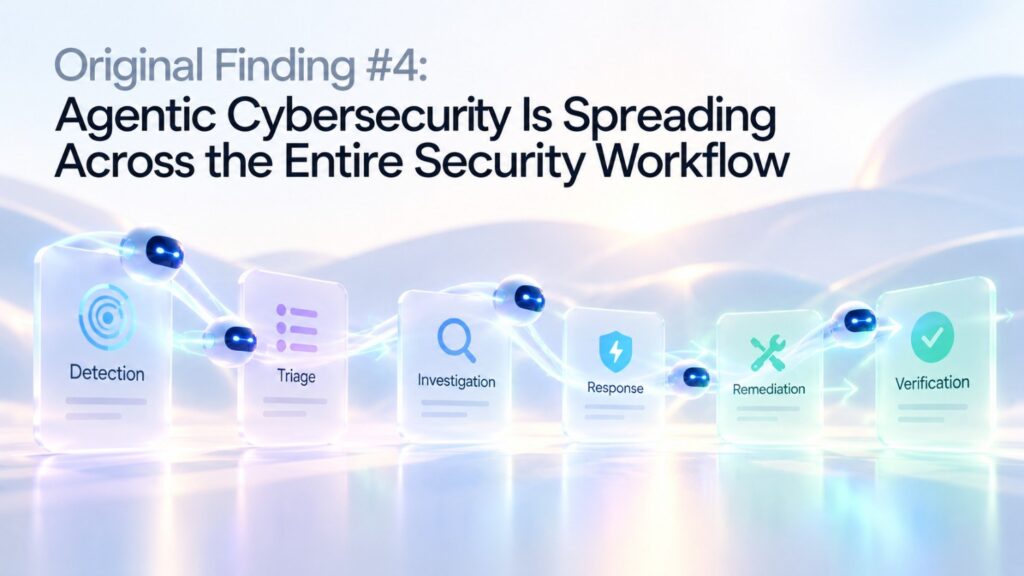
Original Finding #4: Agentic Cybersecurity Is Spreading Across the Entire Security Workflow
Our ten-company sample covers at least eight different types of cybersecurity work.
That is important because it shows that agentic AI is not limited to alert triage or SOC automation.
| Security workflow | Boston example |
| Security investigations | 7AI |
| Browser threat hunting | Push Security |
| Application remediation | Legit Security |
| Autonomous red teaming | Assail, SpartanX |
| AI and agent testing | Mindgard |
| Data access control | Ray Security |
| Agentic software governance | Neo |
| API, MCP, and agent security | AppSentinels |
| Agent action inspection | NXT |
The market therefore looks much broader than one giant “AI SOC analyst” category.
A more realistic view is that cybersecurity will develop many specialized agent systems, each responsible for a different part of the security process.
That creates more room for startups because the work is highly specialized.
The company that automates browser threat hunting may be very different from the company that manages agent permissions, which will be different again from the company that performs autonomous red teaming.
7AI Shows What Happens When Security Software Starts Owning the Investigation
7AI is one of the clearest examples of how the role of cybersecurity software is changing.
The company was founded in 2024 by Lior Div and Yonatan Striem-Amit, both of whom previously helped build Cybereason. Its core idea is that a large amount of security work can be delegated to specialized AI agents rather than being pushed into a human analyst’s queue.
That does not simply mean summarizing an alert.
An investigation agent can gather context, follow evidence across several systems, decide which questions need to be answered, and move the investigation toward a conclusion.
The important change is the location of the human inside the workflow.
In a traditional model, the person starts the investigation and the software supports the process.
In an agentic model, the software may begin the investigation on its own and involve the person when approval, uncertainty, business context, or unusual risk requires human judgment.
That is a very different design.
The Better Question Is Not Whether AI Replaces Analysts
The more useful question is where people should enter the process.
Some alerts may be safe for an agent to investigate completely.
Others may require review before any response happens.
Still others may involve sensitive systems, executive accounts, customer data, or production infrastructure where a person should remain the final authority.
That means the future of security operations will probably be defined by carefully designed handoffs between machines and people rather than by complete human removal.
Push Security Is Turning Threat Hunting Into an Agent Workflow
Push Security shows how the same idea can be applied outside the traditional SOC.
The company focuses on browser and identity security, which has become increasingly important as more attacks move through cloud applications, phishing sites, stolen credentials, and session-based techniques.
Threat hunting has traditionally depended on experienced researchers who study attacker behavior, form theories, search large amounts of data, test what they find, and then convert that knowledge into new detections.
That process can be slow.
Push is using agentic systems to automate more of that loop.
The important point is not simply that AI is helping researchers work faster.
The more important change is that parts of the research-to-detection process can be handled continuously by software.
That means a product can move from observing an attack pattern toward turning that pattern into a deployable defense with less manual work in between.
This is a deeper level of automation than a chatbot that explains suspicious browser activity.
It moves AI closer to the production workflow that actually protects users.
Legit Security Is Automating the Work Between Discovery and Fix
Application security has had the same structural problem for years.
Finding vulnerabilities became easier, but fixing them remained difficult.
Companies installed more scanners and collected more findings. Development teams then had to investigate those findings, understand the relevant code, decide which issues mattered, write the fix, test the change, and move it through the development process.
That created a growing gap between discovery and remediation.
Agentic systems are beginning to target that gap.
Legit Security is using agents to help prioritize vulnerabilities, generate changes, prepare pull requests, and validate fixes.
This matters because the real business outcome is not the discovery of another vulnerability.
The outcome that matters is removing the vulnerability safely.
Remediation Could Become More Valuable Than More Detection
This changes the economics of application security.
A company with ten scanners and a massive vulnerability backlog may not need an eleventh scanner.
It may need a system that can reduce the backlog.
That is why remediation agents could become more valuable than another layer of detection.
The strongest products in this category will not simply identify where the problem is located.
They will understand enough of the surrounding software to prepare a useful fix without introducing new risk.
That is much harder, but it is also much closer to the outcome security teams actually want.
Assail and SpartanX Show Why Red Teaming Is Becoming Machine Work
Offensive security is another area where agents have a natural advantage.
Traditional red teaming is highly skilled work. Security experts probe systems, look for weak points, chain vulnerabilities together, test assumptions, and determine whether a real attack path exists.
The problem is that people cannot test everything continuously.
Modern companies change too quickly.
Applications are updated, APIs are added, cloud environments shift, identities change, and AI-generated code can introduce new problems at a much faster pace.
Autonomous systems can potentially test far more often.
Assail and SpartanX are both exploring this direction.
The Shift Is From Periodic Testing to Continuous Testing
This may be the most important change in offensive security.
Traditional penetration testing is often scheduled as an event.
A company brings in a team, defines a scope, runs the engagement, receives a report, and then waits months before the next major test.
Autonomous red teaming creates the possibility of a different model.
Testing can become continuous.
A machine-driven system can repeatedly probe approved targets, validate whether weaknesses are exploitable, and track whether previously discovered issues have actually been fixed.
Humans still matter because scope, authorization, business context, and complex attack reasoning remain important.
However, the repetitive part of the work can become much more frequent.
That could reshape how offensive security services are priced and delivered.
Neo Represents the Other Side of the Boom: Controlling Autonomous Software
Not every important Boston company in this market is using agents to perform security work.
Some are trying to control the agents that are spreading through the enterprise.
Neo is a clear example.
Its focus is on helping security teams understand what AI-enabled software is doing, which capabilities have appeared, what permissions are involved, and how policies should be applied.
This problem is becoming more urgent because agentic software behaves differently from traditional software.
A normal application usually has a fairly narrow set of expected functions.
An AI agent may be able to read documents, search internal systems, send messages, call APIs, change files, create code, modify infrastructure, or trigger other workflows.
That makes traditional permission models less useful.
Security Teams Need to Understand Capability, Not Just Application Identity
In an agentic enterprise, knowing which application is installed may no longer be enough.
Security teams also need to know what that application can do at a particular moment.
An AI system might gain a new integration.
A plugin might expose additional data.
A new API might allow the agent to trigger a financial process.
A permission change might allow a system to act on behalf of a user in a way nobody originally expected.
This makes capability-level control much more important.
The question becomes less about whether an application is approved and more about whether a specific action is allowed under a specific set of conditions.
That is a much more complex security problem.
Ray Security Shows Why Data Access Becomes More Dangerous When Agents Can Act
Ray Security is approaching agentic security from the data side.
That matters because useful agents need access to information.
The more information they can access, the more useful they can become.
The same access can also create risk.
An agent may retrieve confidential information for the wrong user.
It may have access to far more data than its current task requires.
It may interact with a compromised external tool.
It may process malicious instructions hidden inside content.
It may also retain permissions long after the original business need has disappeared.
Traditional data security products were mainly built around people and applications.
Agentic enterprises introduce another kind of actor: autonomous software that can request, combine, interpret, and move information on behalf of users.
That means data access policies need to become much more context-aware.
The system may need to understand who asked the agent to act, what the agent is trying to do, which data it wants, which tool it is using, and whether the requested action is appropriate.
That is a much harder problem than traditional access control.
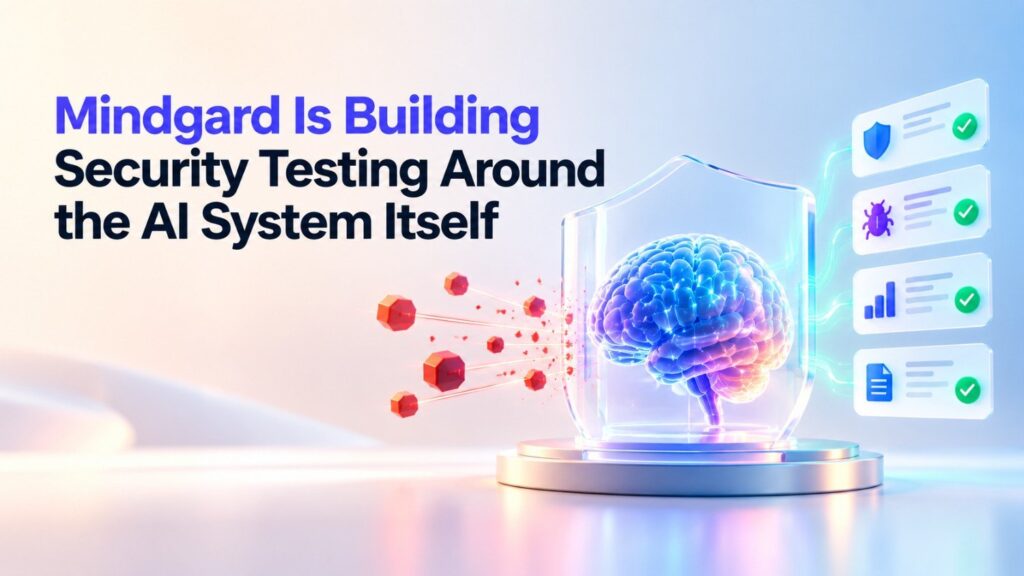
Mindgard Is Building Security Testing Around the AI System Itself
Mindgard operates in another important part of the market.
Its focus is not mainly on securing traditional endpoints or applications.
Instead, it tests AI models, AI applications, and agentic systems for weaknesses.
This category exists because AI systems create attack paths that older security tools were not designed to understand.
Prompt injection is one example, but the problem is much broader.
A modern AI application may combine model reasoning, memory, APIs, sensitive data, external tools, identities, permissions, code, and other agents.
A weakness can appear at any point where those systems connect.
That creates a new testing problem.
Traditional scanners may still be useful, but they are not enough.
Companies need tools that can test the behavior of the AI system itself.
As more businesses deploy agents, this category is likely to grow quickly.
AppSentinels Shows Why APIs and MCP Are Becoming Security Boundaries
APIs are becoming even more important in an agentic environment because agents become useful when they can interact with other systems.
A model that only produces text has limited operational power.
An agent connected to APIs can do real work.
It can update a CRM, query a database, create a ticket, modify a file, call an internal service, send a message, or trigger a business process.
That means API connections become a major security boundary.
The same is true for Model Context Protocol environments and other systems that connect models to external tools.
AppSentinels is working around this part of the stack.
The strategic point for Boston startups is simple.
Teams should not treat API and tool security as something that can be added after the product is finished.
If an agent can act, the connection between the agent and the tool is part of the security model from the beginning.
The Biggest Opportunity May Be Between Detection and Action
When we map the companies in our sample across the full security workflow, one pattern appears again and again.
The most interesting agentic products are often positioned between detecting a problem and taking action.
Traditional security products became extremely good at finding things.
They found suspicious traffic, vulnerable software, exposed credentials, unusual login attempts, risky configurations, and possible malware.
That created more information.
It did not always create faster resolution.
Agentic systems are attacking the middle of the process.
They can gather context, determine what is relevant, prepare a response, and in some cases execute the response.
The New Workflow
Traditional model
Signal
↓
Alert
↓
Human investigation
↓
Human research
↓
Human decision
↓
Human action
Agentic model
Signal
↓
Agent investigation
↓
Context gathering
↓
Risk decision
↓
Approved automated action
↓
Human oversight and exception handling
This does not remove the human.
It changes the work humans are asked to do.
Instead of manually processing every alert, people can spend more time defining rules, reviewing unusual cases, handling high-impact decisions, improving detections, and deciding where automation should stop.
That is a much more valuable use of scarce security talent.
Original Finding #5: Boston’s Agentic Security Market Is About Workflow Depth, Not Chat Interfaces
One of the clearest patterns across the Boston sample is that the strongest products are not centered on conversation.
They are centered on execution.
7AI talks about investigations being completed.
Push focuses on threat hunting and detection deployment.
Legit focuses on remediation and pull requests.
Assail and SpartanX focus on active security testing.
Neo focuses on control.
Ray focuses on access and remediation.
The market is moving away from the idea of simply asking AI questions about security data.
It is moving toward assigning the system a bounded job.
That is a much harder product to build.
It is also much more valuable when the system can perform the work safely and consistently.
A Better KPI Dashboard for Agentic Cybersecurity
Companies should not judge a security agent by how many conversations employees have with it.
That measures usage, not value.
A stronger dashboard focuses on how much trusted work moves from detection to outcome.
| KPI | What it tells you |
| Cases completed without manual investigation | True automation depth |
| Median investigation time | Whether the workflow is actually faster |
| Human escalation rate | How often automation reaches its limit |
| False escalation rate | Whether humans are still receiving unnecessary work |
| Unauthorized-action rate | Whether controls are working |
| Rollback rate | Whether automated changes regularly need reversal |
| Detection-to-remediation time | Whether the full workflow is improving |
| Analyst hours returned | How much human capacity automation creates |
| Findings fixed per week | Better AppSec outcome than findings discovered |
| Validated attack paths | Better red-team outcome than raw vulnerability count |
| Percentage of agent actions logged | Basic governance coverage |
| Percentage of sensitive actions requiring approval | Authority control |
| Cost per completed investigation | Operating efficiency |
Automation Depth Is More Useful Than Feature Count
A product that saves five minutes in a ninety-minute workflow can still be helpful.
However, it is very different from a product that can safely complete most of the workflow on its own.
That is why companies should measure automation depth.
Break the process into stages and identify how many of those stages still require a person.
The goal should not automatically be complete automation.
The goal should be the highest level of automation that remains safe and reliable.
Human-in-the-Loop Is Really an Authority Design Problem
The phrase “human in the loop” is used constantly in AI, but it often lacks precision.
A better approach is to define authority.
What is the agent allowed to observe?
What can it recommend?
What can it change?
What can it delete?
What can it disable?
What can it send outside the company?
Which actions can it perform without approval?
These questions create a much clearer control model.
A Simple Authority Ladder
| Level | Agent authority | Example |
| 1 | Read only | Search logs |
| 2 | Analyze | Investigate an alert |
| 3 | Recommend | Suggest account suspension |
| 4 | Prepare | Draft remediation or code fix |
| 5 | Execute reversible action | Disable a session |
| 6 | Execute high-impact action | Isolate infrastructure |
| 7 | Autonomous cross-system action | Complete several linked remediation steps |
Different agents should have different levels of authority.
A phishing agent may be able to gather evidence automatically but require approval before disabling an executive account.
A code-remediation agent may be able to prepare a pull request but not merge directly into production.
A red-team agent may be able to attack approved targets but should not be allowed to move outside its defined scope.

This is why the right question is not simply whether an agent is autonomous.
The better question is where its autonomy ends.
Security Agents Need Their Own Audit Trail
Every important agent action should be reconstructable.
A company should be able to determine what triggered the agent, what data it inspected, which tools it used, what conclusion it reached, which action it took, and what rule allowed the action to happen.
The organization should also know whether a human approved the action and whether the result can be reversed.
This becomes especially important when agents can make changes to production systems.
Traditional security logs are designed to show what software did.
Agentic environments also need enough operational evidence to explain how the workflow reached that result.
That does not require storing every internal model calculation.
It does require a clear history of actions, permissions, tool calls, approvals, and outcomes.
Without that record, autonomous security becomes extremely difficult to govern.
Boston Companies Should Start With Repetitive Work, Not the Most Impressive Demo
The easiest way to waste money on agentic cybersecurity is to start with the most dramatic use case.
A better approach is to start with work that is repetitive, expensive, measurable, and constrained.
Alert enrichment may be a good starting point.
Phishing investigation can be another.
Vulnerability triage, pull-request preparation, known-threat hunting, and continuous testing can also work well.
The common feature is not that these tasks are simple.
The important point is that the workflow has enough structure to measure whether the agent is doing the job correctly.
Start With a Baseline
Before deploying an agent, companies should measure the existing human workflow.
If a security investigation takes fifty minutes, record that.
If thirty percent of alerts require escalation, record that.
If critical vulnerabilities take ten days to fix, record that.
Without a baseline, teams cannot tell whether the new system actually improved anything.
A Practical 90-Day Plan for Boston Companies Testing Security Agents
Days 1–30: Choose One Workflow
Start with one repeatable security process.
Map every step and identify the systems involved.
Document the data the worker needs and separate low-risk decisions from high-impact decisions.
The goal during the first month is not to automate everything.
The goal is to understand the workflow deeply enough that the organization knows where automation is safe.
Days 31–60: Run the Agent Beside the Human Process
During the second phase, allow the agent to investigate, prepare actions, or make recommendations without becoming the final authority.
Compare the agent’s decisions with those made by experienced staff.
Track where the two disagree.
Those disagreements are extremely valuable because they show where the system lacks context, where instructions are unclear, or where the business process itself is poorly defined.
Days 61–90: Automate Low-Risk Actions
Once the company understands the main error patterns, allow the agent to execute reversible and low-risk actions.
Keep high-impact actions behind human approval.
Measure time saved, cases completed, escalation rates, false positives, rollback rates, and security outcomes.
Only expand authority when the data supports it.
What Boston Cybersecurity Founders Should Build Next
The next opportunities in agentic cybersecurity are becoming easier to see.
Another generic security chatbot will be difficult to defend.
Another basic alert summarizer will also be easy to copy.
The stronger opportunities are likely to involve deeper ownership of security workflows.
Remediation Agents
Cybersecurity already has a lot of detection.
What it lacks is enough remediation capacity.
Products that can safely remove vulnerabilities, permissions, exposed secrets, and configuration mistakes could create significant value.
Identity and Permission Control for Agents
As agents receive credentials, API keys, delegated authority, and access to internal systems, enterprises will need a stronger identity layer for non-human workers.
This could become one of the largest new categories in cybersecurity.
Agent Observability
Companies will need to understand what agents are doing across the organization.
Security teams will need records of tool calls, permission changes, sensitive data access, failed actions, unusual behavior, and policy violations.
Autonomous Security Testing
Software is changing faster than traditional testing schedules can handle.
AI-generated software may accelerate that problem even further.
Continuous autonomous security testing is a logical response.
Boston already has several companies moving in that direction.
Agent Control Planes
Enterprises may eventually need a central layer that understands every important agent, what it can access, what it can do, and when its authority should be limited.
That control layer could become the equivalent of identity management for autonomous software.
Why Boston Has an Advantage in This Market
Boston’s advantage is not simply that the region has strong AI talent.
Many cities have that.
Boston has a useful combination of cybersecurity experience, enterprise software expertise, technical universities, experienced founders, and investors who understand complex business software.
That matters because cybersecurity is difficult to sell and difficult to deploy.
Enterprise customers want reliability.
They want integrations.
They want access controls.
They want private deployment options.
They want audit trails.
They want clear explanations of who is responsible when something goes wrong.
These requirements favor companies that understand enterprise infrastructure rather than companies built only around impressive AI demos.
Boston has a long history of producing that type of company.
That gives the region a credible foundation for the next phase of cybersecurity.
The Risk: Agentic Security Can Create a New Security Problem
There is an obvious tension at the center of agentic cybersecurity.
The more authority an agent receives, the more useful it can become.
The same authority also increases the amount of damage the agent could cause if it is compromised, manipulated, misconfigured, or simply wrong.
That means agentic security systems need to solve two problems at the same time.
They need enough power to perform meaningful work.
They also need strong limits on that power.
This is likely to become one of the defining design problems of the entire market.
The winners will not be the companies that provide the most autonomy.
They will be the companies that provide the most useful autonomy while maintaining control, visibility, and clear boundaries.
The Security Stack Could Be Rebuilt Around Software That Works
The first generation of cybersecurity tools was mainly about visibility.
The next generation improved detection.
Later systems added orchestration and automation.
Agentic software introduces another step.
It allows security systems to understand a goal, gather evidence, make bounded decisions, use several tools, and carry part of the work toward completion.
That could reshape the security stack.
A SIEM becomes more valuable when software can reason across its information rather than simply store events.
A vulnerability scanner becomes more useful when the surrounding system can help prioritize and remediate what it finds.
A browser security product becomes stronger when threat research can be converted into protection more quickly.
A penetration-testing platform becomes more valuable when controlled testing can run continuously rather than occasionally.
The unit of value is changing.
Security software is moving away from being measured only by the amount of information it produces.
It is increasingly being measured by how much useful work it completes.
The Bigger Story: Boston Is Building Digital Security Workers
Calling these products AI tools does not fully capture what is changing.
A tool waits for a person to use it.
A worker takes responsibility for part of a process.
That distinction explains why the Boston market is becoming so important.
7AI is trying to own more of the investigation process.
Push is automating parts of threat hunting.
Legit is moving deeper into remediation.
Assail and SpartanX are automating offensive testing.
Neo is building controls for agentic software.
Ray is focusing on how autonomous systems interact with sensitive data.
Mindgard is testing the AI layer itself.
These companies operate in different parts of cybersecurity, but they are responding to the same structural shift.
Software is becoming capable of doing more than presenting information.
It can now act on that information.

That changes the role software plays inside the security team.
Final Takeaway: Boston’s Cybersecurity Boom Is Moving From Better Tools to Automated Work
The most important thing happening in Boston cybersecurity is not simply the use of generative AI.
The deeper change is that the boundary between software and security labor is becoming less clear.
Our BostonBizScene sample identified ten companies using agentic AI across security operations, browser defense, application security, offensive testing, data protection, AI security, API security, and agent control.
Six companies in the sample with clean, publicly reported funding figures account for roughly $444.8 million in disclosed capital.
About 60% of that funding sits in 7AI and Neo.
At the same time, 60% of the broader ten-company sample was founded in 2024 or later.
Those numbers point to a young market that is already attracting serious capital.
More importantly, the data shows that Boston is not betting on one narrow category.
The region is producing agents that investigate, hunt, fix, test, and attack.
It is also producing systems that monitor agents, control agents, secure agent access, and test whether agentic systems themselves can be trusted.
The strongest companies in this market will probably not be the ones that make cybersecurity more conversational.
They will be the ones that can take a clearly defined security workflow, complete a meaningful part of it at machine speed, explain what happened, remain inside strict authority limits, and involve people exactly where human judgment is most valuable.
That is the larger opportunity.
Boston’s next generation of cybersecurity startups is no longer building only software for security teams.
Increasingly, they are building software that can become part of the security team itself.
What This Means for Boston Businesses Over the Next Two Years
For Boston companies, the next phase of cybersecurity will not be about deciding whether AI belongs inside the security team. That decision is already being made by the market. The more important question is how quickly companies can adopt agentic security without creating new risks in the process.
The first change will likely happen in repetitive security work. Tasks such as alert review, vulnerability triage, browser threat analysis, access reviews, phishing investigations, and basic remediation are strong candidates because they involve large amounts of repeatable work. These are also areas where companies can measure improvement clearly by looking at response time, case volume, escalation rates, and the amount of manual work removed.
The second change will involve security architecture. As more departments begin using AI agents, security teams will need visibility into what those agents can access and what actions they can perform. This will create demand for a new layer of controls around permissions, identity, data access, tool usage, and agent behavior.
That change will affect companies outside the cybersecurity industry as well.
Financial firms, healthcare companies, biotech businesses, universities, software companies, and professional services firms across Greater Boston are already operating in environments where sensitive data and strict compliance rules matter. As these organizations introduce AI agents into more workflows, they will need security controls that were not necessary when software was mainly passive.
An ordinary software application may wait for a person to click a button.
An agent may take the next step on its own.
That difference changes the risk model.
Security Leaders Will Need to Treat Agents Like Digital Employees
One useful way to think about AI agents is to treat them like digital employees with specific jobs, permissions, and managers.
A human employee is not normally given access to every system in the company. Their permissions are based on what they need to do.
Agents should be treated the same way.
A security investigation agent may need access to logs, endpoint data, identity systems, and threat intelligence. It probably does not need access to payroll information.
A coding agent may need access to source code and testing systems. It should not automatically receive production database access.
A customer-service agent may need access to account history while being blocked from sensitive internal systems.
This type of role-based design will become increasingly important as companies deploy more autonomous systems.
Boston Could Become a Testing Ground for Enterprise-Grade Agent Security
Boston is particularly well positioned for this transition because the region has a large concentration of industries where security mistakes are expensive.
Healthcare organizations must protect patient information.
Financial firms deal with sensitive transactions and regulated data.
Biotech companies protect valuable research and intellectual property.
Software companies need to protect code, infrastructure, and customer information.
These environments create strong pressure to build agentic systems that are not only powerful, but also controlled, explainable, and auditable.
That could become one of Boston’s biggest advantages.
The city does not necessarily need to produce the largest number of consumer AI applications to become important in the agent economy. It can become a center for the infrastructure that makes autonomous software safe enough for serious business use.
If that happens, Boston’s cybersecurity boom will be bigger than a wave of security startups.
It could become part of a broader shift in how enterprises design, manage, and trust digital workers.