
AI agents are getting most of the attention right now. The demos are easy to understand. An agent writes code, answers a customer, researches a market, updates a system, or completes a task that once required a person to move between several pieces of software.
But the agent that a user sees is only the top of the system.
Underneath it sits a growing collection of infrastructure. The agent needs a model. It needs affordable inference. It needs memory. It needs a way to plan work, call tools, keep track of state, recover from errors, ask for human approval, log its actions, test its performance, and prove that it did not step outside the rules.
That hidden layer may become one of the most important parts of the agentic AI market.
Boston is becoming particularly interesting here.
The region is not simply producing companies that put a chat window on top of a large language model. A newer group of startups is working much deeper in the stack. Some are building inference systems. Some are designing runtimes for long-running agents. Others are tackling multi-agent supervision, organizational memory, agent testing, security, and governance.
That matters because the enterprise AI market is moving from a simple question — “Can the model answer correctly?” — toward a much harder question:
“Can the entire system complete real work reliably?”
Our analysis suggests Boston may be developing a strong position around that second problem.
The Short Version: Boston Is Building the Control Plane for AI Agents
BostonBizScene reviewed a focused sample of eight active Boston-area companies whose products can reasonably be classified as infrastructure for agentic AI rather than simply end-user AI applications.
The sample includes Liquid AI, Subconscious, OpenProse, Rindler and its Maxxwell product, Novus, Haven AI, Agentic Highway, and Test Agent Lab.
We also examined three acquired Boston-area infrastructure companies — Neural Magic, Quotient AI, and Bytebot — as a separate comparison group. They were excluded from calculations describing the active startup market.
The most important result is surprisingly clear.
Six of the eight active companies, or 75%, primarily operate above the foundation-model and basic inference layers. Their products focus on things such as orchestration, supervision, memory, workflow control, security, governance, or testing.
Only two companies in the core sample primarily operate at the model or inference layer.
That suggests something important about Boston’s emerging position in agentic AI.
Boston does not appear to be trying to win only by producing a larger model.
It is increasingly building the machinery that lets companies turn models into dependable workers.
Original BostonBizScene Agent Infrastructure Dataset
| Company | Greater Boston base | Primary layer in our model | Current role |
| Liquid AI | Cambridge | Foundation models and deployment | Efficient models and deployment infrastructure |
| Subconscious | Cambridge | Agent inference | Long-horizon inference for agents |
| OpenProse | Boston | Runtime and orchestration | Infrastructure for reliable long-running agent workflows |
| Rindler / Maxxwell | Boston | Agent supervision | Coordinating and supervising coding-agent sessions |
| Novus | Boston | Enterprise orchestration | Multi-agent orchestration and workflow control |
| Haven AI | Boston | Memory and context | Persistent organizational memory for agents |
| Agentic Highway | Boston | Security and governance | Inventory, security evidence, controls, and agent governance |
| Test Agent Lab | Boston | Evaluation and testing | Simulation and compliance testing for voice agents |
Liquid AI was spun out of MIT CSAIL and describes itself as an efficiency-first foundation-model company. Its products are designed to make AI capable while reducing compute requirements and allowing deployment across cloud, on-premises, and edge environments.
Subconscious, meanwhile, is based in Cambridge and describes itself as an inference platform specifically designed for long-horizon agents. Its system is aimed at workloads involving hundreds of steps and very large amounts of context rather than short chatbot exchanges.
OpenProse is a Boston YC company founded in 2026 that describes its product as open-source infrastructure for long-running AI work, including a declarative language and runtime for agent workflows.
Rindler is also listed by Y Combinator as a Boston infrastructure company. Its current Maxxwell product is designed to help developers operate multiple coding-agent sessions from one place, although the company’s own documentation is careful to distinguish what the early-access product can do today from features still on the roadmap.
Haven is building what it describes as a continuously learning memory and context layer for companies, allowing both people and agents to work with deeper knowledge about customers, products, and business decisions.
Agentic Highway, founded in 2026, is taking another part of the problem: identifying agentic assets, checking their security posture, controlling what they can do, and generating evidence that can map to frameworks such as NIST AI RMF and ISO 42001.
Test Agent Lab is attacking the evaluation side. Its product simulates large numbers of customer conversations against voice agents and scores performance, task completion, accuracy, and compliance, with a particular focus on regulated financial businesses.
Together, these companies give us a useful picture of what the Boston agent stack is becoming.
How We Conducted the Original Research
Before going deeper into the findings, it is important to explain exactly how we built the dataset.
This is not meant to be a complete census of every AI company in Massachusetts. The phrase “AI infrastructure” has become so broad that counting every company that uses it would produce a meaningless number.
Instead, we applied a narrow test.
A company entered the main dataset only when its public product description showed that it was building a reusable technology layer required to run, supervise, improve, secure, or support AI agents.
We included six categories:
| Infrastructure category | What we counted |
| Model and deployment | Technology for running the intelligence underneath agents |
| Inference | Systems that make agent reasoning faster, cheaper, or able to continue for longer |
| Runtime and orchestration | Technology that controls how agents plan, execute, coordinate, and recover |
| Memory and context | Persistent systems for giving agents useful organizational knowledge |
| Evaluation and observability | Systems for measuring whether agents work correctly |
| Security and governance | Systems for controlling authority, permissions, risk, and evidence |
We excluded ordinary AI consultancies, generic software-development firms, and companies whose main product was simply an agent for one business function.
Vertical AI agents are important, but this article is asking a different question: Who is building the machinery those agents increasingly depend on?
The research cutoff was September 25, 2026.
Public company websites were given priority. Y Combinator profiles, company announcements, government sources, and other public records were used to cross-check location, founding information, funding, and acquisition status.
Where founding dates were unclear, we left them unclear instead of estimating them.
That last point matters because original research becomes useless when tidy percentages are created from uncertain data.
Original Finding #1: 75% of Our Active Sample Is Above the Model Layer
The easiest mistake to make when thinking about artificial intelligence is assuming the model is the product.
Sometimes it is.
But an autonomous enterprise system needs much more.
In our eight-company core sample, Liquid AI is the clearest foundation-model company, while Subconscious works directly on the inference layer that makes long-running agent reasoning possible.
The other six primarily sit farther up the system.
Chart: Where the Active Boston Sample Sits
| Broad layer | Companies | Share |
| Foundation model or inference | 2 | 25% |
| Agent control, orchestration, memory, security, or evaluation | 6 | 75% |
Control-layer companies: ███████████████ 75%
Model/inference companies: █████ 25%
This is the first major conclusion from the analysis.
Boston’s most interesting opportunity may not be trying to reproduce the same foundation-model competition happening elsewhere.
It could be building the infrastructure enterprises need after they choose a model.
Why That Market Could Become Very Large
Imagine a bank builds an AI agent that reviews account information and handles customer requests.
The model is only one component.
The bank still needs to answer questions such as:
Which systems can the agent access?
What customer data can it see?
Can it make a recommendation?
Can it update a record?
Can it send money?
Which decisions need human approval?
What happens when the model gets confused?
What happens when a tool fails halfway through the task?
How does the company reconstruct exactly what happened three months later?
How does the compliance team test a new version before deployment?
Those questions create entire software categories.
That is why the agent infrastructure opportunity may ultimately become much broader than the model market alone.
Original Finding #2: The Boston Stack Is Forming Around Control, Not Just Intelligence
A chatbot is relatively easy to control because its normal action is simple: produce text.
An agent is different.
An agent can potentially send an email, create code, update Salesforce, modify a database, schedule a shipment, refund a customer, approve a document, launch another agent, or interact with external software.
That means autonomy turns an AI quality problem into an operational control problem.
Our sample reflects that transition.
OpenProse focuses on reliable long-running execution. Rindler’s current Maxxwell product focuses on supervising multiple coding agents. Novus provides orchestration and workflow control. Haven provides memory and context. Agentic Highway provides security and governance. Test Agent Lab tests agent behavior before deployment.
These are different products, but they all sit around the same underlying question:
How do we keep autonomous software useful without losing control of it?
A Simple Model of the Emerging Agent Stack
| Layer | Main question |
| Model | Can the system reason? |
| Inference | Can it reason economically for a long time? |
| Memory | Can it remember the information that matters? |
| Runtime | Can it keep a task running correctly? |
| Tools | Can it interact with real systems? |
| Orchestration | Can several steps or agents work together? |
| Evaluation | Can we measure whether the system succeeded? |
| Security | Can we limit what it is allowed to do? |
| Governance | Can the organization prove who authorized what happened? |
An enterprise agent does not become dependable because one layer is excellent.
It becomes dependable when the layers work together.
That distinction is likely to define the next part of the market.
The Agent Stack Is Starting to Look More Like Cloud Infrastructure Than a Chatbot
The early generative-AI market made the model feel like the center of everything.
That was understandable. Model quality improved extremely quickly, and the difference between generations could be dramatic.
Agentic software changes the economics.
Once several strong models are capable of performing a task, the competitive question moves elsewhere.
A company starts asking which system has better uptime, lower cost, better context management, more dependable tool calling, clearer logs, stronger security, safer approvals, and easier recovery.
Those are infrastructure questions.
The cloud market followed a similar broad pattern.
Companies stopped thinking only about servers. They built databases, observability products, identity systems, queues, deployment tools, security systems, integration platforms, and control planes around the underlying compute.
AI agents are starting to create their own version of that expansion.
Liquid AI Is Building Near the Bottom of the Boston Agent Stack
Liquid AI is one of the most heavily funded companies in this group and one of the companies closest to the underlying model itself.
The company was started in 2023 by a team connected to MIT CSAIL. It is developing Liquid Foundation Models designed around efficiency, deployment flexibility, customization, and lower computing requirements.
That matters for agentic AI because agents can consume enormous amounts of compute.
A normal chatbot may answer once.
An agent may think, call a tool, inspect the result, reconsider its plan, call another tool, read several documents, write a file, check the file, encounter an error, recover, and continue.
Multiply that process across hundreds or thousands of tasks and inference economics become extremely important.
Agent Cost Is Not Just Token Price
Companies sometimes evaluate AI models by looking at the price per million tokens.
That number alone can be misleading for agents.
The better metric is closer to:
Cost per successfully completed task.
A cheap model that repeatedly fails, retries, or requires human intervention may ultimately cost more.
A more expensive model that completes the work cleanly may be cheaper.
The infrastructure around the model can also change the result substantially.
That is where companies such as Liquid and Subconscious become particularly interesting.
Subconscious Is Attacking the Long-Horizon Inference Problem
Subconscious describes itself as an inference layer designed specifically for agents and says its technology is aimed at workloads involving very long contexts and hundreds of steps. The company is based in Cambridge and emerged from MIT research.
This addresses one of the least glamorous but most important problems in autonomous AI.
Agents get expensive as tasks get longer.
They also get confused.
The context can fill with old information. Repeated prompts create more token usage. Earlier decisions may stop being useful. A task that appeared straightforward at step five may become messy by step 150.
Traditional inference systems were largely built around requests and responses.
Agent inference increasingly needs to think in terms of sessions, state, context management, repeated decisions, and sustained throughput.
Subconscious says its system can compress less useful context and support long-running workloads more efficiently. Its public product materials position the platform specifically around agents rather than ordinary chatbot inference.
Original Finding #3: Capital Intensity Changes Dramatically by Stack Layer
Liquid AI announced a $250 million Series A in December 2024.
Subconscious announced $5.1 million in funding in August 2026.
Those numbers should not be treated as a direct company comparison. The companies are at different stages, the rounds happened at different times, and Liquid is pursuing a broader foundation-model strategy.
But the difference is still useful.
The $250 million Liquid round was roughly 49 times the size of the $5.1 million Subconscious financing.
Chart: Two Very Different Infrastructure Capital Profiles
| Company | Publicly announced round used here | Primary layer |
| Liquid AI | $250M | Foundation model and deployment |
| Subconscious | $5.1M | Agent inference |
Liquid AI: █████████████████████████████████████████████████ $250M
Subconscious: █ $5.1M
This is not a claim that one layer is inherently better.
It shows that the AI infrastructure market can support very different company-building models.
Building frontier or near-frontier model technology can require enormous capital.
Building a specialized runtime, memory layer, evaluation tool, or security product may allow a smaller team to attack a narrower infrastructure bottleneck.
That should matter to Boston founders.
You do not need hundreds of millions of dollars to build an important layer of the agent stack.
OpenProse Is Treating Long-Running Agent Work Like a Programming Problem
OpenProse is one of the clearest examples of the shift away from prompt engineering toward agent engineering.
Y Combinator describes the Boston company as building an open-source operating system for reliable long-running agents. Its approach includes a declarative language and runtime for agent workflows.
That framing is important.
Most people interact with generative AI by writing a prompt.
But complex autonomous work cannot always be managed effectively through one enormous instruction.
Imagine an AI workflow that researches 100 companies, verifies claims, revisits weak evidence, compares results, writes a report, runs quality checks, and asks for approval before publication.
That process needs structure.
It may need branching paths.
It may need retry logic.
It may need durable state.
It may need rules defining which tasks can run in parallel.
It may need to survive interruptions.
In other words, agentic systems increasingly need something that looks like a runtime.
Why “Prompt Engineering” May Become Too Small a Concept
The prompt remains important.
But enterprises are gradually moving toward a larger abstraction.
Instead of asking:
“What prompt should we write?”
They increasingly need to ask:
“What process should this agent execute?”
That is a much more powerful question.
The best agent systems may eventually resemble small software organizations. They will contain models, tools, permissions, workflows, memory, supervisors, evaluators, and humans.
The infrastructure that coordinates them becomes strategically important.
Rindler Shows Why Multi-Agent Supervision May Become Its Own Category
Rindler’s current product, Maxxwell, focuses on developers operating several coding agents.
The problem is easy to understand.
Running one coding agent is manageable.
Running ten at the same time creates a new problem: the human becomes the scheduler.
Which agent is still working?
Which one is waiting for approval?
Which one took the wrong approach?
Which one needs more context?
Which completed something that should be reviewed?
Maxxwell is intended to bring those sessions into one workspace. The current public product emphasizes visibility across Claude Code and Codex sessions, while Rindler’s documentation carefully says that some more advanced automatic supervision capabilities remain product direction rather than functions users should assume are already fully implemented.
That qualification is useful.
Agent startups often describe a future state that is more capable than their present product.
Enterprise buyers need to separate those two things.
The Human Bottleneck Changes When Agents Multiply
One agent may save a person time.
Twenty agents can create a management problem.
That means a new category of software can appear between the human and the agents.
Its job is not necessarily to perform the work.
Its job is to manage the workers.
That layer could monitor status, group approvals, spot stalled tasks, detect duplicate work, allocate resources, summarize progress, and escalate only the decisions that truly require a person.
If enterprises begin operating hundreds or thousands of agents, supervision could become an enormous market.
Novus Represents the Enterprise Orchestration Layer
Novus describes its platform as infrastructure for building, orchestrating, and scaling multi-agent systems, with multi-model support, enterprise security, integrations, and workflow control. Its public company profile lists Boston as its headquarters, while the company says it also operates in Istanbul.
This represents another important part of the agent stack.
Enterprises rarely want an agent that exists by itself.
They want it to work with systems already inside the company.
That might mean Salesforce, internal APIs, knowledge bases, document repositories, finance tools, ticketing systems, cloud infrastructure, or databases.
The orchestration layer becomes the bridge between reasoning and operations.
Why Multi-Model Infrastructure Matters
Companies are also becoming less willing to assume that one model will handle every job.
One model may be best for deep reasoning.
Another may be cheaper for classification.
A smaller local model may be preferable when sensitive data cannot leave an environment.
A fast model may handle routine work while a more expensive model is called only when confidence falls below a threshold.
That turns model routing into an economic decision.
The agent infrastructure layer can decide which model gets which job.
This can become one of the most practical ways companies control AI spending.
Haven AI Shows Why Agent Memory Is Becoming Infrastructure
Haven may represent one of the most interesting emerging layers because memory sounds simple until a company tries to build it properly.
Its public product describes a continuously learning multi-store memory architecture intended to give teams and AI workflows persistent knowledge about products, customers, and business decisions.
That solves a major problem.
A company does not simply need an agent that knows what is written in a document.
It needs an agent that understands what changed.
What did a customer request?
Which request is still current?
What decision did the product team make?
Why was that decision made?
Which customers are affected?
What source supports the information?
Is the information still true?
Those are memory questions.
Memory Without Provenance Can Become Dangerous
An agent remembering information is not enough.
It should ideally remember where that information came from.
Suppose an agent believes a customer contract permits something.
Was that fact extracted from the signed contract?
An old sales note?
A Slack conversation?
An employee’s guess?
A document that has since been replaced?
The answer changes how much authority the information deserves.
Haven’s recent engineering materials emphasize areas such as provenance, contradiction handling, retrieval, persistent memory, tool use, agent state, checkpoints, human approvals, and observability.
That combination is a useful preview of where enterprise agent memory may go.
Memory will not simply mean “store more text.”
It will mean storing structured facts with time, source, confidence, relationships, and history.
Agentic Highway Is Building Security for Software That Can Act
Security changes when AI becomes autonomous.
Traditional software usually executes logic that engineers explicitly wrote.
An agent can choose actions dynamically.
That creates a different attack surface.
A malicious instruction may convince an agent to reveal information.
An over-permissioned tool may allow it to modify something it should only read.
An outdated integration may carry credentials with more authority than the agent needs.
A compromised component may enter an agent workflow through a dependency or MCP server.
Agentic Highway is building around this problem.
Its Vettd product describes itself as a trust layer for the agentic supply chain. It inventories assets such as agents, models, tools, prompts, credentials, workflows, and MCP servers, then connects that inventory to security evidence and control.
The company says it was established in Boston in 2026 and is taking an open, vendor-neutral approach to this problem.
Agent Security Eventually Becomes an Authority Problem
The central security question is not simply:
“Can someone hack the model?”
It is:
“What can this software do if something goes wrong?”
An agent that can read a public webpage has limited authority.
An agent that can issue refunds has more.
An agent that can change production infrastructure has much more.
An agent that can initiate a financial transaction may require a completely different control structure.
This is why permissions must become part of agent architecture.
The safest enterprise agent will not necessarily be the smartest agent.
It may be the agent whose authority has been designed most carefully.
Test Agent Lab Shows Why Evaluation Needs to Move Before Deployment
Most software teams test deterministic code by asking whether the expected input creates the expected output.
Agents are harder.
The same request may produce slightly different paths.
One agent may ask a follow-up question.
Another may call a tool immediately.
A third may misunderstand the request entirely.
That makes evaluation a major infrastructure problem.
Test Agent Lab focuses on simulated testing for voice AI and IVR systems. Its public description says simulated customer personas can run large numbers of conversations against an agent and score the results against criteria such as task completion, accuracy, tone, and regulatory compliance.
This is particularly important in regulated sectors.
You do not want the first serious test of a financial voice agent to happen with a real customer.
The Future of Agent Testing May Look Like Continuous Stress Testing
The better model is likely continuous testing.
Before deployment, run thousands of scenarios.
After a model change, run them again.
After a prompt change, run them again.
After adding a tool, run them again.
After changing the knowledge source, run them again.
Then compare the results.
That produces something much closer to software release engineering than ordinary prompt testing.
Original Finding #4: Most of the New Boston Infrastructure Companies Are Extremely Young
We also examined founding dates.
A formal founding year was clearly available for seven of the eight active companies.
Five of those seven were founded in either 2025 or 2026.
That is 71% of the companies with a clearly verified founding year.
| Company | Public founding year |
| Novus | 2020 |
| Liquid AI | 2023 |
| Subconscious | 2025 |
| Rindler | 2025 |
| OpenProse | 2026 |
| Haven AI | 2026 |
| Agentic Highway | 2026 |
| Test Agent Lab | Not included in founding-year calculation |
Test Agent Lab publicly introduced its product in 2026, but we did not count a formal founding year because the available sources did not establish one clearly enough.
This matters because it shows how new this category remains.
Much of the Boston agent infrastructure market did not exist two years ago.
Some important layers may not have clear category leaders yet.
Boston Already Has Three Useful Infrastructure Acquisition Signals
A second dataset provides another clue.
Boston has already produced several infrastructure companies that later became acquisition targets.
Neural Magic
Neural Magic was founded in Somerville and developed technology for improving AI inference efficiency. Red Hat announced the acquisition in November 2024 and completed it in January 2025.
Quotient AI
Boston-based Quotient AI developed monitoring, evaluation, and reinforcement-learning technology for AI systems. Databricks announced in 2026 that it was acquiring the company to strengthen agent evaluation and continuous improvement across products including Genie Code and Agent Bricks.
Bytebot
Y Combinator lists Boston-founded Bytebot as acquired. The company developed an open-source container that gave computer-use agents access to mouse, keyboard, screen, files, and applications.
These three companies worked in different areas.
Neural Magic focused on inference.
Bytebot focused on the environment in which agents could act.
Quotient focused on evaluating what AI systems did.
Yet all three sat below the normal end-user application layer.
A sample of three companies is far too small to prove a broad acquisition trend.
It is still a meaningful signal.
Strategic technology companies are showing interest in owning infrastructure that makes AI systems cheaper, more capable, or more reliable.
Boston’s Agent Stack Is Growing From the Region’s Existing Strengths
This infrastructure cluster did not appear from nowhere.
MIT CSAIL says more than 500 startups have spun out of the laboratory across areas including AI, machine learning, security, robotics, data, and software.
Massachusetts is also making direct investments in AI infrastructure.
The state launched the Massachusetts AI Hub in 2024, with the goal of connecting academia, startups, businesses, and government around applied AI.
In 2025, the state announced a $31 million grant aimed at expanding access to high-performance computing.
In May 2026, Massachusetts, IBM, and Red Hat opened applications for an AI startup accelerator connected to the Massachusetts AI Hub.
Boston’s economic-development materials also cite JLL research saying the city has ranked second in U.S. VC funding for AI companies since 2020 and remains a top-five global AI hub.
None of this guarantees Boston will dominate agent infrastructure.
But the ingredients are unusually relevant.
The region combines AI research, enterprise software experience, cybersecurity knowledge, robotics, healthcare, financial services, biotech, and industries where reliability matters.
That creates a good environment for infrastructure companies solving difficult operational problems.
The Missing Layers May Be the Bigger Opportunity
The current Boston ecosystem is still incomplete.
That is not necessarily a weakness.
For founders, missing layers can be opportunity maps.
Agent Identity Could Become a Major Category
Human employees have identities.
They have job titles, permissions, managers, access levels, and employment records.
Agents may need something similar.
An enterprise eventually needs to know:
Which agent made this request?
Who owns that agent?
Which model was running?
What version was deployed?
What permissions did it have?
Which credentials did it use?
Who approved those credentials?
When do they expire?
That sounds like identity and access management rebuilt for autonomous software.
Boston’s security ecosystem could make this particularly interesting.
Agent Payments Will Need Control
Once agents buy goods, reserve inventory, pay vendors, or move money, the payment layer becomes more complicated.
An agent should not simply receive an unrestricted company card.
It may need limits based on amount, category, vendor, time, purpose, or risk.
A procurement agent might be allowed to buy approved supplies below $500 without asking anyone.
A $30,000 purchase might require management approval.
An unusual vendor might trigger security review.
That produces a programmable financial-control layer for machines.
Agent Data Provenance Could Become Essential
Retrieval systems answer:
“What information should the model see?”
Enterprise systems increasingly need to answer:
“Why should the model trust this information?”
Those are different questions.
A future agent data layer may track source, timestamps, ownership, version history, conflicts, and confidence automatically.
That could become particularly important in healthcare, finance, legal work, and scientific environments.
The Agent Stack Boston Companies Should Actually Build
For Boston businesses, the lesson is not to buy one product from every category.
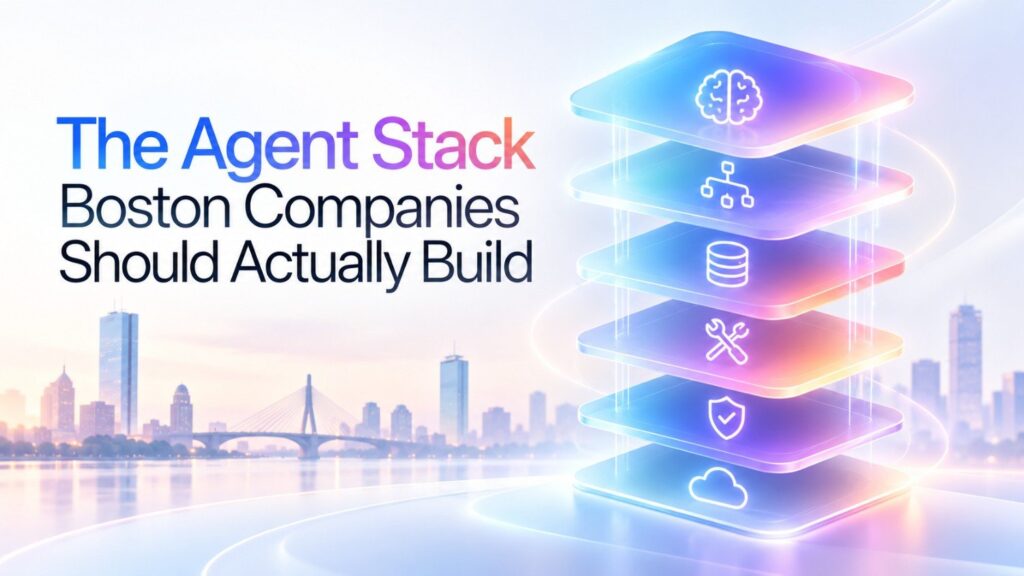
The lesson is to think in layers before deploying autonomy.
Layer 1: Choose the Intelligence
Start with the model.
But avoid designing the entire architecture around one provider unless there is a strong reason to do so.
Model capabilities and pricing are changing too quickly.
Where possible, create an abstraction that allows workloads to move between providers.
Layer 2: Design the Runtime
Define what happens after the first model response.
How does the agent choose the next action?
Where is state stored?
How are retries handled?
When does a task stop?
Can the process resume after an interruption?
How are parallel jobs coordinated?
If the company cannot answer those questions, it does not yet have an agent architecture.
It has a demo.
Layer 3: Build Memory Deliberately
Do not send the entire company knowledge base into every prompt.
Decide which information the agent actually requires.
Separate short-term task context from long-term organizational memory.
Attach dates and sources to important facts.
Delete or downgrade stale information.
Memory quality can matter more than memory size.
Layer 4: Give Tools Narrow Permissions
Every tool should have the minimum authority required.
Separate read access from write access.
Separate drafting from sending.
Separate recommendation from approval.
Separate calculating a payment from initiating a payment.
A simple rule is useful:
Increase autonomy only after narrowing authority.
Layer 5: Instrument Everything
Log the agent’s actions.
Record tool calls.
Record failures.
Track retries.
Track model usage.
Record human interventions.
Track which prompts, models, tools, policies, and memory versions were active for each run.
Without traces, debugging becomes guesswork.
Layer 6: Build Evaluation Before Scaling
Create test cases based on real work.
Include normal situations.
Include edge cases.
Include malicious inputs.
Include missing information.
Include conflicting instructions.
Include tool failures.
Include cases where the correct action is to stop and ask a human.
The purpose of evaluation is not to prove that the agent is perfect.
It is to discover where it fails before those failures become expensive.
Layer 7: Put Governance Around Authority
Define who owns the agent.
Define who can change it.
Define who approves new tools.
Define who reviews incidents.
Define when a human must intervene.
Define how quickly the agent can be disabled.
Governance should be designed into the system rather than written into a policy after launch.
The Agent KPI Dashboard Boston Companies Should Build
Agent programs often begin with the wrong metrics.
Companies track prompts sent, users active, or number of AI interactions.
Those metrics tell you that the technology is being used.
They do not tell you whether useful work is being completed.
A better dashboard measures outcomes and control.
| Metric | What it tells management |
| Task completion rate | How often the agent actually finishes the assigned job |
| First-pass success rate | How often it succeeds without retries |
| Human intervention rate | How frequently a person must rescue the workflow |
| Tool-call success rate | Whether connected systems are functioning reliably |
| Average retries per task | Whether the agent is wasting compute or getting stuck |
| Cost per completed task | Whether automation is economically useful |
| Time per completed task | Whether the agent is improving cycle time |
| Escalation accuracy | Whether the agent knows when to ask for help |
| Evaluation pass rate | Whether releases meet quality thresholds |
| Policy violation rate | Whether the agent stays inside its authority |
| Rollback rate | How frequently deployments must be reversed |
| Unexplained-action rate | Whether teams can reconstruct why important actions happened |
The most important metric may eventually be cost per correctly completed unit of work.
That number combines intelligence, infrastructure, reliability, and economics.
It is much harder to game than token usage.
A 90-Day Agent Infrastructure Plan for Boston Companies
Companies do not need to build the entire stack immediately.
They should start with one workflow where success can be measured clearly.
Days 1–30: Map the Work Before Choosing the Agent
Document the human process.
Identify every system involved.
Identify every point where judgment is required.
Identify irreversible actions.
Identify sensitive information.
Identify the point at which a human currently catches mistakes.
Then calculate the current baseline.
How long does the process take?
What does it cost?
How often does it fail?
How many people touch it?
Without a baseline, there is no honest way to calculate AI ROI.
Days 31–60: Run the Agent With Limited Authority
Give the system enough access to perform meaningful work, but avoid giving it maximum autonomy immediately.
Let it read.
Let it prepare.
Let it recommend.
Require approval for high-impact actions.
Record every important decision.
Build an evaluation dataset from actual cases.
During this phase, human intervention is useful data rather than a failure.
Every intervention shows where the system does not yet deserve autonomy.
Days 61–90: Increase Authority Where Evidence Supports It
Review the logs.
Which tasks consistently succeed?
Which tools fail?
Which decisions repeatedly require human correction?
Where does the agent waste tokens?
Which context improves performance?
Which context adds noise?
Then increase autonomy only in areas where the data supports it.
The goal is not to remove humans as quickly as possible.
The goal is to move humans toward the decisions where they add the most value.
How Founders Should Think About Opportunities in the Boston Agent Stack
The easiest agent companies to understand are vertical applications.
Build an agent for accountants.
Build an agent for lawyers.
Build an agent for sales.
Build an agent for healthcare.
Those can become large businesses.
But infrastructure founders should look for problems that every successful vertical agent eventually encounters.
Ask What Breaks at 10,000 Agent Runs
Many agent demos work at ten runs.
The infrastructure opportunity appears at 10,000.
What becomes expensive?
What becomes difficult to debug?
What becomes dangerous?
What becomes impossible for one person to monitor?
What creates compliance work?
What generates support tickets?
What fails when the workflow lasts four hours instead of four minutes?
Those questions reveal infrastructure markets.
Build Around Pain That Increases With Autonomy
Some problems get smaller as models improve.
Others get larger.
Security gets more important as agents receive more authority.
Evaluation gets more important as agents handle higher-value work.
Observability gets more important as workflows become longer.
Memory gets more important as agents need persistent business context.
Supervision gets more important as companies operate many agents simultaneously.
Infrastructure founders should prefer problems that grow with the success of agentic AI rather than problems that disappear when the next model arrives.
What Investors Should Watch
Investors evaluating agent infrastructure should be careful with impressive demos.
A beautiful demo does not always reveal a defensible infrastructure company.
The harder questions are about recurring dependency.
Does the product sit in the critical path of agent execution?
Does the customer depend on the historical data stored in the platform?
Does the product become more valuable as agent volume rises?
Does switching become difficult because the product controls workflows, policies, memory, or evaluation datasets?
Does the platform remain valuable if the underlying model provider changes?
Can the company charge based on completed tasks, agents, traces, compute, security coverage, or another growing unit?
These questions reveal whether the startup is building an enduring layer or a temporary wrapper.
Why the Acquired Companies Matter More Than They First Appear
Neural Magic, Bytebot, and Quotient provide an early lesson.
The visible AI application is not always where strategic value accumulates.
Red Hat wanted inference and model optimization capabilities.
Databricks wanted stronger evaluation and reinforcement-learning infrastructure for production agents.
Bytebot built a computer environment that allowed agents to operate normal software.
These are infrastructure functions.
As agents become embedded in major software platforms, large technology companies may decide that certain layers are too important to remain external dependencies.
That does not mean every Boston agent-infrastructure company will be acquired.
It means infrastructure can become strategically important even when ordinary consumers never recognize the company’s name.
Boston Does Not Need to Recreate San Francisco’s AI Ecosystem
Boston’s strongest strategy may be specialization.
Trying to copy another technology hub rarely produces a durable advantage.
Boston already has a different collection of assets.
It has MIT and other major research institutions.
It has deep enterprise software experience.
It has strong healthcare and life-sciences industries.
It has robotics.
It has cybersecurity.
It has financial institutions.
It has industries where AI must interact with complex physical, operational, or regulatory systems.
Those conditions naturally create difficult infrastructure problems.
The most interesting Boston companies may therefore be the ones solving those problems rather than trying to build another general chatbot.
Original Finding #5: The Most Valuable Layer May Be the One Between Intelligence and Authority
Looking across the dataset, one theme connects almost every company.
Liquid makes intelligence more efficient to deploy.
Subconscious tries to make sustained agent reasoning economically practical.
OpenProse structures long-running execution.
Rindler helps humans supervise multiple agents.
Novus coordinates models and workflows.
Haven gives agents persistent context.
Agentic Highway controls and documents authority.
Test Agent Lab attempts to prove that agents behave correctly before real customers are exposed to them.
Taken together, these companies reveal a broader transition.
The main technical problem is no longer just generating intelligence.
It is connecting intelligence to authority.
That connection is where real economic value appears.
It is also where operational risk appears.
Intelligence Without Authority Is a Copilot
It can suggest.
It can summarize.
It can draft.
It can explain.
Intelligence With Authority Becomes an Agent
It can act.
It can modify.
It can buy.
It can send.
It can deploy.
It can approve.
It can move a workflow forward without waiting for another human prompt.
That gap between knowing and doing is where much of the new infrastructure stack is being created.
The Bigger Story: Enterprise AI Is Becoming an Infrastructure Market
The first generation of generative AI made almost every company focus on the model.
Which model has the highest benchmark?
Which model has the largest context window?
Which model writes the best code?
Those questions still matter.
But businesses deploying agents will gradually care about another set of questions.
Which system finishes the workflow?
Which system survives failure?
Which system remembers the right information?
Which system keeps costs under control?
Which system can be audited?
Which agent has permission to take this action?
Which system catches a mistake before a customer does?
Which system can tell a human exactly what happened?
Those questions are much closer to traditional enterprise infrastructure.
They are also where Boston looks increasingly interesting.
The region already has startups working from the bottom of the stack — efficient models and inference — through long-running runtimes, orchestration, supervision, memory, testing, security, and governance.
The ecosystem is still early.
The companies are young.
Several categories have no obvious winner.
There will be pivots. Some products will disappear. Others will get absorbed into larger platforms. New layers will emerge as enterprises discover problems that nobody anticipated.
That uncertainty is exactly why this moment matters.
The agent market is not simply producing smarter software.
It is creating a new computing architecture.
And if our Boston dataset is an early indication, a meaningful part of Boston’s opportunity may lie in building the infrastructure that lets autonomous software operate safely, economically, and reliably.
The biggest Boston agent company of the next decade may not be the company with the most human-like chatbot.
It may be the company almost nobody outside enterprise technology knows by name — because its software quietly sits underneath millions of AI agents and makes sure the work actually gets done.