

For the first few years of the generative AI boom, the easiest product to build was a copilot.
A salesperson could ask AI to write an email. A doctor could ask it to summarize a note. A software engineer could ask it to suggest code. A customer service worker could ask it to draft a response. The AI helped, but the human still sat in the driver’s seat.
Boston’s newest generation of AI companies is starting to build something different.
Instead of asking, “How can AI help a person do this task faster?” more founders are asking, “How much of this job can the software actually finish?”
That small change in the question leads to a very different kind of company.
An AI copilot generally waits for a person, produces an answer, and gives control back. An AI agent can receive a goal, decide what steps are needed, use software tools, update systems, check whether the job worked, and keep moving until it reaches a stopping point or needs human help.
That distinction matters more in Boston than it may first appear.
Boston is unusually strong in industries where work is expensive, technical, fragmented, and often buried inside old systems. Clinical research, healthcare administration, cybersecurity, robotics, biotechnology, enterprise software, industrial operations, and financial services all contain workflows in which highly paid people still spend enormous amounts of time moving information between systems.
Those are attractive targets for AI agents.
Our analysis of Y Combinator’s current Boston AI directory found a clear change in the language and product design of newer companies. Among Boston AI companies in the directory from 2023 through 2026, 50% show a direct agent or autonomy signal under our methodology. Among companies from earlier cohorts, the figure is 20%.
Our separate analysis of ten publicly announced Boston and Cambridge funding events connected directly to autonomous AI, agentic software, or infrastructure built specifically for agents identified $811.1 million in disclosed capital. The three largest events alone account for roughly 77.7% of that sample.
This does not mean copilots are disappearing.
It means the center of gravity is moving.
The next Boston AI company may still have a chat box. But the chat box is increasingly becoming the command line for software that does the work.
The Short Version: Boston AI Is Moving From Helping With Work to Owning More of the Work
The simplest way to understand the shift is to look at what happens after the AI produces its first answer.
A copilot normally stops.
An agent continues.
If a customer asks where an order is, a copilot can find the policy and draft an answer. An agent can look up the order, check the carrier, determine whether the package is late, decide which policy applies, issue a refund if allowed, update the support ticket, send the customer a message, and record what happened.
That is not a better chatbot. It is a different operating model.
Our Boston research suggests four important things are happening at once.
| BostonBizScene original finding | Result |
| Recent YC Boston AI companies, 2023-2026, with a direct agent/autonomy signal | 50% |
| Earlier YC Boston AI companies with the same signal | 20% |
| Increase in our average autonomy score for newer companies | 60.3% |
| Explicitly agentic/autonomous companies that are domain-specific rather than horizontal | 75% |
| Explicit autonomy companies involving physical-world execution | 37.5% |
| Verified Boston/Cambridge agentic funding-event sample | $811.1M |
| Share of that capital represented by the three largest events | 77.7% |
These numbers do not prove that every Boston AI startup will become an autonomous agent company. They show that autonomy has moved from an unusual feature to a serious design choice among a meaningful part of the city’s newest AI startup generation.
That change also fits the wider Boston technology environment. CBRE’s 2026 analysis puts Boston seventh among North American tech-talent markets and says 17% of the region’s tech talent has AI-specialty skills, one of the highest concentrations measured. Massachusetts has also been building an AI Hub, including a $31 million state grant to expand access to high-performance computing and programs targeting AI development in sectors such as healthcare, life sciences, advanced manufacturing, financial services, and robotics.
That last point is important.
Boston is not simply producing more AI software. It is increasingly producing AI for industries where software has to understand complicated work before it can safely perform it.
AI Agents vs. AI Copilots: What Is Actually Different?
The words “agent,” “assistant,” and “copilot” are now used so loosely that they can become almost meaningless.
A company can add an agent label to a chatbot without fundamentally changing what the product does. That is why the useful distinction is not branding. The useful distinction is authority.
A Copilot Produces Something for You
A copilot helps a person make or execute a decision.
You provide a prompt. The AI reads information, reasons about it, and returns an answer, recommendation, draft, summary, prediction, or piece of code.
The person then decides what happens next.
This can create enormous value. There is nothing outdated about the model.
If an oncologist receives a summary of a 200-page medical record instead of reading every page manually, that can save meaningful time. If a lawyer receives a useful first draft of a contract, the value is real even though the AI never sends the contract itself.
An Agent Is Given a Job
An agent moves one step further.
Instead of merely producing information, it is given some level of authority to pursue an outcome.
NIST describes modern AI agents as systems in which AI models are combined with software that allows them to use tools and take actions beyond simply generating text. NIST has now launched an AI Agent Standards Initiative focused specifically on secure and interoperable systems capable of autonomous action.
The practical difference looks like this:
| Question | AI copilot | AI agent |
| Who normally starts the task? | Human | Human, event, schedule, or another system |
| Main output | Information or draft | Completed work or changed system state |
| Can it call other software? | Sometimes | Usually essential |
| Can it perform several steps? | Limited | Core capability |
| Can it adapt the plan? | Sometimes | Often |
| Does a human approve every action? | Usually | Not necessarily |
| Primary KPI | Time saved, quality, adoption | Completion, resolution, cost per outcome |
| Main risk | Bad advice | Bad action |
| Human’s role | Operator | Supervisor, exception handler, decision owner |
That last difference changes almost everything.
A wrong paragraph is annoying.
A wrong refund, deleted database record, medical authorization, financial transaction, security action, or robot movement can become expensive very quickly.
Agentic AI therefore increases both the potential value and the need for good controls.
The Autonomy Ladder Is More Useful Than the Agent Label
Companies should not treat AI as a choice between “copilot” and “fully autonomous agent.”
There are several levels in between.
For this article, BostonBizScene created a five-level autonomy model that we used to evaluate startup descriptions.
| Score | Operating model | What the AI can do |
| 0 | AI substrate | Provides models, data, infrastructure, APIs, or enabling technology |
| 1 | Assistive AI | Searches, analyzes, recommends, predicts, or drafts |
| 2 | Workflow automation | Performs defined steps but operates inside a relatively fixed workflow |
| 3 | Bounded agent | Pursues a goal, selects actions, uses tools, and adapts within defined limits |
| 4 | Autonomous execution | Owns a substantial end-to-end workflow or performs consequential physical/digital actions |
This is not an industry standard. It is our editorial research framework.
More importantly, the score does not measure whether a company is “good.” A score of 1 may be the correct design for a medical decision, while a score of 4 may be ideal for a low-risk repetitive process.
The purpose is to measure how much authority is being transferred from the human to the software.
Original Research Methodology: How We Measured Boston’s Shift Toward Autonomy
To avoid selecting only exciting agent startups and then declaring that Boston has become an agent hub, we needed a defined starting population.
We used Y Combinator’s September 2026 directory of AI companies headquartered in Boston. YC currently lists 22 companies in that category. The directory includes companies from several generations, giving us a simple way to compare newer startups with companies created before the current agent wave.
How Each Company Was Coded
We reviewed the public description YC currently displays for each company.
The autonomy score was based only on what the public description says the product does. We did not increase scores because a founder used fashionable language elsewhere, and we did not assume that ordinary automation was an AI agent.
We also recorded a separate “explicit autonomy signal.”
A company received that signal when its public description clearly referenced agents, autonomous execution, or a system taking responsibility for achieving a goal through multiple actions.
That gives us two measurements.
The autonomy score captures degree. The explicit signal captures whether autonomy is central enough to the product that it appears directly in the company’s public positioning.
The Full 22-Company Boston Dataset
| Company | YC cohort | Main area | Autonomy score |
| Dipole Labs | 2026 | Semiconductors/AI | 0 |
| Rindler | 2026 | Developer agent infrastructure | 3 |
| Insurf | 2026 | Health insurance decision systems | 2 |
| Degla | 2026 | Autonomous drone missions | 4 |
| Riverbank | 2025 | Enterprise infrastructure mapping | 0 |
| Boost Robotics | 2025 | Autonomous data-center robotics | 4 |
| Bramante | 2025 | Biotech and automated labs | 1 |
| Blueshoe | 2025 | AI-enabled legal services | 1 |
| Delineate | 2025 | Clinical-trial agents | 3 |
| HYBRD | 2024 | Adaptive AI fitness agent | 3 |
| Sensei | 2024 | Robotics training data | 0 |
| Yuma AI | 2023 | Autonomous customer support | 4 |
| FlyCode | 2022 | Payment optimization | 2 |
| NuMind | 2022 | NLP development tools | 1 |
| Bytebot | 2021 | Computer-use agent infrastructure | 3 |
| Kernal Biologics | 2020 | Biotech | 0 |
| Nextera Robotics | 2020 | Industrial robotics | 3 |
| Perceptive Technologies | 2020 | Robotic dentistry | 2 |
| ZETA SURGICAL | 2019 | Surgical navigation | 1 |
| Centaur | 2019 | Human-AI data systems | 1 |
| Alpha Vantage | 2018 | Financial data APIs | 0 |
| Helix Nanotechnologies | 2017 | Biotechnology | 0 |
The underlying company descriptions come from YC’s Boston AI directory. For example, YC says Rindler’s product coordinates several coding agents, Delineate is building AI agents for clinical-trial design, Yuma provides autonomous customer-service agents, Boost Robotics builds autonomous mobile robots, and Degla is designed so a user states a mission while the system determines how to execute it.
There are limitations.
YC companies are not the whole Boston market. The directory excludes many important local startups. Company descriptions are also marketing materials rather than independent product audits.
That is why we use this dataset as a directional cohort analysis, not as a claim about the percentage of every AI company in Greater Boston.
Original Finding #1: Direct Agent or Autonomy Signals Are 2.5 Times More Common in the Newer Cohort
The first pattern is difficult to miss.
Among the 12 companies in our YC dataset from the 2023 through 2026 cohorts, six meet our direct agent/autonomy test.
That is 50%.
Among the ten companies from 2017 through 2022, two meet it.
That is 20%.
Chart: Share With a Direct Agent or Autonomy Signal
| Cohort | Share | Visual |
| 2023-2026 | 50% | ██████████ |
| 2017-2022 | 20% | ████ |
The newer-group share is therefore 2.5 times the earlier-group share.
The difference also appears when we use the broader five-point autonomy score.
The older cohort averages 1.30.
The newer cohort averages 2.08.
That is an increase of about 60.3%.
This does not mean AI suddenly became autonomous in 2023. Robotics companies had been working on autonomy for years, and Bytebot was already building infrastructure for computer-use agents.
What changed is the range of jobs being targeted.
Autonomy is moving from specialized robotics and experimental systems into customer support, clinical research, software engineering, health insurance, fitness, project management, cybersecurity, and administrative work.
That is a much larger market.
Original Finding #2: Boston’s Agent Bet Is Mostly Vertical, Not a Generic Chatbot Bet
Eight companies in the 22-company dataset meet our explicit autonomy test.
Six of those eight are designed around a clear domain or operational environment.
That gives us a vertical share of 75%.
The pattern matters because it suggests Boston’s advantage may not come from building a general-purpose AI assistant that competes directly with the largest foundation-model companies.
Boston startups can instead build agents that understand a particular job unusually well.
Delineate is a good example.
YC describes the Boston startup as building agents for accelerated clinical-trial design. Its system processes existing research into specialized datasets used by scientists, and the founding team combines biological engineering and AI backgrounds.
Yuma attacks customer support and e-commerce rather than every office workflow.
HYBRD focuses on adaptive athletic coaching.
Boost Robotics targets data-center operations.
Degla turns natural-language instructions into multi-drone mission execution.
Nextera focuses on robotics and industrial automation.
This is classic Boston.
The region has spent decades creating companies around deep domain knowledge. The agent era gives those companies a new way to turn knowledge into software that can act.
Original Finding #3: More Than One-Third of Boston’s Explicit Autonomy Group Touches the Physical World
Three of the eight companies in our explicit-autonomy group involve meaningful physical-world autonomy: Degla, Boost Robotics, and Nextera Robotics.
That is 37.5%.
That share would look unusual in many software ecosystems.
Boston has a much stronger robotics base than most cities. MassRobotics reported in March 2026 that startups that had been residents of its ecosystem had collectively raised $2 billion since the organization launched in 2017.
The newest example is much larger.
Cambridge-based Walden Robotics emerged from stealth in July 2026 with a $300 million seed round. The company is developing general-purpose robots for manufacturing and logistics and says its systems are designed to perform useful work in real production environments.
MIT research is also pushing in the same direction. Recent MIT projects have combined generative AI with physical simulation and robotic systems, including work that allows generated designs to be tested in simulation and research connecting natural-language instructions to robotic fabrication.
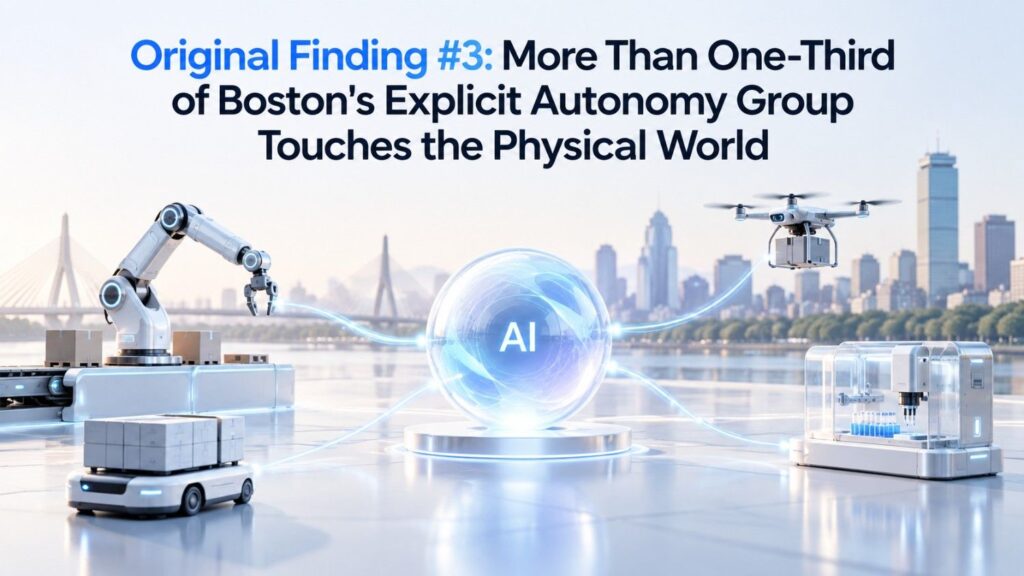
The Boston autonomy story is therefore bigger than office agents.
Some of the most valuable agents here may eventually have arms, wheels, sensors, cameras, and access to factory floors.
Original Finding #4: Our Verified Agentic Funding Sample Reached $811.1 Million
We built a second dataset to look at capital.
This one is intentionally different from the YC analysis.
We identified ten Boston or Cambridge companies with publicly verifiable funding announcements in 2025 or 2026 where the company’s product or funding thesis is explicitly connected to AI agents, autonomous execution, or infrastructure and controls designed specifically for agents.
We used the amount announced in the relevant funding event rather than mixing current valuations with total historical funding.
Boston Agentic AI Funding-Event Sample
| Company | Funding event used | Agentic layer |
| Walden Robotics | $300M | Physical autonomy |
| Blitzy | $200M | Autonomous software development |
| 7AI | $130M | Cybersecurity agents |
| Neo | $100M | Agent control and security |
| Maven AGI | $50M | Customer-experience agents |
| GenHealth.ai | $16.5M | Healthcare back-office agents |
| Subconscious | $5.1M | Long-running agent infrastructure |
| Yuma AI | $5M | E-commerce support agents |
| LogicFlo AI | $2.7M | Life-sciences agents |
| Coworked | $1.8M | Project-management agent |
| Total | $811.1M |
The sample is deliberately conservative but not exhaustive.
It should not be interpreted as total Boston agentic-AI funding. There are agent-related companies we have not included, and there are broader AI companies that may contain agent features without making autonomy central to the public funding announcement.
What this dataset does show is where substantial visible capital is going.
Chart: Capital by Agentic Layer
| Layer | Capital | Share |
| Digital work execution | $406.0M | 50.1% |
| Physical autonomy | $300.0M | 37.0% |
| Agent controls/infrastructure | $105.1M | 13.0% |
That distribution is more interesting than the headline total.
Half of the capital is going into software that performs work.
More than one-third is going into physical autonomy.
Another 13% is going into infrastructure needed to control, secure, or economically run agents.
Boston is therefore developing three parts of an agent economy at the same time.
Original Finding #5: The Capital Is Extremely Concentrated
The $811.1 million headline needs context.
Walden Robotics, Blitzy, and 7AI account for $630 million of the sample.
That is 77.7%.
Add Neo and Maven AGI, and the five largest events represent roughly 96.2% of all the capital in our dataset.
Chart: Funding Concentration
| Group | Capital | Share of sample |
| Top 3 events | $630M | 77.7% |
| Top 5 events | $780M | 96.2% |
| Remaining 5 events | $31.1M | 3.8% |
This tells founders something important.
Investors are not simply throwing equal amounts of money at anything with “agent” on the website.
Large checks appear to be concentrating around businesses that can make a credible case for very large markets, deep technical barriers, enterprise distribution, or infrastructure that becomes more important as agent adoption grows.
For an early startup, that is actually encouraging.
You do not need a $200 million round to build a valuable agent company.
LogicFlo raised $2.7 million to pursue specialized life-sciences work. Coworked raised $1.8 million around project execution. Subconscious has raised $5.1 million to attack the economics of long-running agents.
The question is not how large the round is.
The question is whether the startup owns a valuable workflow.
Boston’s Most Important Shift: From Answer Quality to Work Completion
Copilot products are usually judged by the quality of their output.
Was the summary accurate?
Was the draft useful?
Did the generated code compile?
Agents require another measurement system.
The important question becomes: Did the job get finished correctly?
That sounds obvious, but it changes product design.
A customer-service company should stop measuring only whether an answer sounds good and start measuring whether the ticket was actually resolved.
A security company should not only measure the quality of a threat summary. It should measure whether the investigation reached the right conclusion, whether the correct systems were updated, whether dangerous actions were blocked, and how often a person needed to intervene.
A healthcare administrative agent should be measured on completed authorizations, clean claims, resolved denials, turnaround time, exception rates, and financial results.
This is where Boston companies are beginning to become especially interesting.
Yuma AI Shows the Difference Between Answering a Ticket and Resolving It
Customer service is one of the easiest places to see the agent-versus-copilot distinction.
A support copilot reads the ticket and suggests a response.
That can save time.
But a support agent can potentially do something far more valuable.
It can find the customer’s account, inspect an order, apply company policy, make a change inside another application, issue an approved credit, update the help desk, and tell the customer what happened.
YC currently describes Boston-listed Yuma AI as an autonomous support-agent platform for e-commerce. Yuma says its system can retrieve information from other services and take actions in external applications, and the company reports that some merchants automate a substantial share of support tickets through the platform. Those automation figures are company-reported rather than independently audited, but the product architecture is the important part of the story.
The value proposition has moved from “help the support representative type faster” to “reduce the number of tickets a representative has to touch.”
That is the economic jump founders are chasing.
Layer Health and GenHealth.ai Show Two Different AI Models Inside the Same Boston Industry
Healthcare gives us an even better comparison because both approaches can be useful.
Boston-based Layer Health raised a $21 million Series A in 2025 around AI-powered medical chart review. Its platform focuses on extracting useful information from fragmented medical records and automating a highly manual review process.
That is valuable analytical automation.
Now compare it with Boston-based GenHealth.ai.
GenHealth announced a $16.5 million Series A in September 2026, bringing its stated total funding to $30 million. The company says its agents carry out intake, eligibility verification, prior authorization, billing, and denial workflows inside EHRs, payer portals, fax systems, and phone systems. Human staff remain involved for exceptions and decisions requiring judgment.
The comparison is not about which company has the “better” AI model.
They are attacking different units of work.
One turns difficult information into something easier to use.
The other is designed to move work through operational systems.
That distinction will increasingly determine how AI companies price products, measure ROI, design integrations, and structure customer deployments.
7AI Is Turning Cybersecurity Analysis Into Cybersecurity Work
Security operations centers have a familiar problem.
They receive more alerts than human analysts can investigate.
Traditional software helps collect, rank, and display those alerts. Copilot-style AI can summarize them.
Boston-based 7AI is pushing further toward autonomous investigation.
The company raised a $130 million Series A in December 2025, taking its reported total funding to $166 million. It describes its product as AI agents that perform security work such as signal enrichment, threat investigation, alert triage, and other actions that would otherwise consume analyst time.
By May 2026, the company said its agents had processed more than seven million investigations and were completing investigation work end to end. Those are company-reported operating metrics, but they demonstrate the KPI change clearly.
A security copilot answers, “What happened here?”
An agent is increasingly expected to investigate what happened and move the incident toward resolution.
That creates far more potential value.
It also creates far more responsibility.
Blitzy Shows What Happens When One Agent Becomes Thousands
Software development may be the fastest-moving example of this transition.
The first generation of coding AI completed lines, wrote functions, explained code, and helped engineers debug problems.
That was a copilot model.
Cambridge-based Blitzy is targeting something larger.
The company announced a $200 million funding round at a reported $1.4 billion valuation in May 2026. Blitzy describes its platform as autonomous software development in which large numbers of AI agents can cooperate over long periods to build software.
The difference is profound.
A coding copilot makes the engineer faster inside the existing development process.
A software-development agent begins to change the process itself.
The engineer becomes less of a person typing every implementation detail and more of a person specifying architecture, reviewing plans, defining tests, controlling scope, handling unusual cases, and checking results.
That is why agent infrastructure is becoming a category of its own.
Rindler, OpenProse, and Subconscious Show the Second-Order Opportunity
One of the strongest signals in Boston is that startups are now appearing to solve problems caused by other AI agents.
That tends to happen when a technology moves from demonstration to infrastructure.
Rindler is a good example.
Its current YC description focuses on developers running several coding agents at once. The product gives users a higher-level way to see what different agent sessions are doing and identify the decisions that actually require human attention.
OpenProse is working lower in the stack. YC describes the Boston company as building open-source infrastructure for reliable long-running agent workflows.
Cambridge-based Subconscious goes lower still.
The company announced $5.1 million in funding on September 22, 2026 for inference infrastructure designed specifically for long-running agents. The company argues that agents become unusually expensive because they repeatedly process very large contexts over many steps, so it is building systems to compress and manage that workload more efficiently.
This creates a useful way to think about the next Boston AI stack.
The model generates intelligence.
The agent decides what work needs to happen.
Tools let it act.
Infrastructure keeps it running.
Observability tells humans what happened.
Security decides what it should be allowed to do.

That is becoming a much larger ecosystem than a chatbot.
Why Boston Is a Natural Place to Build Narrow but Powerful Agents
Boston probably does not need to win the race to build the world’s most popular general-purpose AI assistant.
Its more defensible opportunity may be making AI extraordinarily good at complicated jobs.
Boston Has Dense Domain Expertise
Many agent products fail because the AI problem is easier than the workflow problem.
A founder can connect a model to an API in a weekend.
Understanding why a clinical-trial team performs 14 steps in a particular order is harder.
Understanding which security alert can safely be closed is harder.
Understanding how a pharmaceutical regulatory document should be created, reviewed, referenced, approved, and versioned is harder.
This is where Boston’s universities, hospitals, biotech companies, research labs, financial institutions, robotics companies, and enterprise-software history become meaningful.
JLL’s 2025 cluster analysis ranked Boston second among U.S. life-sciences startup ecosystems, behind the Bay Area.
That does not automatically make Boston an AI leader.
It does give founders unusually close access to the people who understand expensive workflows.
Boston Has an Unusually High Concentration of AI Talent
CBRE’s 2026 analysis says approximately 17% of Boston’s tech talent has AI-related specialty skills.
That puts the region among the highest concentrations in North America. CBRE also moved Boston to seventh in its broader North American technology-talent ranking.
For agent startups, the combination matters.
They need people who understand machine learning.
They also need people who understand infrastructure, security, robotics, biology, healthcare, finance, and enterprise systems.
Boston can produce both in the same labor market.
Massachusetts Is Funding Applied AI Infrastructure
The Massachusetts AI Hub is also aimed heavily at applied AI.
The state announced a $31 million grant related to expanding high-performance-computing access in 2025. Other programs have included funding aimed at AI models for advanced manufacturing, climate technology, education, financial services, healthcare, life sciences, and robotics.
That sector list looks remarkably similar to the industries where specialized agents can create value.
Boston’s AI opportunity may therefore be less about another universal chat interface and more about connecting intelligent systems to real organizations.
Why Startups Are Moving From Copilot Economics to Agent Economics
There is also a basic business reason behind the shift.
Copilots often sell productivity.
Agents can sell completed work.
Suppose a company has 100 employees using a writing copilot.
Management may know that employees like the software, but calculating the exact financial return can be difficult.
Now imagine an agent that handles 30,000 support cases.
The company can calculate cost per case before deployment, cost per case afterward, escalation rate, refund errors, customer satisfaction, and total labor required.
The ROI becomes easier to measure.
The Agent ROI Equation
A simple way to model an agent is:
Agent Value = Labor Avoided + Cycle-Time Value + Revenue Improvement – AI Cost – Human Review Cost – Failure Cost – Governance Cost
The last four terms are easy to ignore during a demo.
They determine whether a deployment works in production.
A task that costs $4 in model inference but saves $2 of labor is not attractive.
A task that saves $50 of labor but creates a one-in-1,000 chance of a $100,000 mistake may also be a poor candidate for full autonomy.
The important number is not how impressive the AI looks.
It is the expected economic value after errors, supervision, infrastructure, and control are included.
Stop Measuring Agent Adoption Like SaaS Adoption
Traditional software companies love metrics such as daily active users.
That can become misleading for autonomous software.
The best agent may reduce the number of times an employee has to open the application.
A company should therefore measure resolved work, not merely interaction.
| Copilot-era metric | Agent-era metric |
| Daily active users | Tasks completed |
| Prompts per employee | Workflows resolved without intervention |
| Time inside product | Human minutes required per completed workflow |
| Number of drafts | Number of accepted outcomes |
| Response quality | End-to-end success rate |
| Feature adoption | Autonomy rate |
| Suggestions accepted | Escalation rate |
| Tokens generated | Cost per completed job |
| User satisfaction | Outcome quality plus user satisfaction |
| Error rate | Error rate multiplied by severity |
This sounds like a minor analytics change.
It is really a business-model change.
Software is moving from charging people to use tools toward increasingly being judged like labor.
The Most Valuable Metric May Be Human Minutes per Completed Task
Boston founders should pay close attention to one number:
How many human minutes are required for each completed unit of work?
Imagine an insurance process that previously required 20 minutes.
A copilot cuts it to 12.
That is valuable.
An agent completes 80% of cases without human involvement and sends the other 20% to a specialist who spends five minutes on each.
The average human time has fallen to one minute per case.
That is a different economic curve.
The goal is not necessarily zero human involvement.
The goal is using expensive human judgment only where it creates value.
The Winning Boston Model May Be Bounded Autonomy, Not Maximum Autonomy
This is especially important in healthcare, financial services, biotechnology, security, and robotics.
A startup does not win because its AI is allowed to do everything.
It wins when the AI has exactly enough authority to create economic value without creating unacceptable risk.
That means designing boundaries.
A Practical Authority Ladder
| Authority level | AI permission | Example |
| 0 | Read only | Summarize account history |
| 1 | Recommend | Suggest next action |
| 2 | Prepare | Draft the action but require approval |
| 3 | Execute reversible actions | Update a low-risk field |
| 4 | Execute within policy and budget | Issue approved credit below a limit |
| 5 | High-consequence action | Require named human authorization |
This should be designed before the prompt.
Founders often spend enormous energy improving the model while giving far less attention to what the model should be allowed to do.
For an agent business, permissions are part of the product.
Boston’s Regulated Industries Make Human Escalation a Feature
The phrase “human in the loop” is often treated as a safety slogan.
That is not enough.
A useful system must know when the human enters the loop, what information the person receives, what authority the person has, and how quickly the workflow continues afterward.
GenHealth offers a practical example. The company says its agents handle healthcare administrative workflows while its U.S.-based billing staff and customer employees deal with exceptions and decisions that require judgment.
That is more useful than attaching an approval button to every action.
If humans approve everything, the company has rebuilt a copilot with additional steps.

If humans approve nothing, the blast radius can become unacceptable.
Good agent design concentrates human attention at meaningful decision boundaries.
Autonomy Creates a New Security Problem
The security difference between a copilot and an agent is easy to explain.
A compromised copilot might give you a bad answer.
A compromised agent might use your permissions.
That makes identity, authorization, tool access, memory, logging, and action limits critical parts of the architecture.
NIST’s 2026 AI Agent Standards Initiative explicitly focuses on the challenge of agents interacting securely with external systems and internal data. NIST’s analysis of industry responses on agent security also found broad agreement that autonomous agents introduce new threats and that conventional cybersecurity controls need to be adapted for them.
OWASP has now published a Top 10 specifically for agentic applications, covering risks that arise when AI systems plan, act, and make decisions across workflows.
The infrastructure market is responding.
Boston-based Neo emerged from stealth in July 2026 with $100 million in funding to build controls around agentic software. Its product focuses on visibility, permissions, attribution, and policy enforcement for AI-enabled software and agents.
Security is therefore not a side issue in the agent market.
It may become one of the largest markets created by the agent market.
Reliability Matters More When AI Can Act
Agent failures are also different from chatbot failures.
Suppose a chatbot produces an incorrect sentence.
The user may notice it and ignore the answer.
Now suppose an agent makes ten decisions in sequence.
The first decision is slightly wrong. The second decision uses the result of the first. The third action changes a database. The fourth sends information to another system.
Small errors can compound.
MIT researchers provided an interesting warning in 2026. Research from the MIT Media Lab found that AI agents could be unusually sensitive to seemingly small changes in how choices were presented, with model behavior sometimes shifting more than human behavior under similar “nudges.”
That matters because production environments are full of strange inputs.
Agent reliability cannot mean, “It worked in our demo.”
It has to mean the system behaves acceptably across thousands or millions of messy cases.
The Boston Agent Stack Will Need Its Own Observability Layer
When a normal application fails, engineers inspect logs.
When an agent fails, the investigation can be more difficult.
What did the agent believe the task was?
Which data did it retrieve?
Which tool did it select?
Why did it select that action?
Which permissions were available?
What changed after the action?
Did another agent influence the result?
Those questions are creating another infrastructure market.
Coralogix, which is headquartered in Boston, raised $200 million in June 2026 in part around the growing need to monitor and troubleshoot AI agents. The round valued the company at a reported $1.6 billion post-money.
As autonomous systems become common, agent observability could become as normal as application monitoring.
How Boston Companies Should Decide Whether a Workflow Needs a Copilot or an Agent
Not every business process should become autonomous.
The easiest mistake is starting with the technology.
Start with the workflow.
Use a Copilot When Judgment Is the Main Product
A copilot usually makes more sense when the work is highly ambiguous, infrequent, difficult to evaluate automatically, or dependent on nuanced human judgment.
Think about negotiating an unusual partnership, interpreting an unprecedented legal problem, deciding how to communicate a sensitive employee issue, or making a complex clinical judgment.
AI can still help.
It probably should not own the decision.
Use an Agent When Completion Can Be Clearly Defined
Agents become more attractive when the workflow is frequent, repeatable, observable, connected to software systems, and governed by rules that can be expressed or tested.
| Workflow characteristic | Copilot fit | Agent fit |
| High ambiguity | Strong | Weak |
| High volume | Moderate | Strong |
| Clear success condition | Moderate | Strong |
| Easy rollback | Moderate | Strong |
| Reliable APIs/tools available | Helpful | Critical |
| Severe consequence of error | Stronger | Requires tight controls |
| Repetitive multi-step process | Moderate | Strong |
| Human judgment creates most value | Strong | Weak |
| Exceptions are rare and identifiable | Moderate | Strong |
The best first agent workflow often has a boring description.
That is a good sign.
Boring, repetitive, expensive work is where automation economics tend to be strongest.
A 90-Day Agent Deployment Plan for Boston Businesses
Companies do not need to transform an entire department to learn whether agentic AI creates value.
A tightly controlled 90-day deployment can answer the important questions.
Days 1-15: Map One Workflow
Choose a process that happens frequently and already has a measurable outcome.
Do not begin with “We want an AI agent.”
Begin with something like, “Every week our team receives 600 requests, employees check three systems, make one of eight common decisions, update Salesforce, and send a response.”
Document the current time, cost, error rate, wait time, and number of exceptions.
Without that baseline, you will not know whether the agent worked.
Days 16-30: Create the Authority Map
List every action required to finish the workflow.
Then decide which actions the AI can read, recommend, prepare, execute, or never perform.
A refund below $25 may be automatically reversible.
A $25,000 wire transfer is not.
Those should not share the same permission model.
Days 31-45: Run in Shadow Mode
Let the agent process real cases without changing production systems.
Compare what it would have done with what employees actually did.
Measure agreement, errors, missed information, unnecessary escalations, and cases where the agent appeared confident but was wrong.
The purpose is not to produce a beautiful accuracy percentage.
The purpose is to learn where the workflow becomes dangerous.
Days 46-60: Allow Low-Risk Execution
Give the agent permission to perform reversible actions inside narrow limits.
Keep high-risk actions behind approval gates.
Record every tool call and system change.
Now begin measuring cost per completed task and human minutes per completed task.
Days 61-90: Expand Only Where the Data Supports It
Increase autonomy on workflows with strong evidence.
Do not increase autonomy simply because the model can technically perform the action.
If an approval step adds little safety but consumes large amounts of employee time, consider removing it.
If a rare exception can cause serious harm, keep the gate.
The goal after 90 days should not be “maximum autonomy.”
It should be the most economically useful level of autonomy that the evidence supports.
The Biggest Agent Moat May Be the Workflow, Not the Model
Foundation models are improving quickly.
That creates a difficult strategic question for AI startups.
What happens when the underlying model becomes good enough to reproduce today’s product feature?
A company whose entire product is a clever prompt may have a weak position.
An agent startup can build deeper advantages.
It can learn the customer’s workflow.
It can integrate with difficult systems.
It can build permissions.
It can create evaluation datasets.
It can understand exceptions.
It can collect feedback about completed outcomes.
It can develop domain-specific policies.
It can create audit trails.
It can earn enough trust to receive real operating authority.
Those assets are much harder to replace than a chat interface.
This may explain why Boston’s industry knowledge is so strategically valuable.
The difficult part of an insurance agent is not generating English.
The difficult part is understanding insurance operations well enough to act correctly.
Integration Could Become the New Data Moat
The previous software era produced the phrase “data moat.”
The agent era may create an integration moat.
An autonomous system becomes more useful as it gains safe access to the systems where work actually happens.
That may include Salesforce, ServiceNow, Jira, SAP, Epic, payer portals, laboratory software, internal databases, email, scheduling systems, communications platforms, or proprietary industrial equipment.
Coworked’s product illustrates the idea.
The Boston company’s agentic project manager is designed to work across email, chat, voice, Jira, Microsoft tools, Smartsheet, ServiceNow, Salesforce, and other systems rather than forcing employees to perform everything inside a new dashboard.
This is likely to become a recurring pattern.
The winning interface may not be the place where employees spend the most time.
The winning software may be the system that quietly moves work between everything else.
The Next Competitive Battle Will Be Over Decision Rights
Enterprise software used to fight over who owned the data.
Agentic software may increasingly fight over who gets to make the decision.
If Salesforce stores the customer record but another agent decides which customer should receive an offer, which system has the strategic relationship?
If an EHR stores patient information but an administrative agent determines what steps happen next, where does the workflow value live?
If a project-management application holds the tasks but an agent decides which person needs to do what tomorrow, which system is actually managing the project?
That is why agentic AI has the potential to disrupt SaaS without necessarily replacing every system of record.
The agent can sit above those systems and coordinate them.
Copilots Are Not Going Away
The strongest version of the agent thesis does not require declaring the copilot dead.
In many workflows, the copilot is exactly right.
Massachusetts itself offers an interesting example. In February 2026, the state announced a phased deployment of a ChatGPT-powered AI Assistant for executive-branch workers. The goal is to help employees work more effectively inside a controlled environment rather than hand broad autonomous authority to the system.
That approach makes sense for many organizations.
An assistant can create value before the company has developed the permissions, integrations, monitoring, evaluation, and governance required for autonomous action.
Copilots may therefore become the first stage of agent adoption.
Companies learn where AI is useful.
Then they identify repeated requests.
Then they automate safe steps.
Eventually, some workflows become genuinely agentic.
The Better Question Is Not “Agent or Copilot?”
The better question is:
Where should the human decision sit?
Sometimes it belongs at the beginning.
A person tells the AI exactly what to produce.
Sometimes it belongs in the middle.
The agent works until it reaches a consequential decision and asks for approval.
Sometimes the person belongs at the end.
The agent completes the process and the employee audits a sample.
Sometimes the human should only handle exceptions.
That is the real design space.
Boston startups that understand this will have an advantage over companies simply trying to maximize autonomy.
What Boston Founders Should Build Next
The most obvious agent opportunities are becoming crowded.
Generic sales agents, general research agents, meeting agents, and horizontal assistants now have large numbers of competitors.
Boston founders should probably look deeper.
Look for workflows where outsiders struggle to understand why the work is hard.
Look for processes that require information from six systems.
Look for industries with expensive specialists performing repetitive administrative work.
Look for workflows where one day of delay is worth real money.
Look for technical work where an expert currently spends half the day gathering evidence rather than making decisions.
Look for physical operations where skilled workers are forced to perform repetitive, dangerous, or difficult tasks.
That is where Boston’s local knowledge becomes a startup advantage.
Five Questions Every Agent Founder Should Be Able to Answer
An agent startup should be able to explain its product without hiding behind the word “agent.”
What Work Does the System Actually Finish?
“Helps finance teams” is not enough.
Which workflow reaches completion?
The narrower and more measurable the answer is, the easier it becomes to demonstrate economic value.
What Can the Agent Change?
Can it only read data?
Can it send email?
Can it update the CRM?
Can it issue refunds?
Can it submit paperwork?
Can it move a robot?
This tells customers more about the product than the model name does.
When Does a Human Take Over?
The escalation policy should be part of the architecture.
A serious agent company should know which conditions stop autonomous execution.
How Do You Know the Agent Was Correct?
A chatbot can be evaluated partly through response quality.
A production agent needs outcome-based evaluation.
The company needs ground truth, policy tests, simulations, historical cases, failure analysis, and continuous monitoring.
What Happens When It Is Wrong?
This may be the most important question.
Can the action be reversed?
Is there an audit record?
Who receives the alert?
How large can the loss become before the system stops?
A company that cannot explain its failure architecture probably is not ready for meaningful autonomy.
The Bigger Story: Boston Is Building AI That Moves From Interface to Operating Layer
The first generative AI wave changed how people interacted with software.
Instead of clicking through menus, they could ask questions.
The agent wave changes something deeper.
Software can begin to operate other software.
That moves AI from the interface toward the operating layer of a business.
Boston appears unusually well positioned for that transition because much of the region’s economy already revolves around complicated systems.
Healthcare systems.
Clinical systems.
Laboratory systems.
Industrial systems.
Security systems.
Financial systems.
Enterprise software.
Robotics.
These are not easy places to deploy AI.
That difficulty may become the advantage.
The more complicated the workflow, the more valuable domain knowledge becomes.
Final Takeaway: The Real Boston Bet Is Not on Agents. It Is on Completed Work.
Calling something an AI agent will not create a durable company.
Finishing valuable work might.
Our analysis shows a measurable shift inside one defined Boston AI startup cohort. Direct agent and autonomy signals appear in 50% of the 2023-2026 YC Boston AI companies we studied, compared with 20% of earlier companies. The newer cohort also scores roughly 60% higher on our broader autonomy index.
The companies exhibiting those signals are not concentrated in one generic productivity category.
They are working on clinical trials, customer support, robotics, drone missions, fitness, software development, industrial operations, and the infrastructure required to keep agents running.
Capital is following parts of the same trend. Our separate verified funding-event sample identified $811.1 million connected to Boston and Cambridge companies building autonomous digital work, physical autonomy, or agent infrastructure and controls.
None of that means every workflow should become autonomous.
The more useful conclusion is that the unit of value in enterprise AI is changing.
For copilots, companies ask:
How much faster can this make my employee?
For agents, they increasingly ask:
How much work can this system finish correctly?
Boston has an unusually strong set of industries in which answering that second question could create enormous businesses.

The startups that matter most will not be the ones with the most human-sounding chat window.
They will be the ones that understand a difficult job, earn enough trust to receive authority, know when to call a human, and reliably carry the work across the finish line.