
For most of the past decade, the biggest story in artificial intelligence and biology was prediction. Scientists trained increasingly powerful models to look at biological information and answer questions that were once slow, expensive, or extremely difficult to answer in the laboratory.
AlphaFold became the clearest symbol of that shift. The system showed that AI could predict the three-dimensional structure of proteins from their amino acid sequences at a level that transformed an old scientific problem. In 2024, Demis Hassabis and John Jumper shared half of the Nobel Prize in Chemistry for protein structure prediction, while David Baker received the other half for computational protein design. Nobel Prize
But Boston’s biotech industry is now moving into a more important phase.
The question is no longer simply:
Can AI understand biology?
The commercial question is:
Can AI repeatedly produce medicines, delivery systems, antibodies, proteins, and drug candidates that survive laboratory testing, clinical trials, manufacturing, regulatory review, and eventually the market?
That is a far harder test.
Across Cambridge, Somerville, Watertown, and Boston, a growing group of companies is trying to answer it. Generate Biomedicines is pushing AI-designed proteins deep into clinical development. Dyno Therapeutics is licensing AI-engineered gene-delivery capsids. Manifold Bio is coupling generative protein design with large-scale testing inside living systems. Nabla Bio is selling AI-based protein-design capabilities to large pharmaceutical companies. Relay Therapeutics is using computation and structural biology to design small molecules around protein motion. Montai Therapeutics has moved an AI-enabled discovery platform into a Phase 1 clinical program. Other businesses, including 1910 Genetics and Converge Bio, are commercializing the infrastructure around AI-driven drug creation. Generate:Biomedicines
Taken together, these companies reveal something important about Boston’s AI-biotech market in 2026.
The industry is beginning to move from models to molecules, from predictions to experiments, and from demonstrations to commercial contracts.
That transition is much bigger than AlphaFold itself.
The Short Version: AlphaFold Solved One Problem. Boston Companies Are Building Businesses Around the Problems That Come Next
AlphaFold changed biological research because it made protein structure prediction dramatically easier. The AlphaFold Protein Structure Database now contains predictions for more than 200 million protein structures, and Google DeepMind says millions of researchers across more than 190 countries have used AlphaFold tools. Google DeepMind
That matters enormously.
But knowing approximately what a protein looks like does not automatically give a company a medicine.
A drug developer still has to determine what biological target matters, what molecule should interact with it, whether that molecule works inside cells, whether it reaches the right tissue, whether it causes unwanted effects, whether it can be manufactured, whether it works in animals, whether it is safe in people, and eventually whether it improves patient outcomes.
Boston’s emerging AI-biology companies are increasingly building businesses around those downstream problems.
Some design proteins.
Some design antibodies.
Some engineer viral capsids used for gene delivery.
Some use AI to search chemical space.
Some combine machine learning with molecular dynamics.
Others focus on the experimental feedback system required to tell an AI model whether its designs actually work.
That distinction matters because commercial AI biology is not simply a better prediction problem.
It is a closed-loop engineering problem.
The companies that appear furthest along are generally combining four things:
computational models + proprietary biological data + high-throughput experiments + a route to clinical or commercial validation.
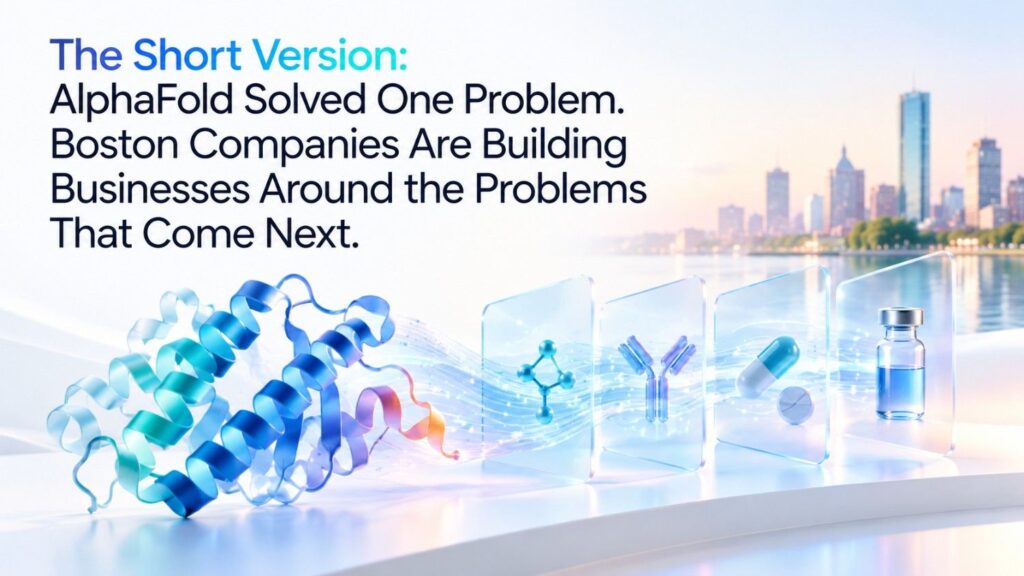
Our BostonBizScene analysis suggests that this combination, rather than model sophistication alone, is becoming one of the strongest indicators of commercialization maturity in Boston’s AI-biology market.
How We Built the BostonBizScene AI-Biology Commercialization Dataset
Before examining individual companies, it is worth explaining how we conducted our analysis.
This article is not based on a venture-capital database ranking companies by money raised. Nor did we simply count companies describing themselves as “AI-powered.”
Instead, we reviewed publicly available company materials, SEC filings, partnership announcements, pipeline information, clinical updates, and other primary or high-quality sources available through October 4, 2026.
We focused on companies meeting three basic conditions.
First, the company needed meaningful operations in Greater Boston, including Boston, Cambridge, Somerville, or nearby biotech centers such as Watertown.
Second, AI or advanced computational methods needed to be connected directly to biological or molecular discovery rather than being used only for administrative work, sales, medical documentation, or general business operations.
Third, there needed to be observable evidence of commercialization, such as a clinical candidate, licensing agreement, pharmaceutical partnership, collaboration revenue, platform customers, or another concrete route toward generating economic value.
This gave us a working group of eight companies that illustrate different stages and business models:
| Company | Boston-area base | Main AI-biology approach | Clearest commercialization evidence |
|---|---|---|---|
| Generate Biomedicines | Somerville | Generative protein design | Five clinical-stage molecules; Phase 3 program; pharma partnerships; public company |
| Dyno Therapeutics | Watertown | AI-designed biological sequences and AAV capsids | Roche and Astellas licenses; partner-driven development |
| Manifold Bio | Boston | AI protein design + direct-to-vivo testing | Roche partnership; large-scale experimental validation |
| Nabla Bio | Cambridge | Generative protein and antibody design | AstraZeneca, BMS and Takeda collaborations |
| Relay Therapeutics | Cambridge | Protein dynamics, machine learning and molecular design | Clinical-stage internal drug pipeline |
| Montai Therapeutics | Cambridge | AI-enabled small-molecule discovery | First platform-derived program entered Phase 1 |
| 1910 Genetics | Boston | Multimodal AI + automated wet labs | Pharma/technology partnering and platform services |
| Converge Bio | Boston | Generative-AI drug-discovery software | More than a dozen pharma/biotech customers reported in early 2026 |
Sources include company disclosures and regulatory filings. Generate:Biomedicines
This is not a complete list of every company applying computation to biology in Massachusetts. It is a deliberately narrower sample designed to study the transition from AI capability to commercial proof.
That distinction produces several useful findings.
Original Finding #1: Boston’s AI-Biology Market Has Already Moved Beyond the “Software Demo” Stage
A few years ago, one of the easiest ways to evaluate an AI-biotech company was to ask whether it could show impressive computational results.
That bar is now too low.
In our eight-company sample, the most advanced businesses have moved into much harder forms of validation.
Generate has programs in human trials, including GB-0895 in Phase 3 severe-asthma studies. Relay has clinical drug programs generated through a heavily computational discovery system. Montai announced on October 1, 2026 that the first candidate produced by its CONECTA platform had entered Phase 1. Dyno has had pharmaceutical partners exercise licenses on AI-designed capsids. Manifold has converted its platform into a large Roche transaction. Nabla has repeatedly expanded relationships with major pharmaceutical companies. Generate:Biomedicines
That gives us a useful commercialization ladder.
Chart: The AI-Biology Commercialization Ladder
| Commercial stage | What it proves | Boston examples |
|---|---|---|
| AI model works computationally | Technical possibility | Common across the ecosystem |
| Designs work in controlled lab tests | Biological usefulness | Nabla, Manifold, Generate |
| Pharma pays to access the system | External economic validation | Generate, Dyno, Manifold, Nabla |
| Partner licenses an AI-designed output | Asset-level validation | Dyno |
| Company advances platform-derived candidate into humans | Translational validation | Generate, Relay, Montai |
| Candidate reaches late-stage clinical testing | Stronger clinical validation | Generate |
| Approved product reaches patients | Ultimate commercial proof | Not yet established for the companies examined |
The last row is extremely important.
Boston has made real progress, but AI-designed biology should not be declared “solved.”
A platform partnership is not an approved drug. A successful animal experiment is not clinical proof. A Phase 1 study is not commercial success. Even a Phase 3 trial can fail.
The market has nevertheless moved much further than the era when AI-biotech businesses were valued mainly on what their models might eventually do.
Investors and pharmaceutical companies can increasingly evaluate what the systems have actually produced.
That is a healthier standard.
AlphaFold Changed the Starting Point, Not the Finish Line
To understand what is happening in Boston, it helps to separate protein prediction from drug creation.
AlphaFold’s great achievement was helping scientists infer protein structures from sequences. AlphaFold 3 extended the idea further by modeling interactions involving proteins and other biological molecules. Google DeepMind
That can remove a major information bottleneck.
But pharmaceutical development involves optimization across many variables at once.
A potential therapeutic protein might bind a target strongly but be unstable.
It might be stable but difficult to manufacture.
It might behave perfectly in a test tube yet fail inside a living organism.
It might reach the bloodstream but never cross the blood-brain barrier.
It might attack the intended biological pathway while also interacting with something dangerous.
This is why the next commercial phase of AI biology looks different from AlphaFold.
The problem is increasingly moving from:
“What structure does this protein have?”
to:
“What molecule should we intentionally create so that it performs a very specific job inside a real patient?”
That second question requires design, measurement, iteration, and development.
Boston is becoming particularly interesting because its companies are attacking several parts of that loop at the same time.
Generate Biomedicines Is Testing the Most Ambitious Version of the Thesis
Among Greater Boston companies, Generate Biomedicines may provide the clearest test of whether generative biology can become a repeatable drug-development system rather than a research tool.
The Somerville company describes its platform as a system that learns relationships between protein sequence, structure, and function and then generates new therapeutic proteins. Generate says its models draw from large collections of known biological information together with proprietary experimental data generated by the company. Generate:Biomedicines
That sounds interesting scientifically.
What makes Generate especially important commercially is how far downstream it has taken the approach.
The company says it now has five clinical-stage molecules. Its lead program, GB-0895, an antibody against TSLP, is in Phase 3 development for severe asthma. Generate also reports additional clinical and preclinical programs spanning several therapeutic approaches. Generate:Biomedicines
That places Generate in a fundamentally different category from an AI company that licenses software.
It is attempting to show that an AI-centered discovery system can become a full drug company.
Generate Has Also Built a Hybrid Business Model
Generate is not relying solely on drugs it owns.
It has signed major collaborations with pharmaceutical companies.
Its relationship with Amgen originally included five programs and was later expanded toward a sixth. Generate has disclosed a $50 million upfront payment and potential milestones reaching $2.2 billion, along with royalties. Its Novartis agreement included $65 million in total upfront consideration, including an equity component, and more than $1 billion in potential milestones. Generate:Biomedicines
Those headline milestone numbers should never be confused with guaranteed revenue. Most biotech milestone pools are contingent on programs meeting future scientific, clinical, regulatory, and commercial goals.
But the structure is meaningful.
Large pharmaceutical companies are effectively paying for access to Generate’s drug-creation engine while Generate also builds its own pipeline.
That creates two possible value streams:
platform economics and product economics.
The difference could become extremely important.
A pure platform business earns value by helping someone else develop drugs.
A pure biotech captures far more upside from a successful medicine but must carry enormous development costs and clinical risk.
Generate is trying to do both.
The Platform Has Started Producing Actual Revenue
Generate reported $31.9 million of collaboration revenue for 2025, up from $20.5 million in 2024. The company said the revenue came from its Novartis and Amgen agreements. SEC
For the first six months of 2026, Generate reported $13.5 million in collaboration revenue. SEC
That does not make the company profitable. Drug development remains extremely expensive, and Generate continues to spend heavily on research and clinical development.
But it matters because collaboration revenue provides something that AI demonstrations cannot:
evidence that external organizations are already paying for the system.
Generate’s 2026 IPO Added Another Form of Market Validation
Generate completed an initial public offering in early 2026 at $16 per share, offering 25 million shares and targeting approximately $400 million in gross proceeds before expenses. Generate:Biomedicines
After the offering, Generate reported approximately $516.6 million in cash, cash equivalents, and marketable securities at the end of March 2026. SEC
The IPO does not prove that generative biology works clinically.
Public markets can price emerging technologies incorrectly in either direction.
But it does move Generate into another stage of commercialization. The company must now report financial performance, trial progress, spending, partnerships, and other information under public-market disclosure requirements.
That creates a valuable benchmark for the rest of Boston’s private AI-biotech sector.
For the first time, investors have a relatively transparent local company through which they can watch the economics of generative protein development develop quarter by quarter.
Original Finding #2: More Than $8 Billion of Headline Deal Value Is Already Attached to Four Boston Protein-AI Platforms
One of the clearest ways to see how quickly the market has changed is to look at publicly disclosed partnership structures.
BostonBizScene reviewed major disclosed transactions involving four protein-focused Greater Boston companies: Generate Biomedicines, Dyno Therapeutics, Manifold Bio, and Nabla Bio.
Using only clearly disclosed headline figures that we could identify—and intentionally avoiding several amounts where comparability was unclear—we get a lower-bound total exceeding $8.4 billion.
BostonBizScene Estimate: Selected Disclosed AI-Biology Partnership Value
| Company | Selected disclosed agreements included | Lower-bound headline value used |
|---|---|---|
| Generate Biomedicines | Amgen + Novartis | >$3.2B |
| Manifold Bio | Roche | >$2.055B |
| Dyno Therapeutics | Astellas collaboration | >$1.6B |
| Nabla Bio | 2024 pharma collaborations + second Takeda deal | >$1.55B |
| Combined lower bound | >$8.405B |
Generate disclosed up to $2.2 billion associated with its Amgen collaboration and more than $1 billion connected to Novartis. Manifold disclosed a $55 million Roche upfront payment plus more than $2 billion in potential milestones. Dyno’s Astellas relationship included $18 million upfront and potential milestones exceeding $1.6 billion. Nabla’s earlier AstraZeneca, Bristol Myers Squibb, and Takeda arrangements were described as exceeding $550 million in upfront and milestone value, followed by a second Takeda relationship containing double-digit millions in upfront and research payments and potential success payments exceeding $1 billion. Generate:Biomedicines
Chart: Lower-Bound Headline Partnership Value in Our Sample
Generate      >$3.20B  ████████████████████████████████
Manifold      >$2.06B  ████████████████████
Dyno          >$1.60B  ████████████████
Nabla         >$1.55B  ███████████████
              -----------------------------------------
Combined      >$8.41B
This requires a major warning.
These are not equivalent to cash received.
Biotech partnership announcements often contain milestone payments that may never be triggered. Some figures include research payments, upfront consideration, development milestones, commercial milestones, equity investment, or royalties with different structures.
Therefore, the $8.4 billion figure should not be interpreted as Boston AI-biotech revenue.
It measures something different.
It shows the scale of potential economic commitments that pharmaceutical companies are willing to attach to Boston-area AI-biology platforms.
That is useful commercial evidence even after discounting the headline numbers heavily.
Dyno Therapeutics Shows That AI Can Be Commercialized as a Component Inside Someone Else’s Drug
Generate is trying to create therapeutics.
Dyno Therapeutics illustrates another model.
Dyno focuses heavily on the delivery systems used by genetic medicines, particularly adeno-associated virus, or AAV, capsids.
A capsid can be thought of as part of the delivery vehicle that helps transport genetic material into particular cells or tissues.
For many gene therapies, this is not a minor technical detail.
Delivery can determine whether a medicine reaches the right organ, achieves a useful dose, avoids unwanted tissues, and works safely enough to become viable.
Dyno uses AI and large-scale biological testing to design new capsids with desired properties.
That makes its product different from a conventional drug.
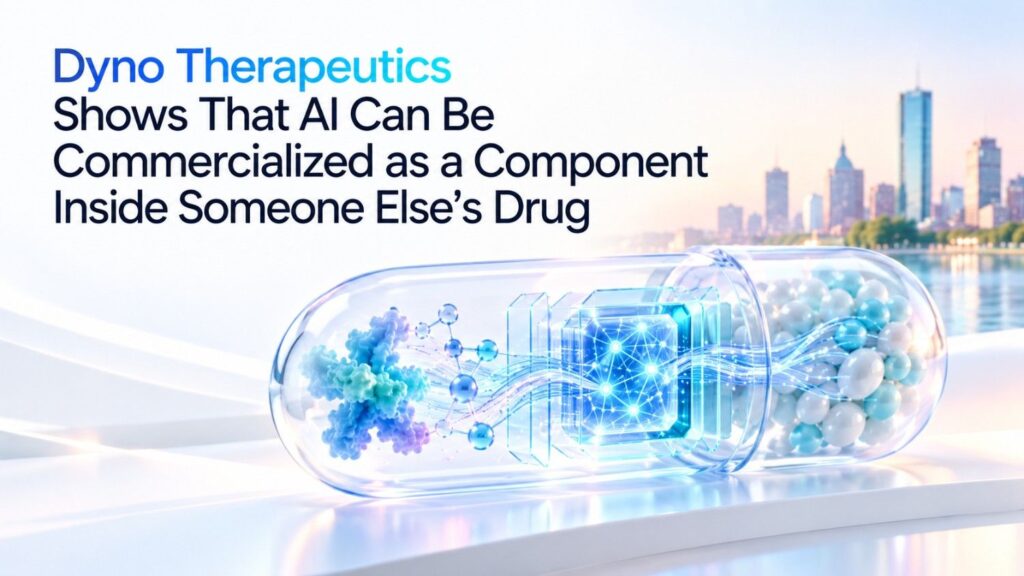
The AI-designed biological object may become infrastructure inside another company’s medicine.
The Licensing Events Matter More Than the Models
Dyno’s strongest commercial evidence is no longer simply that its models can generate sequences.
Partners have begun licensing outputs.
In early 2025, Roche exercised a license related to a Dyno capsid for neurological gene therapy after an earlier partnership. In April 2026, Astellas exercised an option to license an AI-engineered capsid for skeletal-muscle delivery. Dyno said the Astellas event triggered a $15 million license fee in addition to the economics established under the earlier agreement. Dyno
That is a meaningful threshold.
The commercial question becomes less:
“Do you believe our AI is good?”
and more:
“Do you want to build your therapeutic program using this specific thing our AI created?”
Those are very different levels of validation.
Dyno Is Also Moving Toward a Catalog and Platform Model
Dyno has been expanding beyond bespoke research partnerships.
In May 2026, the company announced new engineered capsids for central-nervous-system and muscle delivery while also opening additional AI tools and APIs to therapeutic developers. Dyno
This suggests an important possible evolution in AI biology.
Instead of every pharmaceutical company commissioning a new multi-year discovery program, parts of the industry may eventually buy, license, or access previously engineered biological components more like technology building blocks.
The economics could begin to resemble a mixture of:
custom research,
intellectual-property licensing,
platform access,
and standardized biological infrastructure.
If that happens, AI biology will not commercialize through one business model.
It may produce several.
Manifold Bio Is Commercializing the Experimental Feedback Layer
If AI can generate enormous numbers of proteins, another problem immediately appears.
How do you test them?
A generative model that can propose one million molecules is not very useful if a laboratory can evaluate only a few hundred.
That mismatch between computational generation and physical validation is becoming one of the central problems in AI biology.
Boston-based Manifold Bio is building around exactly that bottleneck.
The company’s approach combines AI-guided design with technologies intended to test many biological molecules directly in living systems.
This matters because biology often behaves differently inside an organism than it does in a simplified laboratory assay.
A molecule can look excellent in vitro and fail completely when confronted with circulation, metabolism, tissue barriers, immune responses, or other real biological constraints.
One 2026 Experiment Shows the Scale Manifold Is Trying to Reach
In March 2026, Manifold and NVIDIA disclosed an experiment in which Manifold tested one million protein-binder designs against 127 targets in a multiplexed study. According to the companies, the experiment measured more than 100 million protein-protein interactions and found specific binders for 68% of the tested targets. Manifold Bio
Those numbers should be viewed as a platform demonstration rather than proof that the resulting binders will become drugs.
But they illustrate the important direction of travel.
Generative AI increases the supply of proposed molecules.
The next bottleneck becomes measurement throughput.
That means some of the most valuable AI-biotech companies may ultimately make their money not because they have the largest model, but because they can generate the best experimental data fastest.
Roche’s Manifold Deal Shows Pharma Is Paying for the Full Loop
In November 2025, Manifold announced a collaboration with Roche focused on brain shuttles that could help therapeutics cross the blood-brain barrier.
The deal included $55 million upfront and potential research, development, clinical, and commercial milestones exceeding $2 billion, along with royalties. Manifold Bio
This transaction is revealing.
Roche is not simply buying access to a general AI chatbot for biology.
The collaboration combines design capabilities, biological measurement, a tissue-targeting shuttle portfolio, and a route toward actual therapeutic products.
That reinforces one of the strongest patterns in our research.
The closer AI becomes connected to experimentally validated biological assets, the clearer the monetization model becomes.
Nabla Bio Shows How a Small Company Can Commercialize AI Biology Through Pharma
Nabla Bio provides another useful model because it remains relatively small compared with large platform companies while securing substantial pharmaceutical relationships.
The Cambridge company combines generative molecular design with its own experimental systems. Its stated goal is to design molecules with multiple desirable properties rather than treating binding as the only objective. https://www.nabla.bio
Nabla has focused significantly on hard protein targets, including membrane proteins that have historically been difficult to address with conventional antibodies.
In 2024, the company announced a $26 million Series A while also disclosing collaborations with AstraZeneca, Bristol Myers Squibb, and Takeda worth more than $550 million in potential upfront and milestone economics plus royalties. LinkedIn
Then the relationship with Takeda expanded again.
In October 2025, Nabla announced a second multi-year Takeda collaboration. Nabla said it would receive upfront and research payments in the double-digit millions and could receive more than $1 billion in success-based payments. BioSpace
The second deal may be more informative than the first.
Why?
Because repeat business can be stronger evidence than an initial experiment.
A pharmaceutical company might sign a first AI partnership because it wants exposure to an emerging technology.
Expanding that relationship after working with the platform suggests the customer saw enough value to continue.
That does not guarantee future drug success, but it is an important signal for anyone evaluating commercial AI biology.
Original Finding #3: Repeat Pharmaceutical Engagement May Become a Better KPI Than Funding
AI-biotech coverage often focuses heavily on venture rounds.
Funding matters because laboratories, compute infrastructure, clinical trials, and scientific staff are expensive.
But capital raised tells us primarily whether investors believe a company may create value.
Repeat pharmaceutical partnerships tell us whether technically sophisticated potential customers are willing to keep paying for access.
That is a different signal.
Our analysis suggests that one of the most useful metrics for evaluating private AI-biology companies over the next several years may therefore be:
Partner Renewal Rate
A company announcing one $500 million “biobucks” agreement can attract attention.
A company whose partner moves from pilot project → expanded program → licensed asset → clinical development demonstrates something much harder.
Dyno’s relationships provide one example of this progression.
Nabla’s expanded Takeda partnership provides another.
Generate’s Amgen relationship expanded from an initial target scope toward another program. Generate:Biomedicines
For founders building AI-biotech companies in Boston, this suggests an important strategic lesson.
Do not optimize only for the biggest possible headline partnership.
Optimize for a project architecture that gives the partner a reason to come back.
Relay Therapeutics Represents the Bridge Between Structural Biology and AI Drug Design
Relay Therapeutics does not fit neatly into the “AlphaFold startup” label, and that is exactly why it belongs in this discussion.
The Cambridge company was founded around the idea that proteins are not rigid shapes.
They move.
Those motions can reveal pockets and states that matter for designing drugs.
Relay’s Dynamo platform combines structural biology, molecular dynamics simulations, machine learning, medicinal chemistry, biophysics, and other experimental techniques. Relay Therapeutics
This provides an important reminder.
The commercialization of AI biology is not happening because every company adopted the same foundation model.
Instead, multiple computational approaches are being connected to different biological problems.
AlphaFold helped normalize the idea that computation could transform structural biology.
Relay represents the broader commercial movement toward using computation to understand proteins dynamically and turn those insights into drug candidates.
Relay’s Commercial Test Is Its Internal Pipeline
Relay is a clinical-stage biotechnology company rather than primarily a software vendor.
Its pipeline includes zovegalisib, also known as RLY-2608, a selective PI3Kα inhibitor being developed for cancers involving PI3Kα mutations. Relay Therapeutics
The company reported $15.4 million of license and other revenue in 2025, while spending approximately $261 million on research and development. SEC
That financial profile highlights another truth about AI drug discovery.
Even if computation makes discovery more efficient, clinical biotech remains expensive.
AI does not remove the need for clinical trials.
It does not remove regulatory work.
It does not remove manufacturing.
And it does not eliminate biological failure.
This is why claims that AI will simply “cut drug development from 12 years to two years” should be treated cautiously.
AI may dramatically accelerate selected parts of the process without eliminating the long downstream path between a promising molecule and an approved medicine.
Montai Shows AI Drug Discovery Moving Into Human Testing Through a Different Route
Montai Therapeutics is attacking another part of the problem.
Rather than concentrating primarily on designing protein therapeutics, the Cambridge company is using AI to search large and unusual chemical spaces for small molecules that can affect difficult biological pathways.
Montai says its CONECTA platform combines biological information, chemistry, machine learning, and integrated drug-development decision making. The company reports a library containing billions of potential chemical structures and says its system is designed to identify candidates for biological pathways that have historically been difficult to drug with oral small molecules. Montai
The key commercial event arrived in 2026.
On October 1, Montai announced that it had dosed the first participants in a Phase 1 trial of MTAI-1025, an oral NRF2 agonist being developed for ulcerative colitis. The company describes it as the first development candidate from its platform to enter clinical testing. Montai
This matters for the Boston ecosystem because it adds another independent test.
Generate is testing generative protein design.
Relay is testing motion-based computational small-molecule design.
Montai is testing AI-guided exploration of broad chemical space.
Different technical approaches are now converging on the same hard endpoint:
Does the molecule work in humans?
1910 Genetics Is Trying to Commercialize the Entire Drug-Discovery Stack
Boston-based 1910 Genetics illustrates yet another direction.
The company combines computational data, laboratory data, AI, automated experimentation, and drug-design systems intended to support both small and large molecules. It offers several partnering formats, including co-discovery, co-engineering, platform access, and asset licensing. 1910 Genetics
This business model is significant because it treats AI drug discovery partly as infrastructure.
Instead of asking pharmaceutical companies to replace their R&D organization, 1910 can potentially sell individual pieces of the stack.
A pharma company might want a complete candidate.
Another might want access to a software module.
Another might want custom model engineering.
Another might want collaborative discovery.
That flexibility could prove useful because large pharmaceutical companies are unlikely to adopt AI biology in exactly the same way.
The buyers differ in data quality, internal compute resources, scientific expertise, risk tolerance, and strategic priorities.
The commercial winner may therefore be the company that can meet pharma where it already operates rather than demanding that the customer rebuild its entire research organization.
Converge Bio Represents the Software-Layer Opportunity
Not every company needs to own a therapeutic pipeline.
Converge Bio represents a more software-oriented path.
The Boston company announced a $25 million Series A in January 2026, bringing reported funding to $30 million. At the time, it said more than a dozen pharmaceutical and biotech customers were using its tools for areas including target discovery, antibody design, and optimization of protein manufacturing. PR Newswire
This creates a much more familiar technology-business model.
Instead of spending hundreds of millions of dollars advancing a molecule through clinical trials, software-oriented companies can try to become tools used across many drug-development organizations.
The possible advantage is scalability.
The disadvantage is that scientific software may capture much less economic value than owning a successful drug.
This tension will shape the industry.
Original Finding #4: Boston Is Producing at Least Four Distinct AI-Biology Business Models
When all eight companies are placed together, a clearer market structure emerges.
Boston AI-Biology Business Model Map
| Model | How money is made | Boston examples | Main risk |
|---|---|---|---|
| AI-native drug company | Own drugs and retain product economics | Generate, Relay, Montai | Clinical failures and enormous capital needs |
| Platform partnership company | Upfronts, research payments, milestones, royalties | Generate, Nabla, Manifold | Dependence on partners and contingent milestones |
| Biological component/IP company | License engineered biological assets | Dyno | Partner development success |
| AI discovery infrastructure/software | Platform access, services, software or discovery contracts | 1910 Genetics, Converge Bio | Commoditization and pricing pressure |
The categories overlap.
Generate, for example, belongs in both the first and second categories.
Dyno is also increasingly offering broader platform access.
That overlap is itself meaningful.
The strongest companies may eventually combine multiple revenue streams rather than choosing a single model.
Why Owning the Drug Can Create Enormous Value
The appeal of an internal pipeline is straightforward.
If an AI system creates a successful drug and the company retains significant rights, it may capture a large portion of the economic value created by that medicine.
This is why Generate’s clinical pipeline is strategically important.
Its platform may help generate molecules, but the long-term value of the company could ultimately be driven more by the medicines than by the AI itself.
That is similar to what happened during earlier technology transitions in biotech.
Recombinant DNA was revolutionary.
Sequencing was revolutionary.
High-throughput screening was revolutionary.
But patients generally do not buy a technology platform.
They buy medicines produced using those technologies.
AI may follow the same path.
Why Selling the Platform Can Still Be Attractive
Owning every drug creates another problem.
Capital.
Drug development consumes huge amounts of money and time.
Generate reported $224.7 million in R&D spending in 2025, while Relay reported approximately $261.4 million. SEC
A young AI-biology startup may therefore decide that partnering is smarter.
Let a pharmaceutical company finance late-stage development.
Collect upfront money.
Earn milestone payments.
Retain royalties.
Use the partner’s clinical, manufacturing, regulatory, and commercial infrastructure.
Then reinvest the proceeds in the platform.
Manifold, Nabla, and Dyno all provide variations on that strategy.
Neither route is inherently superior.
The optimal model depends on the company’s capital base, technology, therapeutic area, competitive position, and confidence in the asset.
Original Finding #5: The Most Valuable Proprietary Asset May Be the Experiment, Not the Model
Perhaps the strongest pattern in our Boston research concerns data.
Public AI models are improving quickly.
AlphaFold structure predictions are widely available.
Academic protein-design methods are advancing rapidly.
Open-source biological models are becoming more capable.
Large technology companies such as NVIDIA are actively building AI systems for biology.
That makes it increasingly difficult to rely on model architecture alone as a permanent competitive advantage.
Companies therefore need another source of defensibility.
For several Boston businesses, that source appears to be experimental feedback.
Generate describes a loop in which machine-learning-driven protein generation is connected to physical experimentation that produces more proprietary data. The company says it has generated, built, and tested more than 42,000 proteins. Generate:Biomedicines
Manifold has built technologies for testing enormous numbers of biological designs, including its million-design NVIDIA study. Manifold Bio
Nabla combines generative models with internal wet-lab systems and large-scale experimental testing. https://www.nabla.bio
1910 explicitly combines computational data with both proxy and ground-truth wet-lab biological data. 1910 Genetics
Dyno combines AI sequence design with high-throughput in vivo experimentation. Dyno
The architecture is remarkably consistent.
The Emerging Boston AI-Biology Flywheel
Biological data
      ↓
AI model
      ↓
Generate candidate designs
      ↓
Build physical molecules
      ↓
Test them in real biology
      ↓
Measure success and failure
      ↓
Create proprietary experimental data
      ↓
Retrain / improve models
      ↓
Generate better candidates
      ↺
This may become Boston’s real competitive advantage.
Not simply “better AI.”
Better learning systems.
Why Experimental Data Can Become a Moat
Imagine two companies using similarly capable public protein models.
Company A can generate ten million theoretical proteins.
Company B can generate one million.
At first, Company A looks stronger.
Now imagine that Company B can physically manufacture and test 100,000 candidates every month, measure exactly which ones work in relevant biological systems, and continuously feed those results back into its models.
Company A can test only 500.
After several cycles, the difference in generation capacity may matter much less than the difference in feedback quality.
Company B is learning from reality.
This is one reason Boston has a structural advantage in AI biology.
Greater Boston is not merely an AI cluster.
It is an enormous experimental biology cluster.
The area contains biotechnology companies, pharmaceutical R&D operations, hospitals, academic laboratories, genomics researchers, structural biologists, chemists, automation companies, and experienced clinical-development talent.

The AI can sit unusually close to the physical system it is attempting to model.
Boston’s Advantage Is Not That It Invented AlphaFold
AlphaFold was developed by Google DeepMind, not in Boston.
Many important advances in computational protein design have emerged elsewhere.
The world’s AI-biology ecosystem spans London, San Francisco, Seattle, New York, Toronto, China, Europe, and many other research centers.
Boston should therefore avoid a simplistic story claiming that it somehow “owns” AI biology.
It does not.
Boston’s potential advantage lies elsewhere.
The city has one of the deepest concentrations of infrastructure needed to turn biological computation into medicine.
That includes wet labs.
Animal research.
Medicinal chemistry.
Protein science.
Clinical-development executives.
Biotech founders.
Venture capital.
Pharmaceutical partners.
Research hospitals.
Regulatory knowledge.
Manufacturing expertise.
And scientists who have spent entire careers discovering why apparently promising biological ideas fail.
Those capabilities become more valuable, not less valuable, when AI can generate hypotheses faster.
Original Finding #6: AI Is Moving the Bottleneck Downstream
Technology often solves one constraint only to expose another.
Before AlphaFold, obtaining structural information could itself be a major limitation.
As structure prediction becomes easier, other bottlenecks become more visible.
Our research suggests at least five are emerging.
The AI-Biology Bottleneck Shift
| Earlier bottleneck | What AI improves | New bottleneck that appears |
|---|---|---|
| Understanding protein structure | Structure prediction | Choosing therapeutically useful interventions |
| Generating candidate molecules | Generative models | Testing huge design volumes |
| Finding promising hits | AI screening | Translating hits into developable drugs |
| Optimizing molecules computationally | Predictive models | Real-world biological validation |
| Producing more hypotheses | AI agents/models | Deciding which experiments deserve scarce lab capacity |
This shift creates business opportunities.
Manifold attacks experimental testing.
Dyno attacks delivery.
Generate attacks programmable protein therapeutics.
Nabla attacks difficult protein targets.
Relay attacks protein dynamics.
Montai attacks hard-to-drug pathways using broader chemistry.
The value is moving from simply predicting biology toward removing the next physical constraint in drug creation.
What AlphaFold Still Does Not Tell a Drug Company
This distinction deserves emphasis because the phrase “AI drug discovery” can create unrealistic expectations.
Suppose AlphaFold gives researchers an excellent predicted structure of a disease-associated protein.
They still may not know whether interfering with that protein will help patients.
They may not know where to bind it.
They may not know whether the desired binding site appears in the right state inside a cell.
They may not know whether a designed molecule will cross the relevant tissue barrier.
They may not know whether the immune system will react badly.
They may not know whether a molecule can be manufactured reliably at commercial scale.
They may not know whether chronic dosing is safe.
And they certainly do not know whether the medicine will succeed in a randomized Phase 3 trial.
AI biology therefore does not eliminate pharmaceutical development.
It changes where intelligence enters the process.
Original Finding #7: Boston’s Most Advanced Companies Are Becoming “AI + Biohardware” Companies
Another phrase may become increasingly important over the next few years:
biohardware.
The successful AI-biology company increasingly resembles neither a conventional software business nor a traditional biotech.
It is a combination.
Generate explicitly describes integrating computation with biohardware and physical experimentation. Generate:Biomedicines
1910 combines AI with laboratory automation.
Manifold builds experimental systems capable of measuring enormous numbers of biological designs.
Dyno combines computational design with high-throughput biological assays.
This architecture creates a different type of company.
Software engineers, machine-learning researchers, biologists, automation engineers, protein scientists, medicinal chemists, and drug developers must operate inside the same loop.
That has significant consequences for Boston’s labor market.
The most valuable employee may increasingly be someone who can cross boundaries rather than working inside only one discipline.
The Talent Market Will Become More Hybrid
Traditional biotech organizations could often separate computational teams from laboratory teams.
AI-native biology makes that division harder to maintain.
A model scientist needs to understand which predictions can actually be measured.
An experimental biologist needs to understand how data quality affects training.
A protein scientist needs to know which molecular properties can be encoded as design objectives.
A machine-learning engineer needs to recognize when a model is optimizing an easy proxy instead of the biological result that matters.
A clinical developer needs to help discovery teams understand which properties eventually matter in patients.
That produces demand for hybrid skills.
For Boston universities and training programs, this creates a clear opportunity.
The region should not train only more AI engineers.
It should train more scientists who understand both AI and experimental biology.
A BostonBizScene Commercialization Scorecard
To make comparisons easier, we created an editorial scoring framework for the eight-company sample.
This is not a valuation model and should not be used as investment advice.
The purpose is to compare observable commercialization progress across very different business models.
Each company receives 0–5 points across five categories:
Clinical translation: Has an AI-enabled output reached clinical development?
External validation: Have sophisticated outside partners paid for or licensed the platform/output?
Experimental feedback: Does the company appear to own a meaningful wet-lab or biological learning loop?
Business-model proof: Is there evidence of actual revenue, licensing, customers, or repeat commercial relationships?
Platform-to-product connection: Can we clearly connect the computational system to tangible biological assets or drugs?
BostonBizScene AI-Biology Commercialization Index
| Company | Clinical translation | External validation | Experimental loop | Business proof | Platform→product | Total /25 |
|---|---|---|---|---|---|---|
| Generate | 5 | 5 | 5 | 5 | 5 | 25 |
| Dyno | 2 | 5 | 5 | 5 | 5 | 22 |
| Relay | 5 | 3 | 5 | 3 | 5 | 21 |
| Manifold | 1 | 5 | 5 | 5 | 4 | 20 |
| Nabla | 1 | 5 | 5 | 5 | 4 | 20 |
| Montai | 4 | 3 | 4 | 2 | 5 | 18 |
| 1910 Genetics | 1 | 4 | 5 | 4 | 3 | 17 |
| Converge Bio | 0 | 4 | 2 | 4 | 2 | 12 |
These scores are deliberately based on commercialization maturity rather than scientific quality.
A lower score does not mean the technology is weaker.
For example, a young platform could possess world-class science but still score low because its designs have not yet reached the clinic.
The framework also favors companies developing therapeutics because human trials provide unusually strong observable validation.
The score should therefore be read as:
“How much public evidence exists that this AI-biology system has moved toward commercial use?”
not:
“Which company will ultimately succeed?”
What the Scorecard Reveals
Three patterns stand out.
First, Generate is currently the most vertically integrated commercialization experiment in our sample. It has AI, proprietary experiments, pharma partnerships, collaboration revenue, public-market financing, and late-stage clinical development.
Second, several companies can demonstrate very meaningful commercialization without owning late-stage drug programs. Dyno, Nabla, and Manifold show that licensing technology or platform-generated biological assets can create large economic opportunities before the AI company itself runs Phase 3 trials.
Third, software alone appears harder to distinguish once general-purpose biological AI improves. Companies sitting closer to proprietary experiments, unique biological data, and therapeutic assets may have stronger defenses.
That third point could become increasingly important.
What Pharmaceutical Companies Should Learn From Boston
Large pharmaceutical companies should resist two opposite mistakes.
The first is dismissing AI biology as hype because many AI-discovered drugs have not yet reached approval.
That standard is too simplistic.
Drug development takes years. Technologies adopted today can create measurable productivity improvements long before the first approved product emerges.
The second mistake is treating every company with a generative model as equivalent.
They are not.
Pharmaceutical buyers should evaluate the entire learning system.
Ask What Happens After Generation
A vendor saying it can generate one million proteins sounds impressive.
The more useful question is:
How many can you physically build, test, and learn from?
Then ask:
How fast?
In what biological system?
With what reproducibility?
Against what baseline?
And does the resulting data improve the next design cycle?
Those questions expose whether a company has a genuine discovery engine or mostly a generation engine.
Examine Partner Behavior, Not Only Partnership Announcements
A press release can make any collaboration sound transformative.
Follow what happens later.
Does the partner expand the program?
Does it exercise a license?
Does a molecule advance?
Does research funding continue?
Are milestones triggered?
Repeat behavior provides much better information than the original announcement.
Separate Headline Deal Value From Real Cash
A “$2 billion AI partnership” may involve only a small upfront payment.
The remaining value can depend on years of successful development.
Executives should therefore track at least three numbers separately:
upfront cash, near-term research funding, and contingent milestone value.
Mixing all three produces misleading comparisons.
What Boston AI-Biology Startups Should Learn
Boston founders have a different set of lessons.
Build the Feedback Loop Before Building the Story
It is tempting to lead with the size of a foundation model.
That may become less useful every year.
General AI capabilities will improve.
Competitors will reproduce architectures.
Open models will spread.
Compute will become more accessible.
The harder asset to copy is often proprietary biological feedback.
Build a system that gets smarter because your company performs experiments competitors do not.
Pick a Bottleneck Pharma Already Pays to Solve
The strongest Boston transactions are connected to expensive existing problems.
Dyno addresses gene delivery.
Manifold addresses blood-brain-barrier transport and in vivo validation.
Nabla tackles difficult protein targets.
Generate tries to systematically create protein therapeutics.
These are not AI solutions searching for a pharmaceutical problem.
They attack bottlenecks that already cost drug developers large amounts of time and money.
That is a much better starting point.
Do Not Confuse Model Performance With Drug Performance
A benchmark measures a model.
A patient experiences a medicine.
The distance between those things is enormous.
Founders should therefore design company milestones that move steadily toward biological and clinical reality.
That might mean:
model benchmark → experimentally confirmed binder → developable molecule → animal efficacy → candidate nomination → IND → Phase 1.
Each stage removes a different kind of risk.
What Investors Should Track Instead of AI Buzzwords
Investors evaluating AI-biology companies should also update their dashboards.
Traditional software metrics alone do not work.
Traditional biotech metrics alone may miss platform improvements.
A better framework combines the two.
Suggested AI-Biology KPI Dashboard
| KPI | Why it matters |
|---|---|
| Design-to-test cycle time | Measures how quickly the learning loop turns |
| Percentage of generated molecules physically tested | Reveals whether generation outruns validation |
| Experimental hit rate | Tests model usefulness in real biology |
| Partner renewal rate | Measures customer validation |
| License exercises | Strong evidence an external party values a specific output |
| Candidate nominations per year | Shows platform productivity |
| Time from program start to candidate | Measures discovery efficiency |
| Clinical-stage platform outputs | Connects AI to human translation |
| Proprietary data generated per cycle | Indicates whether the moat compounds |
| Cash cost per validated program | Connects technology to economics |
These metrics will not all be publicly available.
But they are closer to the underlying business than the number of model parameters or GPUs a company owns.
The Biggest Unanswered Question: Does AI Improve Clinical Success Rates?
This is ultimately the metric that matters most.
Drug discovery produces many promising candidates already.
The pharmaceutical industry’s hardest economic problem is that so many fail later.
AI can create more molecules.
It can identify new binding sites.
It can optimize multiple molecular properties.
It can reduce search costs.
But the truly transformative outcome would be a measurable increase in the probability that a program entering development eventually becomes an approved drug.
We do not yet have enough mature AI-designed clinical programs to answer that question confidently across the industry.
That means the next decade of AI biology will look less like a model benchmark competition and more like a giant longitudinal experiment.
Every clinical candidate becomes another data point.
Boston is likely to produce many of those data points.
Clinical Data Will Eventually Replace AI Marketing
This could be healthy for the industry.
During an emerging-technology boom, companies can spend years debating who has the best architecture, dataset, model, or platform.
Clinical trials impose a more unforgiving standard.
Did the medicine reach the tissue?
Did the biomarker change?
Did symptoms improve?
Were side effects acceptable?
Did the trial meet its endpoint?
Those questions are not impressed by branding.
As Generate, Relay, Montai, and future Boston AI-generated programs move further through trials, the quality of the field’s evidence should improve rapidly.
What Happens If AI Makes Drug Discovery Much More Productive?
There is another question worth considering.
Suppose these systems genuinely work.
Suppose companies can generate better drug candidates several times faster.
The pharmaceutical industry may then face a surprising new problem:
too many good programs.
Clinical-development capacity could become the bottleneck.
Capital allocation could become harder.
Trial recruitment might become more competitive.
Manufacturing capacity for complex modalities could become more valuable.
Regulators could face more novel molecules.
Pharma companies might need much better systems for deciding which AI-generated candidates deserve clinical resources.
In other words, solving discovery could expose bottlenecks further downstream.
That would be a good problem compared with today’s low productivity, but it would still need to be solved.
Boston Could Benefit Disproportionately From That Shift
If discovery output rises sharply, regions with strong downstream drug-development infrastructure become more valuable.
Boston already possesses much of that infrastructure.
This creates a possible reinforcing loop.
More AI-generated candidates attract more experimental work.
More experiments generate more proprietary data.
More data improve AI systems.
Better systems attract pharmaceutical partnerships.
Partnerships bring capital.
Capital funds more laboratories and clinical programs.
Successful programs attract talent.
Talent starts more companies.
That is the ecosystem-level version of the same learning loop companies are trying to build internally.
Why This Could Be Bigger Than “AI Drug Discovery”
Calling this market “AI drug discovery” may eventually feel too narrow.
What is emerging looks more like a new operating system for biological engineering.
AI models propose interventions.
Robotic or high-throughput systems build them.
Experiments test them.
Software captures the results.
Models learn.
Humans guide goals and interpret unexpected biology.
Then the loop repeats.
The unit of progress is no longer simply a scientific paper or isolated experiment.
It becomes the learning cycle.
The company able to execute more useful cycles per year may gain a compounding advantage.
That is a very different way to think about biotech productivity.
AlphaFold May Ultimately Be Remembered as the Beginning, Not the Destination
AlphaFold deserves its place as one of the landmark scientific developments of modern AI.
It helped prove that machine learning could solve biological problems many researchers once considered extraordinarily difficult.
But its broader commercial legacy may come from what it inspired.
Once scientists saw that AI could infer protein structure, the obvious next question became:
Can we design proteins?
Then:
Can we design antibodies?
Can we predict interactions?
Can we engineer delivery vehicles?
Can we optimize molecules for multiple properties?
Can we run experiments automatically?
Can we learn from living systems?
Can we create medicines on demand?
Those questions are now turning into companies.
And in Boston, those companies are increasingly turning into clinical trials, licensing agreements, pharmaceutical collaborations, and real revenue.
What Boston Business Leaders Should Watch Through 2027
The next 12 to 24 months should produce far better evidence about which AI-biology business models actually scale.
Generate’s Phase 3 program will be especially important because late-stage clinical progress takes the platform discussion much closer to the ultimate test of patient value.
Montai’s first clinical program will begin producing another set of human data.
Dyno’s licensed capsids can be followed as partners move their gene-therapy programs forward.
Nabla’s expanded Takeda partnership will test whether repeated AI-generated protein work produces development candidates.
Manifold’s Roche collaboration should reveal how well direct-to-vivo discovery translates into partner programs.
Meanwhile, software and infrastructure players will need to prove that pharmaceutical adoption can expand beyond experiments into durable workflows.
The ecosystem should therefore become easier to judge.
Not because AI models will stop improving.

Because the outputs will move deeper into reality.
Final Takeaway: Boston Is Commercializing the Layer After AlphaFold
The easiest way to misunderstand Boston’s AI-biology boom is to think every company is trying to build another AlphaFold.
Most are not.
AlphaFold helped make protein structure computationally accessible.
Boston companies are increasingly working on what comes next.
Generate is asking whether proteins can be systematically generated as medicines.
Dyno is asking whether AI can engineer better delivery vehicles for genetic medicines.
Manifold is asking whether generative design can be coupled with massive real-world biological testing.
Nabla is asking whether difficult therapeutic proteins can be designed rather than discovered through long rounds of trial and error.
Relay is asking whether protein motion can guide more precise small-molecule development.
Montai is asking whether AI can systematically explore chemical spaces humans have barely used.
1910 Genetics is building infrastructure connecting AI to automated experiments.
Converge Bio is packaging parts of the new discovery stack for pharmaceutical customers.
These approaches are different, but they are converging on the same commercial truth.
Prediction is becoming cheap. Validation is becoming valuable.
The strongest Boston companies are therefore building more than models.
They are building systems that can design something, create it physically, test it against reality, learn from what happened, and repeat the process.
Our analysis of publicly disclosed deals shows more than $8.4 billion of lower-bound headline partnership value attached to just four Boston-area protein-AI platforms, even before counting several additional transactions. That does not mean $8.4 billion has changed hands, and it certainly does not prove the resulting drugs will succeed. It does show that sophisticated pharmaceutical companies are assigning substantial potential value to this new discovery infrastructure. Generate:Biomedicines
The next phase will be harder.
AI-designed molecules must survive animal studies.
They must survive manufacturing.
They must survive regulators.
Most importantly, they must survive human biology.
That is where Boston’s advantage could become unusually important.
The region already knows how difficult that part is.
If the first generation of AI biology was about teaching computers to understand proteins, the next generation will be about connecting those computers to laboratories, drug-development teams, pharmaceutical partners, clinical trials, and patients.
That is the market now forming across Greater Boston.
And it may ultimately matter far more than the model that started the conversation.