

For years, companies have tried to make project managers more productive by giving them better software. They introduced project trackers, dashboards, communication platforms, planning tools, calendars, ticketing systems, portfolio management software, meeting tools, document platforms, and increasingly complex reporting systems.
Yet the basic problem never really disappeared. Someone still has to figure out what changed, ask why a task is late, update the plan, chase the owner, record the risk, schedule the next meeting, prepare the status report, remember what was decided three weeks ago, and explain to leadership when a small delay is becoming a serious business problem.
That person is usually a project manager, program manager, delivery lead, operations manager, chief of staff, or somebody else quietly doing project-management work without carrying the formal title. Much of their value comes from keeping people, information, deadlines, decisions, and systems synchronized when the organization itself is constantly changing.
A new generation of AI companies is now asking a much larger question. Instead of building software that helps a project manager manage work, what happens when the software starts taking responsibility for part of the management process itself?
Boston is becoming an interesting place to watch this transition. One Boston company, Coworked, has built Harmony, which it describes as an AI project manager designed to operate inside the systems businesses already use. In May 2026, the company announced a $1.8 million funding round as it expanded a product designed to help maintain timelines, coordinate actions, track risks, prepare reports, schedule meetings, and support the repetitive operational work required to keep a project moving.
That is fundamentally different from another dashboard.
The bigger story, however, is not about Coworked alone. Across Boston’s AI ecosystem, startups are increasingly building systems that do something after understanding information. These systems monitor work, coordinate software agents, update plans, perform multi-step tasks, interact with business applications, and increasingly move from generating answers toward completing outcomes.
That pattern points toward a much broader change in knowledge work. Business information is starting to become executable.
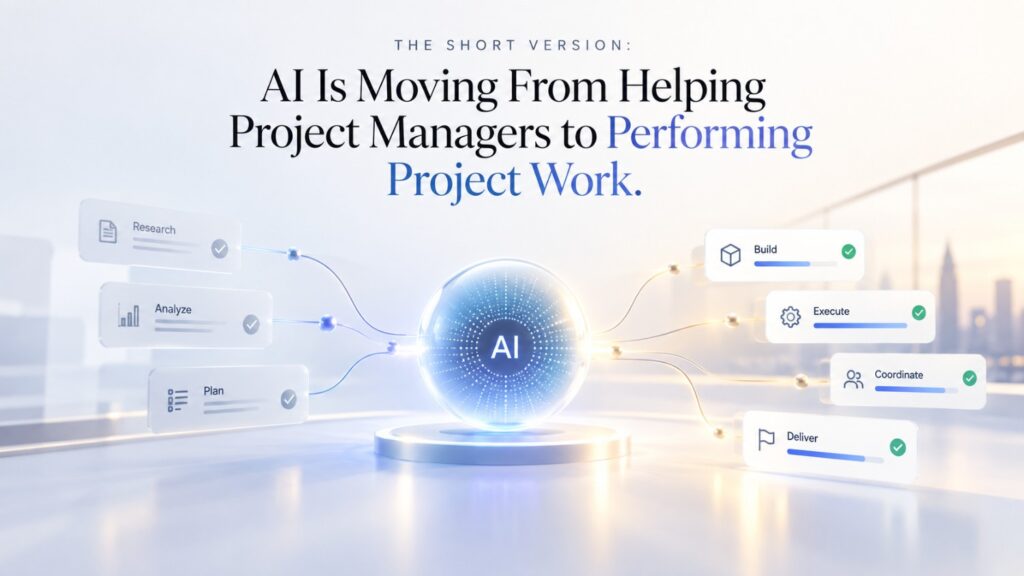
The Short Version: AI Is Moving From Helping Project Managers to Performing Project Work
The first wave of workplace generative AI mainly helped employees create information faster. It could summarize a meeting, draft an email, turn messy notes into a project brief, suggest action items, explain a spreadsheet, prepare a presentation, or rewrite a status update in a cleaner format.
Those capabilities can save meaningful amounts of time, but the human still owns almost every important step in the workflow. If the AI identifies five overdue tasks, somebody still has to decide what happens next. If it summarizes a meeting, somebody still needs to update the project system, contact the right people, change the schedule, document the risk, and explain the effect to the rest of the organization.
Agentic AI changes this relationship because the software can potentially move from describing work to participating in it. An AI project manager could observe what is happening, maintain project memory, compare current conditions with the original plan, ask owners for missing information, update systems, schedule follow-ups, prepare reports, identify exceptions, and continue repeating that process without waiting for a person to manually restart the workflow every time something changes.
The human does not necessarily disappear from this model. Instead, the human can move higher in the decision chain, spending less time reconstructing project status and more time handling strategy, negotiation, trade-offs, stakeholder relationships, organizational politics, and decisions where accountability still needs to remain clearly human.
That distinction matters in Boston because the region has a large concentration of expensive knowledge work. Bureau of Labor Statistics data for the Boston-Cambridge-Newton metropolitan area counted 18,840 project management specialists in May 2025, with a mean annual wage of $121,710. The same labor market also included tens of thousands of management analysts, market research professionals, accountants, auditors, compliance specialists, technology workers, and other professionals whose jobs contain substantial amounts of coordination work.
Boston therefore has both sides of the emerging market. It has companies building more capable AI agents, while also having a large base of organizations paying highly skilled people to coordinate complicated work across healthcare, software, life sciences, finance, higher education, research, professional services, and technology.
Original Research: How We Analyzed Boston’s AI Project Management Opportunity
Before measuring this opportunity, it is useful to define what actually counts as an execution-oriented AI system. The term “AI agent” has become so broad that almost any software product with a language model can now be described as agentic, which makes meaningful comparison difficult.
For this article, BostonBizScene used a narrower definition. We considered an AI system execution-oriented when its public product description clearly indicated that the software could autonomously perform work, change the state of a workflow, coordinate several tasks or agents, adapt a plan when conditions changed, or take action in another system without requiring a person to manually complete every individual step.
A chatbot that simply answers questions about a project would therefore not meet the standard. A meeting transcription service would not qualify merely because it creates a summary. An analytics product that identifies a problem but leaves all subsequent work to a human would also remain outside the category.
Using this framework, we reviewed the 22 companies listed on Y Combinator’s Boston artificial intelligence startup directory in September 2026. The page provides a useful snapshot of startup activity associated with Boston, although it should not be treated as a complete census of the regional AI ecosystem, and at least one company on the directory is shown in nearby Providence rather than Boston itself.
Each company was manually coded using the public description available through Y Combinator. If the description mainly emphasized analytics, models, intelligence, infrastructure, data, or tools without clear evidence that the product independently carried work forward, we placed it outside the execution-oriented group. If the description clearly involved autonomous action, workflow execution, physical automation, orchestration, adaptive planning, or an AI agent performing work, it was placed inside the execution-oriented category.
This is intentionally a conservative methodology. The goal was not to produce the largest possible number, but to see how much of the Boston AI sample already reflects the deeper product architecture needed for software that manages and completes work.
Original Finding #1: About 45% of the YC Boston AI Sample Is Already Execution-Oriented
Our manual analysis identified 10 of the 22 companies in the sample as clearly execution-oriented under the definition above. That equals approximately 45.5% of the companies reviewed, while the remaining 54.5% were primarily focused on models, intelligence, infrastructure, data, analytics, tools, or other forms of AI.
That does not mean 45% of Boston AI startups are building project managers. They clearly are not. What the finding suggests is that a substantial part of Boston’s emerging AI ecosystem is already moving toward the same basic idea required for an AI project manager: the software should not merely understand what is happening but should be able to influence what happens next.
| Product orientation | Companies | Share of sample |
| Clearly execution-oriented | 10 | 45.5% |
| Primarily intelligence, tools, infrastructure, data or other AI | 12 | 54.5% |
| Total | 22 | 100% |
This becomes more interesting when we look at what some of those companies actually do. Boston startup Rindler, for example, is building Maxxwell, a system designed to help developers supervise multiple coding agents. Its public YC description explains that an orchestrator can monitor other coding sessions, report completed work, make some routine decisions, and bring the developer the questions that actually need human attention.
The domain is software engineering, but the management structure is familiar. The system watches multiple workstreams, determines which ones are moving, identifies where progress has stopped, resolves some routine issues, and escalates higher-value decisions to a person.
That is coordination.
Other Boston-area AI companies show similar patterns in different industries. Delineate applies AI agents to clinical trial design and research workflows. Yuma uses autonomous agents in customer service. HYBRD continuously adjusts training plans as conditions change. Degla is working on software that turns a stated objective into a multi-drone mission and adapts when the physical environment changes.
These products operate in very different markets, but the underlying direction is similar. Software is increasingly being given responsibility for maintaining progress toward an outcome rather than simply producing information for somebody else to act upon.
Coworked Is Making the AI Project Manager Idea Literal
Coworked is especially useful to study because it is not using project management as a loose metaphor. The company is explicitly positioning Harmony as an AI project manager.
Its product materials describe a system designed to operate across the communication and project tools employees already use. Instead of forcing every worker into another separate application, the idea is for the agent to exist across email, chat, meetings, documents, project delivery systems, calendars, and reporting workflows.
This design makes sense because much of project management is not one large, complicated action. It is hundreds of small actions that need to happen in the correct order and with the right context.
Imagine a standard project meeting ending at 11:00 a.m. During the call, one developer says an API migration will finish three days later than expected. Legal has still not approved an agreement required before launch. Finance agrees to release additional spending. A customer asks for another review. Somebody mentions that a key employee will be unavailable next week.
A normal meeting assistant can summarize those statements. That saves note-taking time, but the project itself has not moved.
A genuine AI project manager would need to understand the consequences. It might update the delivery schedule, record the legal approval as a dependency, revise the risk register, assign the correct action, contact the owner, schedule the additional customer review, update the approved spending record, check whether the employee’s absence creates another bottleneck, calculate whether the launch date is now at risk, and prepare a revised status summary.
That difference is the entire market opportunity. The product is no longer mainly creating content. It is helping execute the workflow that the content describes.
The Existing PM Software Stack Is Exactly Why AI Agents Have an Opening
Modern project teams rarely suffer from a lack of software. The opposite is usually true. A single program can involve Jira for technical work, Slack or Teams for communication, Google Drive or SharePoint for documents, spreadsheets for finance, a CRM for customers, an HR system for staffing, email for approvals, and a separate project-management platform for reporting.
Each system may work perfectly well on its own. The problem appears between the systems.
A developer updates a Jira issue, but the steering committee deck remains unchanged. A senior manager approves a decision in email, but the action tracker still shows it as pending. Finance changes a budget number in a spreadsheet, while the project dashboard continues showing the previous estimate.
Human project managers spend an enormous amount of time repairing these gaps. They act as living integration layers between tools that were never designed to understand one another.
That is why the AI project-management opportunity may not depend on replacing Asana, Jira, Monday.com, Smartsheet, Microsoft Project, or any other major project platform. The more immediate opportunity may be sitting across all of them.
An agent that understands the context of the project can potentially notice when two systems disagree, ask for clarification when needed, and update the correct destination after receiving an answer.
The key product advantage therefore may not be a better task list.
It may be cross-system awareness.
Original Finding #2: Boston Has About $2.29 Billion in Annual Project Management Wage Capacity
The Bureau of Labor Statistics counted 18,840 project management specialists in the Boston metro area in May 2025. Their mean annual wage was $121,710.
Multiplying those figures produces an estimated annual wage base of approximately $2.29 billion. This number is a BostonBizScene calculation rather than a figure published directly by BLS, and it is best understood as a measure of the economic scale surrounding the occupation rather than a prediction about potential savings.
| Metric | Boston metro figure |
| Project management specialists | 18,840 |
| Mean annual wage | $121,710 |
| Calculated annual wage base | ~$2.29 billion |
| Employment location quotient | 1.02 |
The estimate is conservative in several ways. It excludes employee benefits, employer taxes, project-management contractors, consultants, independent professionals, and the thousands of people performing project-management work under titles such as program manager, product manager, delivery manager, operations manager, implementation manager, chief of staff, engineering manager, marketing manager, or transformation lead.
The location quotient of 1.02 also deserves context. Boston does not have an extraordinary concentration of employees carrying the specific BLS title “project management specialist” relative to the rest of the United States.
However, the surrounding labor market tells a more interesting story. Business and financial operations represent a larger share of employment in Boston than nationally. Management occupations are also heavily represented, as are computer and mathematical roles.
These are precisely the kinds of jobs where planning, research, approvals, stakeholder coordination, reporting, scheduling, analysis, documentation, and cross-functional execution appear constantly. The region’s actual exposure to AI-based coordination is therefore almost certainly broader than the formal project-management occupation alone suggests.
Original Finding #3: The Larger Opportunity Sits Around the Project Manager
Boston’s business and financial operations workforce illustrates how quickly the opportunity expands when we stop focusing only on job titles. BLS data counted nearly 243,000 people in this broad occupational group in the Boston metro area.
Within that total were approximately 26,450 management analysts, 21,770 human resources specialists, 32,310 market research analysts and marketing specialists, 37,150 accountants and auditors, 10,920 compliance officers, and 10,090 buyers and purchasing agents.
These are not project-management occupations in the formal sense, but their work often looks surprisingly project-like. A management consultant gathers information, coordinates interviews, analyzes the situation, tracks decisions, manages deliverables, prepares recommendations, and repeatedly updates clients.
A marketing team manages campaigns containing deadlines, content, approvals, budgets, agencies, assets, distribution channels, analytics, and stakeholder reviews. Compliance teams manage evidence, deadlines, documents, exceptions, investigations, approvals, and remediation steps.
Procurement teams handle requests, suppliers, prices, contracts, documents, approvals, delivery dates, negotiations, and internal stakeholders. Human resources teams coordinate recruiting processes, onboarding, workforce changes, benefits, employee cases, training, and compliance requirements.
This suggests that the AI project manager may eventually stop being a standalone software category. Project-management capability could instead become an invisible coordination layer inside many forms of business software.
Boston’s Knowledge-Work Density Makes the Market More Interesting Than the Job Title Suggests
Boston’s advantage is not simply that it employs project managers. The deeper advantage is that the region contains a high concentration of industries where coordination mistakes are unusually expensive.
A missed dependency inside a small marketing campaign may cause inconvenience. A missed dependency inside a drug-development program can delay work that has already consumed millions of dollars.
A late software feature may upset a customer. A poorly coordinated healthcare technology rollout can create operational or compliance problems across an entire institution.
This changes the value equation for AI project management.
When the cost of delay is high, even small improvements in visibility can matter. When a program has dozens of interdependent workstreams, detecting a schedule problem several days earlier can be far more valuable than saving twenty minutes on a status report.
That means the best business case may eventually shift away from pure labor savings. The greater value could come from reducing surprise.
Project managers are often judged on whether they keep projects predictable. AI systems that continuously monitor dependencies, commitments, risks, and changing assumptions may make that prediction layer much stronger.

Boston’s concentration of biotech, healthcare, enterprise software, financial services, research, and engineering therefore creates a particularly rich environment for testing whether agents can improve complex execution rather than simply office productivity.
Why Boston Is a Natural Testing Ground
Boston has an unusually dense collection of organizations where coordination is both expensive and difficult. That matters because AI becomes more economically valuable when the underlying workflow involves costly employees, complicated information, multiple stakeholders, and a significant penalty for delays or mistakes.
Healthcare projects can touch physicians, administrators, information-security teams, insurers, regulators, vendors, finance departments, and IT systems. Life sciences programs can involve scientists, clinical teams, contract research organizations, manufacturers, regulatory specialists, legal teams, investors, and technical documentation that evolves continuously.
Financial services projects frequently connect technology, security, compliance, risk, finance, operations, and senior leadership. Universities coordinate research across departments, laboratories, funding organizations, partner institutions, ethics processes, and outside collaborators.
Enterprise software companies manage another complicated network involving engineers, product managers, customers, security teams, designers, sales organizations, customer-success teams, support teams, and finance.
These environments do not mainly suffer from a lack of project plans. Their harder problem is keeping the plan synchronized with a reality that is changing every day.
That is exactly the type of problem an always-on agent could eventually address.
Persistent Project Memory Could Become the Core Product
One of the most valuable AI project-management features may sound less exciting than autonomous execution, but it could be even more important. That feature is persistent project memory.
Projects create enormous amounts of context across many systems. Decisions are made in meetings, new risks appear in email, developers discuss implementation problems inside tickets, executives change priorities in presentations, customers raise requests during calls, finance teams alter constraints in spreadsheets, and employees discuss alternatives inside chat channels.
Traditional project-management software captures only part of this information because somebody normally has to enter or update it manually. That creates a persistent problem that could be called project memory loss.
Every participant knows part of the truth, but few people possess the full picture. The project manager often becomes the human bridge holding those fragments together.
An AI system that can maintain reliable project memory changes the economics of many downstream tasks. Status reporting becomes much easier because the system already knows what changed. Risk reviews can become continuous instead of waiting for the next weekly meeting.
New team members can understand why earlier decisions were made without forcing experienced employees to reconstruct months of history. Executives can ask why a milestone moved and receive an evidence-backed answer based on recorded project history.
The key word, however, is reliable. An AI system that confidently remembers the wrong decision or mixes information from two different projects creates more risk than value.
That is why memory architecture, permissions, source tracking, audit logs, and evidence will become as important as the language model itself.
Reliability Will Matter More Than Cleverness
The AI market has spent years rewarding systems that produce impressive answers in short demonstrations. Project management creates a harder standard because the agent may need to remain useful for months.
A project can last six months, eighteen months, or several years. During that time, employees leave, priorities shift, budgets change, deadlines move, vendors fail, new executives arrive, customer needs evolve, and the meaning of earlier decisions can change.
An AI project manager therefore needs long-running consistency.
It cannot simply give a smart answer on Monday and contradict that answer on Thursday without understanding why the situation changed. It must distinguish between an old plan and a new one, recognize which source has authority, and preserve an accurate history of important decisions.
This creates a very different technical challenge from a chatbot.
The question is no longer, “Can the model answer this prompt?”
The question becomes, “Can the system maintain trustworthy operational state over thousands of interactions and hundreds of changing facts?”
That is much closer to enterprise infrastructure than consumer AI.
Boston startups that solve this reliability problem could eventually build something more valuable than another project-management feature. They could build infrastructure used across many types of autonomous knowledge work.
AI Project Managers Could Eliminate the Weekly Status Chase
Status collection remains one of the clearest examples of knowledge workers spending expensive time on low-value coordination. The process is familiar inside almost every large organization.
A project manager contacts six workstream owners. Three respond quickly, one gives information that is already outdated, another says everything is fine despite an unresolved dependency, and the last person does not respond until a second reminder is sent.
The PM then checks Jira, compares the latest information with last week’s status, updates a spreadsheet, cleans up language, revises a dashboard, prepares slides, and explains exceptions to leadership. By the time the final report reaches executives, part of it may already be stale.
An agent changes this workflow because it does not need to wait until Friday afternoon to begin collecting status. It can monitor relevant systems continuously.
When a milestone becomes overdue, the agent can identify it immediately. It can contact the owner, gather context, compare the explanation with the system of record, determine whether a downstream dependency exists, and update a draft risk assessment.
The project manager can then receive only the exceptions that actually require judgment.
This is where the economics of AI project management become much more interesting. The largest benefit is not that AI writes the weekly report faster.
The larger benefit comes from shrinking the manual coordination process required before the report can exist.
Original Finding #4: Modest Automation Could Return Thousands of FTE-Equivalent Hours
Using the Boston metro’s 18,840 project management specialists as a baseline, we can model several scenarios showing the gross amount of labor capacity associated with different levels of task automation.
These scenarios are not forecasts of job losses. They are simply mathematical illustrations of how much work capacity would become available if AI eventually performed a portion of the tasks currently completed by people in the occupation.
| Share of PM work automated | Gross FTE-equivalent capacity | Wage-value equivalent |
| 10% | 1,884 | ~$229 million |
| 20% | 3,768 | ~$459 million |
| 30% | 5,652 | ~$688 million |
| 40% | 7,536 | ~$917 million |
The distinction between capacity and job elimination is crucial. If an AI system removes 30% of the administrative workload from a project manager, that does not automatically mean the company removes 30% of its project managers.
The organization could instead manage more projects with the same team. It could shorten delivery times, reduce dependence on outside consultants, give senior project leaders larger portfolios, improve the quality of project information, or allow employees to spend more time on difficult work.
This is likely to be one of the most important near-term effects of AI across knowledge work. AI may expand the amount of work one professional can manage before it eliminates entire professional roles.
The Hidden Consulting Opportunity Could Be Even Bigger
There is another economic layer that formal employment statistics do not fully capture. Large organizations often hire external consultants, implementation partners, systems integrators, and project-management contractors because internal teams cannot absorb the coordination required by major transformations.
A large software rollout may involve a software vendor, a consulting firm, internal IT, security, finance, operations, legal, and several business departments. Some of the consulting bill is paying for deep expertise.
But some of it is also paying for coordination.
Consultants schedule workstreams, maintain action logs, prepare steering committee materials, reconcile information, chase decisions, document risks, create reports, organize workshops, and keep dozens of participants aligned.
If AI agents can absorb part of that coordination load, the economics of consulting engagements could change.
Companies may still hire expert advisers, but they could require fewer junior resources dedicated mainly to project administration. A smaller consulting team supported by agents may be able to manage a similar volume of work.
That could make AI project management strategically important for Boston’s professional-services market as well as its software market.
Why “Will AI Replace Project Managers?” Is the Wrong Question
Project management contains many different types of work, and treating them as one single activity creates a misleading debate.
Sending a reminder for an overdue task is relatively easy to automate. Updating a schedule after receiving a confirmed date is also manageable. Preparing a routine status report from structured project data is increasingly straightforward.
The harder work looks very different. Deciding whether a frustrated executive should be challenged during a steering committee requires judgment. Recognizing that two powerful leaders quietly disagree about the actual purpose of a project requires organizational awareness.
Convincing a resistant department to support a painful change involves trust, persuasion, and political skill. Determining whether employees are hiding a problem because they fear blame requires understanding human behavior that may never appear in the project-management system.
The useful question is therefore not whether AI can replace project managers. The better question is which parts of project management can become reliably machine-executable and which parts continue to require human authority.
BostonBizScene’s Project Management Automation Map
| Project activity | Automation potential | Reason |
| Meeting notes | Very high | Digital, repetitive and low risk |
| Action-item capture | Very high | Clear structure and ownership |
| Routine reminders | Very high | Repetitive and rule-based |
| Status-report preparation | Very high | Mostly information gathering and summarization |
| Project documentation | High | Information often already exists digitally |
| Schedule updates | High | Strong when dependencies are explicit |
| Risk monitoring | High | Agents can watch signals continuously |
| Meeting scheduling | High | Structured constraints are easier to automate |
| Resource conflict detection | High | Data-heavy pattern matching |
| Basic issue escalation | High | Thresholds can often be defined |
| Vendor coordination | Medium | Many standard steps but important exceptions |
| Budget monitoring | Medium-high | Strong when financial data is structured |
| Priority trade-offs | Medium | Requires business judgment |
| Negotiation | Low-medium | Human relationships remain important |
| Executive politics | Low | Critical information may remain implicit |
| Change leadership | Low | Trust and persuasion dominate |
| Final accountability | Very low | Organizations still need clear human ownership |
This map suggests a sensible adoption strategy. Companies should not begin by asking an AI system to run an entire strategic transformation independently.
They should start with highly observable, repetitive, reversible coordination work. Autonomy can then expand slowly as the organization gains evidence that the system is accurate, useful, secure, and predictable.
The Best AI Project Manager May Not Need Its Own Dashboard
One of the more interesting ideas behind Coworked’s approach is the concept of a headless AI project manager. Rather than becoming another destination employees have to visit, Harmony is designed to work through the tools and communication channels that already contain project information.
That could become an important design principle for the next generation of enterprise software. Traditional SaaS assumes that a human comes to an application, opens a dashboard, finds information, decides what to do, and then completes the next action.
Employees open Salesforce to view customer activity. Project managers open Jira or Asana to inspect work. Somebody visits ServiceNow to handle a request. Somebody else updates Smartsheet.
AI agents can reverse that relationship.
The agent can come to the work instead. It can watch relevant systems, notice an event, interpret its importance, take an approved action, request missing information, update the correct record, and escalate the situation when a human decision is needed.
If that model becomes reliable, the dashboard becomes less important. The strategic layer is the agent sitting across several systems and keeping them synchronized.
Boston’s Rindler Shows What Managing Other Agents Could Look Like
Rindler offers another clue about where project management may be going. Its Maxxwell product is designed for developers using several coding agents simultaneously.
According to the company’s public YC description, an orchestrator can watch those coding sessions, see which agents are working or waiting, understand what has been completed, make some routine decisions, and present the developer with the issues that genuinely require human judgment.
Now extend that idea beyond software engineering.
One agent performs market research while another monitors customer requests. Another prepares financial analysis, another checks compliance documentation, another coordinates vendors, and another watches the project schedule.
A higher-level project agent supervises those agents, tracks their dependencies, understands when one output affects another, and brings only the most important decisions back to the human project leader.
That changes the role of management.
The project manager becomes less like a person updating a tracker and more like somebody supervising a small digital workforce.
Microsoft has described a related direction through its discussion of human-agent teams. Its 2025 Work Trend Index reported that a large share of leaders expected digital labor to expand workforce capacity over the following 12 to 18 months.
Different companies use different terms, but the organizational idea is converging. Employees may increasingly manage outcomes through a combination of human colleagues and software agents.
Knowledge Work Carries a Large Coordination Tax
Modern office work contains countless tiny coordination transactions that are easy to ignore individually. Someone reads a message, finds a document, checks a calendar, opens a ticket, asks an owner, waits for the answer, sends a follow-up, updates a spreadsheet, copies information into another system, notifies a stakeholder, schedules a meeting, and rewrites the same material for a different audience.
Each action may require only a few minutes. The cost comes from the enormous volume and the constant switching between systems.
Microsoft’s workplace research has repeatedly highlighted the fragmented nature of modern knowledge work, where meetings, email, messages, applications, and notifications continually compete for employee attention. Project managers are especially exposed because their role often exists at the intersection of all those streams.
In many organizations, part of the project manager’s job is effectively compensating for weak information architecture. The organization has too many disconnected tools and participants for everybody to remain synchronized automatically.
That suggests AI project management could evolve into a kind of middleware for human work. Its function would not be merely connecting databases, but connecting people, plans, decisions, commitments, systems, and changing business conditions.
Original Finding #5: Boston’s Expensive Knowledge Work Makes Automation More Valuable
The economics of automation depend partly on the cost of the work being automated. Boston has an expensive labor market, especially in the professional occupations where agentic AI is most likely to appear first.
BLS data for May 2025 reported a mean hourly wage of $43.09 across all Boston metro occupations. Management occupations averaged $88.02 per hour, business and financial operations averaged $54.89, and computer and mathematical occupations averaged $65.47.
That creates a powerful incentive to remove low-value coordination from high-value employees. A company paying an experienced program manager a six-figure salary does not want that person spending Friday afternoon copying project updates from six different systems into a presentation.
It wants that professional resolving trade-offs, managing difficult stakeholders, anticipating risk, and helping the organization make better decisions.
The same logic applies to Boston’s engineers, scientists, analysts, compliance professionals, financial workers, marketers, healthcare administrators, and research teams. AI does not need to replace their core expertise to create substantial economic value.
It only needs to reduce the operational friction wrapped around that expertise.
The Winning AI Project Manager Needs Access, Not Just Intelligence
A powerful language model alone cannot become an effective project manager. If it cannot reach the applications where work happens, it remains an advisor sitting outside the workflow.
A useful AI project manager needs access to project plans, calendars, email, chat, tickets, documents, financial systems, customer platforms, procurement tools, contracts, meeting transcripts, organizational structures, and reporting systems. It also needs enough context to understand how those sources relate to one another.
Access alone is still not enough because the system also needs permission to act. That introduces one of the largest enterprise challenges in agentic AI.
A company must determine what information the agent can see, what records it can change, which people it can contact, which actions require approval, which actions are automatically allowed, and how every important decision can later be reviewed.
The real competition may therefore depend less on who has the most impressive chatbot and more on who can combine intelligence, identity, permissions, integrations, workflow logic, security, and auditability.
This is particularly important in Boston’s healthcare, financial-services, biotechnology, research, and enterprise-software markets, where data sensitivity and regulatory requirements can make careless automation extremely expensive.
Human-in-the-Loop Is Really About Designing Authority
Companies frequently say they want humans in the loop, but that phrase is too broad to guide an actual deployment. A more useful question is which decisions the AI should be allowed to make independently and which decisions require a human owner.
An agent might be allowed to remind somebody about an overdue task without approval. It might automatically update a confirmed completion date or prepare a new project record based on verified information.
The same agent could be permitted to draft a status report but required to obtain human approval before sending it to senior leadership. It might identify a budget problem but remain unable to transfer money or approve new spending.
A company could therefore treat AI autonomy as a ladder rather than a switch.
| Authority level | Agent role | Example |
| Level 1 | Observe | Detect an overdue task |
| Level 2 | Recommend | Suggest contacting the owner |
| Level 3 | Prepare | Draft the message and proposed update |
| Level 4 | Execute within policy | Send reminder and update approved fields |
| Level 5 | Escalate exceptions | Ask a human when authority or confidence is insufficient |
This structure is much safer than giving a new agent broad autonomy immediately. It also makes performance easier to measure because the organization can expand authority one layer at a time as evidence of reliability improves.
The Biggest Implementation Risk May Be Bad Organizational Data
There is another problem companies may discover when they try to deploy AI project managers. Their project data may not be good enough for automation.
Many organizations have duplicate tasks, outdated plans, unclear owners, conflicting deadlines, missing decisions, and status information that depends on informal knowledge inside a few employees’ heads.
A human project manager can often compensate for that mess. The PM knows that the date in one system is wrong, understands that a particular stakeholder never updates their tasks, and remembers that leadership quietly changed the scope two weeks ago.
An AI system sees the records.
If the records are inconsistent, the agent may automate the inconsistency.
This means some companies will need to improve their operating discipline before meaningful autonomy becomes possible. Clear ownership, consistent naming, reliable project systems, documented decision rights, and structured workflows will become more valuable as agents enter the organization.
In that sense, agentic AI could force companies to confront operational problems they have tolerated for years.
What Boston Companies Should Automate First
The best starting point is not necessarily the company’s largest or most important project. It is usually a workflow where coordination pain is high, actions happen frequently, data already exists digitally, and mistakes remain reversible.
Weekly reporting is an obvious candidate because so much time is spent collecting, cleaning, validating, and rewriting information. Risk, action, issue, and decision management is another useful area because the work follows recognizable patterns while still allowing a human to approve serious changes.
Meeting follow-up is especially attractive. An AI agent could read the transcript, identify commitments, match them against known tasks, detect potential schedule conflicts, prepare updates, ask owners for missing details, revise a draft action log, and present only the important exceptions to the human project manager.
Once the PM approves those changes, the agent can update the relevant systems.
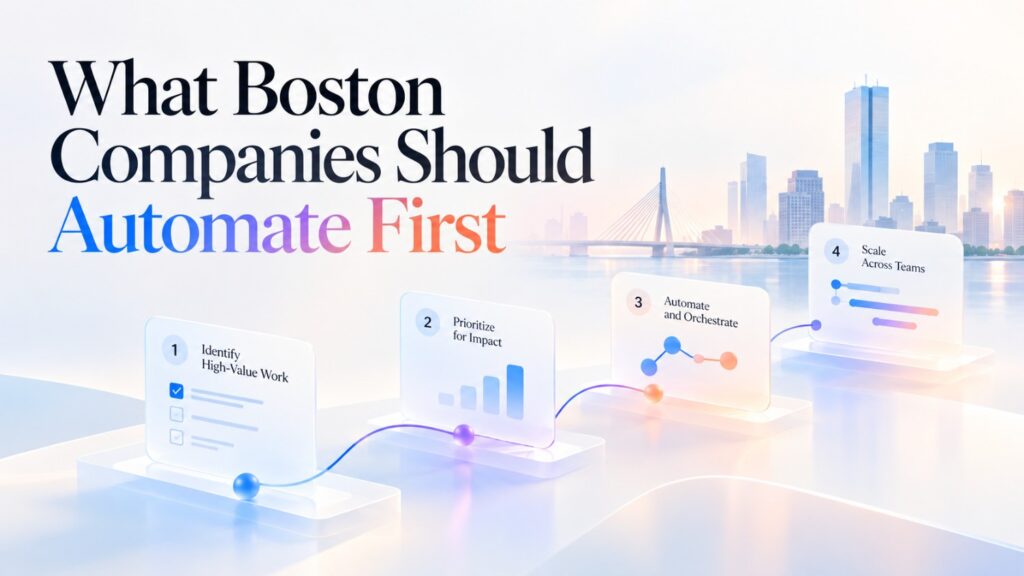
That workflow provides much more value than a simple meeting summary because it connects conversation to execution.
A Practical 90-Day AI Project Manager Pilot
Boston companies do not need to redesign an entire project-management office to learn whether this technology is useful. A carefully structured 90-day pilot can produce enough evidence to understand where the economics work and where the risks remain too high.
Days 1-15: Measure the Existing Coordination Load
The first step is understanding where project-management time actually goes. For two weeks, a small group of project managers can classify their work into a few meaningful categories such as planning, stakeholder management, meetings, reporting, follow-up, administrative updates, risk management, problem solving, and decision support.
The goal is not to create a perfect time-and-motion study. The goal is to discover where expensive employees are repeatedly doing work that is structured enough for a machine to help.
A company may discover, for example, that senior project leaders spend eight hours each week collecting status information and maintaining reporting systems. That becomes a far more useful starting point than simply asking employees whether they want an AI assistant.
Days 16-30: Choose One Repetitive Coordination Loop
Once the organization understands where time is going, it should select one workflow instead of attempting to automate the entire project lifecycle. Weekly status collection, action tracking, meeting follow-up, and reporting are usually better starting points than strategic prioritization or executive stakeholder management.
The workflow should also happen frequently. If a process occurs only twice per year, it becomes difficult to produce enough evidence during a short pilot.
A weekly or daily workflow creates many opportunities to test the system, compare its behavior with human work, and identify failure patterns.
Days 31-45: Establish Ground Truth
Automation becomes dangerous when nobody can agree on what the correct output should be. Before an AI system begins taking meaningful actions, the organization needs clear operating rules.
Teams should define which systems are authoritative, what counts as a valid project status, which fields the agent may update, what information must never be changed automatically, which actions need approval, and who remains accountable when the software makes a mistake.
This stage may feel less exciting than deploying the AI itself, but it often determines whether the eventual system becomes trustworthy.
Days 46-60: Run the Agent in Shadow Mode
During shadow mode, the AI can observe the workflow and prepare actions without actually executing them. The company can then compare what the agent would have done with what the project manager eventually chose to do.
This makes it possible to measure missed risks, false escalations, incorrect owners, wrong dates, incomplete context, and unnecessary actions without exposing the organization to the full consequences of those errors.
Shadow mode also reveals whether the company’s own underlying data is good enough for automation. Sometimes the biggest problem is not the AI but inconsistent project records.
Days 61-75: Allow Low-Risk Actions
If shadow-mode performance is acceptable, the organization can gradually permit reversible actions. The agent might send routine reminders, create draft records, schedule approved follow-ups, update confirmed action statuses, or prepare reports for human review.
High-impact decisions should remain protected during this phase. Budget changes, major timeline commitments, staffing decisions, customer promises, contractual actions, and strategic priority changes generally require more careful authority controls.
Days 76-90: Measure Capacity Returned
The final stage should focus on outcomes rather than AI usage. The important question is not how many prompts employees entered or how many summaries the system created.
Companies should measure how many project-management hours were returned, how much faster risks were detected, how long status reporting took, how many overdue tasks required manual chasing, how current project data became, and how many errors or corrections the agent created.
A strong AI project-management deployment should reduce coordination effort while maintaining or improving project quality.
A Better KPI: Coordination Hours per Project Week
BostonBizScene recommends that companies testing AI project management track a simple operating measure we can call Coordination Hours per Project Week, or CHPW.
CHPW represents the total employee time spent finding project status, moving information between systems, chasing routine actions, preparing repetitive updates, manually reconciling records, and synchronizing stakeholders when the work does not require major strategic judgment.
The purpose is not to reduce every form of coordination. Good projects require communication and leadership.
The purpose is to identify coordination that exists mainly because information is fragmented.
A company should measure CHPW before introducing the AI system and then measure it again after 30, 60, and 90 days. The result should also be compared with delivery quality, because reducing coordination hours while increasing missed dependencies would be a bad trade.
This KPI creates a more useful business conversation. Instead of asking whether employees “like the AI,” leaders can ask whether the organization is using fewer expensive human hours simply to maintain a shared understanding of what is happening.
Do Not Reward an AI Agent for Looking Busy
AI agents introduce a strange new management problem. They can generate enormous amounts of visible activity at almost no marginal labor cost.
An agent can send hundreds of reminders, prepare dozens of summaries, open new tasks, produce reports, schedule meetings, and update dashboards. The organization may feel more automated simply because more things are happening.
That does not mean the project is getting better.
Companies therefore need metrics tied to operational outcomes.
| Metric | What it tests |
| Coordination hours removed | Whether human capacity is actually returned |
| Action closure time | Whether work moves faster |
| Risk detection lead time | Whether problems become visible sooner |
| Project data freshness | Whether systems reflect current reality |
| False escalation rate | Whether the agent creates noise |
| Agent correction rate | How often humans must fix its work |
| Human approval frequency | Where autonomy remains limited |
| Milestone predictability | Whether planning becomes more accurate |
| Stakeholder response time | Whether coordination improves |
| Cost per managed project | Whether the economics improve |
The most important discipline is connecting agent behavior to project results. An AI project manager should not be rewarded for producing more artifacts.
It should be rewarded for reducing friction while helping the organization deliver work more reliably.
AI Project Managers Could Change Enterprise Software Pricing
Traditional project-management software is generally sold as software. Pricing often revolves around seats, users, feature tiers, storage, project counts, or enterprise contracts.
Agentic products could create very different economics.
If an AI system truly performs project-management labor, customers may eventually compare its price with the cost of people, consultants, outsourcing, delayed projects, and management overhead rather than with the price of another SaaS subscription.
That can dramatically expand the amount customers are willing to spend on software that produces measurable labor capacity.
A normal project dashboard may need to justify a monthly subscription costing tens of dollars per employee. An AI system that removes hundreds of hours of coordination work from a major program can potentially be evaluated against a completely different budget.
This is why AI-native business software may increasingly experiment with pricing based on projects managed, autonomous workflows completed, agent activity, successful outcomes, consumption, or measurable capacity returned.
The product starts behaving economically like labor even though it is technically software.
PMOs Could Become Smaller but More Powerful
Large project-management offices often exist because companies need a central group to create standards, collect reporting, manage governance, maintain templates, resolve escalations, and provide visibility across large portfolios.
AI could change the operating model of these teams.
Instead of dozens of people collecting updates and preparing recurring reports, a future PMO might rely on agents to maintain much of the portfolio information automatically.
The human team could spend more time deciding where capital should go, identifying systemic risks, comparing projects, resolving conflicts between departments, and challenging programs that are no longer delivering enough value.
That would make the PMO less administrative but potentially more strategic.
The same department might oversee more projects without growing headcount at the same rate.
For CFOs and chief operating officers, this could become one of the strongest reasons to explore agentic project management.
Project Management Could Become More Senior, Not Less Important
Automation discussions often assume that if machines take over tasks, the remaining job becomes less important. In project management, the opposite could happen.
If AI absorbs routine coordination, human project managers may spend a larger share of their working day on the parts of the profession that require the most experience. That includes strategy, negotiation, leadership, executive communication, organizational design, conflict management, prioritization, and difficult trade-offs.
A project manager whose main value comes from maintaining spreadsheets and moving status information between systems faces growing automation pressure. A project leader who can enter a failing transformation, determine what is genuinely wrong, rebuild trust between several executives, restructure the program, make painful trade-offs, and get the organization moving again is solving a much harder problem.
The role may therefore move away from project administration and toward project leadership.
That would also change hiring.
Companies may eventually need fewer employees whose main strength is maintaining project mechanics, while placing greater value on people who combine business judgment, communication, technical understanding, financial knowledge, organizational awareness, and the ability to supervise automated systems.
Entry-Level Project Management Could Face a Training Problem
There is an important complication that businesses should not ignore. Many experienced project leaders originally developed their judgment while performing routine project work.
Junior professionals schedule meetings, prepare notes, maintain trackers, create status reports, chase updates, and support senior managers. Those tasks can feel administrative, but they also expose beginners to how projects actually behave.
They learn which stakeholders frequently miss deadlines. They see how executives respond to bad news. They discover how small assumptions become large risks. They observe how experienced managers negotiate scope and handle difficult conversations.
If AI absorbs much of this entry-level work, companies may remove some of the very activities through which future project leaders traditionally gain experience.
Project management will not be alone in facing this problem. Accounting, law, software engineering, consulting, finance, marketing, and several other professional fields rely on junior employees completing simpler work before taking responsibility for more complicated decisions.
Organizations will need more intentional apprenticeship systems. They cannot assume future leaders will naturally gain experience through administrative work if much of that administrative work disappears.
Boston’s Wider AI Ecosystem Shows the Same Shift
The strongest argument that AI project management could become important is not simply that one Boston startup is building an AI PM. The deeper evidence is that the same execution model is appearing across unrelated industries.
Yuma is building autonomous customer-support agents designed to take action across connected systems rather than only suggest responses. Delineate applies AI agents around clinical-trial research and design.
Boost Robotics is building automation for physical inspection and maintenance work in data centers. Degla is working on systems where a user provides an objective and software coordinates how a group of drones should complete the mission.
Rindler supervises coding agents. Coworked coordinates enterprise projects.
The industries are different, but the architecture increasingly looks familiar.
A goal is defined, the system gathers context, a plan is created, actions occur, results are observed, the plan adjusts, and difficult exceptions are escalated.
That loop could become one of the defining structures of the next generation of business software.
The Bigger Story: Management Software Is Turning Into Management Labor
Traditional software mainly stored, displayed, organized, or analyzed work. Agentic software increasingly participates in the work itself.
A CRM historically recorded customer activity, but an AI sales agent can initiate outreach and follow up. A support platform historically stored tickets, while a support agent can investigate and resolve some of them.
A security platform traditionally displayed alerts, while security agents increasingly investigate those alerts and complete parts of the response process. Project-management software historically stored plans, tasks, dates, documents, and status information.
An AI project manager can potentially help execute the processes represented by those records.
That difference changes what companies are actually purchasing.
Instead of buying software only because employees need somewhere to work, organizations begin buying software because the software itself contributes labor.
The application stops being merely a tool.
It becomes productive capacity.
Original Finding #6: Project Management Could Be an Early Test of Broader Knowledge-Work Automation
Our Boston analysis suggests that project management matters for a reason much larger than the project-management software market itself. The profession contains many of the capabilities required before AI can reliably automate complex knowledge work.
A project manager has to maintain context over long periods. The work spans many applications, requires communication, involves deadlines and dependencies, contains repeated decisions, depends on past events, combines routine tasks with high-risk exceptions, and requires somebody to know when human judgment becomes necessary.
Those are precisely the problems AI systems must solve before they can operate independently inside complicated business environments.
If companies can make autonomous systems reliable in project management, the same technical architecture can spread into finance, compliance, procurement, marketing, operations, customer success, research, administration, information technology, and other office functions.
Project management may therefore become one of the proving grounds for the autonomous enterprise.
What Boston CEOs Should Ask Their Teams Now
The wrong starting question for an executive is whether the company should buy an AI project manager. That focuses attention on the technology before understanding the business problem.
A much more useful question is where highly paid employees are spending large amounts of time maintaining coordination instead of creating value.
Executives should look for projects with excessive status meetings, repeated manual reporting, several copies of the same information, constant chasing of action owners, outdated project systems, slow escalation, duplicated data entry, and unpleasant Friday-afternoon reporting rituals.
Those are not merely signs of inefficient project management. They are signs that the organization’s coordination architecture may be weak.
AI becomes useful when it attacks that underlying problem.
What Project Managers Should Do Now
Project managers should not wait for their employer to redesign the profession. The safest long-term strategy is to move toward the parts of the job where judgment, business understanding, accountability, and human relationships matter most.
That means learning more about strategy, finance, negotiation, organizational incentives, business models, data, change management, and decision rights. It also means becoming comfortable evaluating AI output and understanding where automated workflows fail.
Future project managers may need to spend less time becoming experts at maintaining spreadsheets and more time becoming experts at designing how humans and machines work together.
The profession may gradually shift from managing tasks to managing systems of execution.
What Boston AI Founders Should Build
There is still a large gap between an impressive agent demonstration and a trustworthy enterprise manager. That gap is where some of the most valuable startup opportunities may exist.
The market does not need another generic chatbot attached to a project dashboard. It needs reliable infrastructure for long-running work.
That includes project memory that remains accurate, permissions that respect organizational boundaries, actions that are fully auditable, escalation rules that behave predictably, integration with old enterprise systems, continuous evaluation of agent behavior, strong identity controls, and interfaces that allow humans to understand why an important action occurred.
Boston is well positioned for that challenge because the region has deep expertise in enterprise software, healthcare, cybersecurity, financial services, robotics, life sciences, regulated industries, and complex technical systems.
Those strengths become increasingly valuable as agentic AI moves from demonstrations into real operational environments.
The next stage of the market will not be won by clever prompts alone. It will be won by companies that can put AI inside important workflows without destroying trust.
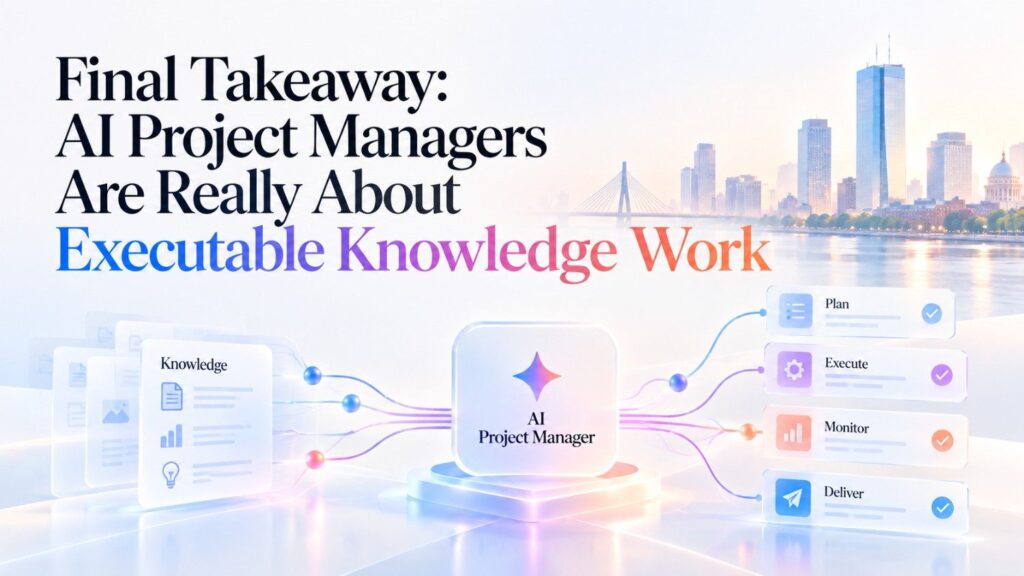
Final Takeaway: AI Project Managers Are Really About Executable Knowledge Work
It is easy to hear the phrase “AI project manager” and imagine a chatbot that sends reminders or produces cleaner status reports. That interpretation is far too narrow.
The larger idea is software that maintains context over time, follows work across several systems, takes routine actions, coordinates people and machines, identifies exceptions, adjusts plans, and continuously pushes a project toward an objective while knowing when authority must return to a human.
Boston now has a startup explicitly building toward that model through Coworked and Harmony. At the same time, a wider set of Boston AI companies is applying autonomous execution to coding, clinical research, customer service, robotics, industrial operations, and other forms of work.
Our analysis of Y Combinator’s Boston AI directory found that about 45% of the 22-company sample showed a clear execution or automation component under our conservative definition. That does not make all of them project-management companies, but it does show how quickly Boston’s AI startup ecosystem is moving from systems that provide intelligence toward systems that perform work.
Boston also has 18,840 formally classified project management specialists earning an average annual wage of $121,710. That represents approximately $2.29 billion in annual wage capacity before employee benefits and the much larger group of adjacent professionals doing project-management work are included.
Those numbers do not prove that AI will eliminate project managers, and that is not the most useful conclusion to draw from them. They explain why the economic incentive to automate coordination is so strong.
The more likely early transformation is a project-management office where machines handle a growing share of repetitive administrative work while humans remain responsible for strategy, accountability, difficult trade-offs, organizational change, stakeholder trust, negotiation, and high-impact decisions.
That shift could also change the economics of consulting, enterprise software, PMOs, and professional development. Smaller teams may manage larger portfolios, project systems may become more automated, and organizations may begin evaluating software according to the amount of productive capacity it creates rather than the number of employees logging into it.
That is why AI project managers deserve attention even from business leaders who have little interest in project-management software itself. This category is testing a much larger proposition about how companies will operate.
For decades, business software mainly gave employees better places to record, organize, and analyze work. The next generation of software is starting to participate in that work, maintain context around it, and take responsibility for parts of the execution process.
If that transition succeeds, the project-management market will be only one part of the story. The real transformation will be the arrival of executable knowledge work across the entire Boston economy.