
For more than 20 years, the basic shape of business software has stayed surprisingly stable.
A company buys a customer relationship management system. Employees type information into it. They open dashboards. They move records through stages. They update fields. They check alerts. They export reports. Then they jump into another piece of software to do the next part of the job.
Accounting software works differently from sales software, but the basic pattern is similar. So are project management tools, help desks, security dashboards, lending systems, and many other enterprise applications.
Humans operate the software.
AI agents are starting to challenge that model.
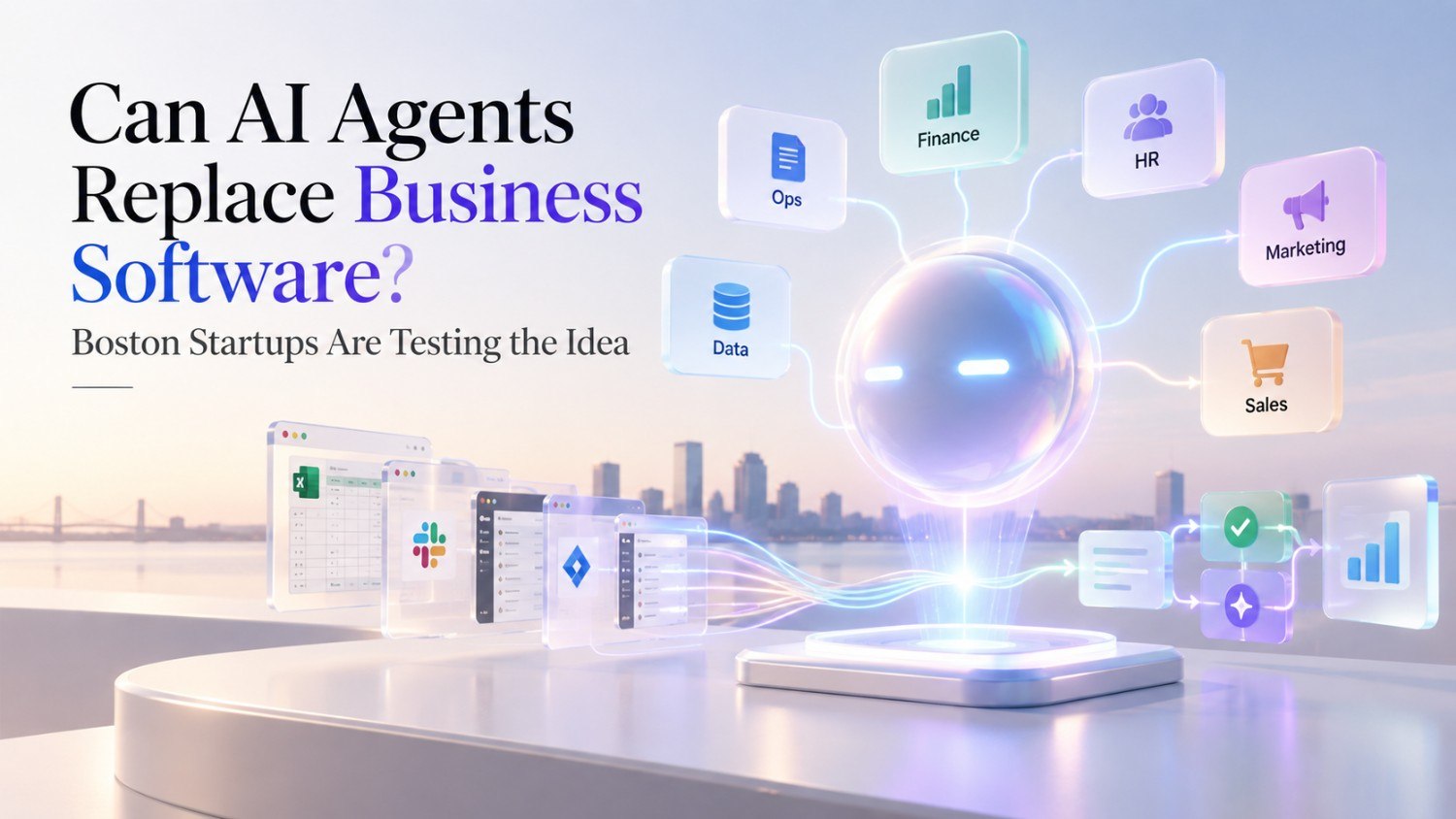
Instead of asking a person to open five applications and complete a 12-step process, an AI agent can increasingly read the information, decide what needs to happen, use the relevant tools, complete several steps, and bring the human back only when a judgment or approval is needed.
That raises a much bigger question than whether companies should add AI features to their existing software.
What happens if the agent becomes the main way work gets done and the traditional software becomes infrastructure sitting quietly underneath it?
Boston is becoming a useful place to study that question.
Startups in Boston and Cambridge are experimenting with AI agents in customer service, CRM, cybersecurity, commercial lending, project management, healthcare, life sciences, software development, manufacturing, and other complex areas.
Some are building new applications. Others are building agents that sit on top of old software. A third group is developing the security, control, and infrastructure layers needed when thousands of autonomous software workers begin operating across a company.
None of this proves that Salesforce, ServiceNow, Jira, Zendesk, Workday, or other large software platforms are about to disappear.
The more interesting finding is that the job of business software is starting to change.
Traditional software stores information and gives humans tools.
Agentic software is beginning to use that information and perform the work itself.
That difference could reshape one of the largest markets in technology.
The Short Version: Business Software May Not Disappear, but the Human Interface Could Shrink
The easiest mistake is to frame this debate as a simple contest between SaaS and AI agents.
That is probably too simple.
Businesses still need databases. They need permissions, audit logs, customer records, transaction histories, workflow rules, APIs, security controls, and systems that preserve important company information.
AI agents do not remove those needs.
What they may remove is the requirement for people to constantly operate those systems themselves.
A salesperson may no longer need to spend much time inside a CRM.
A support employee may no longer need to manually read every ticket.
A security analyst may no longer need to investigate every alert.
A commercial lender may no longer need to move between spreadsheets, documents, borrower systems, and credit tools for every review.
A software engineer may increasingly assign a job instead of manually performing each coding step.
That is the pattern appearing across several Boston startups.
Day AI, for example, describes itself as an AI-native successor to traditional CRM. It automatically collects context from conversations and other sources rather than depending on employees to continually update CRM records. The company raised a $20 million Series A in February 2026 after an earlier $4 million seed round.
Maven AGI is applying a similar idea to customer experience. Its agents work across existing help desks, CRMs, voice systems, and other tools while attempting to resolve customer issues end to end. Maven says some customer deployments have reached autonomous resolution rates as high as 93%.
Boston cybersecurity company 7AI goes further into execution. Its platform says it has processed more than 14 million alerts and reclaimed more than two million analyst hours since launching. The company raised a $130 million Series A in December 2025, bringing its total disclosed funding to $166 million.
The implication is important.
The next generation of enterprise software may not be defined by better menus, better dashboards, or cleaner forms.
It may be defined by how much work the software can complete without requiring somebody to operate those menus, dashboards, and forms in the first place.
Original Research: We Studied Boston’s Emerging Agentic Software Layer
To examine this idea more carefully, BostonBizScene created a new observation set focused specifically on Boston-area companies building AI systems that can perform business work.
This is not intended to be a complete census of every AI company in Greater Boston. It is a focused dataset designed to answer one question:
How close are Boston’s emerging AI companies getting to replacing the work traditionally performed through business software?
Our Methodology
We reviewed publicly available product documentation, company announcements, startup directories, funding announcements, and company descriptions available through September 27, 2026.
Companies were included when they met three conditions.
First, the company needed a clear Boston or Cambridge connection through its headquarters, operating location, or public startup profile.
Second, AI had to be central to the product rather than simply one minor feature.
Third, the product needed to either perform business work autonomously or provide infrastructure required for agents to perform that work.
That produced the following primary observation set.
| Company | Main Area | What the AI Is Beginning to Do |
| Day AI | CRM / sales | Captures customer context, maintains relationship memory, supports GTM agents |
| Maven AGI | Customer service | Resolves customer issues and performs multi-step service actions |
| 7AI | Cybersecurity | Investigates security alerts and executes security workflows |
| EnFi | Commercial lending | Executes parts of commercial credit and lending workflows |
| Coworked | Project management | Performs coordination work associated with project managers |
| OpenHands | Software development | Executes coding and engineering tasks |
| Layer Health | Healthcare | Automates medical chart review |
| LogicFlo | Life sciences | Executes regulated knowledge workflows |
| Robby | Home services | Finds revenue opportunities and directs sales activity |
| Delineate | Clinical development | Processes evidence for clinical-trial decisions |
| Tulip | Manufacturing | Uses agents to analyze plant data and support operational actions |
| Neo | Enterprise security | Controls and governs increasingly autonomous software |
| Subconscious | Agent infrastructure | Makes long-running agents more efficient |
| Rindler | Agent infrastructure | Helps AI agents interact reliably with websites |
There are several different business models inside this group. That is exactly why the dataset is useful.
Some companies are directly attacking existing software categories.
Others are attacking individual workflows.
Still others are building the infrastructure that becomes necessary if agents succeed.
Together, they provide a useful picture of what an agent-centered business software market could look like.
Original Finding #1: The Most Important Shift Is From Systems of Record to Systems of Action
Traditional enterprise software was built around the idea of a system of record.
A CRM stores the customer record.
An ERP stores business operations data.
A project management platform stores tasks.
A security information and event management platform stores security events.
A ticketing system stores support cases.
These systems became extremely valuable because companies needed one reliable place where important information lived.
AI does not eliminate that need.
But it creates a second layer.
That layer is a system of action.
A system of record answers:
“What do we know?”
A system of action asks:
“What should happen next, and can I do it?”
That is a major change.
Day AI Shows What This Could Mean for CRM
CRM is a good place to see the shift because traditional CRM depends heavily on humans maintaining the database.
Salespeople have calls.
They update opportunities.
They add notes.
They change stages.
They enter follow-up dates.
Managers then use the resulting database to understand the business.
The problem is obvious. If employees fail to update the software correctly, the system of record becomes incomplete.
Day AI is built around a different assumption.
The company says software can observe conversations and other customer interactions directly instead of waiting for employees to manually translate those interactions into CRM fields. Day describes its architecture as a context graph and agent control plane rather than simply a conventional CRM with an AI assistant added to it.
That may sound like a technical difference.
Commercially, it is much bigger.
If the software can automatically understand what happened with a customer, maintain the account context, identify what should happen next, and eventually assign agents to act on that context, much of the traditional CRM interface becomes less important.
The database still matters.
The work of feeding and operating the database matters less.
Chart 1: The Traditional Software Loop Versus the Agent Loop
| Traditional SaaS Model | Agentic Model |
| Human receives information | Agent receives information automatically |
| Human enters information | Agent creates or updates context |
| Human checks dashboard | Agent monitors conditions |
| Human decides next action | Agent recommends or selects action |
| Human opens another tool | Agent calls another tool |
| Human completes task | Agent completes routine steps |
| Human records result | Agent records result automatically |
The biggest disruption may therefore happen above the database rather than inside it.
Software does not vanish.
Human software operation declines.
Original Finding #2: Boston Startups Are Targeting Workflows With High Labor Costs
One of the clearest findings from the Boston dataset is where founders are choosing to deploy agents.
They are not limiting themselves to trivial administrative tasks.
Many are targeting workflows where each hour of human work is relatively expensive.
Cybersecurity analysts are expensive.
Commercial credit professionals are expensive.
Software engineers are expensive.
Clinical researchers are expensive.
Healthcare workers are expensive.
Pharmaceutical specialists are expensive.
Customer support at large scale is expensive because even relatively inexpensive interactions become costly when millions of them must be processed.
This creates a strong economic incentive for autonomy.
7AI Turns Security Alerts Into an Economic Problem
Security operations centers provide a particularly clear example.
A modern company can generate huge volumes of alerts. Many need investigation even though only a small share may require serious human action.
Traditionally, companies solve the problem by employing security analysts and giving them a collection of security tools.
7AI is attempting to move the repetitive investigation itself into AI agents.
The company reports more than 14 million alerts processed and more than two million analyst hours saved on its current public metrics page. It also cites deployments where the number of security tickets humans needed to review fell dramatically after agent adoption. These are company-reported figures rather than independently audited measures, so they should be treated as vendor evidence, not universal benchmarks.
The direction still matters.
A traditional security product helps an analyst investigate.
An autonomous security product conducts the investigation and sends selected cases to the analyst.
Those are fundamentally different products.
EnFi Is Applying the Same Idea to Commercial Lending
Boston-based EnFi describes its product as an AI-native platform that provides agents for end-to-end commercial lending workflows. The company raised a $15 million Series A in February 2026, bringing total funding to $22.5 million.
Commercial lending is exactly the type of market where agents could become valuable.
A credit professional may need to collect financial statements, review spreadsheets, analyze borrower performance, identify changes, prepare credit materials, monitor loans, and move information between multiple systems.
Not every decision can or should be delegated.
But much of the preparation around the decision can potentially be automated.
This distinction is critical.
AI agents do not need to replace the chief credit officer to reshape commercial lending software.
They only need to remove a meaningful percentage of the manual work surrounding each credit decision.
Original Finding #3: Workflow Replacement Looks More Likely Than Immediate Software Replacement
The phrase “replace business software” can create the wrong picture.
It sounds like a company cancels Salesforce on Friday and runs entirely on an autonomous agent on Monday.
That is unlikely to be how most enterprise transitions happen.
A more realistic sequence is emerging.
Stage One: The Agent Sits Beside the Software
At first, companies add an agent to existing tools.
The agent reads data but performs limited actions.
This is close to the copilot model.
Stage Two: The Agent Begins Operating the Software
The agent gains access to APIs, databases, email, messaging systems, ticketing products, browsers, and other enterprise tools.
Humans still own the workflow, but the agent performs more of the individual steps.
Stage Three: The Agent Owns the Routine Workflow
At this point, the worker does not ask the software what to do.
The worker manages exceptions while the agent completes the normal process.
Stage Four: The Interface Collapses
Once employees rarely interact directly with the original application, the interface becomes less strategically important.
The database, security controls, and APIs remain important.
The dashboard loses value.
Stage Five: A New System of Record May Emerge
This is the most disruptive stage.
If the agent-native product captures the information, stores the context, orchestrates the workflow, executes actions, and preserves the audit trail, businesses may start questioning why they need the original application at all.
Day AI’s positioning around “life after CRM” is one of the clearest public examples of a Boston company explicitly pursuing this idea.
Original Finding #4: Customer Support May Reach This Future Earlier Than Many Other Functions
Customer support has several qualities that make it unusually suitable for agents.
The work is high volume.
Much of the input is digital.
Policies are often documented.
Successful outcomes can be measured.
Many actions can be accessed through APIs.
Escalation paths already exist.
That combination makes support a strong testing ground for agentic enterprise software.
Maven AGI Is Testing End-to-End Resolution
Maven AGI does not position its agents merely as question-answering bots.
Its platform connects to existing systems and attempts to complete customer outcomes across chat, email, voice, and web. Maven says its agents can take multi-step actions and work with current systems of record without requiring customers to migrate all their data.
That architecture provides an important clue about the future of SaaS.
The old application can survive underneath.
The agent becomes the layer the customer or employee interacts with.
This is potentially more dangerous to traditional software vendors than a simple AI feature.
If the agent owns the workflow, it owns the user relationship.
And software companies have historically created enormous economic value by owning that relationship.
The Interface Is Often Where SaaS Built Its Moat
Traditional software companies have spent decades making interfaces easier to use.
Better search.
Better forms.
Better dashboards.
Better navigation.
Better reporting.
Better mobile applications.
Agents change the question.
Instead of asking:
“How do we make this screen easier for an employee to use?”
a company can ask:
“Why does the employee need to use this screen at all?”
That is a very different product design problem.
Original Finding #5: Boston’s Agent Economy Is Already Attracting Serious Capital
We also examined disclosed financing for a smaller subset of Boston-area companies where comparable recent funding announcements were publicly available.
To avoid creating a misleading “total Boston funding” number, we used the latest clearly disclosed funding event for each company in the observation set rather than combining every historical funding event.
Selected Recent Funding Events
| Company | Recent Disclosed Financing | Primary Agentic Area |
| 7AI | $130M | Cybersecurity |
| Neo | $100M | Agent security and control |
| Maven AGI | $50M | Customer experience |
| Layer Health | $21M | Medical chart review |
| Day AI | $20M | CRM |
| OpenHands | $18.8M | Software development |
| EnFi | $15M | Commercial lending |
| Subconscious | $5.1M | Agent infrastructure |
| LogicFlo | $2.7M | Life sciences |
| Coworked | $1.8M | Project management |
| Observation-set total | $364.4M |
The underlying announcements report $130 million for 7AI’s Series A, $100 million for Neo’s launch financing, $50 million for Maven AGI’s Series B, $21 million for Layer Health’s Series A, $20 million for Day AI’s Series A, $18.8 million for OpenHands’ Series A, $15 million for EnFi’s Series A, $5.1 million for Subconscious, $2.7 million for LogicFlo, and $1.8 million for Coworked.
Again, this is not all Boston AI funding.
It is an intentionally narrow observation set.
But even within this small sample, the latest disclosed funding events total approximately $364.4 million.
Chart 2: Capital in the Observation Set
| Category | Latest-Round Capital | Share |
| Workflow/application companies | $240.5M | 66.0% |
| Agent infrastructure/control companies | $123.9M | 34.0% |
| Total | $364.4M | 100% |
Our classification places Day AI, Maven AGI, 7AI, EnFi, Layer Health, LogicFlo, and Coworked in the direct workflow/application group. OpenHands, Neo, and Subconscious were placed in the execution, infrastructure, or control-layer group for this specific calculation.
The precise boundary is imperfect. OpenHands, for example, is both an application and an agent platform.
The larger point is more useful than arguing over one classification.
Capital is flowing into both sides of the agent economy: the agents that perform work and the infrastructure required to control them.
That is what a developing software stack looks like.
The New Enterprise Stack May Have Four Layers
If agents continue to improve, business software may separate into four major layers.
Layer One: Systems of Record
These systems hold trusted business data.
Companies will still need databases for customers, transactions, employees, inventory, policies, medical information, code, and many other records.
This layer may remain surprisingly durable.
Layer Two: Context
Agents need more than rows in a database.
They need conversations, documents, policies, past decisions, relationships, permissions, and current business conditions.
Day AI’s focus on a context graph shows why this layer is becoming strategically important. A traditional record might say that a sales opportunity is worth $200,000. Context can explain what happened in the last three calls, who is worried about the purchase, why the deal slowed down, and what the customer asked the company to do next.
Layer Three: Agents
This is where decisions and work happen.
A support agent resolves an issue.
A security agent investigates an alert.
A coding agent fixes a bug.
A lending agent reviews financial information.
A project agent follows up on incomplete work.
This is the layer receiving much of the current attention.
Layer Four: Control
Once agents can act, companies need systems that answer new questions.
Which agents exist?
What can each agent access?
What actions did the agent take?
Which model was used?
What did the agent spend?
What data did it touch?
Was the action permitted?
Can the decision be reconstructed?
Can the agent be stopped?
That helps explain why Boston companies such as Neo and Agentic Highway are already appearing around agent security, governance, and accountability.
Neo emerged from stealth in July 2026 with $100 million in funding and is building controls for AI agents and increasingly agentic enterprise applications.
Boston-based Agentic Highway describes its Vettd product as a trust layer for the agentic software supply chain, designed to create inventory and evidence around agentic assets.
These companies are an important signal.
Entire control categories rarely emerge around technologies nobody expects businesses to deploy.
Why the Old SaaS Interface Is Vulnerable
For years, SaaS economics benefited from adding functionality.
Every department wanted another application.
Every problem produced another dashboard.
Every workflow produced another interface.
Eventually, companies ended up with hundreds of applications.
AI agents can potentially reverse some of this fragmentation.
An employee may not care whether an action is completed in Salesforce, Jira, Zendesk, ServiceNow, a proprietary application, or a browser portal.
The employee cares that the job gets done.
An agent can potentially hide the complexity underneath.
Rindler Is Solving the “No API” Problem
This creates another infrastructure challenge.
Agents work best when software provides reliable APIs.
Unfortunately, much of the business world still runs through websites built for humans.
Boston-based Rindler is working on that gap. Its public materials describe technology that converts websites into structured interfaces that agents can use more reliably, including authenticated websites and flows without convenient traditional APIs.
This is important because the agentic enterprise cannot wait for every old software vendor to redesign its product.
Agents need ways to operate the systems companies already use.
If technologies like this become reliable enough, the web itself can start to behave like a giant agent-accessible API.
That would reduce the power of the visible interface even further.
Software Development Shows How Quickly the Model Can Change
Coding is another useful market to watch because the transition from assistant to agent has happened quickly.
The first wave of generative AI coding products suggested code.
The developer remained responsible for most of the workflow.
Agentic development tools are moving toward receiving a job, inspecting a codebase, modifying files, running commands, testing work, and producing a result for review.
Boston-area OpenHands is explicitly built around autonomous software work.
Its product documentation describes agents that complete engineering tasks across codebases rather than simply providing code suggestions. The platform supports automated workflows, APIs, GitHub and GitLab integrations, self-hosted deployment, and the coordination of multiple agents.
OpenHands raised an $18.8 million Series A in November 2025 after previously announcing $5 million in funding for its open-source agent work.
This provides a preview of what may happen elsewhere.
The product does not need to replace the source-code repository.
It does not need to eliminate issue tracking immediately.
It does not need to remove every development tool.
It only needs to become the place where more of the work is delegated.
Once that happens, the economic center of the workflow starts moving.
Original Finding #6: The Agent Often Becomes a New User of Existing SaaS
There is another way to understand this transition.
For decades, enterprise software companies designed products for humans.
AI agents introduce a second user.
The agent itself.
That sounds minor, but it changes product strategy.
Agents do not need attractive dashboards.
They do not care whether a button is blue.
They do not need onboarding tours.
They care about structured data, permissions, APIs, deterministic actions, latency, auditability, and predictable system behavior.
Software built for human operators and software built for machine operators have different requirements.
Chart 3: Human Software Users Versus Agent Software Users
| Human User Needs | Agent User Needs |
| Clear navigation | Reliable interfaces |
| Visual dashboards | Structured machine-readable data |
| Forms | Write access or actions |
| Search boxes | Retrieval APIs |
| Tooltips | Schemas |
| Training | Instructions and permissions |
| Easy password login | Scoped authentication |
| Reports | Structured outputs |
| Undo button | Reversible actions and checkpoints |
| Activity history | Full machine audit trail |
This means existing SaaS companies face two choices.
They can expose their software to agents.
Or another company can build an agent layer that learns how to operate the software for them.
Either path reduces the strategic importance of the traditional graphical interface.
Manufacturing Shows Why “Replacing Software” Is Not Always the Right Goal
Cambridge-based Tulip provides an important counterexample to the idea that agentic systems will simply wipe out existing platforms.
Tulip already provides a manufacturing operations platform.
It has now added AI agents inside that system.
Tulip’s documentation describes agents as configurable digital team members that can analyze connected manufacturing information, make decisions, and support tasks such as defect disposition, root-cause work, and operational analysis.
This may become a common path for established SaaS companies.
The product does not disappear.
It evolves from a tool employees operate into an environment where employees and agents work together.
That leads to a critical strategic point.
The real battle may not be SaaS versus agents. It may be agent-native software versus SaaS that successfully becomes agentic.
Some incumbent platforms will adapt.
Others may struggle because their architecture, pricing model, interfaces, or data structures were designed around human seats rather than autonomous work.
Seat-Based Pricing Could Become One of the Biggest Casualties
Traditional SaaS pricing often follows users.
A company has 200 employees.
It buys 200 seats.
The vendor charges a monthly amount for each seat.
That model makes sense when every employee needs to log into the application.
Agentic workflows make the math less obvious.
Imagine a finance team of 30 people using several software products.
Now imagine five AI agents performing the repetitive work that previously required 30 people to interact with those systems.
How many software seats does the company need?
Perhaps 30.
Perhaps 10.
Perhaps one enterprise API contract.
Perhaps pricing shifts toward transactions, tasks, outcomes, compute, or agent activity.
This could create substantial pressure on seat-based SaaS economics even when the underlying software survives technically.
A Simple Example
Consider a business paying $100 per employee per month for a specialized application.
With 100 users:
100 × $100 × 12 months = $120,000 per year.
Now imagine agents perform most routine interaction and only 25 employees need direct software access.
25 × $100 × 12 = $30,000 per year.
The application vendor has not been “replaced.”
Yet 75% of the seat revenue has disappeared.
That is why the agentic shift matters even before complete software replacement becomes possible.
The Biggest Opportunity May Be Software Consolidation
Businesses have spent the past decade adding SaaS products.
Sales uses one system.
Marketing uses another.
Support uses another.
Finance uses another.
Operations uses several.
Data teams connect everything.
Employees copy information between systems.
Consultants build integrations.
IT manages permissions.
The resulting software stack can be expensive and difficult to operate.
AI agents create the possibility of collapsing parts of that complexity.
Not because every database becomes one database.
Because the employee may no longer need to care which database is involved.
Robby Shows the Vertical Version of This Idea
YC-backed Boston startup Robby is building AI agents for home-services companies.
Its public description says the system combines customer and third-party information to find revenue opportunities, generate leads, and give technicians information they can use during customer interactions. It also provides management with a central command layer for revenue activity.
This is an interesting model because a home-services company could otherwise solve those problems using several separate products.
CRM.
Lead generation.
Analytics.
Customer intelligence.
Sales enablement.
Technician software.
An agentic product can potentially combine portions of several categories around one desired result: more revenue.
That is what vertical AI changes.
The software category matters less.
The workflow outcome matters more.
Original Finding #7: Vertical AI May Be More Dangerous to SaaS Than General-Purpose Agents
A general AI agent must understand many businesses.
A vertical agent only needs to understand one deeply.
That can be a major advantage.
A commercial lending agent can learn the structure of credit work.
A pharmaceutical agent can learn regulated life-sciences processes.
A security agent can learn alerts, investigations, and response procedures.
A home-services agent can learn technician visits, customer histories, equipment, and sales opportunities.
A healthcare agent can learn medical records.
When an agent understands a specific domain, it becomes possible to automate more than generic administrative work.
LogicFlo Is a Good Example
Boston-based LogicFlo raised $2.7 million in 2025 to build an AI agent workforce for pharmaceutical, biotechnology, and medical-technology teams.
The company’s focus includes tasks performed by regulatory, medical-writing, quality, and safety specialists.
These are not generic chatbot tasks.
They are specialized workflows where mistakes can matter.
That makes automation harder.
It also makes successful automation more valuable.
Delineate Goes After Clinical-Trial Research
Boston-based Delineate is using AI agents around clinical-trial design and evidence aggregation.
Its YC profile says researchers can otherwise spend months collecting information across research papers and patents, while the company aims to convert that material into structured datasets much more quickly.
Again, the unit of disruption is not a software screen.
It is a block of professional work.
That may be the more useful way to measure the agent economy.
A Better Metric: Automation Depth
Many companies currently say they use AI.
That tells buyers almost nothing.
A much more useful question is:
How deep into the workflow does the AI go?
Boston businesses evaluating agent technology should measure automation depth across five levels.
Chart 4: The Automation Depth Ladder
| Level | AI Capability | Human Role |
| 1 | Answers a question | Human does all work |
| 2 | Generates a draft | Human executes |
| 3 | Recommends an action | Human approves and executes |
| 4 | Executes routine actions | Human handles approvals and exceptions |
| 5 | Owns an end-to-end routine workflow | Human supervises outcomes |
Most early generative AI products lived around levels one and two.
The most interesting Boston companies are pushing toward levels four and five.
Maven attempts autonomous resolution.
7AI investigates alerts.
EnFi describes end-to-end lending workflows.
Coworked is building an agentic project manager designed to perform core coordination functions.
OpenHands executes software-engineering tasks.
The closer software gets to level five, the less useful it becomes to compare it with a traditional chatbot.
The economic comparison shifts toward labor and entire software workflows.
Why Human-in-the-Loop Will Remain Important
None of this means businesses should hand every decision to an autonomous system.
In fact, deeper autonomy makes human control more important.
A chatbot that writes a poor paragraph creates a small problem.
An agent that changes a financial record, blocks a user, modifies production software, denies a transaction, contacts a customer, or changes a security configuration can create a much larger problem.
The role of humans therefore changes rather than disappearing.
Workers move from performing every step to defining authority.
Which actions can the agent take automatically?
Which actions require approval?
What dollar amount requires escalation?
What type of security event requires human review?
Which customer promises can an agent make?
Which records can it modify?
How can an action be reversed?
These become product-design questions, not merely policy questions.
The Control Plane Could Become a Huge New Software Category
When thousands of employees use SaaS, businesses need identity management.
When thousands of servers run, businesses need monitoring.
When thousands of cloud resources exist, businesses need cloud security.
When thousands of agents begin taking actions, businesses will need agent control systems.
That market is already beginning to form.
Neo Is Building Around Agentic Software Risk
Boston-based Neo launched publicly in July 2026 with $100 million in funding.
Its product is designed to help security teams discover, understand, and control AI agents, AI-enabled applications, identities, browsers, and traditional applications that gain agent-like features.
That is significant because enterprise software is becoming less predictable.
Traditional applications usually perform actions explicitly requested through defined screens.
Agents can decide which actions to take based on context.
That flexibility creates value.
It also creates risk.
Subconscious Is Tackling the Compute Layer
Cambridge-based Subconscious is attacking another problem: long-running agents require large amounts of context and inference.
The company announced $5.1 million in financing in September 2026 around technology intended to compress agent context and make long-running agents faster and less expensive.
This is another sign that the market is moving beyond the chatbot era.
Short conversations need one type of infrastructure.
Agents running for long periods, making repeated model calls, maintaining context, and completing complex tasks require something different.
The infrastructure stack changes as the work changes.
What Could Prevent Agents From Replacing Traditional Software?
The agent thesis is powerful, but there are serious limits.
Reliability Still Matters More Than Intelligence
A model can be impressive and still be unreliable.
Businesses do not need an agent that completes a financial workflow correctly 95% of the time if the remaining 5% can create serious losses.
Many enterprise workflows require predictable execution.
That is one reason traditional software has survived for so long.
A database does not creatively reinterpret the number in a field every morning.
Agents must reach a much higher reliability level before they can own sensitive workflows.
Permissions Become Much Harder
Software permissions are relatively straightforward when people click buttons.
Agents may work across many systems.
An agent could potentially read customer information, modify records, send email, update financial data, access code, or take operational actions.
Companies will need very precise control over what each agent can do.
Audits Matter
A human employee can often explain why a decision was made.
Businesses operating in regulated industries may need the same ability from agents.
They need records.
Inputs.
Outputs.
Actions.
Approvals.
Model versions.
Data sources.
Escalations.
Without that evidence, autonomy will stop at the edge of many regulated workflows.
Integration Is Still Messy
Businesses do not run on clean software stacks.
They run on old databases, spreadsheets, email, custom applications, poorly documented APIs, websites, PDFs, and institutional knowledge.
An agent may be intelligent enough to understand the job while still lacking reliable access to the tools required to complete it.
Infrastructure companies are working on this problem, but it remains real.
Why Boston Has an Advantage in This Market
Boston may be unusually well positioned for the next phase of agentic software because the city is strongest in areas where work is expensive, specialized, regulated, or technically difficult.
That includes healthcare.
Biotechnology.
Cybersecurity.
Financial services.
Robotics.
Enterprise software.
Manufacturing.
Engineering.
Scientific research.
These are environments where replacing ten minutes of casual work is not especially valuable.
Replacing ten hours of expert work can be.
Y Combinator’s Boston AI directory listed 22 Boston-headquartered AI startups in September 2026, while its broader Boston B2B directory contained 24 B2B software and service startups. Those directories are not a complete census of the region, but they show meaningful startup density in the exact categories where agentic systems are emerging.
Boston also has a structural advantage.
Founders can recruit people who already understand difficult industries.
The person building the lending agent can understand lending.
The person building clinical software can understand biology.
The person building cybersecurity automation can understand security operations.
As foundational AI models become more widely available, that domain knowledge may become more valuable.
Original Finding #8: Domain Knowledge Could Become the New Software Moat
For much of the SaaS era, one major advantage was the software itself.
Building a polished enterprise application was expensive.
Cloud infrastructure, front-end development, back-end systems, integrations, mobile applications, analytics, and security all required significant engineering resources.
AI is lowering parts of that barrier.
That changes where durable value may sit.
The strongest moat may increasingly come from understanding the workflow better than everyone else.
A lender’s exception process.
A pharmaceutical approval workflow.
A security analyst’s investigation logic.
A hospital’s chart-review rules.
A manufacturer’s quality procedures.
A support organization’s escalation policies.
This knowledge determines whether an agent can actually complete useful work.
Boston has a large supply of people who possess this kind of knowledge.
That could matter more than simply having access to the newest language model.
What Boston Companies Should Do Now
Business leaders should not begin by asking whether they should replace their SaaS stack.
That question is too large.
Start with work.
Find the Workflow, Not the App
Choose one important process.
Map every step.
For example, take a customer-support request.
Where does it arrive?
What information must be collected?
What systems does the employee check?
What decisions are made?
What actions follow?
When is approval required?
What is recorded afterward?
This gives you the real unit of automation.
Calculate the Human Cost of the Workflow
Do not evaluate agents only against software subscriptions.
Calculate the cost of the work.
Suppose 20 employees spend six hours each week on a repetitive process.
That equals 120 employee hours per week.
Across 50 working weeks:
120 × 50 = 6,000 hours per year.
At a fully loaded labor cost of $60 per hour, the workflow costs approximately:
6,000 × $60 = $360,000 per year.
A $50,000 agent system that safely automates half of that work could create a meaningful return even if it adds another software bill.
That is why comparing agent products only with SaaS subscription prices misses the larger opportunity.
Build an Agent ROI Dashboard
Boston companies experimenting with agents should measure them like operating systems, not demos.
A useful dashboard should track several numbers together.
| Metric | Why It Matters |
| Workflow completion rate | Shows whether the agent finishes useful work |
| Human intervention rate | Shows how autonomous it really is |
| Error rate | Measures reliability |
| Escalation accuracy | Shows whether risky work reaches humans |
| Cost per completed workflow | Allows economic comparison |
| Time per workflow | Measures speed |
| Rework rate | Detects hidden quality problems |
| Software interactions eliminated | Measures interface reduction |
| Human hours returned | Measures labor impact |
| Revenue or cost outcome | Connects automation to business value |
One number should receive special attention:
Percentage of workflows completed without human operation of the underlying software.
That may become one of the best indicators of genuine agent adoption.
A 90-Day Plan for Testing Whether Agents Can Replace Part of Your Software Stack
The safest approach is not a company-wide AI transformation.
It is a controlled workflow experiment.
Days 1–30: Map the Work
Select one high-volume workflow with clear outcomes.
Document the current process.
Measure volume, employee time, cycle time, software cost, error rate, and number of systems involved.
Identify actions that are reversible and actions that are dangerous.
Do not automate yet.
Establish the baseline first.
Days 31–60: Introduce Supervised Automation
Allow the agent to perform routine steps but require human approval before meaningful external actions.
Measure where it succeeds.
Measure where it fails.
Most importantly, identify why failures happen.
Was the model confused?
Was information missing?
Was the API unreliable?
Were the instructions unclear?
Was business context unavailable?
Was the workflow itself poorly defined?
Those are different problems and require different solutions.
Days 61–90: Increase Authority Carefully
Once performance is stable, allow the agent to execute low-risk actions without approval.
Keep humans focused on exceptions.
Then compare the workflow with the original baseline.
If labor time falls while quality remains stable or improves, the project is working.
Only then expand the scope.
What SaaS Companies in Boston Should Do
For software vendors, the threat is not that every customer cancels tomorrow.
The larger risk is losing control of the workflow.
If another company’s agent becomes the layer through which customers use your application, your software can slowly turn into infrastructure.
That may pressure pricing and customer loyalty.
SaaS companies should therefore make their products easy for agents to use.
They need strong APIs.
Clear permissions.
Reliable structured outputs.
Event systems.
Machine-readable documentation.
Detailed audit logs.
Granular authentication.
Safe write operations.
Good rollback mechanisms.
And increasingly, they may need their own agents.
The worst strategy may be protecting the old interface because the old interface once created the moat.
The Future May Be Fewer Screens, Not Less Software
This is the central distinction.
AI agents do not necessarily destroy software.
They can make software invisible.
A business may still use dozens of systems behind the scenes.
But instead of employees constantly switching between them, an agent manages the interaction.
The employee communicates the outcome.
The agent chooses the tools.
That changes enterprise software from something humans actively operate into something agents consume.
The databases survive.
The APIs become more valuable.
The traditional interface may become less valuable.
The agent layer becomes more valuable.
The Bigger Story: Software Is Moving From Tool to Worker
The SaaS revolution changed how businesses bought software.
Instead of buying servers and installing large applications, companies subscribed to software delivered through the cloud.
The agentic shift could be even more fundamental.
It changes what companies believe software is supposed to do.
Traditional SaaS gives an employee a tool.
Agentic software receives a job.
That sounds like a small wording change.
It is not.
A tool increases the productivity of the worker.
An agent absorbs part of the worker’s workflow.
The distinction changes pricing, product design, software architecture, security, staffing, management, and competitive advantage.
Boston’s emerging AI ecosystem provides early evidence of this transformation.
Day AI is questioning the old CRM model.
Maven AGI is moving customer support toward autonomous resolution.
7AI is turning security investigations into agent work.
EnFi is applying agents to commercial lending.
Coworked is applying them to project coordination.
OpenHands is applying them to engineering.
Layer Health is automating medical chart review.
LogicFlo and Delineate are applying agentic systems to specialized life-sciences work.
Robby is building agents around the revenue workflow of home-services companies.
Neo, Subconscious, Rindler, and Agentic Highway are building pieces of the infrastructure needed when software starts acting rather than simply waiting for clicks.
The common thread is difficult to miss.
Boston startups are not only adding AI to software.
They are asking what remains of business software once the AI can operate it.
Final Takeaway: AI Agents Probably Will Not Replace All Business Software, but They Could Replace a Huge Amount of Software Use
The most useful question is not whether AI agents will eliminate SaaS.
That framing is too absolute.
The better question is:
How much direct human interaction with business software can agents remove?
If the answer eventually becomes 20%, the software market changes.
If it becomes 50%, software pricing and product design change dramatically.
If agents eventually complete most routine workflows, the graphical application may stop being the center of enterprise computing.
The system of record could remain.
The employee may barely see it.
That is the idea Boston startups are now testing across CRM, customer service, cybersecurity, lending, healthcare, life sciences, project management, manufacturing, and software development.
The winners may not be the companies with the prettiest AI chat window.
They may be the companies that understand a difficult workflow deeply enough to remove the need for that window altogether.
For Boston business leaders, that creates a practical challenge.
Do not ask which AI product can answer the most impressive question.
Ask which workflow still requires an employee to spend hours clicking through software.
Then ask a much more valuable question:
How much of that work could the software do by itself?