

Software development is entering one of its biggest periods of change since cloud computing reshaped how applications were built, deployed, and maintained.
For years, AI coding tools mainly helped developers work faster by completing lines of code, explaining errors, suggesting functions, or turning short instructions into small blocks of software. These tools were useful, but they still depended on a human developer to guide almost every step. The engineer remained the person planning the work, deciding what to change, checking the result, running tests, and moving the task forward.
Coding agents are beginning to change that relationship.
Instead of waiting for a developer to give one instruction at a time, a coding agent can receive a broader goal and work through several parts of the job on its own. It may inspect a codebase, decide which files need to change, create an implementation plan, write code, run tests, review errors, make corrections, and return with a completed result that is ready for human review.
That is a much bigger shift than simply making autocomplete better.
The unit of work is moving from a line of code to an engineering task.
Boston is becoming an important place to watch this change because local startups are not all building the same type of coding product. Some are creating agents that directly perform software work, while others are building systems that manage multiple coding agents, keep long-running agent workflows reliable, reduce infrastructure costs, or provide the surrounding control layer that businesses need before they can trust autonomous software at scale.
That mix matters because the largest opportunity in coding AI may not belong only to the company with the strongest model. It may also belong to the companies that make AI-driven software development reliable, observable, secure, affordable, and manageable inside real enterprises.
The Short Version: Coding AI Is Moving From Assistance to Delegated Engineering
The simplest way to understand the current transition is to compare an AI coding assistant with an AI coding agent.
A coding assistant helps a developer perform a task. A coding agent tries to complete more of the task itself.
With a traditional assistant, a developer might ask AI to create a component, then ask it to build an API, then paste an error message back into the tool, then request a fix, run the tests, inspect the result, and continue guiding the process until the work is finished.
The AI may save time, but the human still acts as the workflow manager.
A coding agent changes that pattern by attempting to own more of the process. The developer can describe a desired outcome, and the agent may inspect the repository, plan the changes, update several files, run tests, fix failures, and prepare the work for review.
This moves coding AI from conversation toward execution.
The most important measurement therefore begins to change as well. Instead of asking how many lines of code the AI produced, engineering teams can start asking how much useful work the AI actually completed.
That change creates new technical and management problems.
Companies need to know how several agents can operate at once without interfering with one another. They need to know how agents should receive access to repositories, infrastructure, databases, terminals, and deployment systems. They also need to understand how long-running agent tasks can preserve context, recover from failures, control costs, and escalate difficult decisions to humans.
These problems are creating an entirely new layer of developer infrastructure, and Boston startups are beginning to build several important parts of it.
Why Boston Is an Interesting Market for Coding Agents
Boston already has many of the ingredients required for a strong developer-tool ecosystem.
The region has major universities, experienced software engineers, cloud infrastructure companies, cybersecurity businesses, healthcare technology firms, robotics startups, biotech companies, financial institutions, and enterprise software vendors. Many of these organizations operate in environments where software quality, reliability, security, and control matter deeply.
That makes Boston especially relevant to the next stage of coding agents.
A small consumer startup may be comfortable allowing an agent to build a simple landing page or internal dashboard. A bank, healthcare software company, robotics business, or infrastructure provider usually needs a much more controlled system.
Its codebase may be large and complex. Its software may interact with sensitive information, regulated workflows, expensive equipment, or business-critical systems. Engineers may need strong testing, clear permissions, detailed logs, approval rules, audit trails, and carefully designed deployment processes.
In these environments, a powerful coding model is only one piece of the solution.
The harder question is how to let software act without losing control.
That is where Boston’s strengths become relevant. The region has spent decades producing enterprise technology, infrastructure software, security tools, and systems for industries where reliability matters. Coding agents may give local founders another opportunity to apply that engineering culture.
BostonBizScene Original Research: Mapping Boston’s Emerging Coding-Agent Stack
To understand what is actually being built in the region, BostonBizScene created a small original dataset of Boston and Cambridge companies directly connected to coding agents or the infrastructure required to run them.
The goal was not to create the largest possible list. It was to build a narrow sample that would reveal where local founders are choosing to compete.
Our Methodology
A company entered the core sample only when it met three conditions.
First, public information needed to place the business in Boston or Cambridge.
Second, the company’s core product had to directly support software creation, autonomous coding, engineering workflows, agent execution, agent orchestration, long-running agent work, or the infrastructure required for those activities.
Third, there needed to be enough public information to identify the main layer of the coding-agent stack the company was building.
Using those rules, five companies stood out as particularly useful for our September 2026 snapshot.
| Company | Boston-area presence | Main layer | Core problem |
| OpenHands | Boston | Coding agent platform | Autonomous software engineering |
| Rindler / Maxxwell | Boston | Agent orchestration | Managing many coding agents |
| OpenProse | Boston | Agent workflow/runtime | Reliable long-running agent work |
| Orion AI | Boston | Data-aware coding and analysis agent | Connecting code with live context |
| Subconscious | Cambridge | Inference and context infrastructure | Cost and efficiency for long-running agents |
The sample is small, so the percentages derived from it should not be treated as a measurement of the entire Boston software market. However, the composition of the sample still reveals several useful patterns about where early local companies see opportunity.
Original Finding #1: Boston’s Opportunity Is Already Larger Than Code Generation
If the coding-agent market were mainly about generating better code, we would expect most local startups to compete on the same question: which system can write software most effectively?
That is not what the sample shows.
Only part of the market is focused directly on code generation and execution. A large portion of the activity is forming around the supporting systems that become necessary once coding agents are capable enough to perform meaningful work.
What Layer Is Each Boston Company Building?
| Coding-agent layer | Companies | Share of sample |
| Direct coding or analytical execution | 2 | 40% |
| Multi-agent supervision and orchestration | 1 | 20% |
| Agent workflow and runtime | 1 | 20% |
| Inference and context infrastructure | 1 | 20% |
Three of the five companies in the sample are primarily working on orchestration, workflow, runtime, or underlying infrastructure rather than simply trying to generate better code.
That represents 60% of the sample.
The percentage itself should be treated carefully because five companies cannot represent an entire regional market. The broader signal is more important.
Boston founders are already thinking beyond the first coding agent.
They are building for what happens when autonomous engineering becomes normal.
Original Finding #2: The Developer Could Become a Manager of Software Agents
Rindler provides one of the clearest examples of this change.
The company is building Maxxwell around a problem that barely existed a few years ago: developers running enough coding agents at the same time that managing the agents becomes a meaningful part of the job.
When a developer works with one coding agent, the interface is relatively simple. The engineer assigns a task, watches the output, and intervenes when needed.
The workflow becomes much more complicated when several agents are operating in parallel.
One agent may be fixing a bug while another writes tests. A third could be upgrading a dependency, a fourth could be generating documentation, and a fifth could be building an internal tool.
At that point, the developer is no longer only writing software.
The developer is supervising work.
They need to know which agent is progressing, which one is blocked, which task needs human judgment, which change is ready for review, and which agent may be moving in the wrong direction.
That creates an entirely new interface problem.
The Software Engineer May Begin to Look More Like a Technical Team Lead
A senior engineer today may coordinate several human developers.
In an agent-heavy environment, that same engineer could eventually coordinate humans and software agents at the same time.
The valuable skill then moves beyond typing code quickly. Engineers will need to break large problems into smaller units, define boundaries, review plans, inspect output, understand architecture, identify incorrect assumptions, and know when human judgment is required.
This makes orchestration software much more important.
If every engineer uses one coding agent, a normal coding interface may be enough.
If every engineer manages ten or twenty agents, developers will need something closer to an operational dashboard.
The Next Developer Interface May Be Organized Around Tasks, Not Files
Traditional development environments are built around files.
Developers open folders, inspect source code, modify functions, run commands, and debug problems.
An agent-based development environment may be structured around work instead.
A developer could see a dashboard showing:
| Task | Status |
| Payment migration | Testing |
| Login bug | Waiting for approval |
| API refactor | Agent blocked |
| Documentation update | Completed |
| Dependency upgrade | Validation failed |
This is a very different way to build software.
Instead of watching every line appear, the developer monitors the state of the work and steps in where human judgment creates the most value.
Original Finding #3: Boston Startups Are Mostly Building Around the Model, Not Trying to Replace It
Another useful pattern becomes visible when we look at where these companies are positioning themselves relative to the largest AI model providers.
None of the five companies in our core sample appears to be building its main advantage around training a giant proprietary frontier coding model.
Instead, they are building around existing models.
That is strategically important.
Rindler works with coding agents that already exist and focuses on helping developers manage them.
OpenHands emphasizes openness and model choice rather than forcing customers to depend on a single underlying model.
Subconscious works on inference and context efficiency for long-running agents.
OpenProse focuses on the runtime and workflow layer.
This creates a different competitive position.
Boston May Be Better Positioned to Build the Control Plane Than the Next Frontier Model
Building a frontier model requires enormous amounts of capital, computing infrastructure, training data, and research talent.
Building the control layer around those models is a different challenge.
It requires understanding how enterprises actually use AI, where workflows fail, how permissions should work, how costs should be controlled, how tasks should be monitored, and how humans should stay involved.
Boston already has a strong history in enterprise software, developer infrastructure, security, and complex technical systems.
That could make the control layer a more natural local opportunity.
The cloud computing market provides a useful comparison.
Most valuable cloud companies did not create new processors. They built databases, monitoring tools, security products, deployment systems, networking platforms, and business applications on top of existing computing infrastructure.
Coding agents may follow the same pattern.
The model matters, but the systems surrounding the model may become equally important.
OpenHands Shows What Autonomous Software Development Could Look Like
OpenHands is one of the most direct examples of a Boston company working on autonomous software engineering.
The company is building an open platform for cloud coding agents. The broader idea is that engineering teams should be able to use AI agents without giving complete control to one proprietary model, editor, or infrastructure provider.
That matters because coding agents require much more than text generation.
They need access to repositories.
They need development environments.
They need tools.
They need permission to run commands.
They need enough computing power to perform work.
They need testing.
They need logs.
They need clear security boundaries.
They also need to operate long enough to complete meaningful tasks.
The Real Shift Is From Suggesting Code to Completing Engineering Work
Consider a traditional coding assistant.
A developer asks the AI to write a test.
The AI responds with code.
The developer reviews it, runs it, fixes anything that breaks, and then moves to the next part of the job.
Now consider an autonomous agent assigned to improve test coverage.
The agent first needs to understand the repository. It needs to identify weak coverage, locate important files, create appropriate tests, execute them, inspect failures, and revise its work until the result is acceptable.
The value is no longer in the first block of generated code.
The value is in the completed loop.
This makes autonomous development look less like autocomplete and more like distributed computing.
Coding Agents Start Looking Like Compute Workers
A cloud coding agent needs an environment in which it can operate.
That environment must contain the right dependencies, access controls, tools, and computing resources. It must also prevent the agent from accidentally reaching systems it should not touch.
Once agents begin working for long periods, companies need additional controls.
Engineering leaders need to know which agent did what, what it changed, why it took an action, whether it exceeded its authority, and how much the work cost.
That is why coding agents quickly become an infrastructure problem.
Rindler Is Attacking the Multi-Agent Management Problem
If OpenHands represents the autonomous software worker, Rindler is closer to the management console.
The company’s basic insight is easy to understand.
One coding agent can be helpful.
Ten coding agents can become difficult to supervise.
A developer running several autonomous sessions can lose time checking terminals, finding stalled jobs, responding to minor questions, and figuring out which task actually requires attention.
Rindler’s Maxxwell product is designed around that coordination problem.
Instead of forcing developers to watch each session separately, the system can bring several coding agents into one environment and surface the tasks that require human involvement.
This Could Become the Development Environment After the IDE
The traditional IDE was created for a world in which humans directly manipulate source code.
Files are central because humans need to open, edit, search, and debug them.
In a heavily agentic workflow, the important object may become the task instead.
The developer may spend less time opening files manually and more time deciding whether the agent’s work is correct.
The interface may therefore evolve from:
files,
folders,
functions,
and terminals
toward:
tasks,
progress,
approvals,
escalations,
failures,
and completed work.
That is a major change in how software development could feel.
OpenProse Is Building for Tasks That Last Longer Than One Prompt
Short AI demonstrations often make agentic coding look easy.
Ask an AI to create a small website and the result may appear in seconds.
Real software engineering is rarely that simple.
Complex work can involve many steps, dependencies, failures, retries, and decisions. One mistake early in the process can affect everything that happens later.
This is the problem OpenProse is approaching.
The Boston company is building infrastructure for reliable long-running AI workflows. Its product direction focuses on the systems required to keep complex agent work structured and recoverable over time.
Long-Running Agents Need More Than Good Instructions
Imagine assigning an agent the task of modernizing an old application.
The agent may need to inspect the architecture, identify outdated dependencies, create a migration plan, update code, run tests, fix broken behavior, revise configurations, and update documentation.
That work may take a long time.
During the process, something is likely to go wrong.
A command may fail.
A service may time out.
The agent may lose track of an earlier decision.
A tool may return unexpected output.
Another process may change the repository.
A reliable system needs to preserve enough state to recover.
That makes workflow management essential.
Agents Need Memory of the Process, Not Just the Prompt
Human engineers naturally remember context while they work.
They remember that a test failed because of a change made ten minutes earlier. They know that one temporary fix should be removed before deployment. They remember which approach has already been tried.
Agents need a technical equivalent.
This creates demand for runtimes that track execution state, dependencies, failures, retries, context, and unfinished work.
The larger the engineering task becomes, the more valuable these capabilities become.
Subconscious Shows Why Coding-Agent Economics Could Become a Major Infrastructure Market
Coding agents have another problem that receives less attention than output quality.
They can become expensive.
A long-running agent may repeatedly read source files, documentation, logs, test results, previous messages, and its own earlier decisions.
As the task grows, the amount of information the model needs to process can grow as well.
That can make agent workloads costly.
Cambridge-based Subconscious is working on this infrastructure problem.
The company is focused on improving how long-running AI systems manage context and inference so that agents can work for longer periods without repeatedly processing unnecessary information.
Agent Cost Could Become the Next Cloud-Cost Problem
Software companies already spend a great deal of effort managing cloud costs.
They optimize queries, reduce wasted computing, clean up unused resources, monitor storage, negotiate infrastructure contracts, and allocate spending across teams.
Agent infrastructure may develop in the same way.
Imagine a company with 1,000 engineers.
Now imagine each engineer running several agents throughout the day.
Those agents may consume model tokens, cloud compute, sandboxes, storage, databases, search tools, and external APIs.
The resulting bill can become significant very quickly.
Cost Per Completed Task Is More Useful Than Cost Per Token
Many AI products advertise model prices in terms of tokens.
That measurement is useful, but it does not tell the whole story.
A cheap model that fails repeatedly may cost more than an expensive model that succeeds immediately.
A better metric for coding agents is total cost per accepted task.
That should include model usage, computing, agent infrastructure, failed attempts, testing, human review, and rework.
Once companies measure costs this way, they can make much better decisions about models, workflows, and automation levels.
Orion AI Highlights the Need for Specialized Coding Context
Not every coding task looks like application development.
Data analysis provides a useful example.
An AI may be able to write correct Python, but that does not mean it understands the state of the analysis.
It may need to inspect datasets, notebook outputs, charts, variables, errors, intermediate results, and prior calculations before deciding what should happen next.
Boston-based Orion points toward this more context-aware form of AI development.
The broader lesson is that the future of coding agents may not be entirely general-purpose.
Specialized Engineering Agents Could Become an Important Market
A web development agent needs one kind of context.
A data-science agent needs another.
A robotics agent may need access to simulation environments, device specifications, hardware interfaces, and testing systems.
A biotech agent may need scientific libraries, research data, and compliance constraints.
A cybersecurity agent may need vulnerability databases, threat intelligence, logs, and security rules.
The underlying language model may be similar across several products.
The surrounding context can be completely different.
This creates room for vertical coding agents that are deeply adapted to one type of work.
Boston’s concentration in robotics, healthcare, biotech, finance, and cybersecurity gives local startups many opportunities to build these specialized systems.
Original Finding #4: At Least $23.9 Million of Clearly Disclosed Capital Is Already Represented in Two Companies From the Core Sample
Funding data for very young companies is often incomplete, so our analysis uses only figures that could be identified clearly from public disclosures.
Two companies in the five-company core sample have especially clear recent financing figures.
OpenHands announced an $18.8 million Series A.
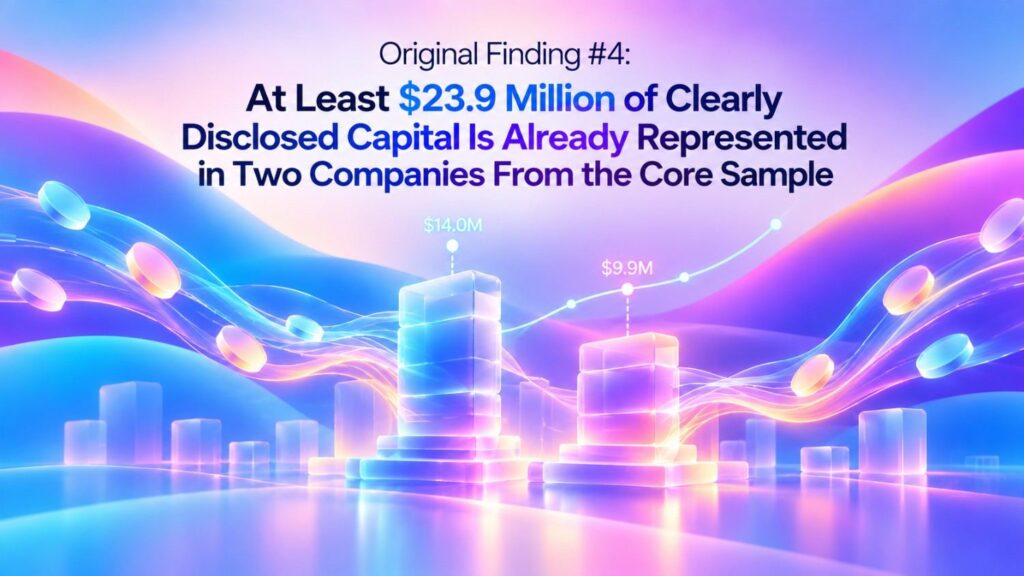
Subconscious announced $5.1 million across pre-seed and seed financing.
That gives us a clearly identifiable minimum of $23.9 million across those two companies.
| Company | Public financing included in analysis |
| OpenHands | $18.8M |
| Subconscious | $5.1M |
| Rindler | Not included |
| OpenProse | Not included |
| Orion AI | Not included |
| Known minimum | $23.9M |
This number should not be described as total Boston coding-agent funding.
It is simply the amount we could clearly verify in the companies included in the narrow research sample.
The more useful conclusion is that capital is already flowing into both direct coding-agent platforms and the infrastructure surrounding long-running agents.
The Wider Market Is Moving in the Same Direction
Boston is not developing separately from the rest of the coding industry.
Across the market, developer tools are moving away from simple code suggestions and toward systems that can execute larger software tasks.
Large technology companies and fast-growing startups are all moving in this direction.
The emerging market includes direct coding agents, model-routing systems, agent runtimes, orchestration software, code-review tools, development environments, memory systems, testing platforms, and infrastructure designed to control costs.
The result is a much broader competitive landscape than the first generation of AI coding tools created.
The question is no longer only which assistant can suggest the best next line.
The question is which system can reliably complete useful engineering work inside a real company.
The Coding-Agent Stack Is Becoming Easier to See
Business leaders should not think of a coding agent as one product.
It is becoming a technology stack with several layers.
Layer 1: The Model
The model provides reasoning and language capabilities.
It understands instructions, reads code, creates plans, and generates changes.
Different models may perform better on different types of engineering work.
Layer 2: Context
The agent needs to understand the environment in which it is working.
That includes source code, documentation, architecture, coding standards, test history, database schemas, previous changes, and internal rules.
Without good context, even a strong model can make poor decisions.
Layer 3: Tools
The agent needs the ability to act.
That may include access to Git, terminals, browsers, databases, cloud systems, issue trackers, testing frameworks, internal APIs, and deployment tools.
Tool access increases capability, but it also increases risk.
Layer 4: Execution Environment
Agents need a safe place to work.
That environment must provide enough access to complete the task while preventing the agent from reaching systems it should not control.
Layer 5: Workflow
Large engineering jobs contain several steps.
Agents need systems that can keep track of those steps, recover from failures, and preserve state.
Layer 6: Orchestration
When several agents work at the same time, companies need a way to coordinate them.
Someone has to understand which tasks are active, which are blocked, which conflict, and which require human attention.
Layer 7: Review and Governance
Autonomous output still needs trust.
Engineering teams need rules for what agents are allowed to change, what requires approval, and how completed work should be validated.
Layer 8: Observability and Economics
Companies also need to understand how agents behave.
They need to measure time, cost, errors, intervention rates, task completion, model performance, and system reliability.
These layers show why coding agents are turning into an infrastructure market rather than remaining a feature inside the editor.
The Bottleneck Could Move From Writing Code to Reviewing It
One of the most important effects of coding agents is that they can dramatically increase the amount of code produced.
That creates a new problem.
Someone still needs to trust the code.
If an engineer normally creates three meaningful pull requests in a week and a group of agents can generate fifteen, the review workload can rise much faster than human capacity.
That means code production may stop being the main bottleneck.
Review may take its place.
Faster Generation Can Create a Review Backlog
This is a familiar operational problem.
When one part of a system becomes faster and the next part does not, work starts piling up between them.
The same thing could happen in software development.
AI increases the speed of production, but humans still need to verify architecture, security, product requirements, performance, and business logic.
This makes automated testing, AI-assisted review, code validation, planning, and risk detection increasingly valuable.
The companies that help businesses trust AI-generated work may become just as important as the companies that generate the work.
Software Development Could Become Far More Parallel
Traditional development often happens sequentially because humans have limited attention.
One engineer works on one problem, then moves to another.
Agents can change that pattern.
A developer may be able to delegate several independent tasks at the same time.
One agent could update documentation while another fixes a bug and another writes tests.
This creates leverage, but it also creates coordination problems.
Parallel Coding Requires Better Boundaries
If several agents change related systems at the same time, conflicts become more likely.
One agent may base its work on code that another agent has just changed.
Two agents may solve the same problem in different ways.
Several agents may introduce incompatible architecture decisions.
This makes task design much more important.
Engineering teams will need clearer boundaries, stronger acceptance criteria, better documentation, and more explicit dependencies.
In other words, coding agents increase the value of good engineering management.
Companies With Cleaner Engineering Systems Will Get More Value From Agents
AI agents will not automatically repair weak engineering practices.
In many cases, they will expose them.
A messy repository is harder for agents to understand.
Weak tests make autonomous changes more dangerous.
Poor documentation reduces the quality of context.
Inconsistent naming makes it harder for agents to locate the right information.
Undocumented systems force the model to guess.
That means disciplined engineering organizations are likely to benefit more from coding agents than chaotic ones.
Documentation Is Becoming Machine Infrastructure
For years, many software companies treated documentation as optional because senior engineers carried important knowledge in their heads.
Agents cannot access that invisible knowledge.
Important information needs to become readable by machines.
Architecture notes matter.
Repository instructions matter.
API documentation matters.
Testing conventions matter.
Decision records matter.
Coding standards matter.
Improving these systems may be one of the cheapest ways to improve coding-agent performance.
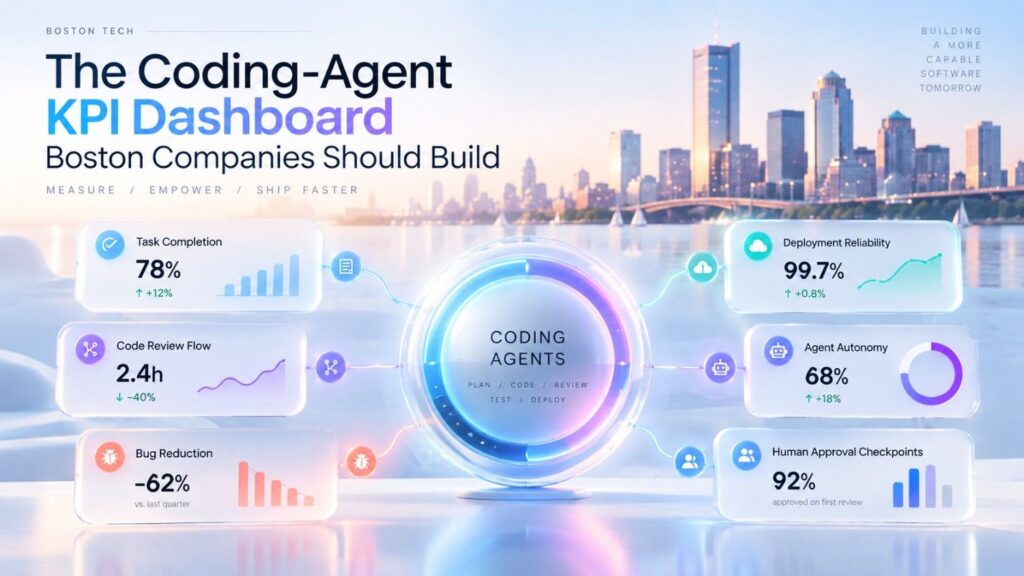
The Coding-Agent KPI Dashboard Boston Companies Should Build
Companies should avoid measuring coding agents only by how impressive the demo looks.
They need operational metrics that show whether the technology is actually improving engineering performance.
Task Completion Rate
Measure how many assigned tasks reach an acceptable result.
If agents start 100 jobs but humans need to completely redo 40 of them, the apparent speed is misleading.
Human Intervention Rate
Track how often an engineer needs to step in.
This reveals whether the system is genuinely autonomous or simply creating more conversational work.
Accepted Change Rate
Measure how much agent-generated work is actually merged, shipped, or deployed.
Unused generated code has little business value.
Rework Rate
Track how often accepted work requires major corrections.
A system that creates large amounts of rework can destroy the productivity gains it appears to create.
Cost Per Accepted Task
Combine model cost, infrastructure cost, testing, agent tools, and human review time.
This produces a much more useful economic measurement than token cost alone.
Time From Assignment to Accepted Result
Measure the complete cycle rather than only generation time.
Include waiting, retries, testing, review, and human intervention.
Escalation Quality
A strong agent should recognize when a problem exceeds its authority or confidence.
Good escalation may be more valuable than reckless autonomy.
How Boston Companies Should Deploy Coding Agents
Companies do not need to give coding agents broad access immediately.
The safer approach is gradual.
Start With Work That Has Clear Boundaries
Begin with tasks where success is easy to judge.
Examples may include documentation updates, test creation, dependency upgrades, small bug fixes, internal tools, or repetitive maintenance work.
The specific task matters less than the clarity of the outcome.
Build Evaluation Before Expanding Autonomy
Companies should establish strong tests, review rules, static checks, security controls, and deployment safeguards before increasing an agent’s authority.
Automation without evaluation creates risk.
Increase Permissions in Stages
A low-authority agent may only read a repository and suggest changes.
The next level may create a branch.
Another level can run tests.
Another may open pull requests.
A higher-authority agent could eventually merge certain low-risk changes.
Production access should require stronger controls.
Autonomy should be earned through demonstrated reliability.
Human Engineers Become More Valuable at Decision Boundaries
Coding agents can reduce repetitive engineering work.
That does not eliminate the need for experienced engineers.
It changes where their value is concentrated.
AI can quickly produce implementation options.
Humans still need to decide whether those options make sense.
Architecture Matters More When Code Is Cheap
An agent can generate another service.
That does not mean the company needs one.
It can add another dependency.
That does not mean the dependency is wise.
It can rewrite a working system.
That does not mean the rewrite creates enough value to justify the risk.
Experienced engineers understand tradeoffs that are not always visible in the code.
They understand business constraints, customer history, previous failures, team capabilities, regulatory requirements, and long-term maintenance costs.
That judgment becomes more important when AI makes implementation faster.
The Best Engineers May Personally Write Less Code
This is one of the most interesting possibilities created by coding agents.
An experienced engineer may spend less time typing and more time defining problems, reviewing plans, checking results, making architecture decisions, resolving unusual issues, and improving the environment in which agents operate.
The job shifts upward.
The engineer becomes responsible for quality, direction, and judgment rather than only production.
A 90-Day Coding-Agent Plan for Boston Businesses
Companies can learn a great deal without redesigning their entire engineering organization.
A controlled 90-day program is enough to identify where coding agents create real value.
Days 1–30: Establish the Baseline
Choose one engineering team and identify several common task types.
Measure how long those tasks currently take, how much review they require, and how often they create rework.
Then introduce coding agents without changing approval rules.
The goal is to understand where agents help and where they create new problems.
Days 31–60: Improve the Environment
Once the company has early data, improve the systems around the agents.
Clean up repository instructions.
Improve documentation.
Strengthen tests.
Create safe development environments.
Define access boundaries.
Record agent actions.
Begin tracking cost per accepted task.
By the end of this phase, the team should know which types of work agents handle reliably.
Days 61–90: Test Controlled Parallelism
Allow experienced developers to delegate several bounded tasks at once.
Measure whether productivity improves or whether coordination becomes the new bottleneck.
Watch for conflicts between agents.
Measure supervision overhead.
If developers begin struggling to manage several sessions, test an orchestration layer.
The goal is not to prove that AI can write code.
The goal is to understand what the operating model looks like when autonomous software becomes part of the engineering team.
What Boston Founders Should Build Next
The coding-agent market is still early enough that many valuable categories remain open.
Agent Testing
Businesses will need ways to test the agents themselves.
Companies need to know whether an agent follows instructions, respects boundaries, uses tools safely, and behaves consistently across repeated tasks.
Agent Observability
Engineering teams need to understand what happened during a long agent session.
Which files did the agent inspect?
Which commands did it run?
Where did it become confused?
What caused the task to fail?
Which model calls consumed the most money?
This creates a major monitoring opportunity.
Agent Identity and Permissions
Human engineers have identities and access controls.
Agents may eventually need the same.
Companies should be able to trace every action back to a specific agent, user, task, and permission level.
Agent Memory
An agent that works repeatedly on the same repository should not need to relearn every important detail each time.
Persistent memory could improve performance significantly.
It also introduces new governance and security questions.
Agent Cost Management
As agent usage grows, companies will want to allocate costs by team, repository, project, task type, customer, and model.
This could become a new form of engineering financial management.
Specialized Engineering Agents
Boston may be particularly well positioned here.
The region could produce agents built specifically for robotics, biotech, healthcare software, finance, cybersecurity, or scientific computing.
These markets require deeper context than a general coding tool may provide.
Five Strategic Changes Boston Companies Should Prepare For
Several broader changes are becoming increasingly likely if coding agents continue improving.
Coding-Agent Management Will Become a Real Developer Category
Once engineers routinely use several agents, supervision becomes a product problem.
Development tools will need better support for task queues, approvals, agent status, escalation, and parallel work.
Workflow Quality Will Matter as Much as Model Quality
As frontier models become more capable, companies may care less about tiny differences in raw model intelligence.
They will care more about reliability, security, context, cost, integration, and control.
The surrounding workflow becomes part of the product advantage.
Agent Infrastructure Will Become an Engineering Budget Line
AI coding costs are unlikely to remain hidden inside a handful of developer subscriptions.
Companies will eventually track inference, sandboxes, runtimes, context systems, monitoring, and orchestration as separate engineering expenses.
Review Will Move Earlier in the Process
When code becomes cheap to generate, companies gain more value by reviewing plans before large amounts of code are created.
AI may therefore make software development more plan-driven rather than less structured.
Engineering Capacity Will Become Less Connected to Headcount
A small team using agents well may eventually complete much more work than the same team could manage manually.
That does not mean companies should simply reduce headcount.
It means team size becomes a weaker indicator of development capacity.
The Biggest Mistake Is Treating Coding Agents Like Faster Autocomplete
The first generation of coding AI trained people to think about productivity in terms of typing.
How many lines did the AI generate?
How many suggestions did the developer accept?
How many minutes did autocomplete save?
Those measurements become less useful as agents take on larger tasks.
The better questions are different.
How much work was completed?
How much human supervision was required?
How reliable was the result?
How much did the completed task cost?
How many jobs could run at the same time?
Which decisions still required an experienced engineer?
These are no longer simple coding questions.
They are operating-system questions.
Boston’s startup activity makes more sense when viewed from that perspective.
OpenHands is working on autonomous software execution.
Rindler is tackling the challenge of supervising several coding agents.
OpenProse is building around reliable long-running workflows.
Subconscious is working on the economics and context infrastructure behind long-duration agents.
Orion points toward a future in which coding systems become specialized around the data, tools, and runtime environment of a particular field.
Each company is attacking a different problem, but together they reveal the outline of a much larger market.
The Bigger Story: Boston Is Building Infrastructure for Software That Builds Software
The most important change in software development is not simply that AI can write code.
That capability is already widely available.
The deeper change is that software is beginning to participate in more of the process required to build other software.
An agent can inspect a problem, form a plan, change files, use tools, run tests, examine failures, revise its work, coordinate with other agents, and return a finished result for a human to review.
Once this becomes common, companies need much more than a strong AI model.
They need execution environments.
They need orchestration.
They need context systems.
They need memory.
They need monitoring.
They need security.
They need permissions.
They need cost controls.
They need testing.
They need reliable methods for deciding when humans should remain in control.
Our BostonBizScene sample found that three of the five companies we examined are primarily focused on orchestration, workflow, runtime, or infrastructure rather than direct code generation.
That 60% figure should not be treated as a measurement of the full Boston market, but it still provides a useful early signal.
Boston’s coding-agent opportunity may not be about building another tool that writes Python slightly faster.
The larger opportunity may lie in building the systems that allow businesses to trust autonomous software with a much larger share of engineering work.
That could become a far bigger market.
When every developer uses one agent, companies need coding tools.
When every developer manages ten or twenty agents, companies need infrastructure.
And if autonomous software eventually performs a meaningful share of routine engineering work, the companies that build and control that infrastructure could become some of the most important developer-tool businesses of the next decade.