
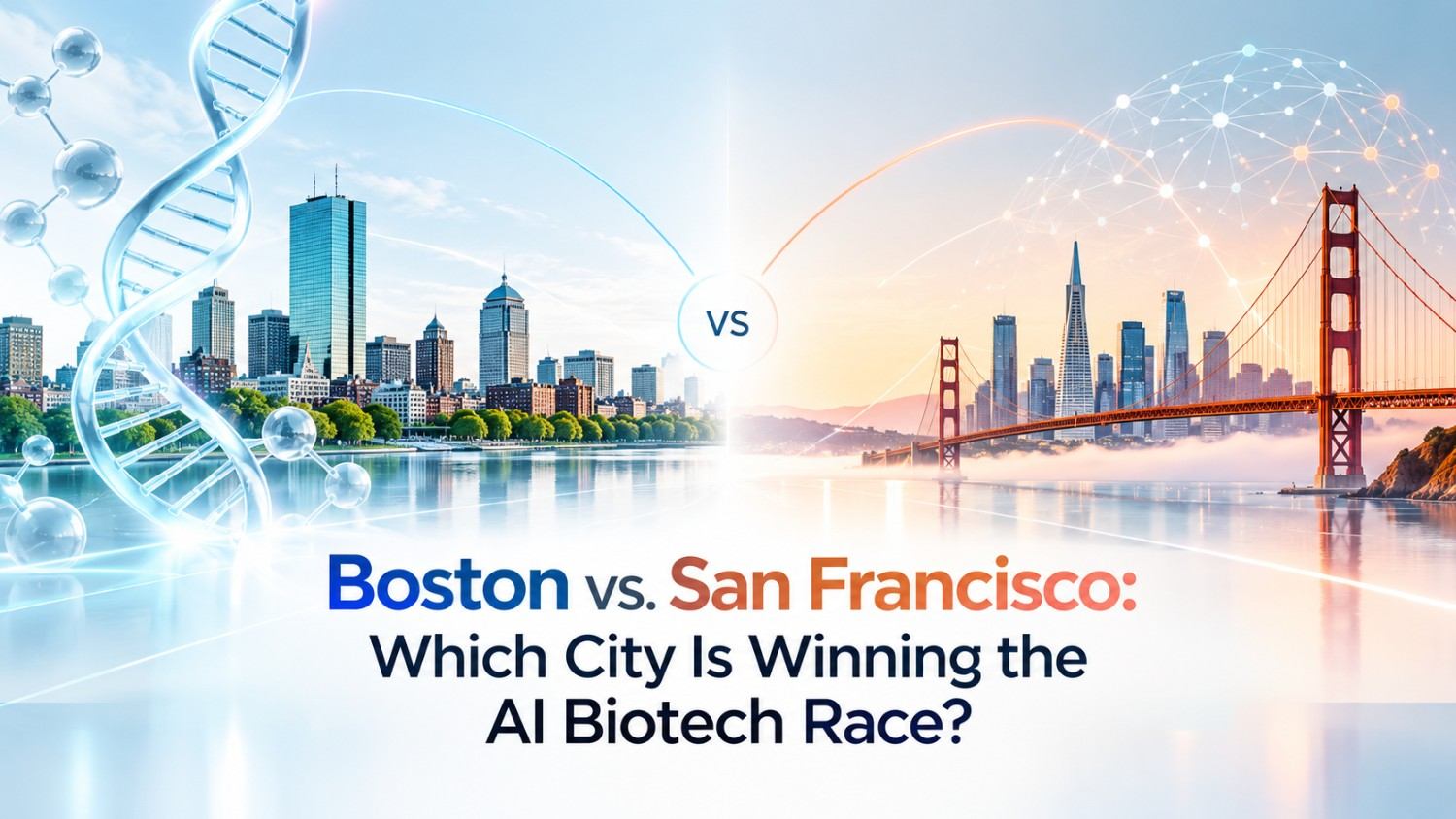
For years, Boston and San Francisco have been compared as technology cities.
That comparison is now moving into a much harder arena.
Biology.
Artificial intelligence is starting to change how researchers find drug targets, design proteins, predict how molecules will behave, choose experiments, analyze biological data, and even control parts of the laboratory itself. The companies that learn how to combine AI with real biological experiments could build some of the most valuable scientific businesses of the next decade.
That makes Boston and the San Francisco Bay Area natural rivals.
Boston has Kendall Square, Harvard, MIT, the Broad Institute, major teaching hospitals, one of the deepest biotech workforces in the world, and an enormous base of laboratory infrastructure.
San Francisco has Stanford, UCSF, Berkeley, Silicon Valley’s AI talent base, some of the world’s largest venture funds, and a culture that has become unusually good at financing very ambitious AI companies before their business models are fully proven.
So which city is actually winning?
After looking at research funding, venture capital, R&D employment, laboratory capacity, recent AI-biotech financings, startup formation, commercialization infrastructure, and the way each ecosystem is changing, the answer is more interesting than a simple Boston-versus-San-Francisco score.
San Francisco currently has the stronger AI capital machine. Boston has the stronger biology-to-company production system.
And if AI biotech increasingly depends on combining models with physical experiments rather than simply building larger models, Boston’s advantage may become more important over time.
That is the central finding of our analysis.
The Short Version: San Francisco Is Winning the AI Funding Race. Boston May Be Better Positioned to Win the AI-Biology Race.
The easiest way to misunderstand this market is to assume that AI biotech is simply another branch of the software industry.
It is not.
Software companies can often improve products by collecting more digital data, training larger models, hiring stronger engineers, and shipping updates. AI-biotech companies eventually need biology to cooperate. They need cells, proteins, animals, clinical samples, laboratories, instruments, scientific staff, regulatory knowledge, and eventually human trials.
That changes the economics of the race.
San Francisco has an enormous advantage whenever the main bottleneck is AI talent, computing infrastructure, frontier-model thinking, and aggressive venture funding.

Boston becomes unusually powerful when the bottleneck moves from building a model to testing what the model believes about biology.
Our analysis of comparable CBRE market data helps show the difference.
| Ecosystem metric | Boston-Cambridge | San Francisco Bay Area | Current advantage |
| Life-science R&D workers | 52,000+ | 42,000+ | Boston |
| Total life-science workforce | ~130,000 | ~147,000 | San Francisco |
| Lab/R&D inventory | ~56 million sq. ft. | ~51.3 million sq. ft. | Boston |
| NIH funding, FY2024 | ~$3.1B | ~$2.0B | Boston |
| Life-science VC, 2019-2024 | ~$55.9B | $51B+ | Boston |
| Life-science VC, 2024 | ~$7.3B | ~$8.6B | San Francisco |
| 2024 VC per R&D worker | ~$140,000 | ~$205,000 | San Francisco |
| NIH dollars per R&D worker | ~$59,600 | ~$47,600 | Boston |
Source data: CBRE’s Boston-Cambridge and San Francisco Bay Area life-sciences market profiles. Boston-Cambridge had more than 52,000 life-science R&D workers, roughly 56 million square feet of lab/R&D inventory, about $3.1 billion in FY2024 NIH funding, and $55.9 billion in life-science VC from 2019 through 2024. The Bay Area had more than 42,000 R&D workers, 51.3 million square feet of lab/R&D inventory, almost $2 billion in NIH funding, and more than $51 billion in VC during the same six-year period.
The table captures the basic tension.
Boston has more research density.
San Francisco currently has more investment intensity.
That difference matters because AI biotech needs both.
How We Built the BostonBizScene AI-Biotech Ecosystem Analysis
Before comparing the cities, it is important to explain what we measured.
There is no official government category called “AI biotech.” Companies can describe themselves as computational biology businesses, AI drug-discovery companies, techbio firms, generative biology companies, scientific AI businesses, protein-design companies, or simply biotechnology companies.
That means any ranking pretending there is a perfect public database of every AI-biotech company would create false precision.
Instead, we built the comparison in layers.
Layer One: The Underlying Life-Science Ecosystem
We started with comparable regional data published by CBRE because its Boston-Cambridge and San Francisco Bay Area profiles use the same basic research framework.
We measured life-science employment, R&D employment, lab capacity, venture funding, and NIH funding.
These numbers tell us something extremely important.
They measure the industrial base beneath AI biotech.
A brilliant biological model does not become a medicine by itself. It eventually needs researchers, laboratories, equipment, clinical development, manufacturing knowledge, regulatory work, and capital.
Layer Two: Recent Capital Momentum
We then looked at recent financing activity.
This is where San Francisco becomes much stronger.
Xaira Therapeutics launched in 2024 with roughly $1 billion in backing, an unusually large starting capital base for a biotechnology company.
Chai Discovery, headquartered in San Francisco, has since developed into another major capital magnet. The company announced a $400 million Series C in 2026 after earlier rounds, while public company databases place cumulative funding above $600 million.
Boston has its own giant financings. Lila Sciences raised $200 million in seed capital and later expanded its Series A to $350 million, bringing total announced capital to $550 million.
Generate then completed a roughly $400 million IPO in February 2026 after raising more than $750 million privately before going public.
These are different types of financings, so they should not simply be added together and treated as a perfect league table.
They do, however, reveal the scale of capital now willing to fund AI-driven biology.
Layer Three: Research-to-Experiment Capacity
We also calculated several derived measures from the regional data.
For example, Boston’s 52,000 R&D workers represent about 40% of its roughly 130,000-person life-sciences workforce.
The Bay Area’s 42,000 R&D workers represent roughly 29% of its 147,000-person life-sciences workforce.
That does not mean every Boston worker is better or every Bay Area company is less scientific.
It suggests something different.
Boston’s life-science labor pool is unusually concentrated in research.
That matters when AI companies need people who can design, run, understand, and improve physical experiments.
Original Finding #1: Boston Has About 24% More Life-Science R&D Workers
The first major difference appears in the research workforce.
CBRE reported more than 52,000 life-science R&D workers in Boston-Cambridge compared with more than 42,000 in the San Francisco Bay Area.
That gives Boston an advantage of roughly 10,000 researchers.
Measured as a percentage, Boston has about 24% more life-science R&D workers.
Chart: Estimated Life-Science R&D Workforce
| Region | R&D workers | Relative scale |
| Boston-Cambridge | 52,000 | ████████████████████ |
| San Francisco Bay Area | 42,000 | ████████████████ |
That number deserves more attention than it usually gets.
AI-biotech companies do not simply compete for machine-learning engineers.
They compete for computational biologists, protein scientists, medicinal chemists, assay scientists, geneticists, automation engineers, translational scientists, clinicians, regulatory specialists, and people who understand both code and experiments.
Boston has built an unusually dense market for these people over many decades.
Why This Matters More as AI Gets Better
Early AI-biotech companies often spent enormous effort proving they could build useful models.
The next generation has a different problem.
More companies now have access to strong open models, cloud computing, pretrained biological models, and increasingly capable software tools. The competitive advantage may therefore move toward the company that can generate better experimental data and learn from it faster.
In that environment, having 10,000 additional life-science R&D workers is not simply a workforce statistic.
It is part of a learning system.
Original Finding #2: Boston’s Life-Science Workforce Is More Research-Heavy
San Francisco actually has the larger overall life-sciences workforce in the CBRE comparison.
The Bay Area has more than 147,000 industry workers compared with approximately 130,000 around Boston-Cambridge.
But look at what happens when we calculate the research share.
| Measure | Boston | San Francisco |
| Total life-science workers | 130,000 | 147,000 |
| R&D workers | 52,000 | 42,000 |
| Estimated R&D share | 40.0% | 28.6% |
Our calculation uses the regional employment totals published by CBRE.
Boston’s estimated R&D share is about 11 percentage points higher.
Another way to say it is that Boston’s R&D concentration is roughly 40% higher than the Bay Area’s when measured as R&D workers divided by total industry workers.
That is a major structural difference.
Boston’s Density Creates Fast Scientific Hiring
Imagine you are building an AI company that designs new antibodies.
You do not simply need five machine-learning researchers.
You may need experts in antibody engineering, protein expression, purification, assay development, immunology, laboratory automation, computational biology, and drug development.
In Boston, many of those people may already work within a relatively compact network stretching through Cambridge, Boston, Watertown, Somerville, Waltham, Lexington, and surrounding clusters.
The value is not just the number of resumes.
It is the number of people who have already worked on difficult biological development problems.
Original Finding #3: Boston Has a Much Larger Public Research-Funding Engine
NIH funding is one of the clearest indicators of biological research capacity.
In FY2024, organizations in Boston-Cambridge received almost $3.1 billion in NIH funding, according to CBRE.
The Bay Area received almost $2 billion.
Boston therefore had approximately 55% more NIH funding.
Chart: FY2024 NIH Funding
| Region | NIH funding | Indexed to SF = 100 |
| Boston-Cambridge | ~$3.1B | 155 |
| San Francisco Bay Area | ~$2.0B | 100 |
The significance goes beyond grant money.
Federal research dollars help pay for graduate students, postdoctoral researchers, instruments, laboratories, datasets, experiments, and years of scientific work that startups may later commercialize.
That means NIH funding acts partly like upstream R&D infrastructure for the private sector.
Boston Gets More NIH Funding Per Life-Science R&D Worker
We also divided NIH funding by R&D employment.
Boston:
$3.1 billion ÷ 52,000 = about $59,600 per R&D worker
San Francisco:
$2.0 billion ÷ 42,000 = about $47,600 per R&D worker
That gives Boston an advantage of roughly 25%.
This should not be interpreted as a productivity score. NIH money goes to universities, hospitals, institutions, principal investigators, and programs rather than directly to regional industry workers.
It is better understood as a rough measure of how much federally funded scientific activity sits underneath each region’s private ecosystem.
On that measure, Boston is extremely strong.
Harvard, MIT, Broad and the Hospital System Are Not Just Brand Names
Boston’s academic advantage is often described lazily.
People list Harvard and MIT and move on.
That misses how commercialization actually works.
Harvard, MIT, the Broad Institute, Massachusetts General Hospital, Brigham and Women’s Hospital, Boston Children’s Hospital, Dana-Farber and other institutions form a dense network in which biological research, clinical medicine, engineering, computing, entrepreneurship, and venture capital regularly collide.
CBRE specifically identifies institutions including Harvard, MIT, Broad, Boston Children’s, Brigham and Women’s, Beth Israel Deaconess and others as core parts of the region’s life-sciences system.
This produces something that is difficult to measure directly.
It reduces the distance between a scientific observation and a company.
Academic Research Can Become a Startup Before Leaving the Neighborhood
Nabla Bio offers a useful example.
The Cambridge company grew out of research connected to George Church’s Harvard laboratory and is building AI-powered approaches to protein and antibody design. Radical Ventures, which led its Series A, described the company as combining AI with wet-lab technology and noted relationships with major pharmaceutical companies.
The company remains located in Cambridge.
That path matters.
A researcher does not necessarily need to leave Boston’s ecosystem when moving from academic science toward commercial science.
The talent, laboratories, investors, founders, pharmaceutical partners, hospitals, and experienced operators are already nearby.
San Francisco Has Its Own Extraordinary Academic Engine
None of this means Boston owns scientific excellence.
San Francisco has Stanford, UCSF and Berkeley.
These institutions are not secondary players.
They produce major discoveries, exceptional founders, strong computational researchers, biomedical scientists, and a continuous supply of companies.
The Bay Area also has an important advantage Boston cannot easily copy.
Its biology ecosystem sits next to the world’s most powerful commercial AI ecosystem.
That creates unusual cross-pollination.
A biology founder in San Francisco can recruit people from frontier AI labs, cloud companies, software infrastructure firms, and some of the world’s most technically aggressive startups.

This becomes especially important for companies whose first competitive advantage comes from the model rather than the laboratory.
Original Finding #4: San Francisco Is Investing More Venture Capital per R&D Worker
This is where the comparison turns.
Boston may have the larger scientific research machine, but San Francisco’s recent private capital intensity is stronger.
CBRE reported about $8.6 billion in Bay Area life-science venture funding during 2024 compared with roughly $7.3 billion for Boston-Cambridge.
That means the Bay Area raised roughly 18% more VC during 2024.
But the more interesting result comes when we divide those dollars by R&D workers.
| Metric | Boston | San Francisco |
| 2024 life-science VC | ~$7.3B | ~$8.6B |
| R&D workforce | 52,000 | 42,000 |
| VC per R&D worker | ~$140,000 | ~$205,000 |
San Francisco’s figure is approximately 46% higher.
Again, this is not money literally handed to each scientist.
It is a regional capital-intensity measure.
And it shows a meaningful difference.
San Francisco Is More Willing to Capitalize Big Technical Bets Early
Consider Xaira Therapeutics.
The company launched with roughly $1 billion in backing in 2024. Its model is explicitly built around using machine learning, data generation and drug development together.
A billion-dollar launch is unusual even in biotechnology.
It tells founders something about the Bay Area capital market.
If investors believe a company could become a foundational AI-biology platform, they may be willing to fund the company at a scale that lets it recruit aggressively and pursue multiple programs from the beginning.
Chai Shows the Same Pattern From the Model Side
Chai Discovery is a particularly useful case because it looks more like an AI-native company entering biology.
The San Francisco company describes itself as building computer-aided design tools for molecules and training frontier biochemical models.
Its funding trajectory has become enormous.
Public disclosures show a $130 million Series B followed by a $400 million Series C, while third-party funding databases place cumulative capital above $600 million.
That is the kind of capital formation Silicon Valley understands extremely well.
Original Finding #5: Boston Still Leads Over the Longer Venture-Capital Window
The recent Bay Area lead should not erase the longer trend.
Between 2019 and 2024, Boston-Cambridge life-science companies secured approximately $55.9 billion in venture funding.
The Bay Area secured more than $51 billion.
Boston’s cumulative total was therefore roughly 10% higher.
Chart: Life-Science VC, 2019-2024
| Region | Six-year VC |
| Boston-Cambridge | $55.9B |
| San Francisco Bay Area | $51B+ |
This creates one of the most important lessons in the entire comparison.
San Francisco’s present momentum is stronger than the six-year total suggests.
The Bay Area appears to be increasing the amount of capital it is willing to place behind AI-native biology companies.
Boston still has an enormous venture ecosystem, but the financing culture is somewhat different.
Boston investors often approach life-science companies through the logic of biotechnology.
San Francisco increasingly approaches parts of AI biology through the logic of technology platforms.
That distinction affects how companies are built.
Boston’s Counterattack Is Lila Sciences
If there is one Boston company that breaks the idea that San Francisco owns giant AI-science financing, it is Lila Sciences.
Lila emerged publicly with $200 million in seed funding.
By October 2025, the company had closed a $350 million Series A, bringing total announced capital to $550 million.
That is not a conventional biotech financing.
Lila is attempting to combine AI models, scientific agents, laboratory automation, physical instruments, and experimental data generation into what it calls AI Science Factories.
The important part is not the branding.
It is the operating model.
Lila Represents Boston’s Best Strategic Position
Lila’s approach points toward a future in which AI does not simply analyze scientific data.
It chooses experiments.
The experiments generate new data.
The data improves the models.
The better model chooses better experiments.
That loop could become the real center of AI-enabled scientific advantage.
And Boston is unusually well positioned for it because the region already contains enormous amounts of scientific equipment, laboratory experience, biomedical talent, and institutional research activity.
Generate Shows What Happens When AI Biology Reaches the Clinic
Generate is important for another reason.
It has moved far enough that AI biology is no longer just a research story.
Generate raised more than $750 million privately before completing an approximately $400 million IPO in February 2026.
Its pipeline has also moved into advanced clinical development.
The company’s own current materials describe multiple clinical-stage molecules, and in October 2026 Generate announced the first patient had been treated in a trial involving its AI-engineered GB-5267 CAR-T program.
This is a key point.
AI biotech ultimately has to become biotech.
Models must eventually produce molecules, programs, clinical results, and medicines.
Generate gives Boston an important proof point in that transition.
Original Finding #6: Boston Has About 9% More Lab Infrastructure
CBRE reported just under 56 million square feet of lab and R&D inventory in Boston-Cambridge.
The Bay Area had approximately 51.3 million square feet.
That gives Boston an advantage of roughly 9%.
| Region | Lab/R&D inventory |
| Boston-Cambridge | ~56.0M sq. ft. |
| San Francisco Bay Area | ~51.3M sq. ft. |
Nine percent may not sound dramatic.
The market conditions make it more important.
The Biotech Downturn Created a Founder’s Market for Labs
Boston built huge amounts of life-sciences space during the expansion years.
Demand then slowed.
Vacancy increased sharply.
That has created pain for real-estate owners but potentially favorable conditions for new companies.
Cresa reported that Greater Boston life-sciences availability reached 38.3% by the end of 2025, after approximately 2.4 million square feet of new projects were delivered during the year. The firm described the market as offering everything from small suites below 5,000 square feet to blocks larger than 100,000 square feet.
Massachusetts reports also show elevated vacancy across Cambridge and Boston.
This can be an advantage for AI-biotech founders.
A startup that might once have struggled to find expensive Kendall Square laboratory space can now negotiate from a stronger position.
Cheap Experiments Could Matter More Than Cheap Offices
This is where comparisons with normal AI companies fail.
For a software startup, a lower office lease may not fundamentally alter product development.
For an experimental biology company, access to fitted laboratory space can change burn rate, speed, equipment needs, hiring, and the amount of capital required before the next scientific milestone.
In other words, Boston’s current laboratory oversupply may become an innovation subsidy created by the previous construction boom.
San Francisco Has Lab Oversupply Too
The Bay Area is experiencing similar pressure.
Cushman & Wakefield reported a Bay Area life-sciences vacancy rate of 29% at the end of the second quarter of 2026. The report also put regional life-sciences employment at approximately 104,400 under its Lightcast-based methodology and showed $2.2 billion in life-sciences VC during the quarter.
The exact employment number differs from CBRE because the firms use different definitions and measurement periods.
That is why we do not combine those employment datasets directly in our Boston-versus-SF calculations.
The broader point is consistent.
Both markets now have more available laboratory capacity than they did during the boom.
The difference is that Boston starts from a somewhat larger lab base.
Original Finding #7: San Francisco Gets More Private Capital From Each Square Foot of Lab Infrastructure
We created another experimental metric by dividing 2024 venture funding by total laboratory inventory.
The result is useful because it gives a rough sense of how much private financing is moving through the physical scientific infrastructure of each market.
Boston:
$7.3B ÷ 56M square feet = about $130 of annual VC per square foot
San Francisco:
$8.6B ÷ 51.3M square feet = about $168 per square foot
That puts San Francisco roughly 29% higher.
This is not a standard real-estate metric, and it should not be interpreted as the productivity of individual buildings.
It is an ecosystem-level capital-density indicator.

And once again, it supports the same conclusion.
Boston has more physical scientific capacity. San Francisco is currently pushing more venture capital through its capacity.
The Biggest Difference May Be How Each City Thinks About AI Biotech
Boston tends to begin with the biology.
San Francisco often begins with the technology.
That sounds like a cultural stereotype, but it produces real business differences.
Boston’s Default Question
A Boston biotech founder may begin with:
What disease mechanism can we understand?
What target matters?
What molecule could work?
What experiment will prove it?
How do we move toward the clinic?
AI becomes a tool inside a biological development process.
San Francisco’s Default Question
A San Francisco AI founder may begin with:
What biological problem becomes possible if the model becomes dramatically better?
Can we build a general platform?
Can the model learn a representation that changes many workflows?
Can software-like scaling laws apply to biology?
Biology becomes the domain in which a new technical system is deployed.
Neither approach is automatically better.
The strongest companies will probably combine them.
The AI Talent Question Clearly Favors San Francisco
Boston’s largest weakness is not biology.
It is frontier AI competition.
San Francisco sits at the center of the modern AI industry.
That matters when a company wants to recruit people who could otherwise work on foundational models, AI infrastructure, agents, robotics, model training, or advanced machine-learning research.
This talent market creates powerful spillovers into biology.
Chai is a good example.
EvolutionaryScale is another example of how researchers from major AI organizations can form biology companies, although EvolutionaryScale itself is based in New York rather than San Francisco and is therefore excluded from our regional funding comparison. Its team came out of Meta’s AI research work and raised $142 million around the launch of the ESM3 protein model.
The broader lesson is clear.
Frontier AI talent now moves between technology and biology far more easily than it did five years ago.
San Francisco benefits from having a much larger pool of that talent nearby.
Boston’s Answer Is Hybrid Talent
Boston does not need to beat San Francisco at producing general-purpose AI engineers.
That may be the wrong competition.
Boston can instead become the best market for people who understand both the model and the experiment.
That includes computational biologists, scientific machine-learning researchers, protein engineers who code, automation scientists, physicians working with AI, and biologists who can use advanced models directly.
This hybrid group may eventually matter more to AI biotech than pure software talent alone.
The Next Scarce Worker May Be the Scientist Who Can Close the Loop
Imagine two teams.
Team A has world-class model builders but weak experimental capabilities.
Team B has slightly weaker models but can design, run, measure, and interpret ten times more useful biological experiments.
If experimental feedback becomes the limiting factor, Team B can eventually produce the stronger system.
This is the possibility Boston should build around.
Boston’s 2026 Biopharma Recovery Is Important
The timing of this race also matters.
Massachusetts entered 2026 after a difficult period for biotechnology employment.
MassBio reported that Massachusetts biopharma employment declined 3.1% during 2025 to 113,503 jobs, the first annual decline in the more than two decades covered by its tracking.
But investment started recovering.
Massachusetts-headquartered biopharma companies raised $3.45 billion during the first half of 2026, up 25% year over year. MassBio said the state accounted for 25% of U.S. biopharma VC during that period.
That creates an unusual environment.
Talent has become more available.
Laboratory space is available.
Capital is returning.
And AI is changing the technical structure of drug development.
That combination could make the current period particularly good for starting new computational biology companies in Greater Boston.
Boston Also Has a Stronger Drug-Development Pipeline Than Its Recent Job Numbers Suggest
The regional downturn can make Boston look weaker than it actually is.
MassBio’s 2026 Industry Snapshot said Massachusetts accounted for 17% of the national drug pipeline, up from 15.7% in the previous report.
That matters because AI biotech eventually needs downstream development capabilities.
A region with strong clinical, regulatory, pharmaceutical, and therapeutic-development experience gives startups more pathways for turning technical breakthroughs into actual drug programs.
San Francisco has deep drug-development capabilities too.
The difference is that Boston’s ecosystem is extremely concentrated around this process.
San Francisco’s Advantage Is the Speed of Belief
If Boston’s advantage is scientific density, San Francisco’s advantage may be something less tangible.
Investors there are unusually willing to believe that a technical curve can change quickly.
That is extremely valuable in AI.
Traditional biotech investing often asks founders to reduce biological risk milestone by milestone.
Silicon Valley AI investing can behave differently.
If investors believe that a model, dataset, platform, or infrastructure layer could become foundational, they may fund the company aggressively before traditional proof exists.
Xaira Is the Clearest Example
Launching an AI-biotech company with roughly $1 billion gives management enormous freedom.
The company can hire expensive researchers.
It can build laboratories.
It can generate proprietary datasets.
It can pursue multiple therapeutic programs.
It can take scientific risks that a company with $30 million cannot.
That does not guarantee success.
It does change the playing field.
Boston Has Its Own Unusually Powerful Capital Architecture
Boston’s advantage is that venture firms are often deeply embedded in scientific company creation.
Flagship Pioneering is the obvious example.
Rather than simply waiting for founders to pitch completed companies, venture-creation organizations can help form companies around scientific ideas, recruit management, build teams, and provide capital over long periods.
Lila and Generate both reflect this ecosystem.
The result is a different model of startup creation.
San Francisco can rapidly finance an ambitious founder.
Boston can sometimes manufacture the company itself.
Boston’s AI-Biotech Startup Base Is Becoming Broader
The ecosystem is not limited to Lila and Generate.
AI Proteins, headquartered in Boston, raised a $41.5 million Series A in November 2025 to advance AI-designed miniprotein therapeutics.
Nabla Bio, based in Cambridge, raised a $26 million Series A in 2024 and is working on AI-driven antibody design.
Converge Bio, which operates in Boston and Tel Aviv, announced a $25 million Series A in January 2026, bringing total disclosed financing to $30 million.

Parallel Bio raised $21 million in 2025 around a human-first experimental platform and has attracted investors from both the AI and biotechnology worlds.
None individually matches the scale of Xaira.
Collectively, however, they show that the Boston market is producing AI-biology companies across multiple layers of the research process.
Our Illustrative AI-Biotech Capital Pulse
Because no official AI-biotech classification exists, we created a small illustrative basket of highly visible companies with clearly disclosed capital events.
This is not an exhaustive market-size estimate.
The goal is to compare the character of recent financing.
Boston Sample
| Company | Selected recent disclosed capital event | Model |
| Lila Sciences | $550M total announced seed + Series A | AI + autonomous experiments |
| Generate | ~$400M 2026 IPO | Generative biology + therapeutics |
| AI Proteins | $41.5M Series A | AI protein design |
| Nabla Bio | $26M Series A | AI antibody/protein design |
| Converge Bio | $30M total disclosed | AI drug-discovery tools |
Sources: company announcements and funding disclosures.
San Francisco Sample
| Company | Selected disclosed capital | Model |
| Xaira Therapeutics | ~$1B backing at launch | Integrated AI drug discovery |
| Chai Discovery | $600M+ cumulative reported funding | Molecular-design AI |
| Latent Labs | $50M total announced at launch | Generative protein models |
| insitro | $400M Series C in 2021* | ML-driven drug discovery |
*The insitro round predates our recent-period comparison and is shown only to demonstrate the depth of the established Bay Area AI-biotech ecosystem.
The pattern is striking.
The Bay Area has created several companies with capital structures that resemble frontier AI businesses.
Boston’s companies are somewhat more distributed across experimental platforms, therapeutics, and scientific infrastructure.
Which City Has the Better Economics for a New AI-Biotech Startup?
The answer depends on what the company actually does.
If You Are Building a Frontier Biological Foundation Model
San Francisco probably has the advantage.
You are closer to world-class model builders, AI infrastructure companies, specialized investors, frontier research networks, and people who understand the economics of large-scale model development.
You may also find investors more comfortable with extremely high compute spending before traditional biotech milestones appear.
If You Need Wet-Lab Feedback Every Week
Boston becomes extremely attractive.
The region offers a larger R&D workforce, more lab space, deeper biomedical research funding, strong university spinout pipelines, major hospitals, and a huge network of biotechnology operators.
The ability to move between code and experiments can be more important than having the world’s strongest pure software network.
If You Are Building an AI-Designed Drug Company
The decision is closer.
San Francisco offers stronger AI recruiting and large-scale capital formation.
Boston offers a deeper therapeutic-development machine.
The best location may depend on whether the company’s first major risk is technical-model risk or biological-development risk.
A Practical Location Framework for Founders
Founders should not ask, “Is Boston or San Francisco better?”
That is too broad.
Ask where the next three major bottlenecks in your company will occur.
| Main bottleneck | Better fit |
| Frontier ML hiring | San Francisco |
| Large AI venture rounds | San Francisco |
| Drug-development talent | Boston |
| Biomedical academic research | Boston |
| Hospital integration | Boston |
| Wet-lab hiring | Boston |
| Foundation-model community | San Francisco |
| Scientific experimentation infrastructure | Boston |
| Consumer-style AI product talent | San Francisco |
| Therapeutics commercialization | Slight Boston edge |
| AI-platform commercialization | San Francisco |
| Autonomous laboratory systems | Boston increasingly strong |
A company can also split teams.
There is no rule saying the entire organization needs to sit in one city.
A frontier-model group could operate in the Bay Area while laboratory and therapeutic teams operate around Boston.
We expect more companies to experiment with exactly this structure.
What Boston Founders Should Copy From San Francisco
Boston should not respond to Silicon Valley by trying to become Silicon Valley.
But there are several habits worth borrowing.
Raise for the Size of the Opportunity, Not Just the Next Experiment
Traditional biotech financing often creates milestone thinking.
Raise enough money to complete experiment A.
Then raise again for experiment B.
That makes sense when biological risk is the only important risk.
AI platforms can have strong scale effects.
If a company needs proprietary data, automation infrastructure, model training, multiple experiments, and software engineering at the same time, undercapitalization can become a competitive disadvantage.
Sell the Platform Vision More Clearly
Boston founders sometimes describe technically extraordinary companies in narrow scientific language.
San Francisco founders are generally better at explaining why a technical platform could become enormous.
That skill matters.
The story should never replace evidence.
But evidence without a clear strategic story can leave major financing opportunities on the table.
Recruit AI Leaders Earlier
AI cannot simply be a service function underneath biology.
If the company’s advantage depends on learning systems, model architecture, scientific agents, or proprietary data loops, AI leadership needs a real seat at the top of the company.
What San Francisco Founders Should Copy From Boston
The reverse is also true.
Bay Area AI-biotech founders can learn from Boston’s discipline.
Biology Does Not Care About the Demo
A model can produce stunning benchmark results and still fail to create a useful medicine.
Biology eventually decides whether the company is right.
That means experimental validation should be designed into the company early rather than treated as something that happens after the model is complete.
Hire Drug Developers Before You Think You Need Them
Drug development contains countless constraints that are invisible at the model stage.
Developability, dosing, toxicity, manufacturability, clinical endpoints, patient selection, and regulatory strategy can determine whether a theoretically brilliant molecule becomes commercially useful.
Boston’s ecosystem has lived through these problems repeatedly.
Build the Data Loop, Not Just the Model
The most durable AI-biotech advantage may eventually come from proprietary experimental data.
Models diffuse.
Research papers spread.
Software tools get copied.
Unique biological learning loops are harder to reproduce.
The Most Important Race Is for Experimental Throughput
Much of the public conversation about AI focuses on model size.
AI biotech could evolve differently.
The key resource may become useful experiments per dollar.
Imagine a company can generate 100,000 candidate molecules.
That sounds impressive.
But if it can only test 50 of them each month, the model has created a new bottleneck.
The company with the better lab system may learn faster even if its original model was weaker.
This Is Where Boston’s Physical Infrastructure Matters
Boston has decades of investment in laboratories, hospitals, research centers, biotechnology suppliers, scientific services, equipment, contract organizations, and specialized workers.
AI can increase the value of this infrastructure.
The region may discover that laboratories once built for conventional biotechnology can become part of an AI-driven scientific data engine.
That is a much bigger opportunity than simply hosting AI startups.
Autonomous Laboratories Could Change the Score Again
Lila Sciences is important because autonomous experimentation points toward a new form of infrastructure.
Instead of scientists manually moving through every step of an experiment, AI systems can increasingly help choose experiments, control instruments, interpret data, and decide what should happen next.
This could produce scientific learning loops that operate continuously.
If that model works, cities with strong physical scientific infrastructure gain new strategic value.
Boston may therefore benefit from AI in a slightly unexpected way.
AI does not make location irrelevant.
It may make access to high-quality physical experiments more important.
Original Finding #8: Boston Has More Public Research Capital While San Francisco Has More Recent Private Capital Intensity
This may be the simplest way to summarize the entire contest.
Boston’s NIH funding per R&D worker is approximately $59,600.
San Francisco’s is approximately $47,600.
Boston is roughly 25% higher.
San Francisco’s 2024 life-science VC per R&D worker is approximately $205,000.
Boston’s is approximately $140,000.
San Francisco is roughly 46% higher.
The Two Capital Systems
| Capital type | Boston advantage | SF advantage |
| NIH / public research intensity | Strong | — |
| Recent private VC intensity | — | Strong |
| Long-run 2019-24 life-science VC total | Slight | — |
| Giant AI-native startup financings | — | Strong |
This suggests two different machines.
Boston has a larger upstream scientific research engine.
San Francisco has a more aggressive downstream venture allocation engine.
The ecosystem that best combines both may ultimately win.
The Current Scorecard
To avoid hiding the judgment behind a fake mathematical ranking, we score categories directly rather than creating arbitrary weighted points.
| Category | Winner | Why |
| Life-science R&D workforce | Boston | ~24% more R&D workers |
| Total life-science workforce | San Francisco | Larger overall workforce |
| Research concentration | Boston | Higher R&D share |
| NIH research funding | Boston | ~55% higher FY2024 funding |
| Laboratory inventory | Boston | ~9% larger |
| 2019-24 life-science VC | Boston | ~10% higher cumulative total |
| 2024 life-science VC | San Francisco | ~8.6Bvs.~7.3B |
| VC per R&D worker | San Francisco | ~46% higher |
| Frontier AI talent | San Francisco | Global AI center |
| Clinical/biopharma depth | Boston | Exceptional density |
| Giant AI-biotech financings | San Francisco | Xaira, Chai |
| Autonomous science momentum | Boston | Lila and surrounding ecosystem |
| University-to-biotech pipeline | Boston | Extremely dense |
| General startup scaling culture | San Francisco | Silicon Valley advantage |
The final result is close because the cities are strong in different ways.
But the category that matters most will change as AI biotech matures.
So Who Is Winning Right Now?
If we define the AI-biotech race as:
Who can finance and build the biggest AI-native biology companies fastest?
San Francisco has the edge.
The financing of Xaira and Chai shows the power of the Bay Area’s AI capital machine. The region combines frontier technical talent with investors willing to place enormous bets on platforms that could reshape scientific discovery.
But if we define the race as:
Who has the deepest system for turning AI-generated ideas into tested biology and eventually medicines?
Boston has the edge.
Its R&D workforce is larger.
Its public biomedical research base is stronger.
Its laboratory inventory is larger.
Its hospitals and academic institutions are unusually dense.
Its biotech company-building infrastructure is mature.
And companies such as Generate and Lila show that Boston can also support companies operating at AI-scale ambition.
Why the Next Five Years May Favor Boston More Than the Last Five
The first wave of modern AI rewarded access to data, compute, algorithms, and model-building talent.
That naturally favored San Francisco.
The next stage of AI biology may increasingly reward something else.
High-quality proprietary experimental data.
Imagine two companies use similar protein foundation models.
One company relies largely on public datasets.
The other operates automated laboratories that continuously produce proprietary assay results and feed them back into its models.
Over time, those companies may become very different.
The second company develops a private learning loop.
Boston is unusually well equipped to build those loops.
But Boston Cannot Become Complacent
The biggest risk is assuming that scientific leadership automatically becomes commercial leadership.
It does not.
San Francisco has repeatedly shown that ecosystems can shift rapidly when talent and money move together.
Boston therefore needs to make AI-biotech company formation easier.
Universities need faster commercialization paths.
Labs need flexible leases.
Investors need to fund platform infrastructure.
Biotech companies need stronger AI leadership.
AI companies need deeper biological teams.
And the region needs to compete aggressively for researchers who can operate across both fields.
Massachusetts is already experimenting with programs designed to keep AI and life-science startups in the state, including new accelerator efforts.
The scale now needs to match the opportunity.
What Investors Should Watch Instead of AI Hype
AI-biotech investors should focus less on how impressive a company’s model sounds and more on the speed of its learning loop.
Several questions matter.
How many experimentally useful designs does the company create?
How quickly can those designs be tested?
How much does each experimental round improve the next generation?
Does the company own the resulting data?
Are experiments automated?
Does performance improve as more experiments are run?
Can the company translate model improvements into better biological outcomes?
Those questions are more important than whether the company’s website says “foundation model,” “generative AI,” or “scientific superintelligence.”
The Real Moat Will Be Model + Data + Experiment + Development
A pure model may not be enough.
A pure wet lab may not be enough.
A pure dataset may not be enough.
The most valuable AI-biotech companies may combine four layers.
The model proposes.
The laboratory tests.
The proprietary dataset grows.
The drug-development organization translates the result into something useful.
That system becomes difficult to copy because each layer improves the others.
Boston already has deep strength in three of those layers.
Its strategic task is to become equally strong in frontier model building.
San Francisco is strongest in the model and capital layers.
Its strategic task is to deepen experimental and development integration.
The Bigger Story: Boston and San Francisco May Be Building Different Versions of AI Biotech
The most interesting conclusion from the data is that the two cities are not necessarily racing toward the same destination.
San Francisco is producing something that looks like AI companies moving into biology.
Boston is producing something that increasingly looks like biology companies becoming AI-native.
Those models will converge.
Chai will need experimental biology.
Generate will need increasingly advanced AI.
Xaira needs both.
Lila is explicitly trying to combine both from the start.
The company that wins may therefore look less like a traditional Silicon Valley software startup and less like a traditional Kendall Square biotech.
It will be a new kind of organization.
A model company.
A laboratory company.
A data company.

And eventually, in many cases, a drug company.
All at once.
Final Takeaway: San Francisco Is Ahead in AI Capital. Boston May Have the Better AI-Biology Machine.
There is no honest way to declare one city the absolute winner today.
San Francisco is clearly ahead in frontier AI talent density and recent private-capital intensity.
Its investors are willing to finance enormous technical visions. Its startup market moves quickly. Xaira and Chai show how rapidly a new AI-biology company can accumulate hundreds of millions of dollars.
Boston’s strengths are different.
Boston-Cambridge has roughly 24% more life-science R&D workers, approximately 55% more NIH funding, about 9% more laboratory inventory, and slightly more cumulative life-science VC over the 2019-2024 period based on comparable CBRE data.
More importantly, Boston has built an unusually dense system connecting research institutions, hospitals, biotech companies, experienced drug developers, investors, laboratories, and scientific workers.
That system becomes more valuable when AI leaves the computer and enters the laboratory.
And that is where the AI-biotech race appears to be heading.
The first era of AI biology was about showing that machine learning could understand biological information.
The next era will be about proving that AI can repeatedly create better experiments, better molecules, better development decisions, and eventually better medicines.
If the main competition becomes who can build the biggest biological model, San Francisco is exceptionally difficult to beat.
If the competition becomes who can build the fastest closed loop between model, experiment, data, and medicine, Boston may have the stronger starting position.
That is why the most useful answer to “Boston or San Francisco?” is not simply one city.
It is this:
San Francisco is currently winning the AI side of the AI-biotech race. Boston is arguably winning the biotech side. The city that learns to combine both systems first will define the next generation of the industry.